
Family : Labridae

Text © Dr. Giuseppe Mazza

English translation by Mario Beltramini
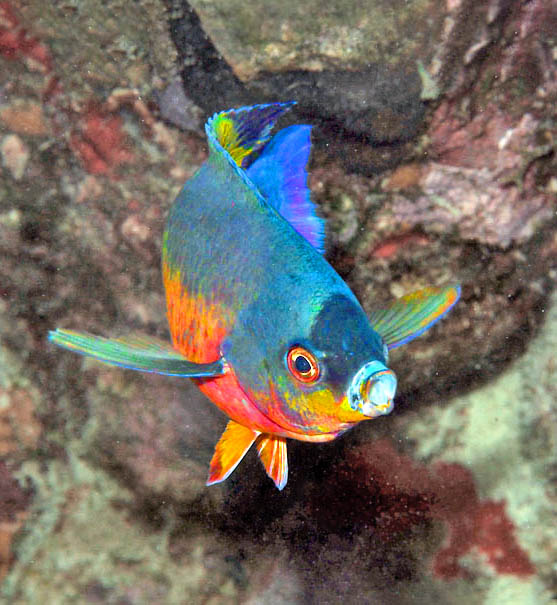
Labridae by sure don’t miss colours but the male of Bodianus parrae is a real champion © Pauline Walsh Jacobson
Within the Labridae, family in which forms and colours seem not to know limits, Bodianus parrae is one of those fishes capable of surprising even those used to the spectacular liveries of the tropical reefs.
At first sight it’s the colour that attracts attention. The big males may display a livery of strong intensity, with purple and violet blending together with ample yellow zones, while the fins add further dark contrasts. But it is sufficient to look at a female or a juvenile to realize that such is not the only face of the species.
Juveniles, females and terminal males in fact show quite different liveries. The first ones are pinkish and relatively inconspicuous, the females have more discreet tones, whilst the individuals reaching the terminal male phase get much more visible.
Therefore it is not only a chromatic transformation, but a change involving sex, behaviour, social relations and reproduction.
The species has also had a small taxonomical history. For a long time it has been known as Clepticus parrae, name still present in the literature and in the underwater guides. Presently, the valid name is Bodianus parrae (Bloch & Schneider, 1801).
The genus Bodianus has a rather unusual etymology. FishBase derives it from “Bodiano” or “Pudiano”, terms that can trace back to the Portuguese “pudor”, a sense of shame. The origin was reported by Jordan & Evermann by the end of the nineteenth century.
The species parrae recalls Antonio Parra, a Portuguese-Cuban naturalist of the XVIII century, author of one of the first works dedicated to Cuban natural history. Parra had already described and illustrated this labrid in 1787, indicating it as Rabirrubia genizarra.
Zoogeography
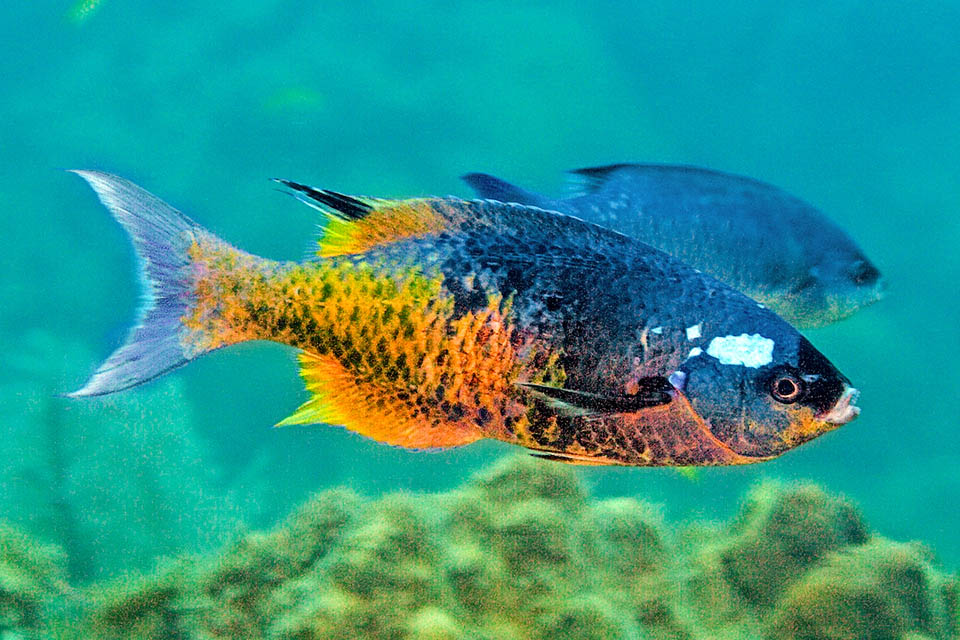
Lives centered in Caribbean and can be 30 cm long. The dull female, right next, in comparison seems another fish © www.carlosestape.photoshelter.com
It’s a species of the tropical western Atlantic. The range includes Bermuda, southern Florida, and Bahamas and extends southwards over the Gulf of Mexico and the Caribbean Sea up to the north of South America, Trinidad and Tobago included.
Ecology-Habitat
Bodianus parrae mainly lives on the outer slopes of the coral reefs, where it does not stand necessarily in close contact with the substratum.
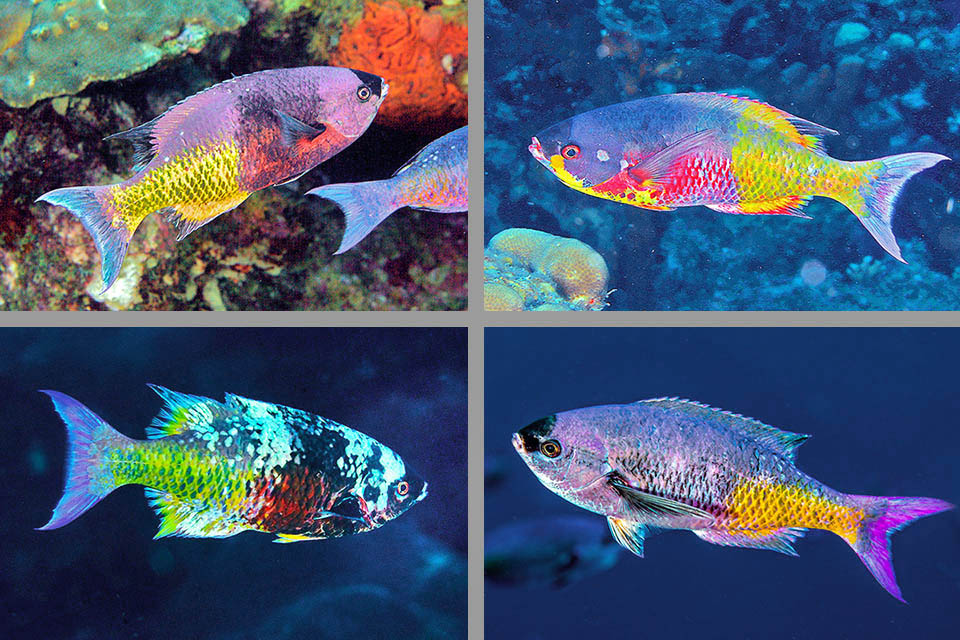
Instead, the male, acting on the chromatophores, is at once ready for any occasion © www.carlosestape.photoshelter.com and © Kevin Bryant top right
It has been reported between 8 and 100 m in depth, even if its norms presence stays at about 40 m. It may frequent also reefs having more superficial patches.
Unlike many labrids spending most of their time exploring the seabed, it often lives in the water column, forming at times big half-water aggregations over the reef.
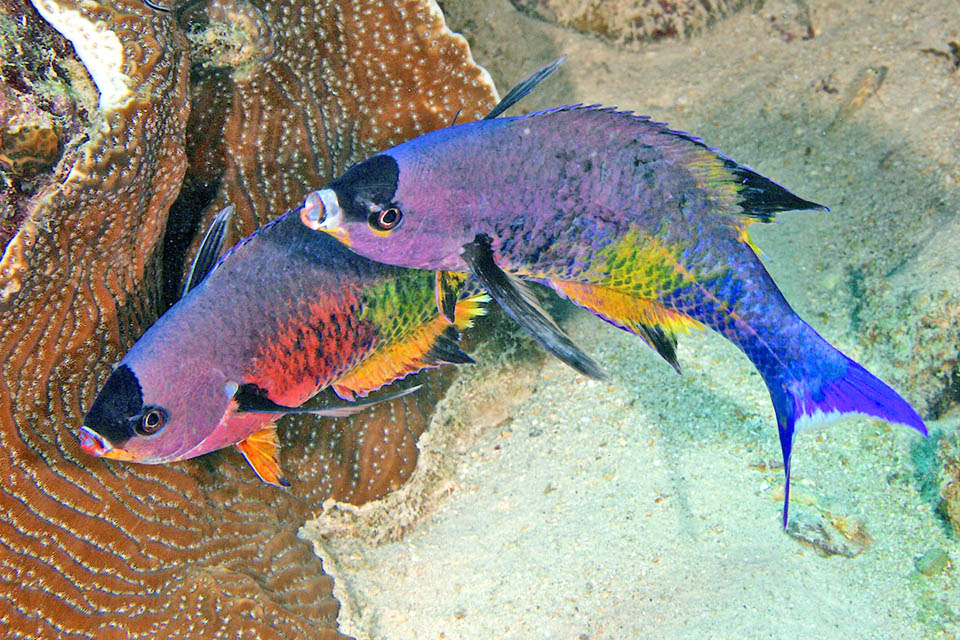
Here two males compete also with colours for a possible territorial dispute © www.carlosestape.photoshelter.com
The plankton is an important part of its diet, along with small jellyfishes, pteropods, pelagic tunicates and larvae of various invertebrates. The moving into the mass of water is therefore a strategy for exploiting a food reserve distributed in space.
The aggregation life allows finally the meeting of individuals of different age and sex and is part of a complex social organization.
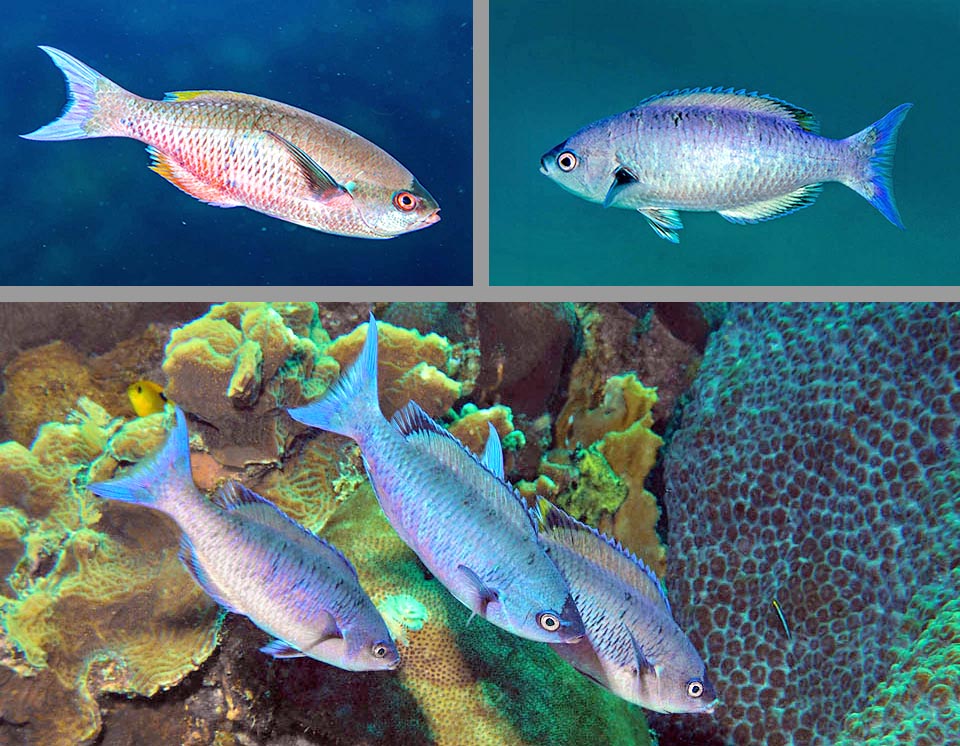
Females have pinkish or bluish shades © www.carlosestape.photoshelter.com (on top). © Pauline Walsh Jacobson (below)
Morphophysiology
The body is moderately elongated and laterally compressed. It may attain the length of about 30 cm, whilst the common length is of about 22 cm; the maximum published weight reaches 320 g.
The dorsal fin presents 12 spines and 10 soft rays, the anal 3 spines and 12-13 unarmed rays. The shape of the caudal fin changes during the growth: in the young it is emarginate, whilst in the adults it gets lunate.
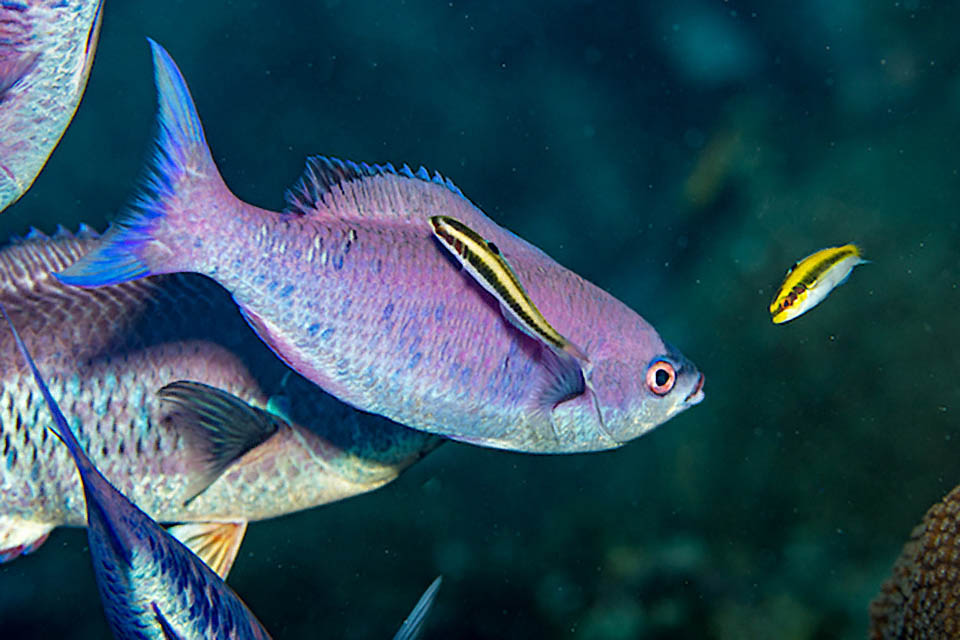
Bodianus parrae frequents shrimps and cleaner fishes © www.carlosestape.photoshelter.com
However the most evident character remains the livery. The background colour is usually violet or purple; in the big individuals appears a marked yellow component, especially in the lower and back part of the body. Some portions of the fins may be blackish.
The difference between sexes is remarkable: the females are relatively moderate, whilst the terminal male can become extremely eye-catching. In the big males the colour also has a rôle in. the communication between individuals.
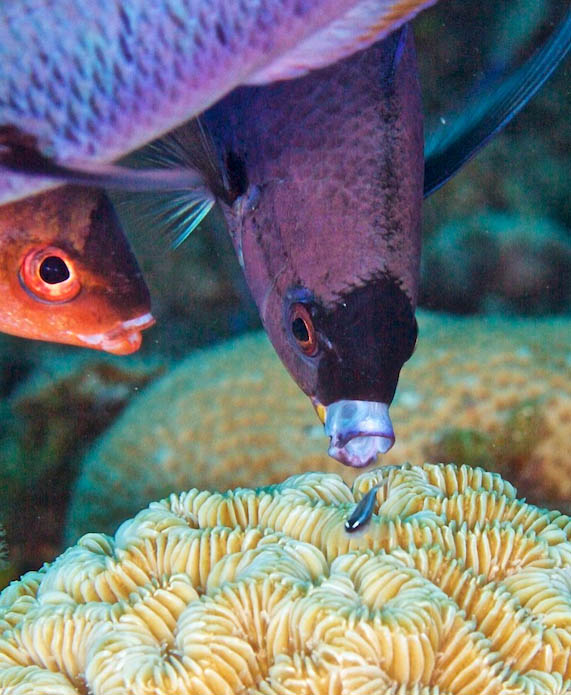
Obviously, it respects them, but there are also predation cases © www.carlosestape.photoshelter.com
Ethology-Reproductive Biology
Reproductive biology is one of the most interesting aspects.
The species is monandric and proterogynous: the individuals that participate in reproduction begin as females and some may later on transform into males.
The change of sex is documented around 15,78 cm of length.
The passage to the male phase does not concern only the reproductive organs, but is accompanied by the appearance of the terminal livery and by modifications in the social and reproductive behaviour.
The juveniles have a pinkish colour and may move in schools.
The adult female represents a next stage, but not necessarily definitive:in presence of the appropriate social conditions, an individual can undertake the transformation to the male phase.
During the interactions between males, posture, movements and livery participate in the communication and may accompany aggressive and territorial behaviours. Therefore, colouration is not only an aesthetic feature, but an element of the complex system of signals that regulates relationships between individuals.
Like various species of reef fishes, it also frequents cleaning stations, where it allows itself to be inspected by specialized organisms. The fish provides access to its own body surface, whilst the cleaner gets food removing ectoparasites and other material.
During the reproductive season it forms “lek”, areas where the males concentrate for the courting and reproductive competition activities. The terminal male, recognizable by its livery, therefore takes on a central rôle in the reproduction.
This combination of sex change, chromatic dimorphism and social behavior renders the reproductive cycle particularly interesting and shows how much the social life may affect the biology of the Labridae.
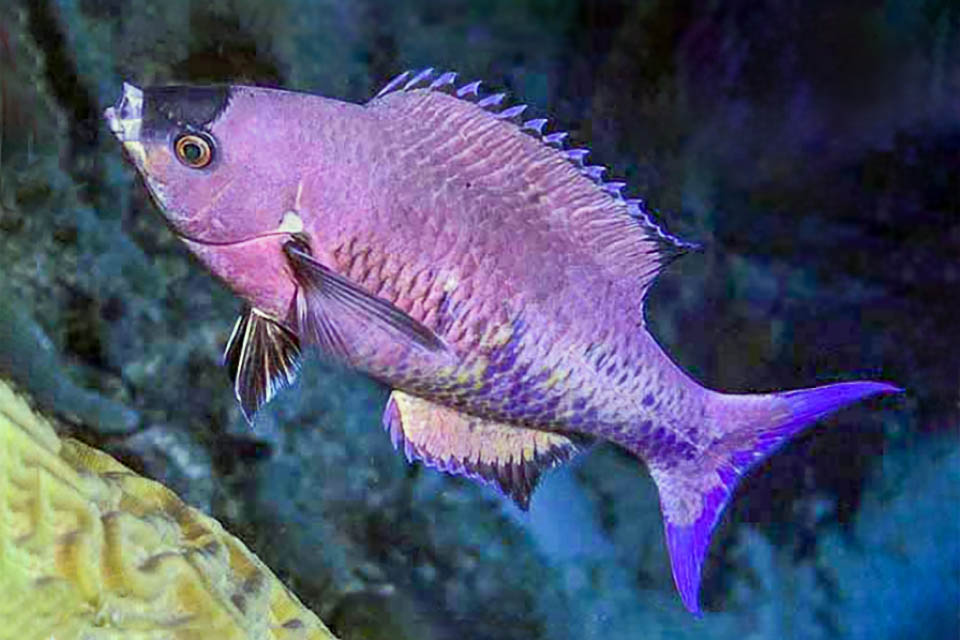
Bodianus parrae is a monandric proterogynous species, that is, females of a certain size can transform into males. Here an intermediate phase © Jim Greenfield
The conservation situation is presently relatively favourable. The resilience is considered as average and the fishing vulnerability low; the commercial fishing has a minor importance, even if the species is seized. and are documented catches with beach nets.
The reproductive biology suggests attention to the big individuals. In a proterogynous species, in fact, the terminal males represent a specific reproductive component of the population, and their selective removal can have consequences on the reproductive structure. In the IUCN Red List it is classified from 2010 as “LC, Least Concern“. The vast geographical distribution and the presence of numerous reef habitats contribute to this evaluation.
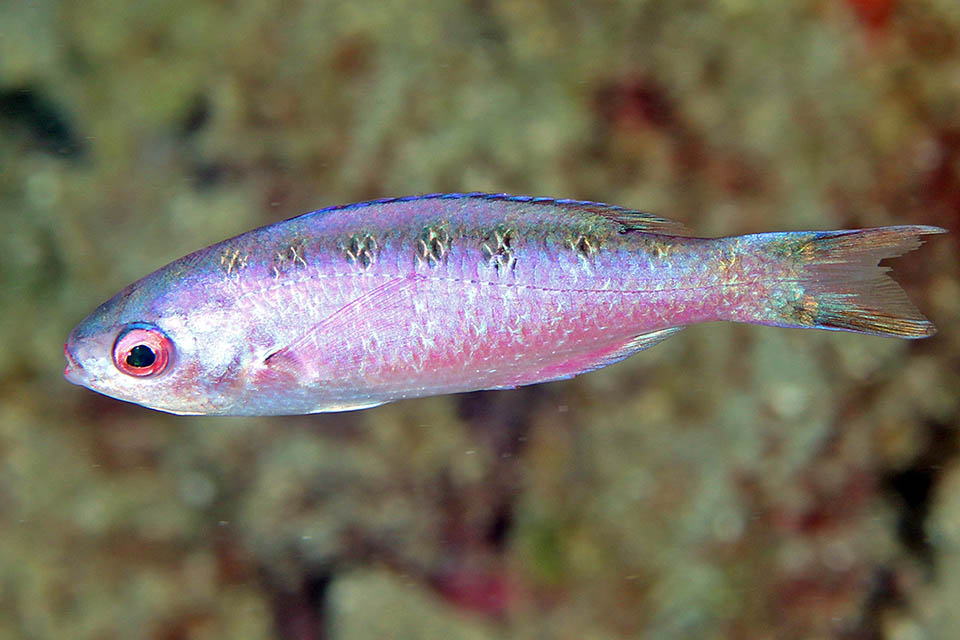
Juveniles, pinkish, don’t have showy drawings and resemble females © Kevin Bryant
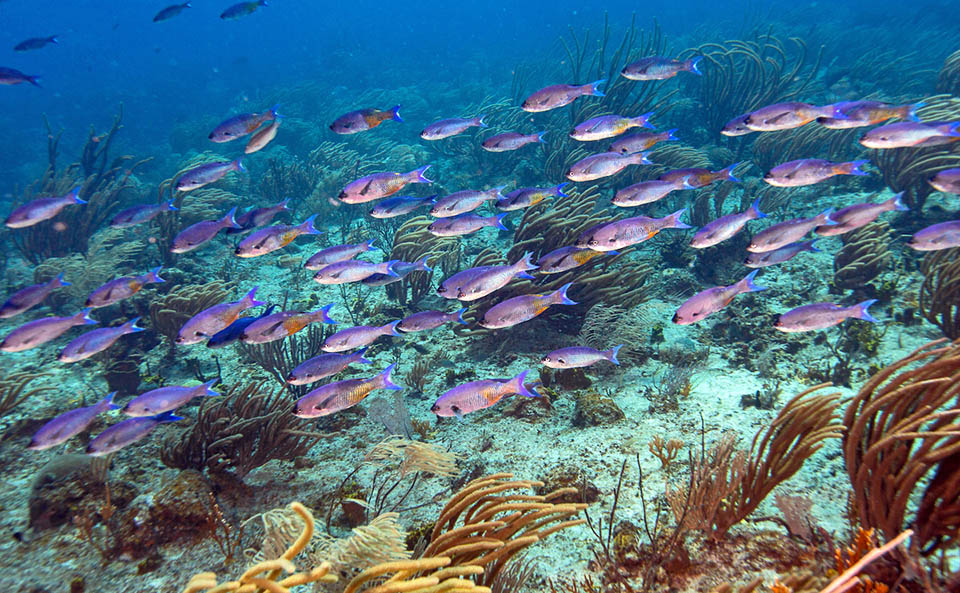
Initially they merged with moving in schools. Bodianus parrae is not an endangered species © www.carlosestape.photoshelter.com
However, the classification does not exclude the risks associated with degradation of the coastal environments. Pollution, sedimentation and deterioration of reefs can compromise over time the quality of the habitats utilized for feeding, the aggregations, the cleaning and the reproduction. The conservation of the coral environments therefore remains important also for this species, whose biology is strictly linked with the structure and the quality of the reef.
Synonyms
Brama parrae Bloch & Schneider, 1801; Clepticus parrae (Bloch & Schneider, 1801); Clepticus genizara Cuvier, 1829.
→ For general information about FISH please click here.
→ For general information about BONY FISH please click here
→ For general information about CARTILAGINOUS FISH please click here.
→ To appreciate the BIODIVERSITY of BONY FISH please click here.
→ To appreciate the BIODIVERSITY of CARTILAGINOUS FISH please click here.