
Family : Labridae

Text © Dr. Giuseppe Mazza

English translation by Mario Beltramini
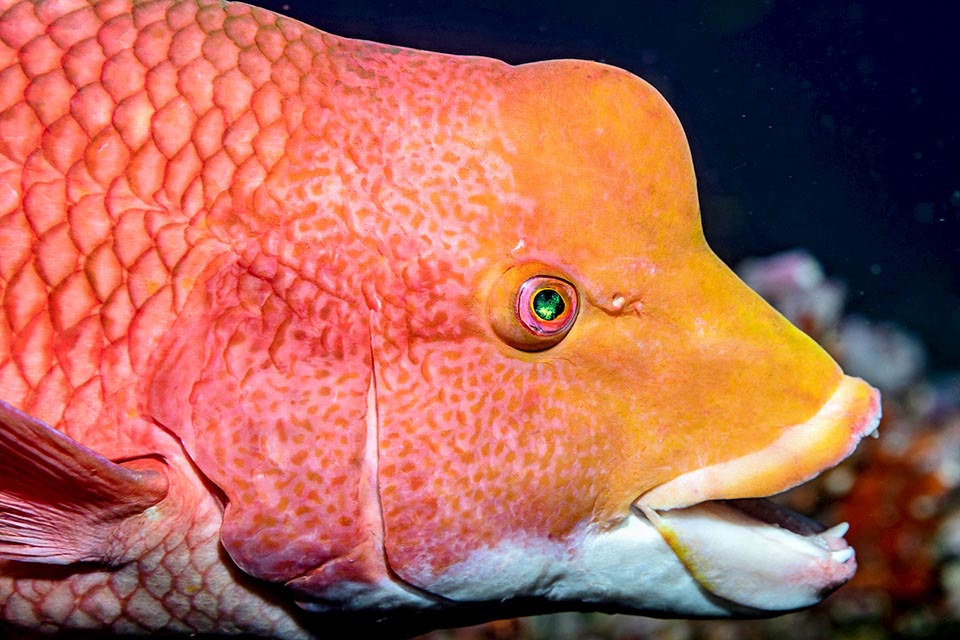
Bodianus diplotaenia is endemic to eastern Pacific, from Guadalupe island and Gulf of California up to Galapagos and central America up to Peru and Chili © www.carlosestape.photoshelter.com
In the order of the Perciformes, among the big Labridae of eastern Pacific, Bodianus diplotaenia (Gill. 1862) strikes first for its transformation that accompanies its growth: from the initially yellow and then red-brownish juveniles, adorned with two showy dark longitudinal bands, to the big adult males, in which the body can assume a splendid shade of blue whilst appears, behind the back edge of the pectoral fin a thin yellow vertical bar. Therefore it is a fish where the development does not modify only the dimensions, but also deeply the look and, with adulthood, the social and sexual rôle of the individual.
The name of the genus Bodianus comes, Latinized, from “bodiano” or “podiano”, Portuguese terms linked to “pudor”, shame, due to their pinkish shades like the cheeks of a young girl’s cheeks.
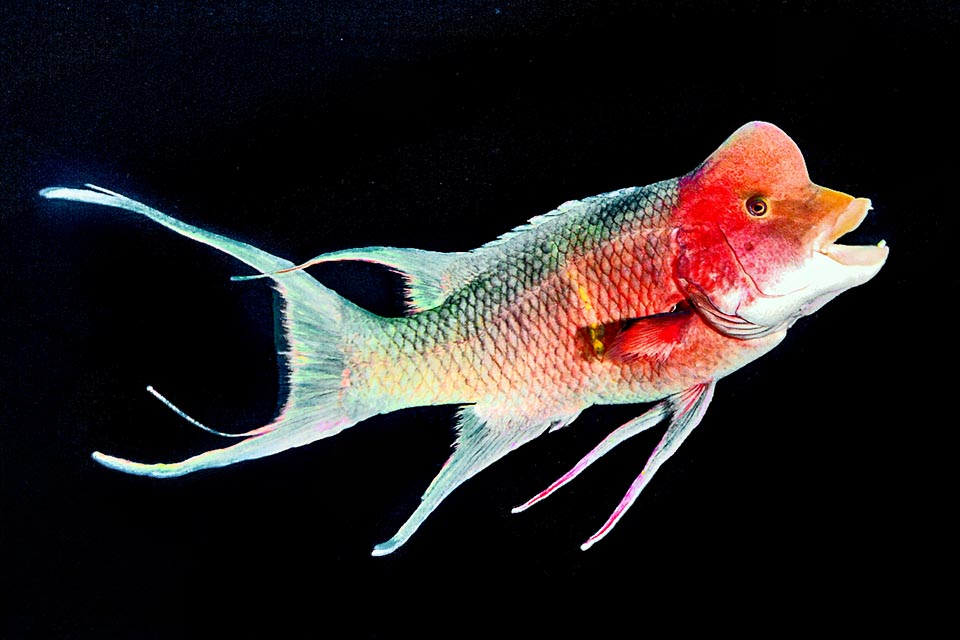
Big males, initially flaming then blue when in terminal phase, show a characteristic hump between eyes and the sides of caudal fin are remarkably elongated © www.carlosestape.photoshelter.com
Conversely, the specific epithet diplotaenia originates from the Greek “diploos”, double, and “tainia”, ribbon, band, with reference to the two characteristic dark stripes present in the juveniles.
Zoogeography
Bodianus diplotaenia is endemic to the eastern Pacific. Its range goes from the island of Guadalupe and the Baja California, including all the Gulf of California, along the coasts of central America up to Peru and Chili, and is present also in important island and archipelagoes of the area, among which, Cocos, Malpelo, Revllagigedo and Galápagos.
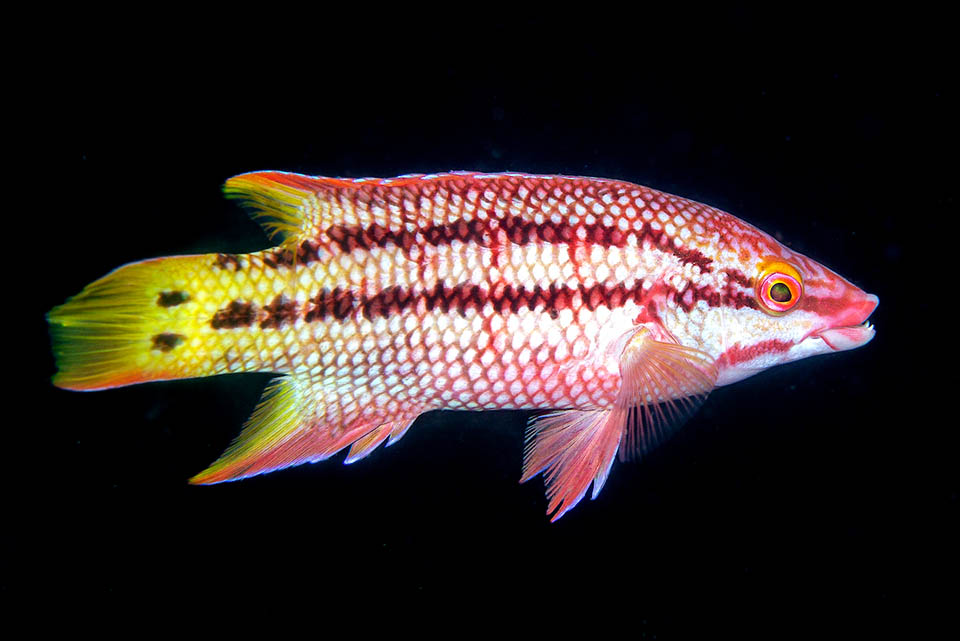
The pointed snout female has like the young the two dark longitudinal bands that have given name to the genus © www.carlosestape.photoshelter.com
This distribution, wholly developed in eastern Pacific tropical and subtropical waters, includes quite different continental and insular environments, from the rocky coasts of the Baja California to the oceanic islands that characterize the region. The species is therefore one of the most characteristic elements of the fauna of the reefs and of the rocky seabeds of eastern Pacific.
Ecology-Habitat
The species is mainly associated with the barrier environments and the rocky seabeds. It normally lives between 5 and 18 m in depth, but it has been reported even up to 76 m. The adults frequent especially rocky or coral zones, even if they may show up on sandy bottoms and in areas where the marine plants are abundant.
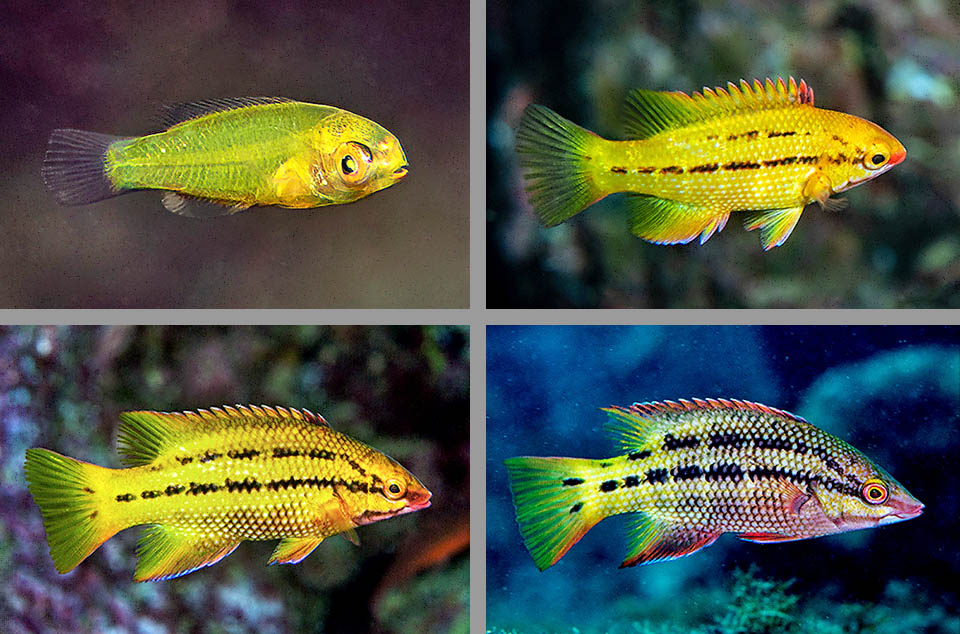
Here first growth phases where yellow predominates, towards female livery © www.carlosestape.photoshelter.com
Bodianus diplotaenia lives mostly solitary, even if it can form small aggregations. Its diet reveals a marked benthic predatory specialization: it primarily catches crabs, brittle stars, mollusks and sea urchins it looks for and crushes thanks to its robust dentition. During the night the individuals take refuge into the crevices of the rocks and the cavities, where they spend their resting hours.
Morphophysiology
Body is robust, moderately high and laterally compressed; the head is big and pointed with a marked hump between the eyes of the big males.
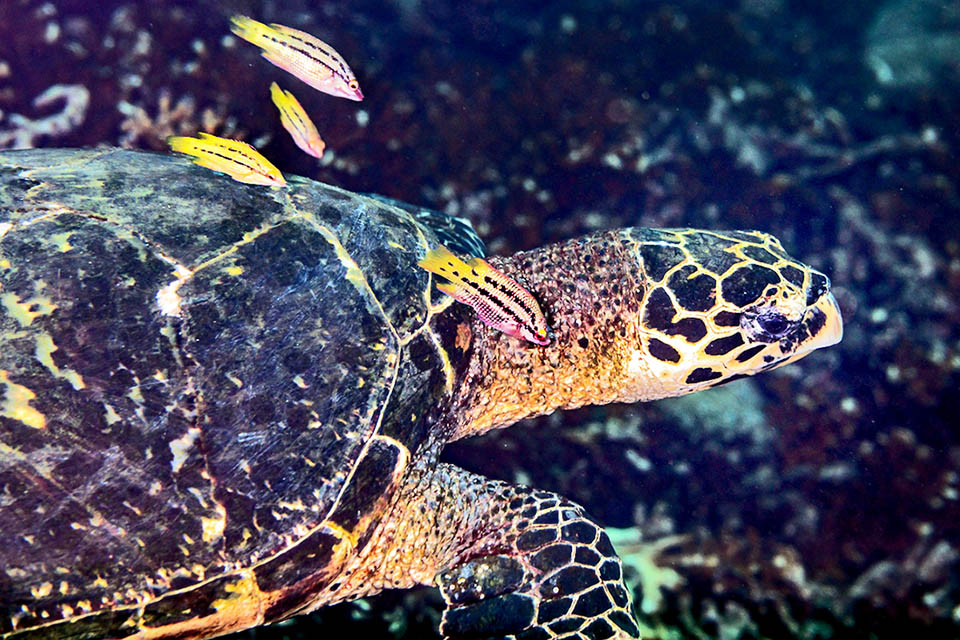
Bodianus diplotaenia is a benthic predator feeding on crabs, brittle stars, mollusks and sea urchins, but when young is also a cleaner fish, as here with a turtle © www.carlosestape.photoshelter.com
The jaws have enlarged canine teeth, slightly curved, wît two front pairs particularly developed in each jaw. The dorsal fin has 12 spiny rays and 10 rays; the anal 3 spines and 12 unarmed rays. Especially in the big individuals the back rays of the dorsal and of the anal extend forming filamentous lobes.
The colouring undergoes a remarkable metamorphosis during the development. The initially yellow young turn red or red-brownish and bear two evident longitudinal black bands. In the big adult specimens the body finally gets mainly light blue. It may reach about 76 cm of total length and a maximum published weight of 9 kg; the commonly reported length is of about 45 cm.
Ethology-Reproductive Biology
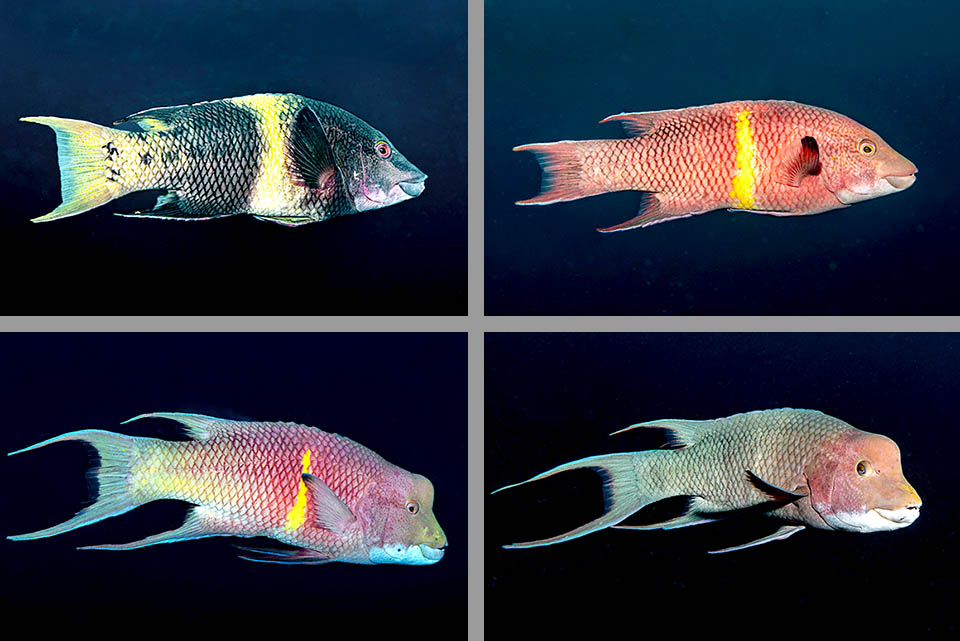
It is a protogynous hermaphroditic species: begins life as female and then some turn in males changing livery again © www.carlosestape.photoshelter.com
One of the most interesting aspects of the biology of Bodianus diplotaenia concerns the sexual system. The individuals start their life as females and later on, some become functional males: it is therefore a protogynous hermaphroditic species. The sex change is associated with the social structure of the population and could be influenced by the local social conditions; however, the fact that the transformation occurs within a dimensional range relatively limited also leaves open the possibility of a genetic component.
Males defend temporarily the reproductive territories. The reproduction, oviparous, occurs in pairs. This social organization allows to understand how the individual growth is intimately linked to the whole biology of the species: the passage from the juvenile livery to the adult one does not simply correspond to the increase of the sizes, but accompanies profound changes in the colouring, in the social organization and in the reproductive function.
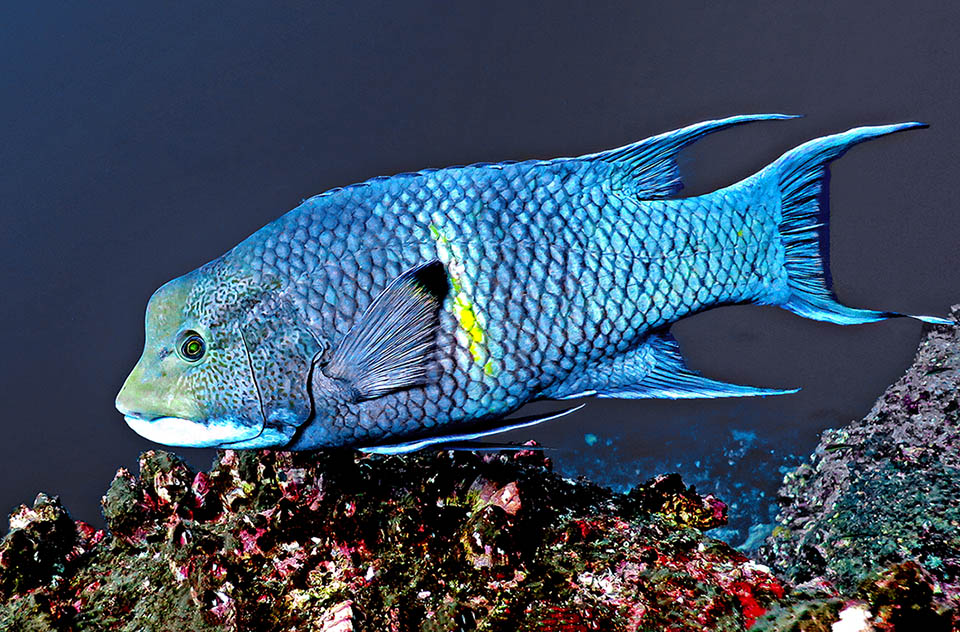
Terminal phase is a majestic blue male, with the body broken by the typical vertical yellow band that starts the change © Michael Eisenbart
From a conservation perspective, the situation requires attention especially for the combination between a relatively low demographic resilience, with a theoretical minimum time of doubling the population standing between 4,5 and 14 years, and a not negligible fishing vulnerability marking 58 on a scale of 100.
However, populations are stable, and considering also the vast diffusion, Bodianus diplotaenia from 2007 appears as “LC, Least Concern” in the IUCN Red List of the endangered species.
Synonyms
Harpe diplotaenia Gill, 1862; Harpe pectoralis Gill, 1862.
→ For general information about FISH please click here.
→ For general information about BONY FISH please click here
→ For general information about CARTILAGINOUS FISH please click here.
→ To appreciate the BIODIVERSITY of BONY FISH please click here.
→ To appreciate the BIODIVERSITY of CARTILAGINOUS FISH please click here.