
Family : Narcinidae

Text © Giuseppe Mazza

English translation by Mario Beltramini
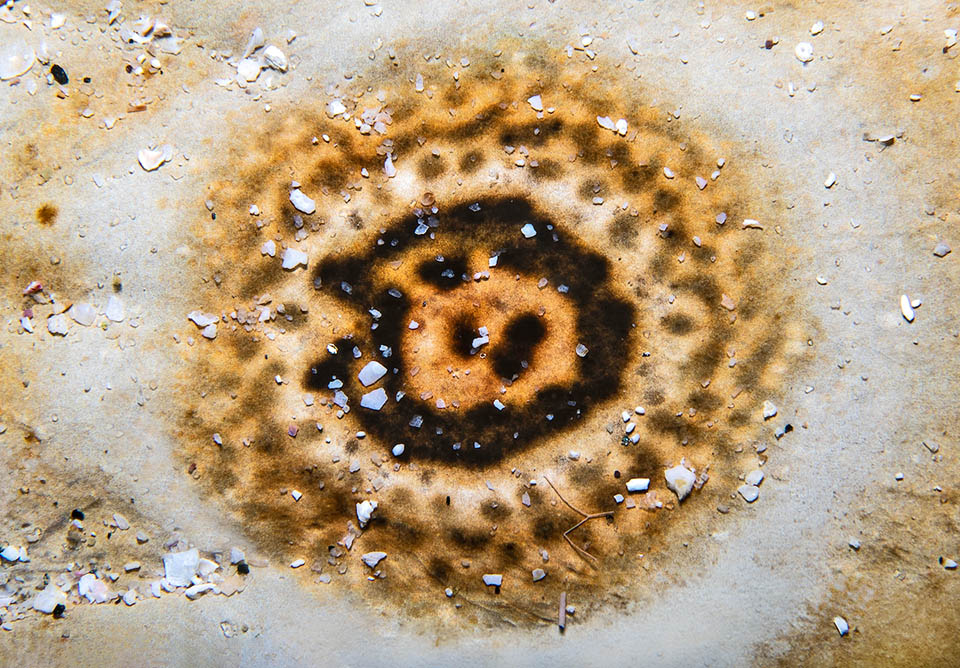
A target for shooting or an eye on the bottom? © www.carlosestape.photoshelter.com
At first glance, it almost looks like a trick of nature: on the back of Diplobatis ommata appears a big circular drawing that is strikingly reminiscent of an eye.
And it is rightly this uncommon characteristic that has inspired the name of the species, ommata, from the old Greek “ómma”, eye.
But this small ray hides something else entirely beneath the skin. On the sides of the front part of the body stand in fact the electric organs, specialized structures barely perceptible like a slight swelling of the body, that produce the discharges done by the fish to defend itself and to interact with the environment. The curious contrast between what is seen and what remains hidden is probably the most fascinating feature of this race, inserted in the order of the Torpediniformes and in the family of the Narcinidae.
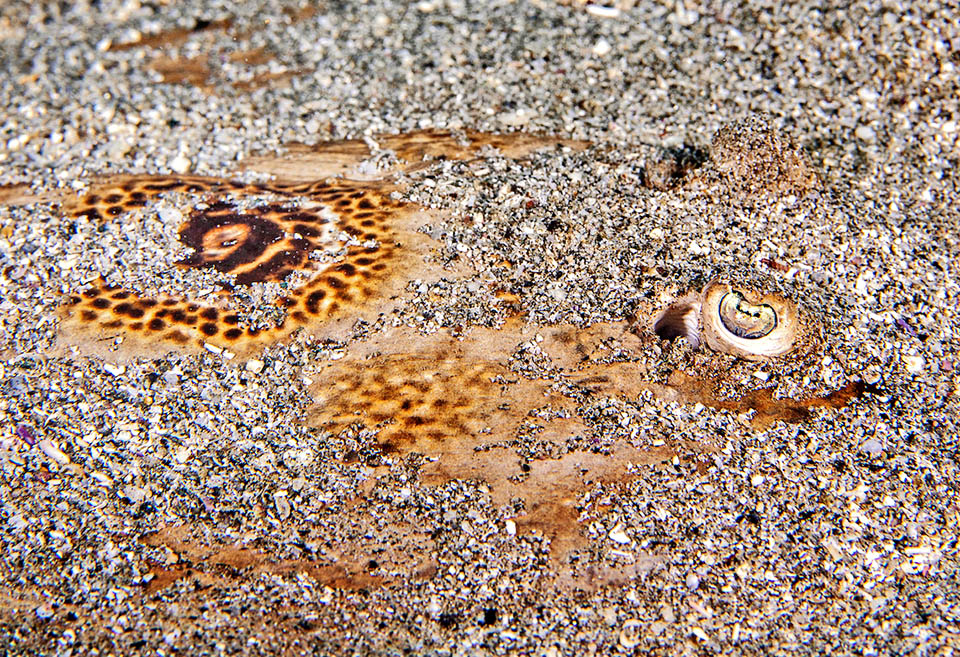
No. It’s the big fake eye of Diplobatis ommata. The true one, right, tiny by comparison, scans surroundings © www.carlosestape.photoshelter.com
The eye on the back is only a drawing, whilst the true ones, close to the spiracles, are tiny, almost invisible at first glance. Also the name of the genus Diplobatis, established by Bigelow and Schroeder in 1948, emphasizes another hidden anatomical feature, coming from the Greek “diplóos”, double, with reference to the two inner openings not visible of each nostril, and “batís”, the term used in old times to indicate the rays and other flat fishes.
Zoogeography
Diplobatis ommata lives in the tropical eastern Pacific Ocean, with a distribution spreading from the Gulf of California southwards along the central America coast up to Ecuador.
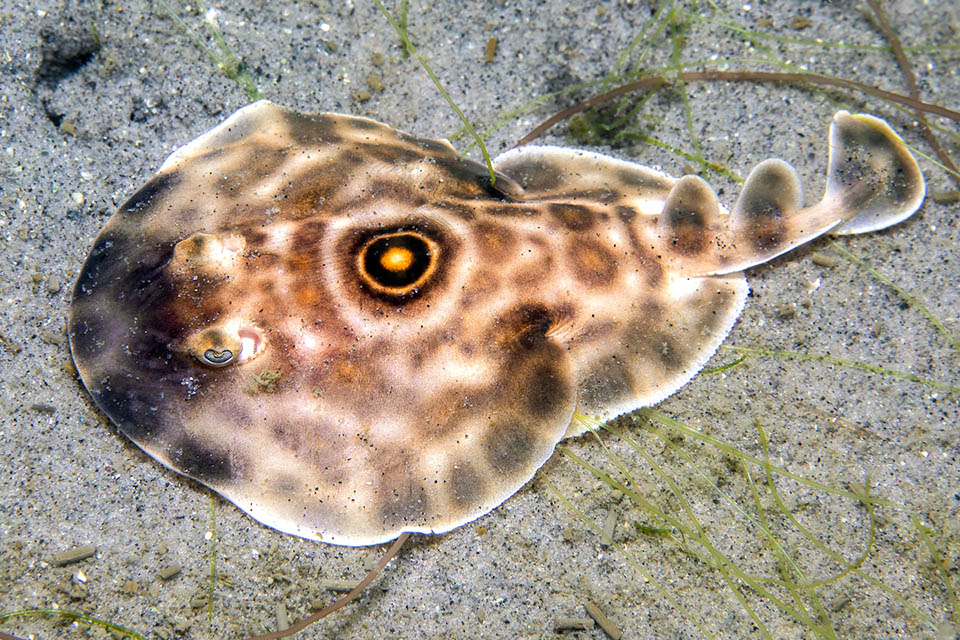
It’s a small tropical eastern Pacific race that does not exceed 25 cm in length © www.carlosestape.photoshelter.com
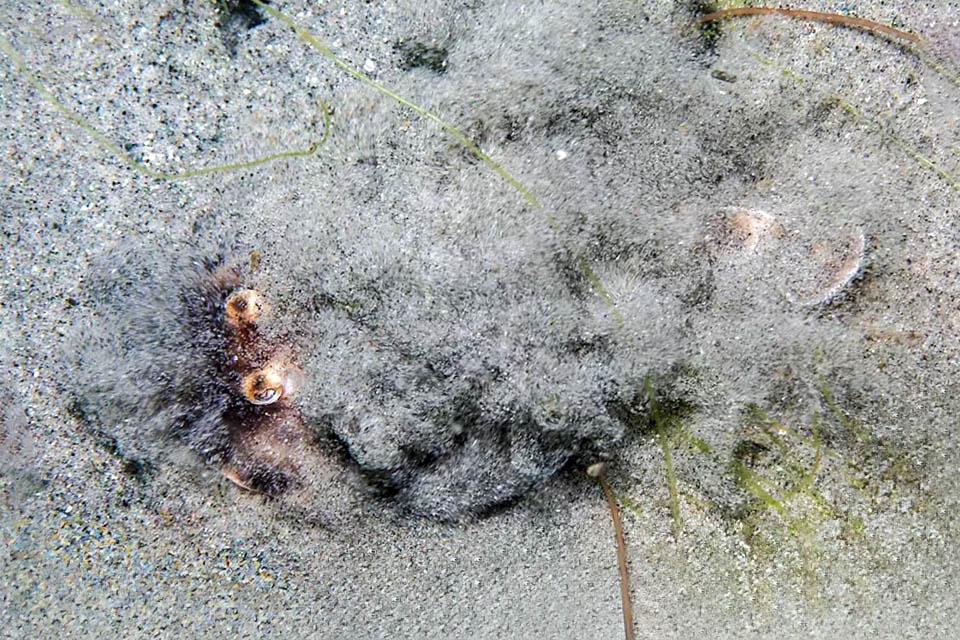
Rarely out in the open during the day, may disappear instantly under the sand © www.carlosestape.photoshelter.com
Ecology-Habitat
It is a coastal and benthic marine species, solitary and nocturnal, present also on rocks but associated mainly with the sandy seabeds and detrital sediments it finds close to the coral formations up to about 95 m in depth.
It spends the hours of the day partially sunken, a strategy that allows it to camouflage and to get unnoticed.
The diet is carnivorous and includes only small benthic invertebrates, in particular crustaceans and worms; also small fishes have been observed. Therefore it is a bottom predator looking for its own prey in the substratum.
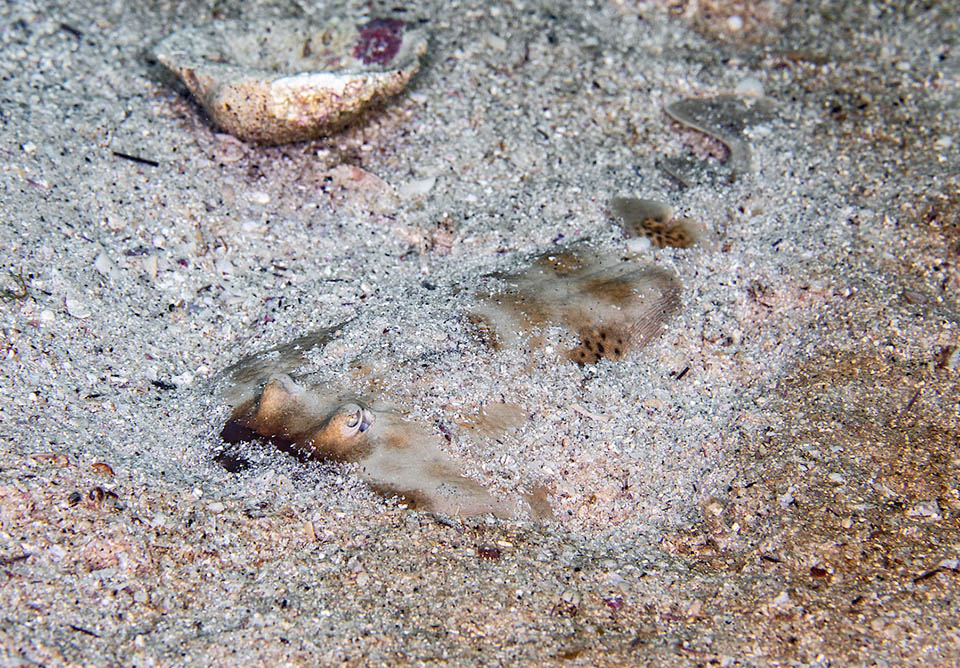
Here, safe, camouflaged on the seabed. Feeds usually on small benthic invertebrates, mainly crustaceans and worms © www.carlosestape.photoshelter.com
Morphophysiology
Diplobatis ommata attains about 25 cm of total length. The body has the typical conformation of the small electric rays: a depressed and slightly oval disc, with its fore margin moderately convex, followed by a relatively robust tail. Two dorsal fins are present, of similar size, a large triangular caudal fin.
The background colouration is usually brownish, often accompanied by a punctuation and by diffused transversal band, with a central drawing that can assume the look of a big target or of a bull’s eye. In some individuals the surrounding drawing is poorly evident and only a large central dark dot remains.
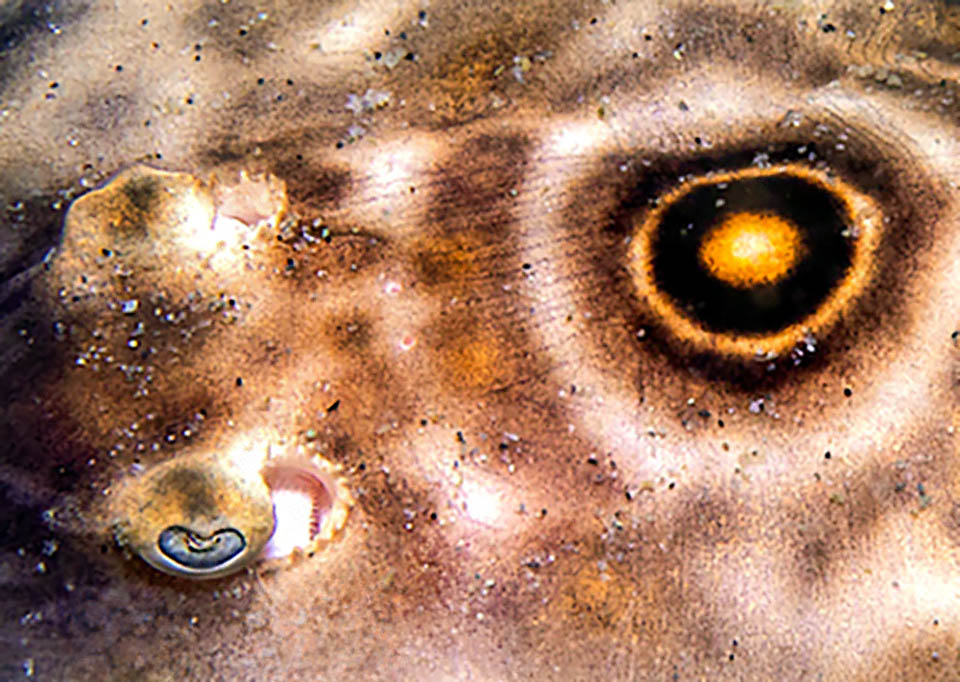
To note, behind eyes, the spiracles carrying water to the gills also when the fish rests on the bottom, and to the centre the two tiny circular holes of the nostrils © www.carlosestape.photoshelter.com
Ethology-Reproductive Biology
Sexual maturity is reached around 15 cm for the males and 18 cm for the females, but for the rest the reproductive biology of Diplobatis ommata is still little known.
Like all cartilaginous fishes, the males have copulatory organs called claspers, used for inserting the seminal fluid into the female cloaca. The eggs are fecundated and develop entirely inside the uterus. The embryos do not get food by means of placenta, but get energy initially from the yolk sac and then from special uterine nutritive secretions.
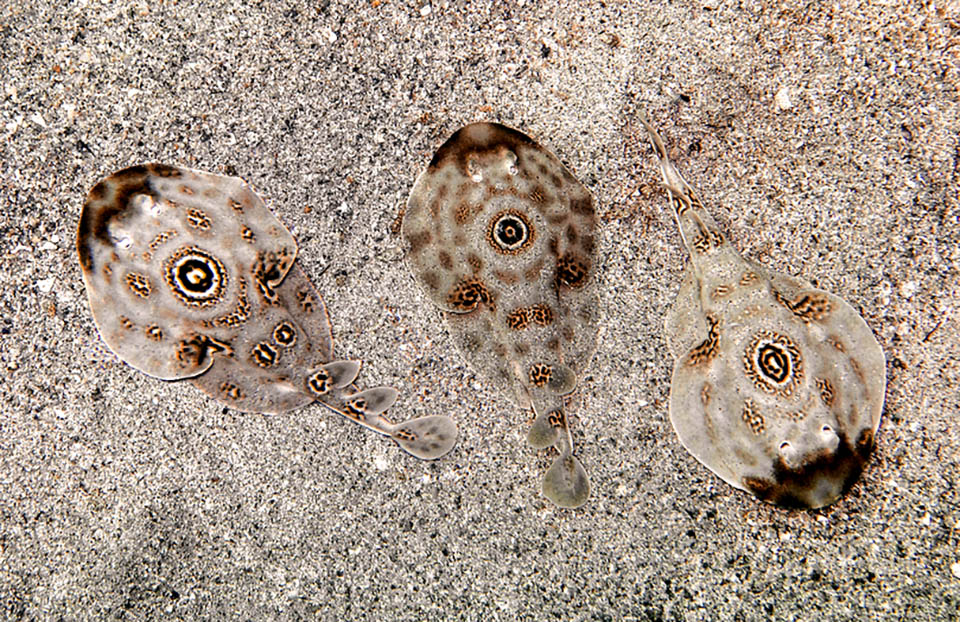
Diplobatis ommata is an ovoviviparous species: fecundation is internal and the just born babies are able to go hunting © www.carlosestape.photoshelter.com
They are born alive, completely formed, presenting themselves as miniature replicas of the adults. They are independent from birth and are already able to utilize their own electric organs and defense and hunting.
Resilience is low with a minimum time for doubling the populations of 4,5-14 years, but the fishing vulnerability marks only 13 on a scale of 100 and from 2019, considered the vast diffusion and the stability of the population,
Diplobatis ommata appears as “LC, Least Concern” in the IUCN Red List of the endangered species. For others, worrying for the trawling of the shrimps in some localities, should be considered instead as vulnerable.
Synonyms
Discopyge ommata Jordan & Gilbert, 1890; Narcine ommata Clark, 1936.
→ For general information about FISH please click here.
→ For general information about CARTILAGINOUS FISH please click here.
→ For general information about BONY FISH please click here
→ To appreciate the BIODIVERSITY of CARTILAGINOUS FISH please click here.
→ To appreciate the BIODIVERSITY of BONY FISH please click here.