
Family : Lobotidae

Text © Dr. Giuseppe Mazza

English translation by Mario Beltramini
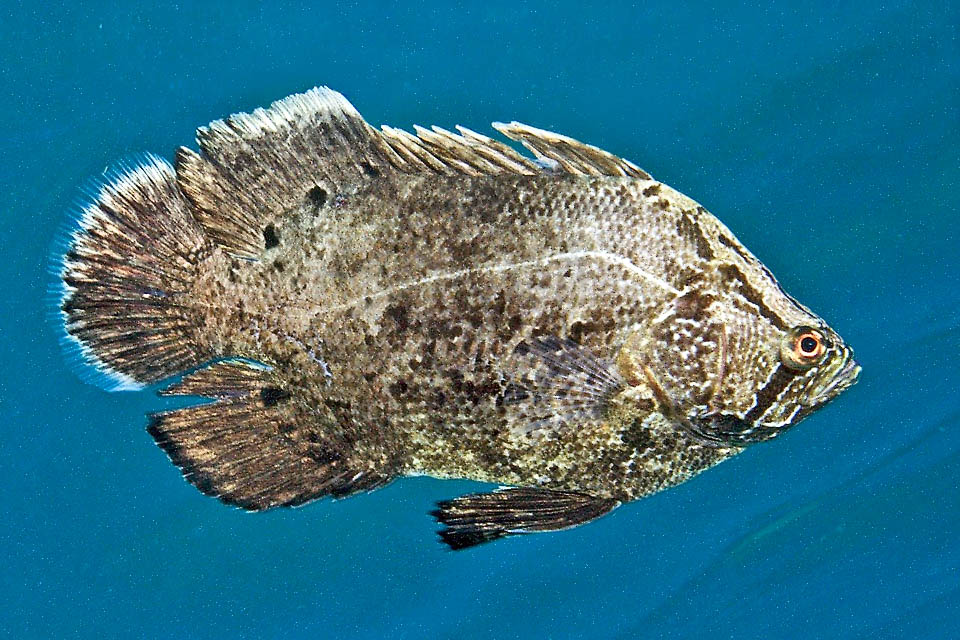
Laterally compressed but stout, the Atlantic tripletail fish (Lobotes surinamensis) may exceed 1 m in length and 19 kg © www.carlosestape.photoshelter.com
Known as Atlantic tripletail due to its breadth and the shape of the soft rays of the dorsal fin and the anal similar to the caudal, or as Buoy fish because of the juveniles that often go swimming lying on one side in the surface like floating leaves, Lobotes surinamensis (Bloch, 1790) belongs to the class of the Actinopterygii, the ray-finned fish, and to the family of the Lobotidae, inserted by some taxonomists into the order of the Perciformes, and by others among the Acanthuriformes or the Spariformes.
The genus Lobotes, created by Cuvier in 1829, is a reference to the caudal lobes, whilst the Surinamensis, species of Suriname in Latin, evokes a place of origin north of Brazil.
Zoogeography
Actually, Lobotes surinamensis is not present only in the Caribbean but, with a preference for the temperatures standing between 18,3 and 29 °C, in the tropical and warm temperate seas of the whole world, apart eastern Pacific, occupied by the similar Lobotes pacifica which, after some, would fall into the variability of the species.
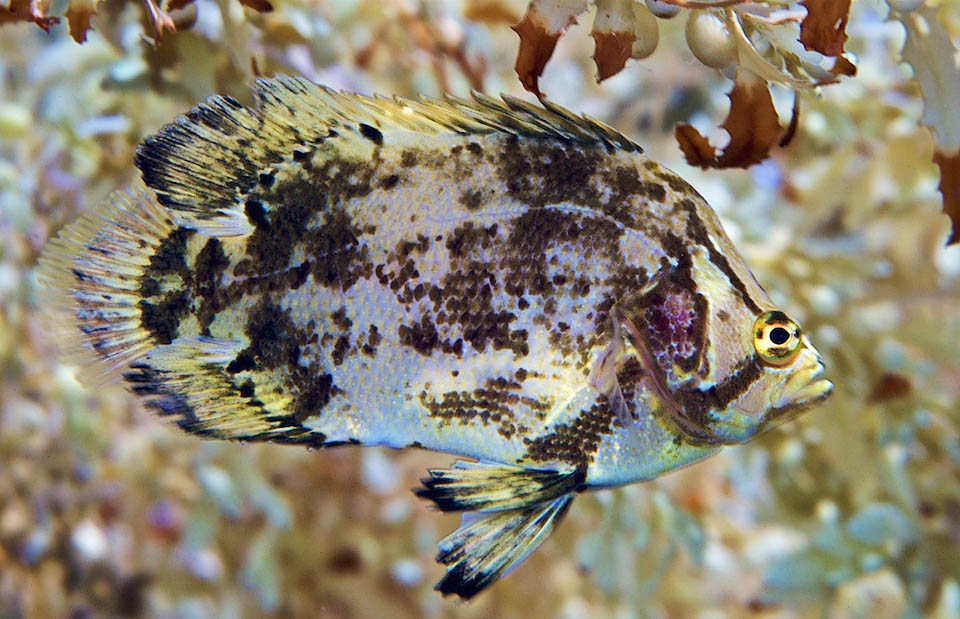
Present in almost tropical and warm temperate seas, it has a changing livery and often hides under buoys, wrecks or floating seaweeds as here among sargassoes © www.carlosestape.photoshelter.com
The numerous reports in the Mediterranean are in part to be verified, but it seems that there is a stable population in its central area.
Ecology-Habitat
Lobotes surinamensis is not a very active fish that goes swimming mainly in shallow waters, between 3 and 35 m in depth, exceptionally pushing up to about 70 m. It also accepts brackish water, going partly up the rivers, and is often found under floating objects, in the shadow of buoys, wrecks or drifting seaweeds like the sargassoes.
Morphophysiology
Lobotes surinamensis may reach the length of 110 cm and a weight of 19,2 kg.
The body, compressed laterally but sturdy, has a concave front profile.
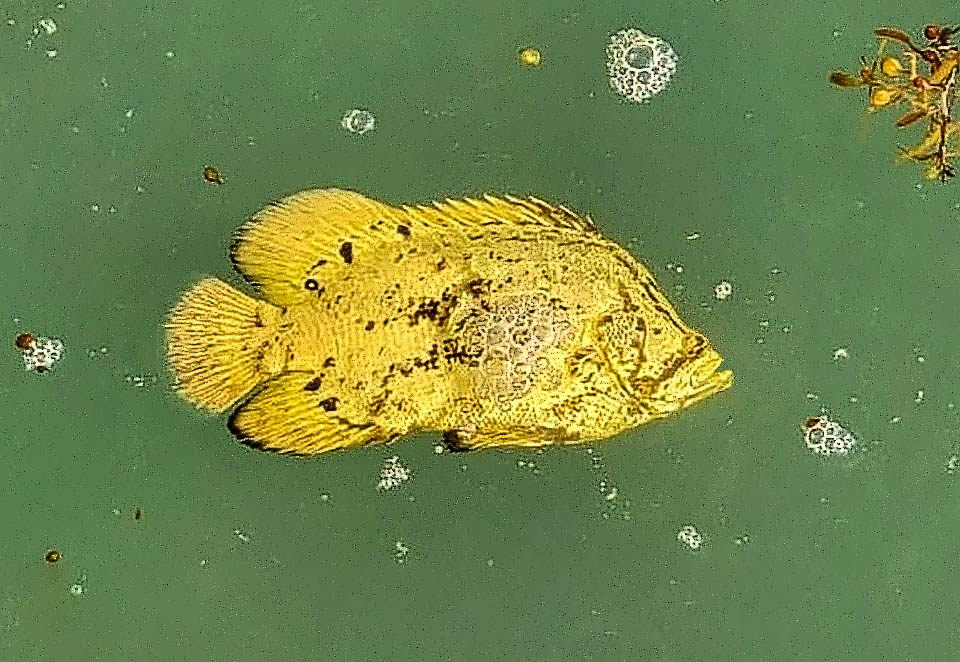
Juveniles, yellow with similar spots, often swim lying on a side in surface similar to floating leaves, hence the vulgar name of Leaffish © Roxana Amarilis Sosa Muñoz
The relatively small eyes are close to the tip of the snout, little over the upper protractile jaw, that displays, like the lower one, a row of short and close-set teeth with an internal band of smaller teeth, whilst the palate doesn’t have them. The large oblique mouth has thick lips. The preoperculum is serrated and the operculum, smooth, has two hidden spines.
The dorsal fin has 1112 spiny rays, followed without notch by 15-16 soft rays, whilst the anal has 3 spiny rays and 11-12 unarmed, and these two showy roundish and symmetrical soft parts that, exceeding the beginning of the caudal fin give the impression of a triple-tail fish. The real caudal fin, rounded, has 15 ramified rays, and the pelvic fins are longer than the pectoral ones.
The ctenoid scales, coarse but of moderate size, are present also at the base of the dorsal fin, of the.anal and of the caudal. Conversely, they are absent in the front area of the head, under the eyes and the jaws.
The well visible lateral line with its 34-45 scales, continues following the profile of the back as it curves.
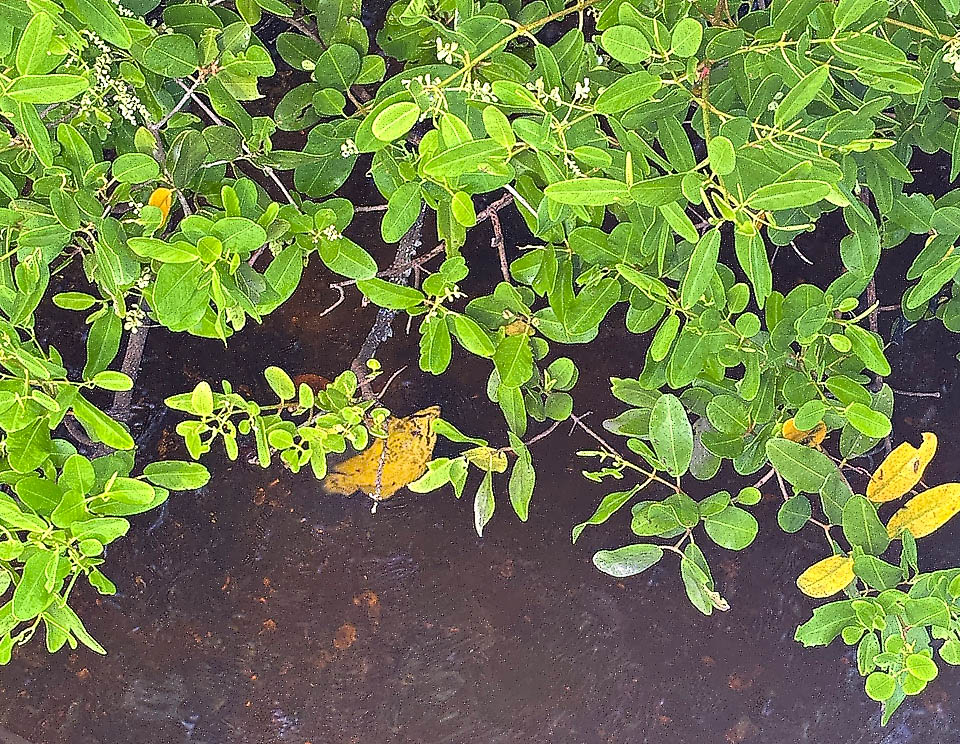
Often they grow sheltered by the mangrove formations, rich in small prey. Here a blooming Laguncularia racemosa, known as White mangrove © charisses
The livery, changeable due to the effect of the chromosomes depending on the circumstances, in the adults appears with dark spots, but can also be greenish yellow at the top and silver grey towards the belly with black spots, whilst the juveniles are yellow, leaving intact the spots and the mimetic dark line protecting the eyes.
Ethology-Reproductive Biology
Lobotes surinamensis is an opportunist predator of small fish and crustaceans, and is in turn preyed upon by bigger species like the Barracuda (Sphyraena barracuda) or the sharks, to which add, on the surface, the pelicans and the seagulls who keep surveying the drifting seaweeds.
The males reach the sexual maturity before their partners and the matings occur in summer with groups close to the estuaries where the big females can entrust to the currents 4,6-8 million of floating eggs per season, releasing them repeatedly, even 700.000 at a time, every 3-5 days.
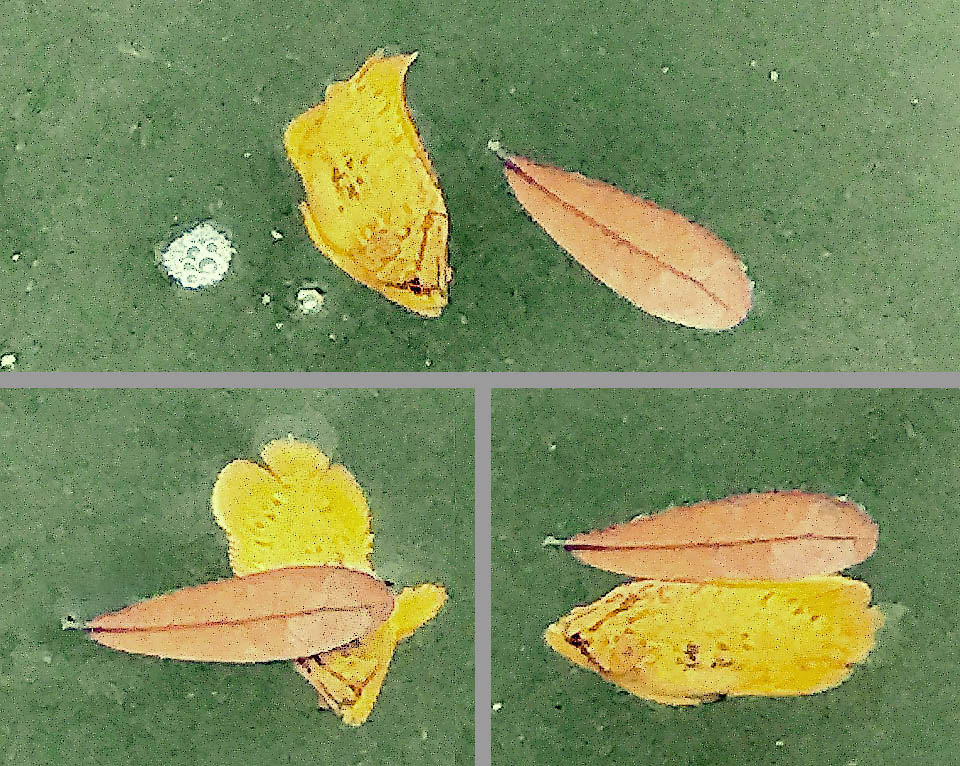
To move unnoticed this juvenile has seen a fallen leaf and doesn’t hesitate, instinctively, to get under it © evangrimes
Before settling on the sea bottoms, the planktonic larvae go through four morphological phases and when they reach the 4 mm they display big eyes with concave heads.
The resilience of the species is high, with a minimum time for doubling of the population of less than 15 months and the fishing vulnerability, relatively low, marks 34 on a scale of 100.
The populations are stable and since 2015 Lobotes surinamensis appears therefore as “LC, Least Concern” in the IUCN Red List of the endangered species.
Synonyms
Holocentrus surinamensis Bloch, 1790; Bodianus triourus Mitchill, 1815; Lobotes somnolentus Cuvier, 1830; Lobotes erate Cuvier, 1830; Lobotes farkharii Cuvier, 1830; Lobotes incurvus Richardson, 1846; Lobotes citrinus Richardson, 1846; Lobotes auctorum Günther, 1859.
→ For general information about FISH please click here.
→ For general information about BONY FISH please click here
→ For general information about CARTILAGINOUS FISH please click here.
→ To appreciate the BIODIVERSITY of BONY FISH please click here.
→ To appreciate the BIODIVERSITY of CARTILAGINOUS FISH please click here.