
Family : Orchidaceae

Text © Prof. Pietro Pavone

English translation by Mario Beltramini
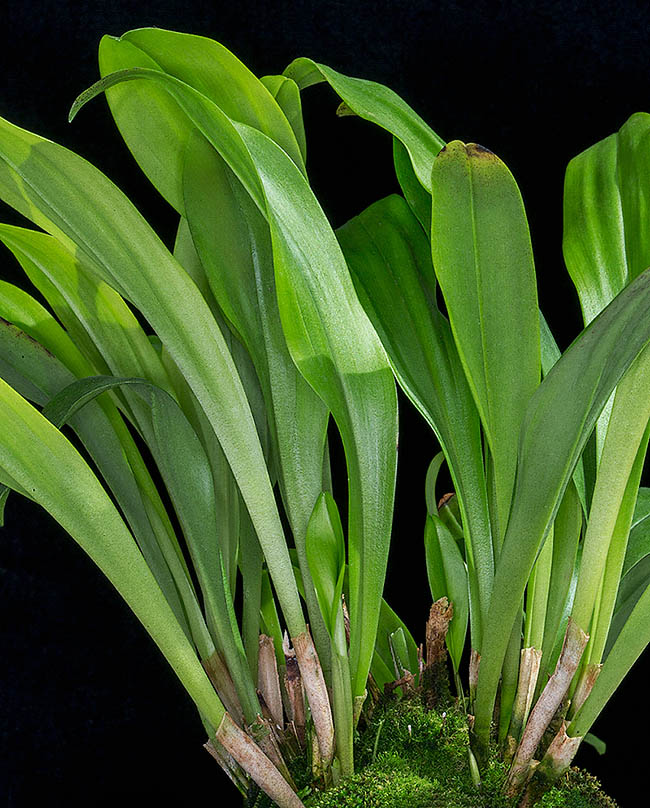
Dracula terborchii is a medium-sized caespitose epiphyte, endemic to the umid altitude forests of Ecuador. The leaves, coriaceous, keeled and narrowed at the base, are wrapped at the base by 2 or 3 tubular sheaths © Mazza
Dracula terborchii Luer & Hirtz is a species belonging to the subtribe of the Pleurothallidinae, to the tribe of the Epidendreae, to the subfamily of the Epidendroideae, and to the family of the Orchidaceae.
The genus Dracula is found in America, in the Central and Western Andes Cordillera, and counts about 146 species.
Formerly some species of this genus were included, since 1870, in Masdevallia, a genus created in 1794 by two Spanish botanists, Hipólito Ruiz López (1754-1816) and José Antonio Pavon (1754-1840).
Carlyle August Luer (1922-2019), studying several specimens of Masdevallia, realized that in the genus were present species having characters substantially different from the others, therefore in 1978 separated them creating a new genus he named Dracula.
The species of the genus Dracula have the shape of the flowers that recalls the snout of a monkey or the head of a dragon, and the leaves are coriaceous, dorsally keeled and progressively narrowed at the base.
All Dracula species grow in the shade often in the bifurcations of the trees, where there are many mosses forming a layer of litter.
Dracula terborchii is an epiphyte endemic to Ecuador found mainly in the hazy forests at altitudes between 1200 and 1400 m.
The etymology of the name Dracula means “small dragon” due to the similarity with a head of a dragon, having the long pointed sepals in almost all species of this genus. The specific epithet honours Hermann ter Borch of Helmond (Netherlands) collector of orchids, particularly those of the genus Dracula.
The species is commonly known as Terborchii Dracula.
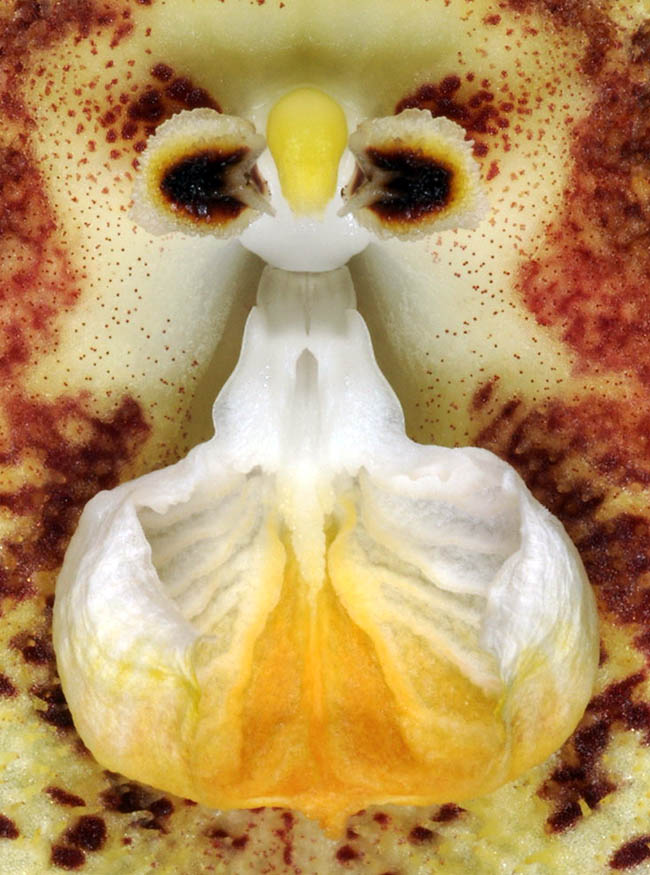
Labellum is white, subdivided in two parts. The apical one presents concave with involuted sides and showy keels © Ron Parsons
Dracula terborchii was collected in northwestern Ecuador, in the Carchi Province, by the collectors Mario and José “Pepe” Portilla. It was the Italian Father Angelo Andreetta (1920-2011), Salesian missionary in Ecuador and great orchid expert, to entice the Portillas to love and cultivate orchids and encouraged them to found in 1991 the great “Ecuagenera” nursery whose current headquarters are located in the Gualaceo Canton, Azuay Province (Ecuador).
In 1996 José Portilla dispatched a plant had collected to the Botanisch Orchideën (Netherlands) of Hermann ter Borch who succeeded to get it flowering in 1997.
The following year a flowered specimen was sent to the expert Carlyle August Luer who recognized it as a new species.
Luer described the species, together with Alexander Charles Hirtz (1951-2024), mining engineer, archaeologist and amateur orchidologist who took care to collect it in nature in September 1998.
The new binomen was published in 1999 in the magazine of the Missouri Botanical Garden (Monogr. Syst. Bot. Missouri Bot. Gard. 76: 137).
Dracula terborchii is a medium-sized caespitose epiphyte, fresh-growing, with erect and robust remicauls, wrapped at the base by 2 to 3 tubular sheaths and with one single apical leaf, erect, finely coriaceous, keeled, elliptic-obovate, sharp that narrows at the bottom in a petiolate base.
The inflorescence is a loose raceme, with few flowers and with a horizontal or descending peduncle, 12-15 cm long, forming in the lower part of the ramifications.
The floral bracts are tubular, 10-15 mm long. The sepals are purplish, densely dotted with dark purple, white at the base, briefly pubescent inside.
The dorsal sepal is ovate, 25-30 mm long and 19-21 mm broad, connate with the lateral sepals for 6 mm to form a widely expanded flower with a subacute apex contracted into a thin purple, 6-7,5 cm long, tail.
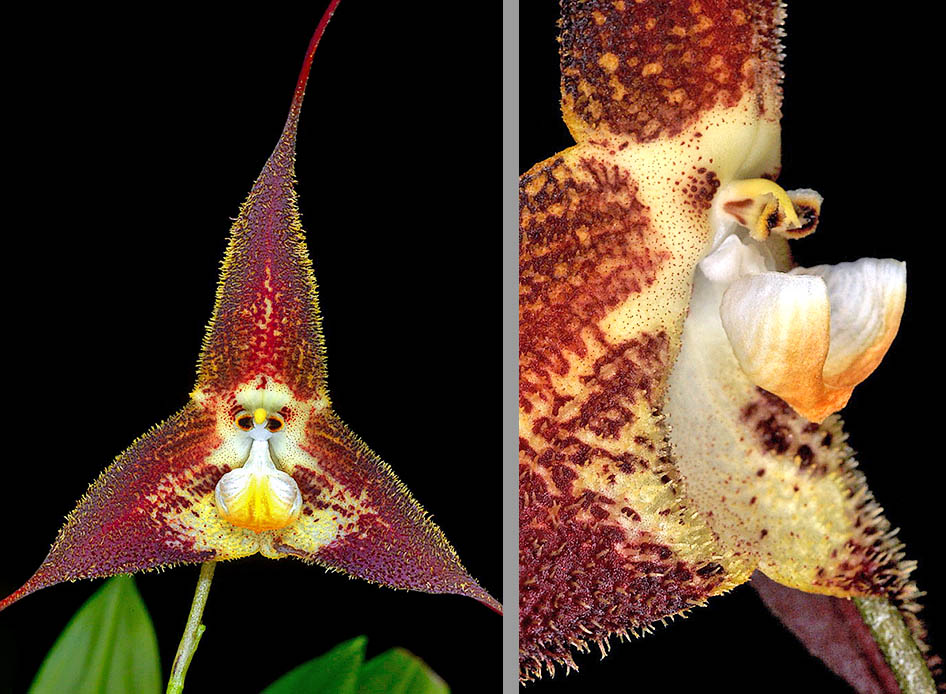
The flower, here enlarged on right, is carried by three purple sepals with apex contracted in the thin very long tail typical of the genus Dracula © Ron Parsons
The lateral sepals are ovate, oblique and subacute, connate, divergent, 30-40 mm long, 20-23 mm broad, with contracted apices in thin tails of purple colour and 6-7 cm long.
The petals, ivory in colour, are dotted with purple, cartilaginous, spatulate, 4 mm long, 2,5 mm broad. The apex is bivalve, papillose between the laminae, and the inner lamina is sharp, the outer one is rounded.
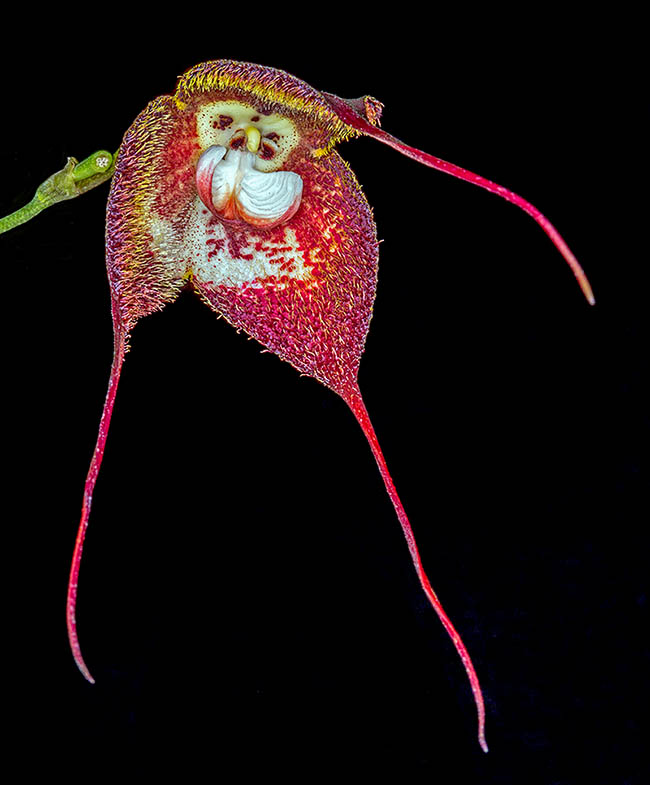
Dracula terborchii labellum has the look and the scent of mushrooms. The fruit flies that live on these in the undergrowth, are then attracted and visiting other plants take care of the pollen transportation © G. Mazza
The labellum is white, subdivided in two portions (bisegmental). The apical portion (epichile), of 11 mm, is transversely elliptical, concave with involute sides, with three longitudinal keels and many radiating laterally. The basal portion (hypochile), hinged at the foot of the gynostemium (or column), is ovoid, 4 mm long and broad, fissured at the centre, with thickened margins.
The column is white, 5 mm long, serrated at the end, with 4 mm long robust foot. The ovary is spheroidal, pubescent, 8 mm long and 4 mm broad. Blooming occurs in winter and in spring.
The pollination is done by fruit flies that thrive among the wild mushrooms located in the growth areas of this orchid. In fact it was noted that the key element of camouflage is the labellum that has the look and the smell typical of the mushrooms.
The fruit is a long and thin capsule, with several very small seeds.
Like many species of Dracula also Dracula terborchii has been recently inserted in the IUCN Red List of the endangered species and is shown as in critical danger because at high risk of extinction in nature, (CR, Critically Endangered).
In cultivation it is an orchid requiring shade or very filtered light and prefers a cool climate (10-25 °C), humid (70-90% of humidity) and ventilated, typical of its natural habitat.
As the inflorescences tend to head downwards, it is better to cultivate it in mesh baskets in order to allow the flower to hang freely. The substratum must be well drained, with fine bark and perlite or sphagnum. It requires frequent waterings and for these is to be exclusively utilized rainwater, distilled or by reverse osmosis, as it is very sensitive to the mineral salts and to chlorine. Stagnations are always to be avoided because root rot can develop. It’s a good thing to use balanced fertilizers, nitrogen, phosphorus, potassium (20-20-20) at the beginning of the season and with more phosphorus to stimulate blooming. Fertilizers should always be used sparingly because the plants are sensitive to excesses.