
Family : Orchidaceae

Text © Prof. Pietro Pavone

English translation by Mario Beltramini
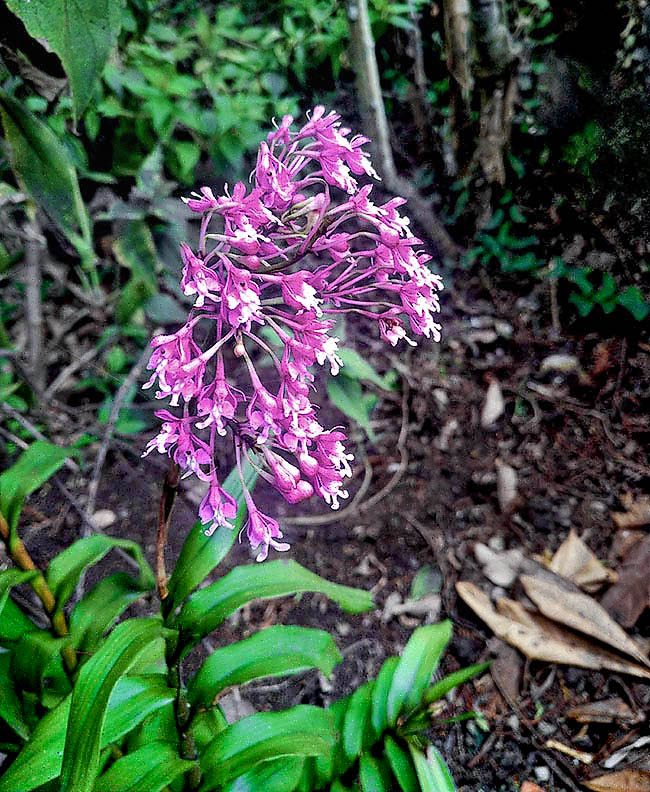
Epidendrum atacazoicum here shown in the Ecuador Cuenca humid forest, is a showy epiphyte, lithophyte or terrestrial orchid, present on the Andes Pacific side between 380 and 2.900 m of altitude © Kabir Montesinos
Epidendrum atacazoicum Schltr. is a species of the subtribe Laeliinae, belonging to the tribe Epidendreae, to the subfamily Epidendroideae and to the family Orchidaceae.
It is found in Ecuador on the Pacific side of the Andes, in the humid mountain forests at altitudes included between 380 and 2.000 m.
Specimens of the species have been found more frequently along the edges of the roads, in the disturbed forests and in sunny places.
It was Friedrich Richard Rudolf Shlechter (1872-1925), German botanist, author of numerous studies on the family Orchidaceae, who assigned it the name and described it utilizing specimens collected by the Jesuit botanist Luis Sodiro (1836-1909) in April 1900 on the western slopes of Mount Atacazo, province of Pichincha, Ecuador.
The description was done on the German magazine “Repertorium specierum novarum regni vegetabilis” (Repert. Spec. Nov. Regni Veg. Beih. 8:67,1921).
The original specimen chosen by Schlechter (holotype) on which he has done the description, was conserved at the Herbarium des Botanischen Gartens und Botanischen Museums Berlin-Dahlem (B), but during the Second World War has been destroyed and therefore, in absence of the holotype, the scholars have chosen another specimen of the same species (isotype) conserved at the Meise Botanic Garden Herbarium (BR) ro represent it (lectotype = selected type).
The genus Epidendrum includes more than 1.4OO species native to tropical and subtropical America, the name comes from the Greek επί, “epi”, over, and δένδρον, “dendron”, tree, “on the trees” referring to the epiphytic posture.
The specific epithet gets its name from that of Atacazo, volcano of Western Cordillera, located 25 km south-west from Quito, in Ecuador.
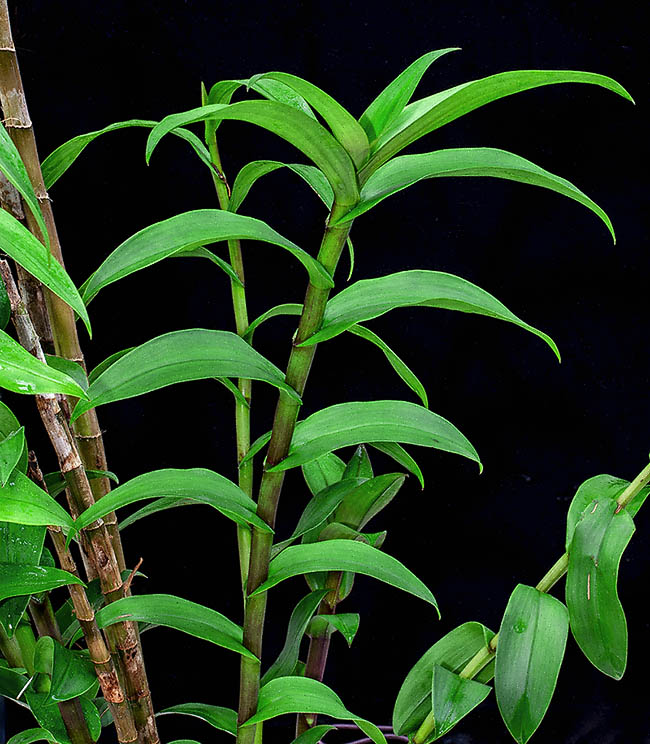
The erect stems, similar to canes, are wrapped by the foliar sheaths and can be 70 cm tall © Dr. Giuseppe Mazza
The Atacazo is a composed volcano (stratovolcano), conical, with steep slopes that has formed from the action of a caldera dated late Pleistocene-Holocene and its last eruption occurred about 2300 years ago.
The common name of the species is Atacazo Epidendrum. In Ecuador the plant is called “Flor de Cristo” (Flower of Christ).
Epidendrum atacazoicum is a perennial plant with fleshy roots, about 60-70 cm tall, epiphytic, lithophytic or terrestrial, with erect simple stems similar to canes, wrapped by the foliar sheaths and completely covered by the leaves.
These are alternate, smooth, erect-patent, elliptic-oblong, sharp, up to 12 cm long, about 2,7 cm broad at the centre.
The inflorescence forms in summer up to autumn, and is a terminal pyramidal panicle, up to 23 cm tall and broad up to 55 cm, with erect-patent peduncles having at the extremities small flowers, about 6 mm of diametre, not scented, of colour varying from pink purple to intense pink.
In each inflorescence we can count more than 200 flowers.
The flower has the intermediate sepal strictly oblong, subacute, 11 mm long, and the lateral ones ascending, strictly elliptic-falcate, sharp, 11 mm long.
The petals are strictly linear, slightly dilated towards the apex, obtuse, uniseriate, having the same length as the sepals.
The 9 mm long labellum is trilobate, with the central lobe bifurcated and divaricate, united (adnate) to the column (gynostemium), usually of a lighter shade than the rest of the flower. The column is suberect, equipped on the front with obliquely squared ears, 9 mm long. The ovary is pedunculate and about 2 cm long.
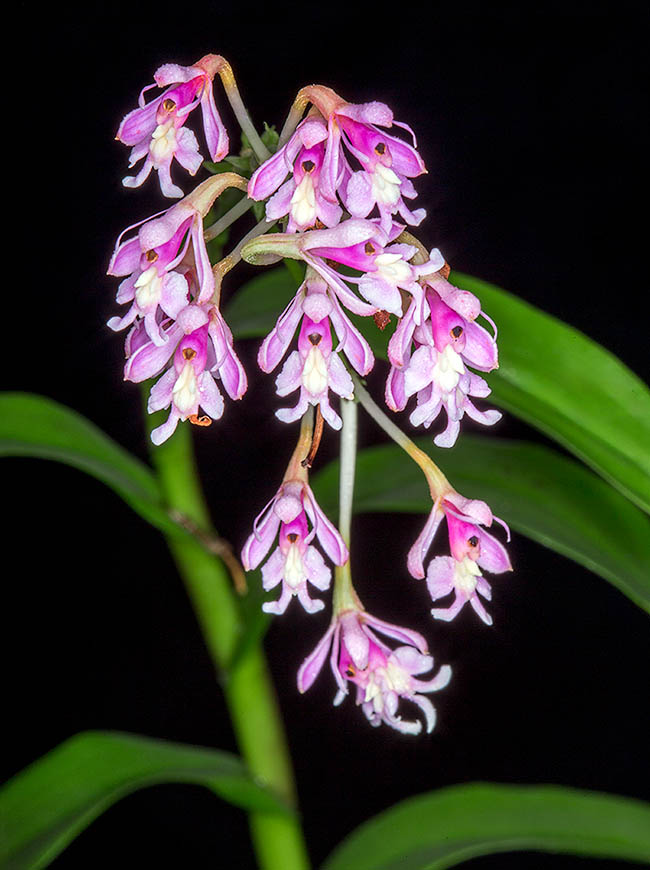
The pyramidal terminal panicle-like inflorescence may reach the 23 cm with 200 scentless flowers © Dr. Giuseppe Mazza
The pollinodia are four, waxy and compressed, organized in two couples, arranged in way to facilitate the pollination done by diurnal lepidopterans or small dipterans.
The single flower, in the popular tradition, is seen as a small “gingerbread man”. Epidendrum atacazoicum is highly sought after by the collectors due to their ornamental value.
It can be grown both indoors and outdoors with intense and indirect light. It prefers warm and humid conditions.
Waterings must be regular in order to maintain the soil constantly humid, but without water stagnation. The loam must be draining, with bark of orchid, to prevent the root rot.
It is good to fertilize every two weeks during the growth season and reduce the frequency during the dormancy period.
Is to be used a balanced orchid fertilizer, such as 20-20-20.
Repotting must be done every two years, in spring or when the plant is not more suitable to its container.
The propagation can be done by division but ensuring that each section has healthy roots and buds. The pruning is usually not necessary, even if it is possible to remove any dead or yellowed leaves in order to keep the appearance and the health of the plant.
A good air circulation serves for preventing fungal infections.
Any presence of parasites like aphids and mites must be promptly treated.
Epidendrum atacazoicum is not a toxic species for pets or human beings, even if it is always a good practice to keep the plants out of their reach due to possible involuntary ingestions.
The Horticultural Association for the education, the conservation and the research of the orchids (American Orchids Society, AOS) has recently awarded two cultivars.
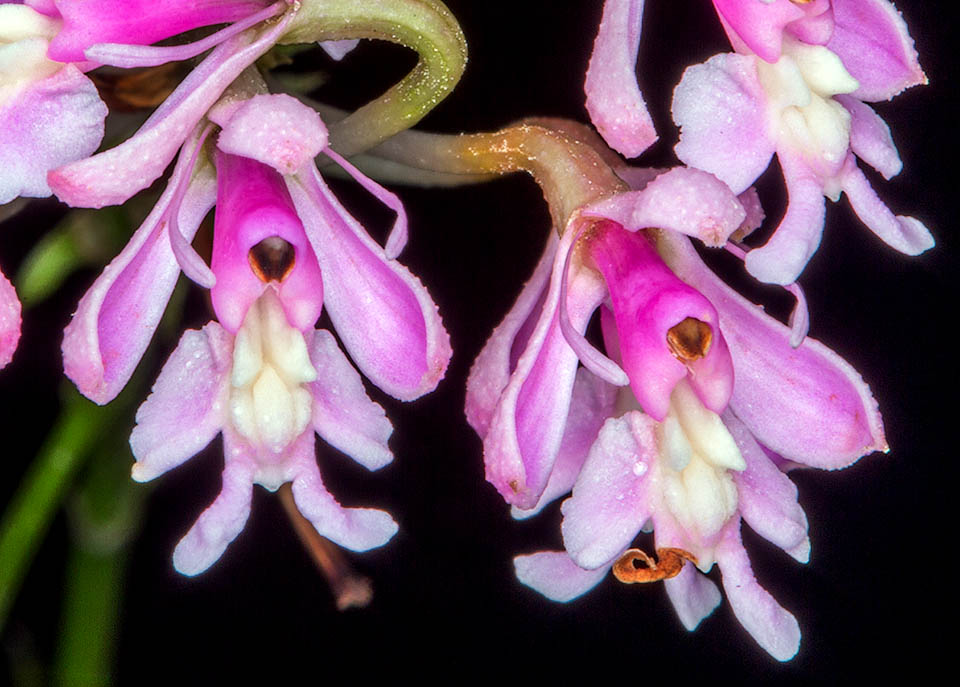
They are pollinated by day lepidopters or small diptera and in popular tradition are called due to their look “Gingerbread men” © Dr. Giuseppe Mazza
Epidendrum atacazoicum ‘Windflower’ is a cultivar awarded in 2010, with the CBR/AOS (Certificate of Botanical Recognition) as natural hybrid of a rare species and exceptionally cultivated.
Epidendrum atacazoicum ‘Ecuaflora’ has been awarded in 2015 with the CCE (Certificate of Cultural Excellence), prestigious recognition due to the number of flowers above the average for the species.
Synonyms: Epidendrum bifalce Schltr.