
Famiglia : Plantaginaceae

Text © Prof.sa Franca Bessi

English translation by Mario Beltramini
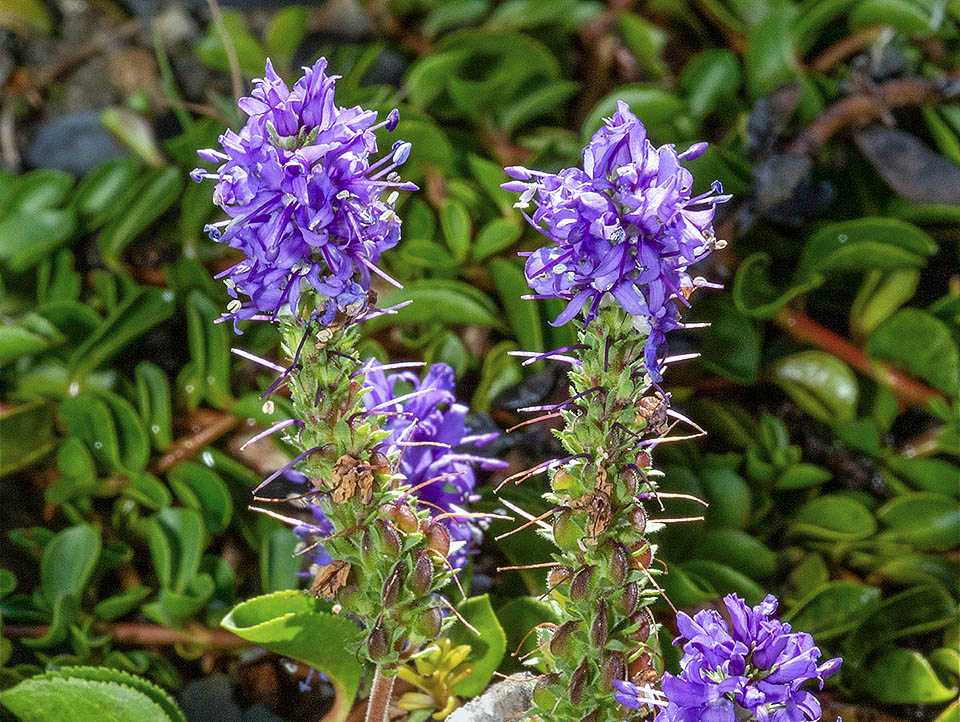
Endemic to western Alps and protected in various sites like in Aosta Valley, Veronica allionii grows between 1500 and 2900 m of altitude © Dr. Giuseppe Mazza
Veronica allionii Vill., is the consolidated denomination of an alpine plant belonging to Veronica I., genus having a very vast distribution in Eurasia, America, in Africa and in Oceania.
The first valid publication of this species stands in “Prospectus de l’Histoire des plantes de Dauphiné et d’une nouvelle méthode de botanique, suivi d’un catalogue des plantes”, Grenoble, Imprimerie Royale, 1779 (p.20) by Dominique Villars who honoured it to Carlo Allioni (1728-1804) from Turin.
It is to be noted that Veronica allionii var. tournefortii Vill., Hst. Pl. Dauphiné (Villars) 2: 9 (1787) is the synonym of Veronica officinalis L.
Carlo Allioni enumerated Veronica pyrenaica All. (presently synonym of Veronica allionii) in “Flora Pedemontana sive enumeratio methodica stirpium indigenarum Pedemontii” :Fl. Pedem. i. 73 (1785).
Flora pedemontana, fruit of more than twenty years work, is still considered a fundamental basic text from a scientific as well as iconographic point of view because it is finely didactic.
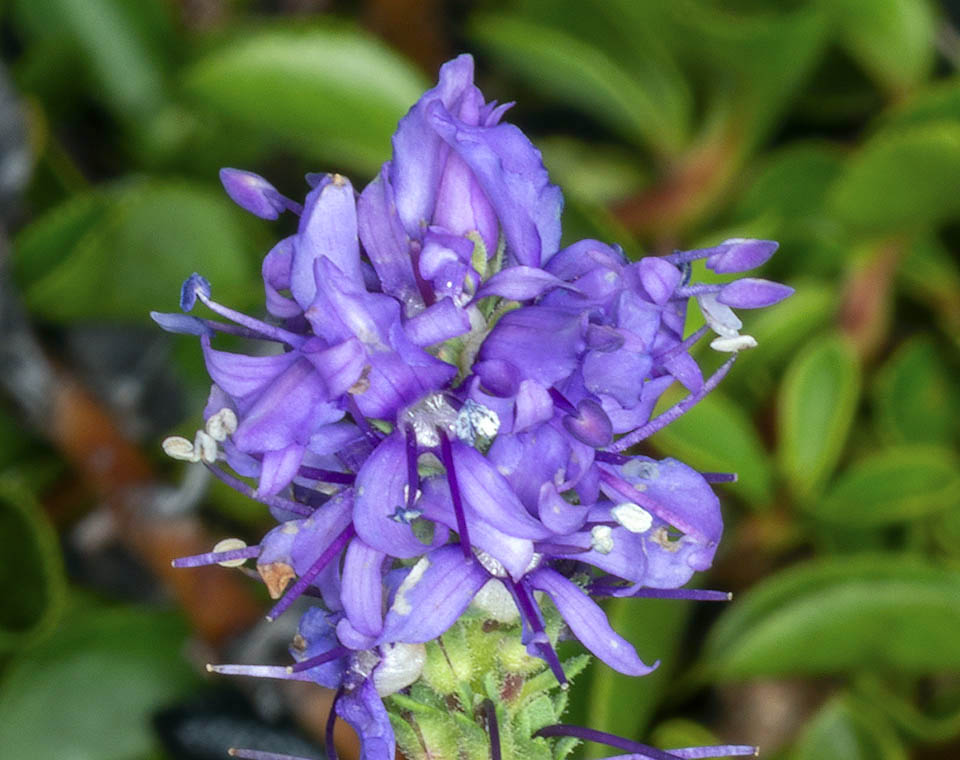
The hermaphrodite subsessile flowers are merged in racemes of 30-60 elements © Dr. Giuseppe Mazza
Even if the dedicatory origin of the specific epithet allionii, the etymology of the generic one keeps uncertain; it is commonly linked to Saint Veronica of the Catholic and Orthodox and, that is, to the pious woman who wiped the face of Christ while he was ascending Calvary.
The common names are Veronica di Allioni, Tè di montagna (Italian), Véronique d’Allioni, Thé des Alpes, Tisane des chamois (French), Allioni’s speedwell (English), Allionis Ehrenpreis (German).
Veronica allionii belongs to the Alpine altitudinal plain and is endemic to south-western Alps. In Italy it is found in Liguria, Piedmont, Aosta Valley; it has been and/or reported as present for the Eastern Pyrenees, the alps of the Haute Provence, the Maritime Alps and Monaco. The “Société de la Flore Valdôtaine” reports it as autochthonous spontaneous species to be strictly protected (very rare vulnerable species) and in the Aosta Valley is protected at the regional level.
Veronica allionii is a small herbaceous perennial plant with greenish to reddish stems, prostrate and partially woody at the base. Resistant to the low temperatures (ca. -15/-20 °C) overcomes the adverse seasons thanks to overwintering buds located at the level of the ground. The sub glabrous leaves, with ciliate tips, are coriaceous , oval, obovate or subround with entire or denticulate margins, folded lengthwise depending on the central vein.
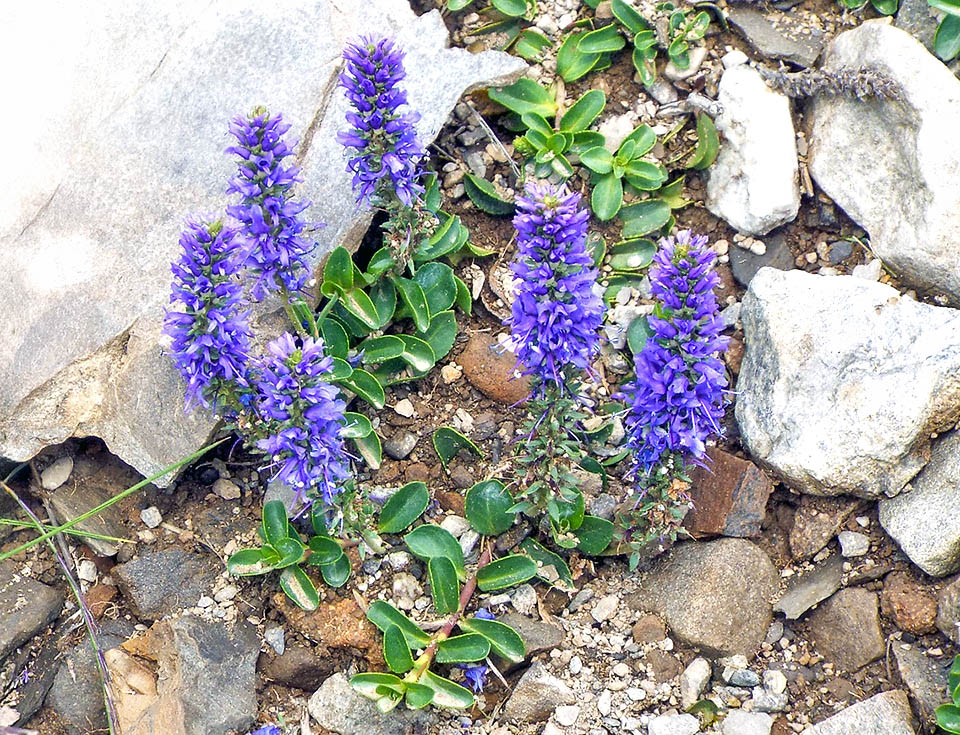
The stem, woody at base and prostrate in the initial part, reaches 15 cm of height rooting at the nodes. The species is traditionally used for digestive infusions © ahmedm
On the stems the leaves are arranged opposite one to each other and the radical leaves do not form a rosette. The racemes are supported by elongated pubescent peduncles, erect, alternate and at times solitary that branch out from the stems; these inflorescences with bracts are full of flowers (30-60) briefly pedicellate, subsessile. The hermaphroditic flowers (erectopatent) have five sepals and the corolla (Ø= 8-12 mm) is wider) is quadripartite (three divisions are narrow and lanceolate and the upper one is wider) from where protrude two stamens with anther and the style is filiform; the corolla is four time longer than the calyx and is conspicuous because of the intense colour from blue to purple. The blooming occurs in July-August. When ripe the obcordate capsule looks like a small dark heart, inside which the seeds are brown-yellowish.
It grows in stony and rocky sub-alpine pastures forming low compact cushions. Due to its morphological characteristics it is utilized for rock-gardening and for edges, also because in the mild winters it is always evergreen.
It is easy to grow but requires sunny positions.
Veronica allionii is a medicinal entity to which were and still are (though in a lesser measure) various healing properties and relevant contraindications, among which are recognized its physiological effects for the digestive function and we remind that it may be utilized for preparing infusions (selection of the aerial part) hence the common names.
Synonyms: Veronica pyrenaica All.
→ To appreciate the biodiversity of PLANTAGINACEAE please click here.