
Family : Orchidaceae

Text © Prof. Pietro Pavone

English translation by Mario Beltramini
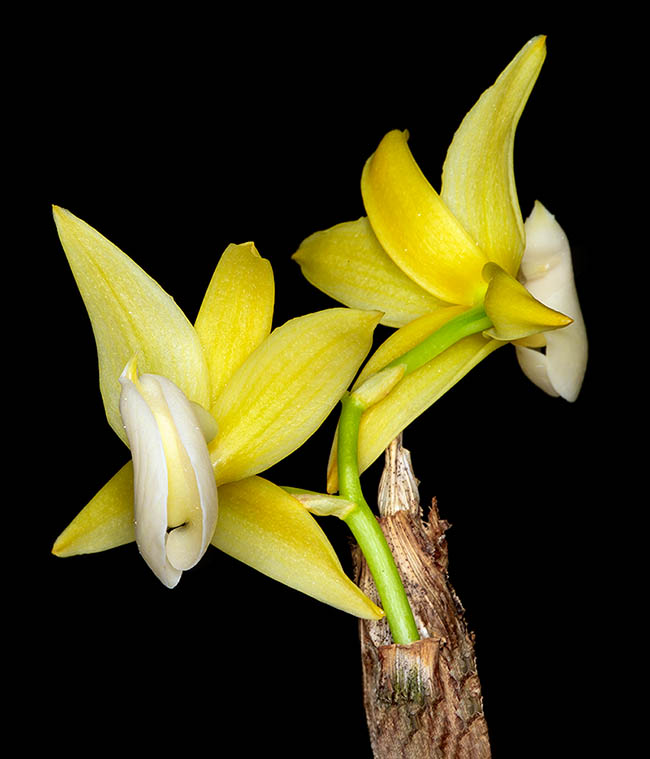
Mormodes warszewiczii, endemic to Brazil, Peru and Bolivia, blooms at the base of pseudobulbs without leaves © Dr. Giuseppe Mazza
Mormodes warszewiczii Klotzsch is a species belonging to the family Orchidaceae, to the subfamily of the Vandoideae, and to the tribe of the Cymbidieae, subtribe Catasetinae.
The species has been described in 1854 by Johann Friedrich Klotzsch (1805-1860) in the historic German magazine of gardening and of botany Allgemeine Gartenzeitung (Allg. Gartenzeitung 22: 65, 1854).
Discovered in Peru byt the Polish traveller and naturalist Józef Warszewicz Ritter von Rawicz (1812-1866) was introduced by him to Germany and given to the care of Mr. Gireoud, leading figure in German horticulture of the XIX century. He was head gardener and later on director of the important private botanical garden of the family Friedrich Nauen, in the Tiergarten district of Berlin, specialized in exotic and rare species.
After just one year the plant flowered and so Klotzsch was able to name it and to describe it scientifically.
Mr. Warszewicz dispatched plants to many public and private botanical gardens, mainly in Berlin, Hamburg, London and Zurich, thus getting funds for his voyages. During his two expeditions, between 1844 and 1853, in tropical America, he sent and carried to Europe tens of thousands of plants among which several hundred new taxa, especially orchids (about 300).
As a consequence, about 180 names of species do exist of which Warszewicz is author or coauthor of the first description, even if he was not a professional botanist. Moreover, to honour his work, more than 60 eponyms, many today fallen into synonymy, were created, others still valid like Brassia warszewiczii Rchb.f., Goeppertia warszewiczii (Lem.) Borchs. & S.Suárez, Mormodes warszewiczii Klotzsch, Oncidium warszewiczii Rchb.f., Philodendron warszewiczii K.Koch & C.D. Bouché. Two genera bear his name: Warczewiczella Rchb.f.(Orchidaceae) and Warszewiczia Klotzsch (Rubiaceae).
Mormodes warszewiczii is a rare species endemic to Brazil, Peru and Bolivia. The name of the genus Mormodes comes from the Greek words mormō (μóρμω), that means “goblin”, “ghost” or “scary monster”, and -oeidēs (-οειδής) that means “similar” or “similar in shape”, alluding to the appearance of the flowers that have an unusual and asymmetrical shape. The specific epithet warszewiczii honours the memory of Józef Warszewicz who collected it and introduced in Europe this plant, commonly known as Mormodes of Warszewicz or Warszewicz Orchid.
Mormodes warszewiczii is a deciduous sympodial epiphyte growing on decaying wood in the humid mountain forests included between 400 and 1150 metres. It has cylindrical ovate pseudobulbs, completely wrapped by several imbricated scarious sheaths, with sharp leaves, linear-lanceolate, and light veins. The pseudobulbs, grouped along the rhizome, ensure, with their water retention, the survival of the plant in environments that are not always constantly humid. The inflorescences, arcuate and up to 50 cm long, form in summer at the base of the pseudobulbs without leaves and are racemes with numerous flowers (10 to 15), waxy and fleshy, very fragrant. The 6-6,5 cm large flowers are campanulate and revolute on the margin. They may have various colours. Often they present yellow or brown-reddish shades with darker dots or specks.
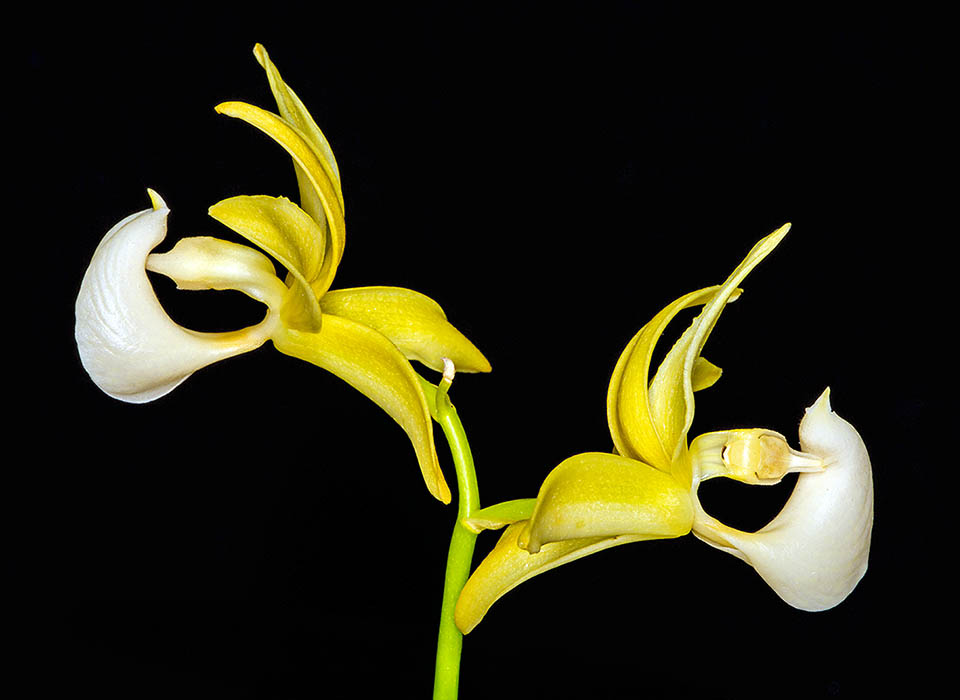
To stick their pollinarium to pollinators and avoid self-pollination, column and labellum make a torsion of 90-180° with respect to the axis of the flower © Dr. Giuseppe Mazza
The sepals and the petals can be yellow covered by reddish, brown or burgundy coloured dots. The labellum, thin and trifid, is usually red-brown, often dotted by even darker shades, somewhat hairy, pale below, with short lateral lobes. The pollinia are two. The flowers are characterized by asymmetry due to the torsion of the column (gynostemium) and of the labellum of 90-180° at the anthesis. Therefore the flowers have an arcuate column not at the centre but twisted to one side, right or left, with respect to the axis of the flower. Because of this there is a mechanical tension that, if touched, throws the pollinarium sticks on one specific side of the body of the insect, this prevents it from coming into contact with a column facing the opposite side. This mechanism consequently optimizes the cross-pollination and avoids the risks of the self-pollination.
Furthermore, Mormodes warszewiczii displays a marked sexual dimorphism. It can have unisexual flowers (male or female) and hermaphroditic flowers (with both sexes) and this depends on the stage of development of the plant and on the environmental conditions. There is a sex determination caused by the environment (availability of light or of nutrients) and not genetic.
The male flowers are produced by smaller plants and present a deeply trilobed and hairy labellum. The female flowers form when the plant produces big and vigorous pseudobulbs. Their labellum is convex, less lobed and without down. The hermaphroditic flowers, having both reproductive organs, avoid the self-pollination maturing the male reproductive organ (pollinaria) and only after that the receptivity of the ovary (proterandrous flowers). They have proterandrous flowers pollinated mainly by the male bees belonging to the tribe Euglossini (family Apidae) being attracted by the scent emitted by the labellum. In fact, these bees collect the scents, only reward without nectar, with their bristly structures placed on the front tarsi to transfer them into the spongy cavities of the rear legs to then utilize them in their nuptial parades.
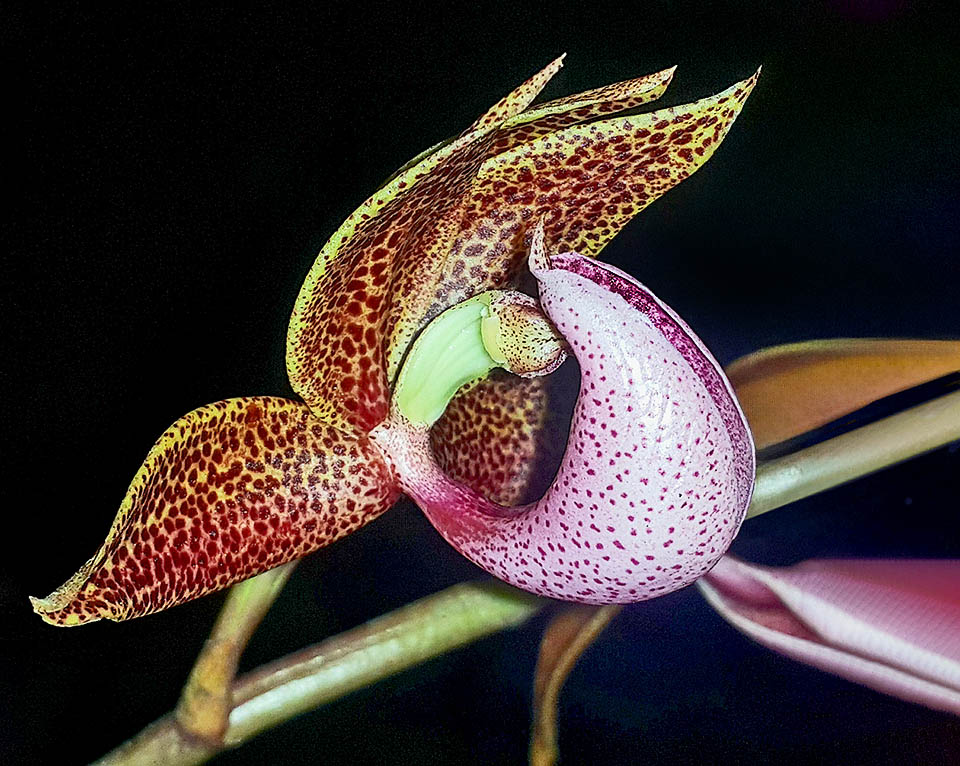
The male, female or hermaphrodite flowers, are mainly pollinated by the male bees of the tribe Euglossini attracted by the strong scent of the labellum © Joe Panozo
When the bee lands on the labellum, looking for scent, stimulates the apex of the column, by making it flex so that one single pollinarium can be released with a snap and fixes on its thorax or on its head. This is favoured also by the asymmetry of the flower due to the torsion of the labellum, to the left or to the right, that obliges the bee to better position itself for the correct fixing of the pollinarium. In turn the bee, always looking for scent, will go to deposit the pollnariumon the female part of the column of another flower in a way that the pollination occurs.
After the fecundation from the ovary forms a dehiscent fruit (capsule) that frees extremely tiny seeds that will be diffused by the wind. The germination requires symbiotic mycorrhizal fungi to provide essential nutrients, as the seeds have no endosperm and depend on the fungi for the initial development. Mormodes warszewiczii is a plant growing on decaying wood or on tree trunks, and adapts to the seasonal cycle with an active growth followed by dormancy. In fect, in winter it goes to rest and completely loses its leaves.
Mormodes warszewiczii is a rare species and its reduced distribution renders it vulnerable to outer factors such as the destruction of its habitat. Therefore it is included into the Appendix II of the CITES. Its trade is consequently strictly monitored and requires specific permits for the exportation in order to guarantee that the collection done in nature is not threatening the survival of the species.
Due to the unusual shapes of the flowers and the scent produced by them, Mormodes warszewiczii is particularly appreciated by the collectors. In fact, this species has been utilized as a parent to create hybrids inside the genus as well as intergeneric. The hybrid Mormodes Jumbo Odin has been obtained by crossing between Mormodes warszewiczii × Mormodes maculata and registered at the International Orchid Register (RHS) on 19/06/2001 by the Nursery Jumbo Orchids (Taiwan).
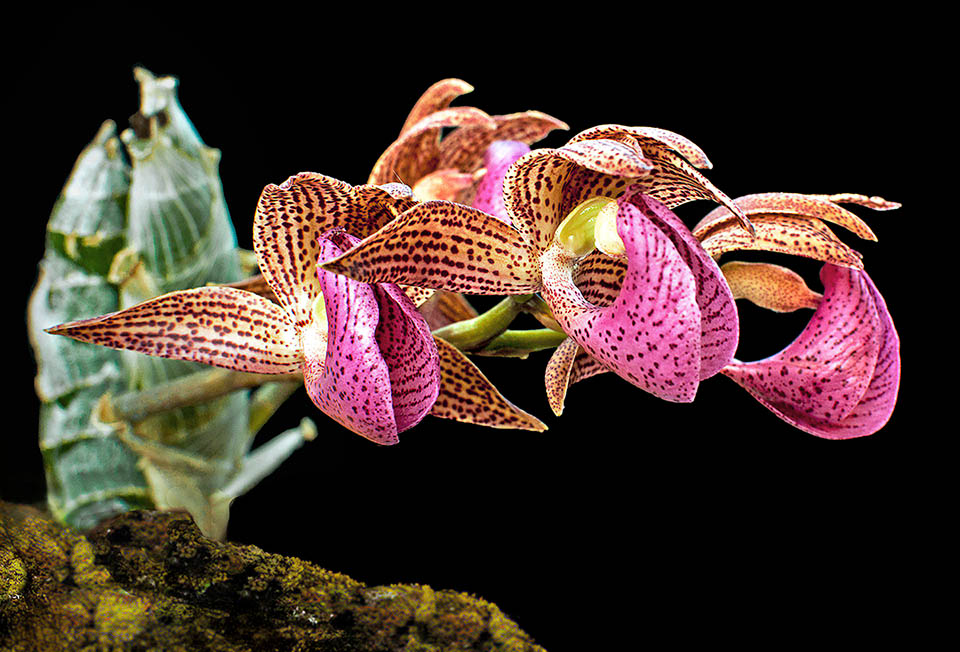
The inflorescence is a curved raceme with 6-6,5 cm flowers, revolute at margins, fleshy, usually yellow, but also brown-reddish with dark spots © Ramūnas
The crossing between Clowesia scurra (= Clowesia amazonica) and Mormodes warszewiczii has created the hybrid × Mormodia Caroline Fzerreira registered in 32020 at RHS by Uberlandio Ferreira, Brazilian hybridizer.
Also numerous selected varieties of the same species do exist. Many of them have been awarded by the American Orchid Society due to the superior qualities of their blooms. Among the most recent having gotten prizes we mention: Mormodes warszewiczii‘Baker’s Mini Butterfly (2014); Mormodes warszewiczii ‘Julio David’ (2012); Mormodes warszewiczii‘ Brent Baker’ (2012); Mormodes warszewiczii ‘Sunset Valley Orchids (2012); Mormodes warszewiczii ‘Nikole’ (1998); Mormodes warszewiczii ‘Mariza’ (1995).
Growing of this plant is not easy also because it is susceptible to rot. However its plants can be grown in plastic or wood baskets to favour the root aeration and employ a substratum made by a well-draining compost based on fine pine bark, sphagnum, charcoal or tree fern fibre.
They prefer bright but filtered light and warm temperatures, 24-29 °C during the day, with a drop in night-time of about 6-8 °C. Humidity from 70% to 85%. Abundant waterings during the growth when the new buds begin to form. Every two or three waterings it is good to add a balanced liquid fertilizer specific for orchids. In order to avoid rotting drastically reduce the waterings during the rest period, when the leaves get yellow and fall, but avoid wrinkling of the pseudobulbs.
Synonyms: Mormodes hirsutissima F.E.L. Miranda (1989); Mormodes revoluta Rolfe (1909); Mormodes wolteriana Kraenzl. (1910).