
Family : Orchidaceae

Text © Prof. Pietro Pavone

English translation by Mario Beltramini
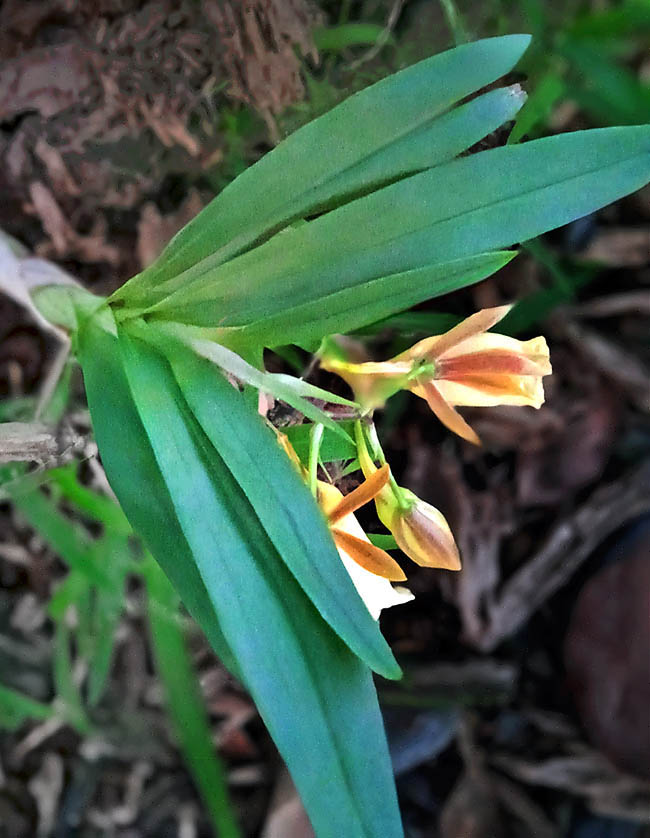
Usually epiphyte, Galeandra baueri is an orchid with big fusiform pseudobulbs and eight deciduous leaves © Danna Lizeth Guevara Prieto
Galeandra baueri Lindl. is a species belonging to the family of the Orchidaceae, to the subfamily of the Epidendroideae, tribe Cymbidieae, subtribe Catasetinae.
This species has been described in the opus of Franz Bauer and John Lindley entitled “Illustrations of Orchidaceous Plants” (F.A.Bauer, Ill. Orch. Pl.: 8 (1830), by the English botanist JohnLindley (1799-1865). The species is depicted in the plate n. 8 (t. 8) realized by the Austrian illustrator Franz Andreas Bauer (1758-1840), official botanical painter of Kew Royal Botanic Gardens.
He was employed in 1790, on Sir Joseph Banks (1743-1820) proposal, with the task of “Botanical Painter to His Majesty” until the end of his life.
The collaboration between John Lindley, recognized as the “father of modern orchidology” and Franz Bauer, who, for his drawings, used the microscope, represented a turning point for the XIX century botany, combining the scientific rigour with unparalleled artistic precision. In fact, this precision allowed Lindley to analyze the complex reproductive structure of the orchids, like the pollinia and the stigma, necessary for the taxonomic classification of these plants and in particular of the genus Galeandra of which Galeandra baueri is the type species.
The sample utilized for the description was coming from Cayenne, French Guiana, collected by the French botanist and collector Joseph Martin (1760-1826) at an altitude of about 1.000 m. It reached Europe as a dried sample whose good Bauer, with the aid of a microscope, was able to make distinguishable all the particulars useful for the description.
Galeandra is a neotropical genus, with 41 species presently accepted, and present from south Florida and Mexico, throughout Central America, West Indies andSouth America up to Paraguay. Most of these species, about 28, are found in the biomes of Brazil (Amazon and Cerrado).
The species of the genus are herbaceous plants, epiphytic with cylindrical or fusiform pseudobulbs, terricolous with ovoidal pseudobulbs, short and thickened.
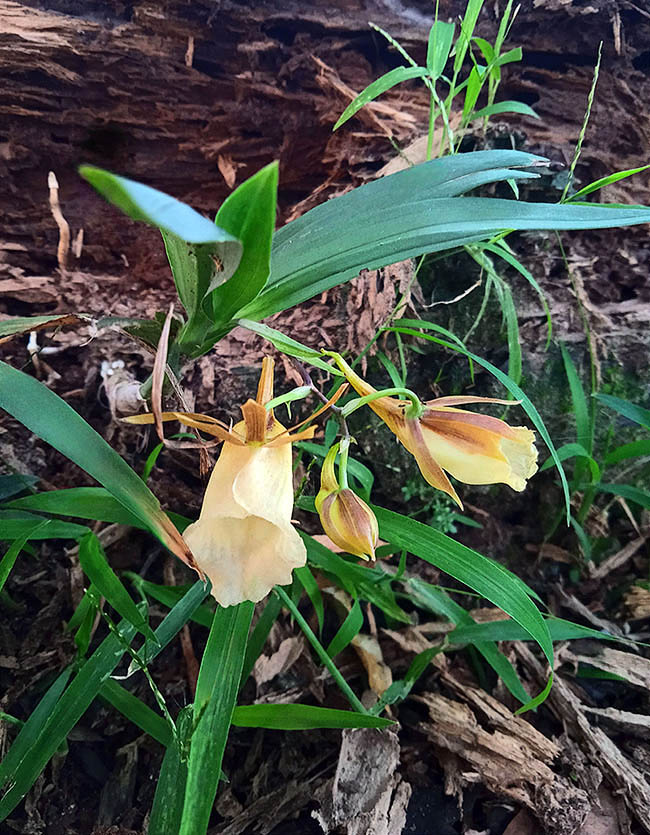
Grows in Bolivia, north Brazil, Colombia, French Guiana, Peru and Surinam, in humid tropical environments between 800 and 1200 m of altitude. The terminal inflorescence is an about 30 cm panicle © Danna Lizeth Guevara Prieto
They have simple and alternate leaves, strictly linear to oblong-lanceolate.
The inflorescence is terminal, raceme or panicle. The flowers are big, rarely small. The labellum is infundibuliform with a spur that in the epiphytes is elongated, thin and attenuate apex, whilst in the terricolous ones is short.
The fruit is an oblong capsule, tricarpellate, dehiscent, with several powdery seeds. The various species are distinguished for the shape of the labellum, for the presence or absence of down on the labellum and on the column, and for the number of keels.
Galeandra baueri is found in Bolivia, northern Brazil, Colombia, French Guiana, Peru, Surinam, mainly in the humid tropical biome, between 800 and 1200 metres of altitude.
In Brazil, it is found in the state of Amapá, as epiphyte on palms of the genus Bactris, along the banks of the water streams; in the tropical gallery forests of Cerrado, in the palm forests on the slopes in the state of Pará.
In Bolivia it is found in the mountain tropical forests of the department of Santa Cruz.
In Peru it is diffused in the valley of Chanchamayo, in the region of Junín.
The name of the genus Galeandra comes from the Latin “galea”, helmet, and the Greek “ἀνδρός” (andro), man, and alludes to the shape of the anther that vaguely recalls a helmet.
The specific epithet is honoured to Franz Bauer. The common name is Bauer Galeandra.
Galeandra baueri is a usually epiphytic herbaceous plant with fusiform pseudobulbs, 16-23 cm long, close on the rhizome, wrapped by several imbricate scarious sheaths, with about 8 leaves, deciduous, linear-lanceolate, pointed, vaginant at the base the pseudobulb (amplexicaul), coriaceous, but flexible with prominent veins 3 of which well visible in the lower pagina. The leaves are 18-25,7 cm long, 1,6-2,1 cm wide.
From the apex of the ripe pseudobulb forms the often ramified inflorescence, up to 30 cm long, loose and pendulous. The inflorescence is a panicle of 4-16 flowers of about 7 cm with greenish peduncle, 2,5 to 4,0 cm long, covered by 9-13 mm long bracts.
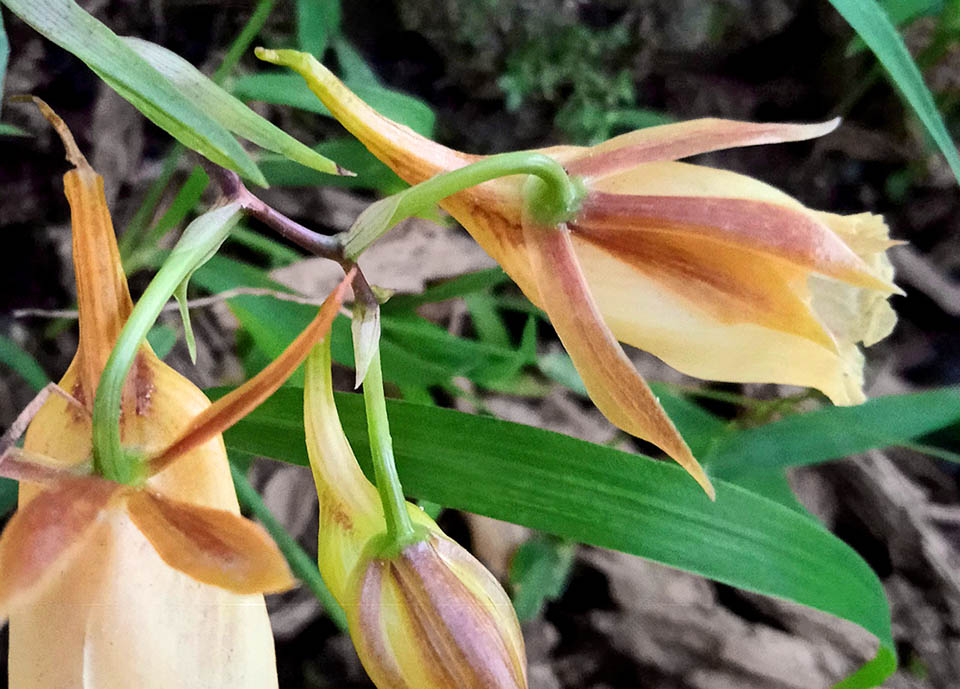
The flowers labellum, almost as long as the pale green ovary, is infundibuliform with a golden yellow spur with characteristic brown stripes © Danna Lizeth Guevara Prieto
The flowers are scented and long-lasting (averagely three weeks). They open in succession from spring to early summer.
The ovary is pedicellate, pale green, 20-25 mm long. The sepals are green-yellowish with brown-reddish thick stripes. The dorsal sepal is erect or curved, 23-28 mm long, 4-6 mm broad.
The lateral sepals are erect or slightly curved, 25-28 mm long, about 6,5 mm broad. Also the petals are erect, 23-24 mm long, 6,5-7 mm broad, also brown-reddish or greenish-brown.
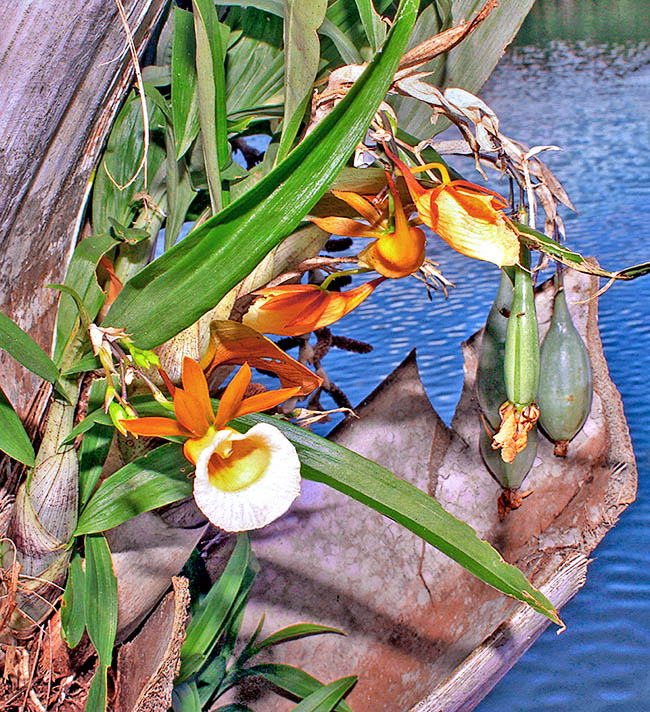
In Brazil it can be found on palms of the genus Bactris, along the water streams banks © Diego Amaya
The labellum is bilobed and varies from rhombic to rhombic-obovate, 54-62 mm long, 48 mm wide, white-yellowish, at times with pink-purplish veins towards the inside.
The disk, on the upper surface of the labellum, is formed by 4 orange keels, the outer ones slightly curved and thickened to the base.
The spur or straight, filiform, with attenuate apex, greenish or golden yellow and with brown stripes on the ventral surface, internally pubscent, almost as long as the ovary.
The column (or gynostemium) is usually glabrous, white-yellowish, with some purple spots on the ventral surface, about 1 mm long and about 4,5 mm broad.
The pollinia are 2, waxy, connected to one single viscidium by means of a long stem whose whole forms the “inverted T” shaped pollinarium.
The anther is white-yellowish, mainly pollinated by bees belonging to the genus Euglossa, with their bright metallic colours varying from blue to green and copper.
The male bees are attracted by the scents (oily aromatic compounds) emitted by the plant.
The shape and the colour of the labellum help the bee in entering and once inside the bee collects the scents with the hair brushes on the front legs and stores them into the cavities on the rear legs to then release them during the courting rites used to attract the females. However, while the bee is busy scraping the scents it hits the pollinarium that attaches on its body and when the bee will go to the successive flower, will carry out the cross-pollination. After fecundation it forms the fruit that is an oblong, tricarpellate capsule, dehiscent, with powdery seeds.
Like all species belonging to the family of the Orchidaceae, also Galeandra baueri is protected by the Washington Convention (CITES). Therefore, international trade is strictly regulated in order to ensure its survival in the wild.
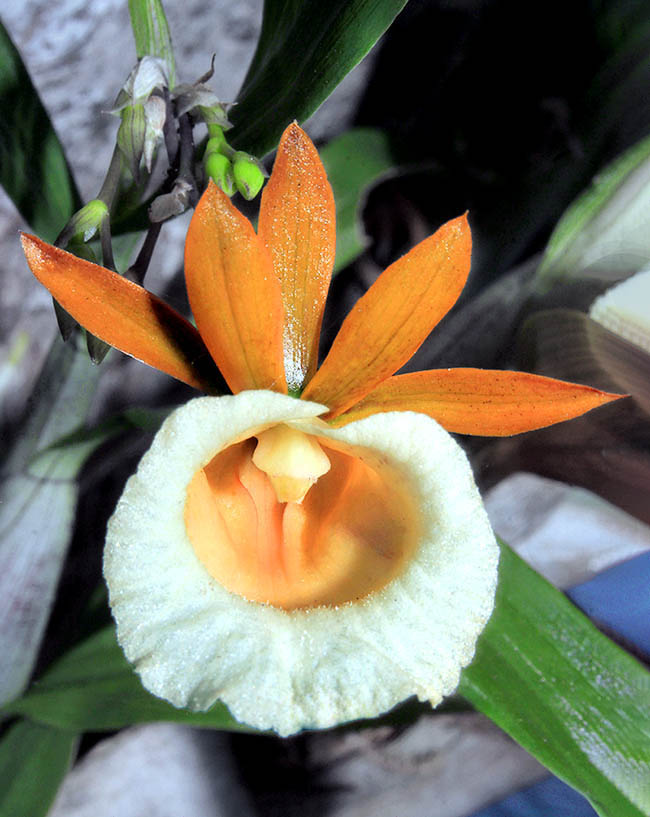
The big scented and long-lasting flowers have sepals and petals with thick reddish stripes. The labellum has inside four typical keels with the anther above shaped like a helmet, as the etymology of genus suggests © Diego Amaya
Galeandra baueri is an ornamental orchid,appreciated by collectors because of its scented flowers (that recall the scents of raspberries) and its infundibuliform labellum.
When grown indoors it requires intense and diffused light, but not direct sun.
It loves a 23-28 °C temperate to warm climate during the day and 14-17 °C the night in order to favour vigorous development.
As a growth substratum, it is good to use a draining compound made of pine bark, fern fibre or sphagnum.
The plant requires high humidity, about 80%, and good air movement in order to prevent rots.
During the phase of growth (Spring-Summer) the waterings must be frequent, 3-5 times per week.
Every two weeks it is good to administer a balanced, very diluted, liquid fertilizer.
During the dormant phase (Autumn-Winter) when the leaves begin to turn yellow, the irrigation water must be reduced and given 1-3 times per month in order to avoid wrinkling of the pseudobulbs.
Repotting must be done every 1-2 years, preferably as soon as the new vegetation (late winter or early spring) appears, before the formation of the new roots.
The leaves are subject to red spider mite attacks especially if in condition of poor humidity.
When the leaves are attacked, fungal diseases do manifest too.
Therefore, once the mites are found, we can spray Marseille soap (10-20 grams) dissolved in one litre of water instead of synthetic products. Wettable sulphur can be used as natural repellent.
Various artificial hybrids of Galeandra baueri do exist.
The primary hybrid Galeandra Beth has been officially registered by J. D. Stubbings in 1994 at the Royal Horticultural Society (RHS).
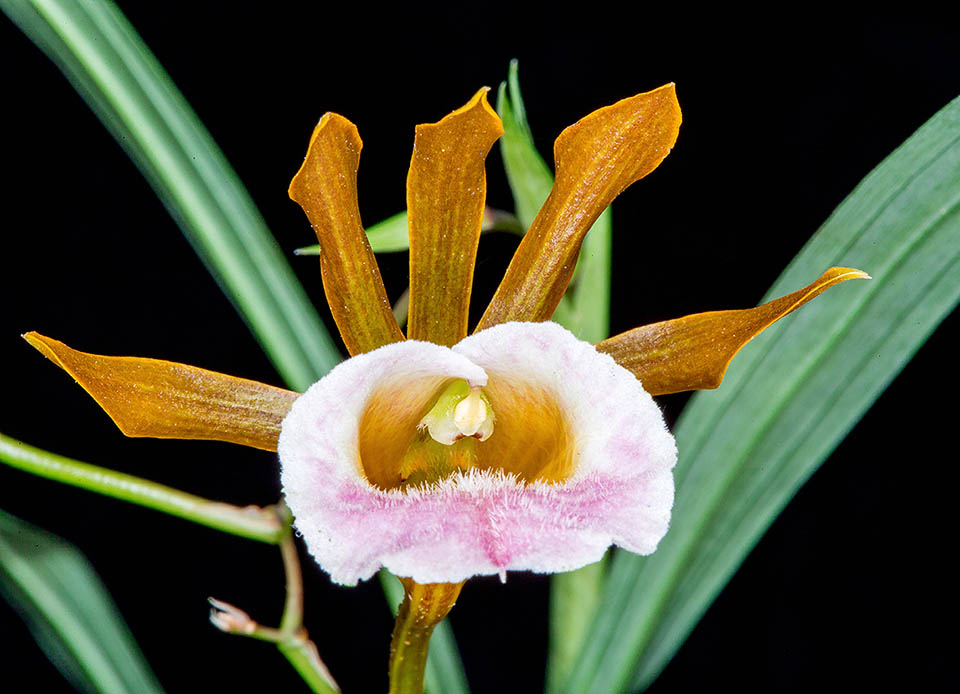
It is yellowish-white, at times with pink-purple veins or shades towards the inside © Dr. Giuseppe Mazza
It is a cross between Galeandra baueri × Galeandra pubicentrum whose flower is bronze, golden brown or olive green in colour, at times with brownish shades. The labellum is usually cream white in the outer part, purple, magenta or intense mauve on the edge and inside.
Galeandra Stanbaudon is a primary hybrid obtained from the cross between Galeandra stangeana × Galeandra baueri by M. & M.F. Bourdon was accepted on 09/23/1997 by RHS. The flowers are of olive-brown or pale green colour, at times with purple shades and labellum white or yellow outside, with streaks or shades, purple, mauve or crimson inside.
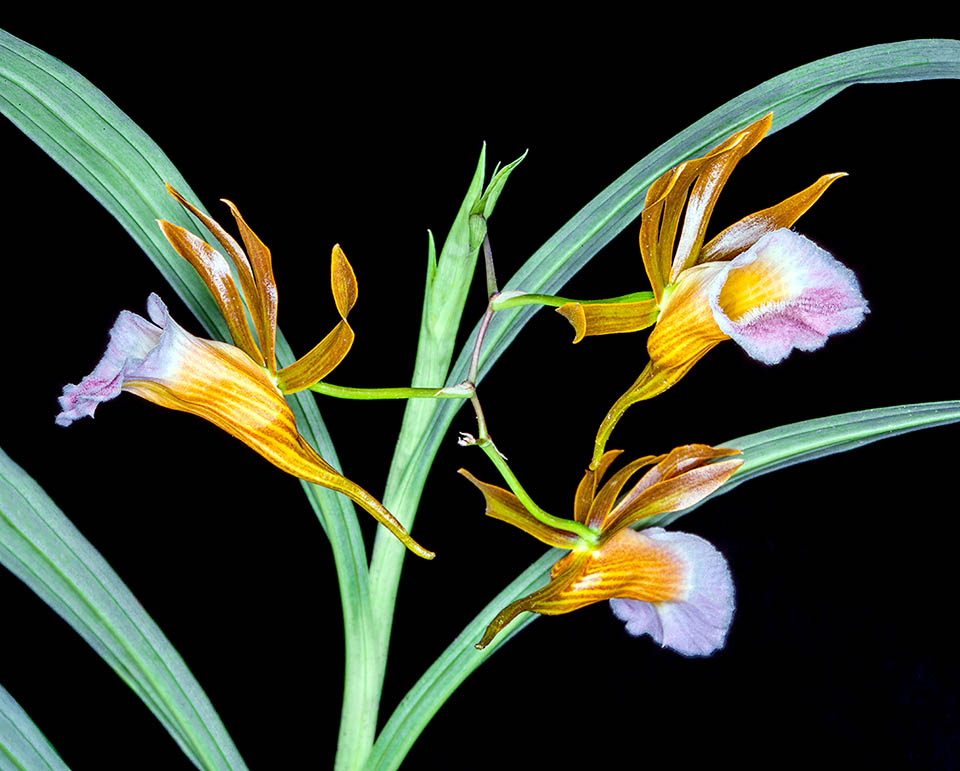
Galeandra baueri is an orchid grown also for its flower scent. Requires intense and diffused light but no direct sun, and if possible 23-28 °C the day and 14-17 °C the night © Dr. Giuseppe Mazza
Despite the absence of distinct taxonomic varieties, there are several cultivars selected by expert nurserymen with particular shades of colour or of vigor. Galeandrabaueri ‘Zoltan’ was awarded by Deutsche Orchideen-Gesellschaft (D.O.G.) in 2014. The American Orchid Society (AOS) has awarded Galeandra baueri ‘Nova’ in 1995; Galeandrabaueri ‘Sandy’ in 1992; Galeandra baueri ‘Santiago’ in 1992 and Galeandra baueri ‘Gracias A Dios’in 1988.
Synonyms: Galeandra cristata Lindl. (1844); Galeandra funckiana Lindl. ex Rchb.f. (1881); Galeandra funckii Lindl. ex Rchb.f. (1856).