
Family : Serranidae

Text © Dr. Giuseppe Mazza

English translation by Mario Beltramini
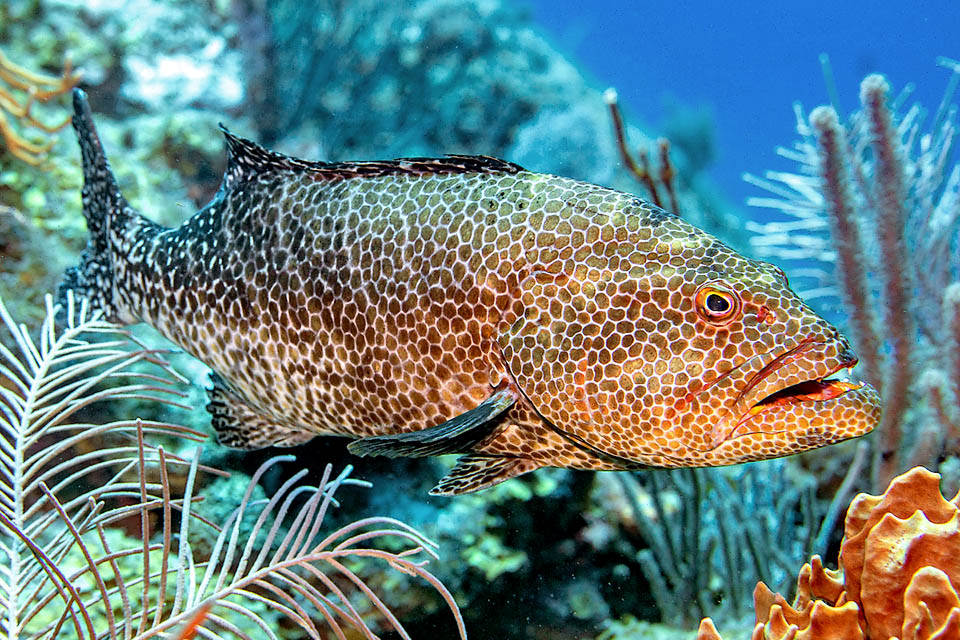
With its honeycomb livery, Mycteroperca tigris is a Caribbean tropical species with a disjunct population in Brazil © www.carlosestape.photoshelter.com
Known as Tiger grouper, Mycteroperca tigris (Valenciennes, 1833) belongs to the class of the Actinopterygii, the ray-finned fishes, to the order of the Perciformes, to the family of the Serranidae, and to the subfamily Epinephelinae.
The genus Mycteroperca, created by Gill in 1862, originates from “mycterus”, nostril, due to the conspicuous rear nostrils, almost twice as large than the front ones, and from “perca”, name often used in the old times for the fishes that recalled in the appearance the Perch.
The specific term tigris, tiger in Latin, even if not explained by Valenciennes, is a clear allusion to the parallel stripes pattern in the upper part of the body evoking the coat of a tiger.
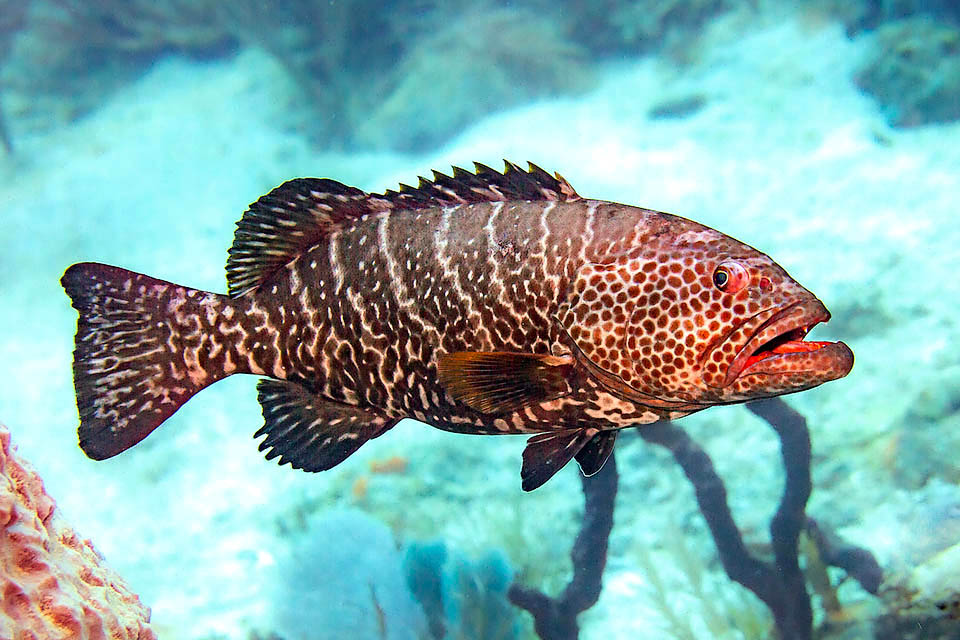
The specific term tigris comes from the 8-11 diagonal parallel stripes on sides evoking a tiger coat © www.carlosestape.photoshelter.com
Zoogeography
Mycteroperca tigris is a Caribbean tropical species present from Bermuda and south-eastern Florida up to teh Gulf of Mexico and then in Venezuela, Guyana and Suriname. Finally, Brazil hosts a disjunct population, from the state of Ceará to that of Rio de Janeiro.
Ecology-Habitat
Mainly diurnal, the Tiger grouper is a solitary benthic species that loves temperatures included between 24,7 and 28 °C and rocky or madreporic environments at 10-24 m of depth in the Caribbean and 60-110 m in Brazil.
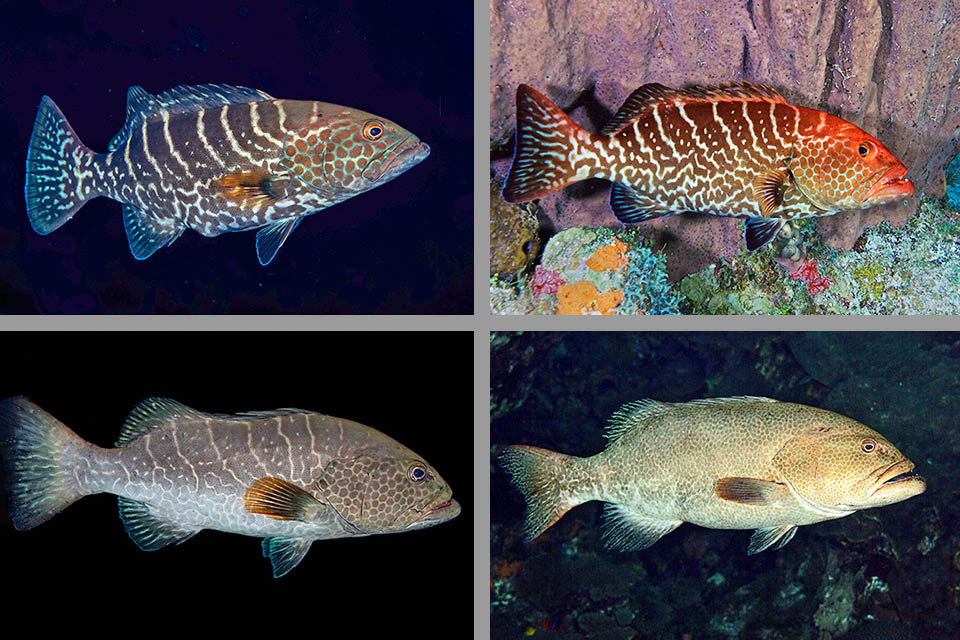
But colour and drawings vary depending on environment and fish mood, up to a beige uniform livery almost stripeless © www.carlosestape.photoshelter.com
Hidden among corals and sponges, preying in ambush, motionless, fishes and crustaceans allowing divers to approach it.
Morphophysiology
Mycteroperca tigris can reach the length of 1 m, with a maximum published weight of 10 kg, even if the current size is of about 40 cm.
The body, with its slightly arched dorsal profile, is robust but long, compressed on the sides and protected by ctenoid scales, rough in the juveniles and smooth in the adults. The dorsal line, continuous, usually counts 82-83 of them.
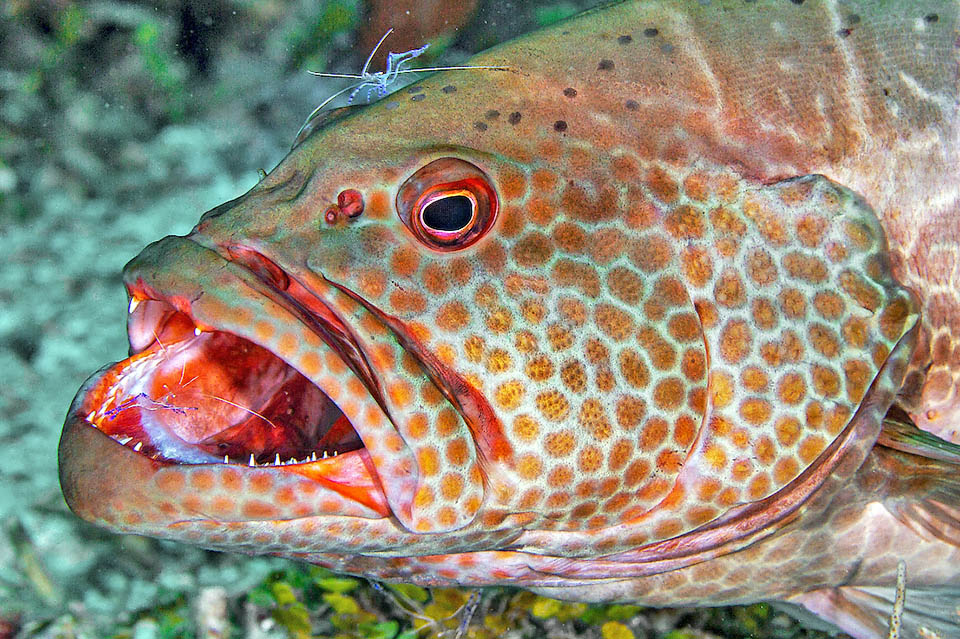
In the cleaning stations head turns red to prompt the intervention, like here with the Pederson’s shrimp (Ancylomenes pedersoni) © www.carlosestape.photoshelter.com
The head, with relatively small eyes, has a protruding lower jaw and a large mouth armed by rows of mobile canines that lean inwards when the capture occurs for holding the prey, then returning to position. These are mostly swallowed whole, or broken in two by the serrated teeth present also on the tongue and on the palate.
The preoperculum, without notches on the top, displays a slight serration in the lower corner.
The dorsal fin, very far back on the head, has 11 spiny rays and 15-17 soft rays; the anal 5 spiny rays and 10-12 unarmed; the pectoral ones, ample and rounded, usually count 17-19 rays; the pelvic, inserted just after the pectoral to grant stability and precision in the movements, are long and thin with one spiny ray and 5 unarmed.
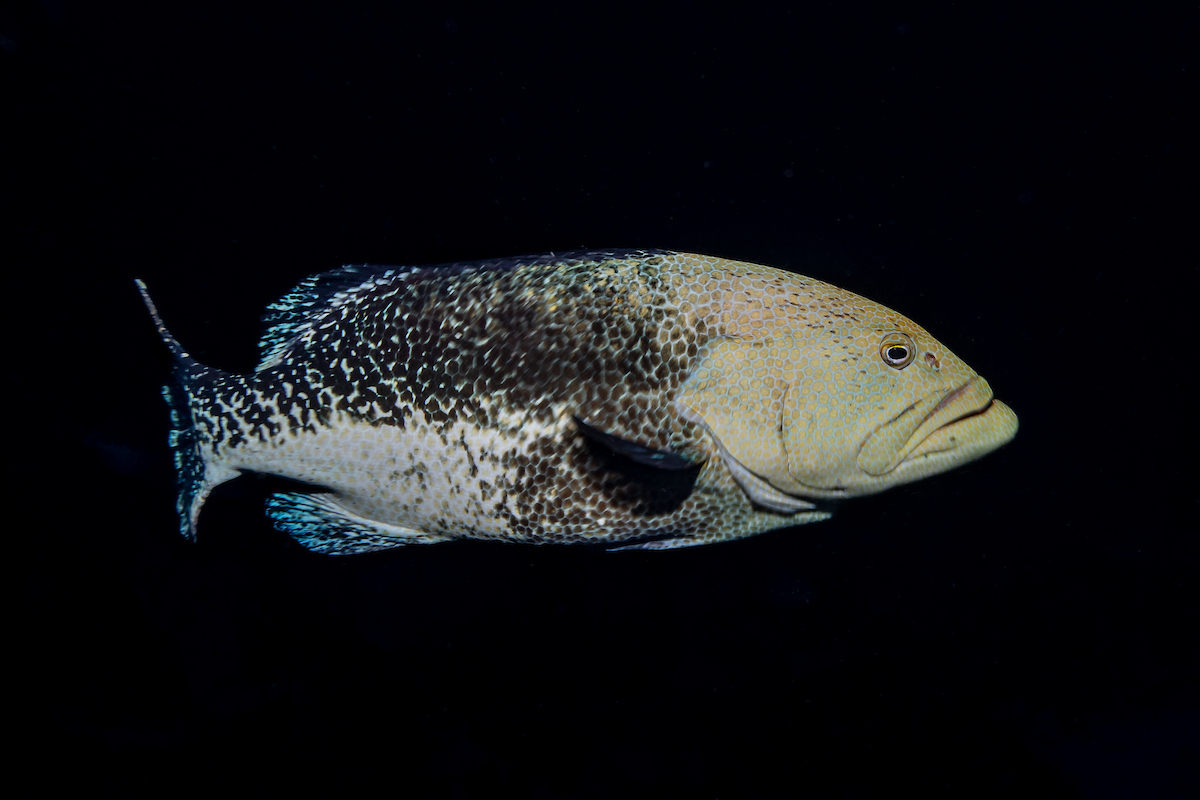
In the reproduction gatherings, as for other groups, the livery breaks with strong white and black contrast zones © www.carlosestape.photoshelter.com
The caudal fin is more or less truncated, as generally happens in the groupers.
The livery of Mycteroperca tigris is extremely variable due to the chromatophores depending on the camouflage needs and the mood of the fish, until it turns in a sort of language: for instance, the body visibly broken into white and black to inform the availability for mating, or the flame-red mouth to prompt interventions at the cleaning stations.
The honeycomb camouflage pattern catches the eye and the previously mentioned 8-11 diagonal parallel stripes on the sides, but the big adults may also display a uniform beige coloured livery, almost without drawings.
Ethology-Reproductive Biology
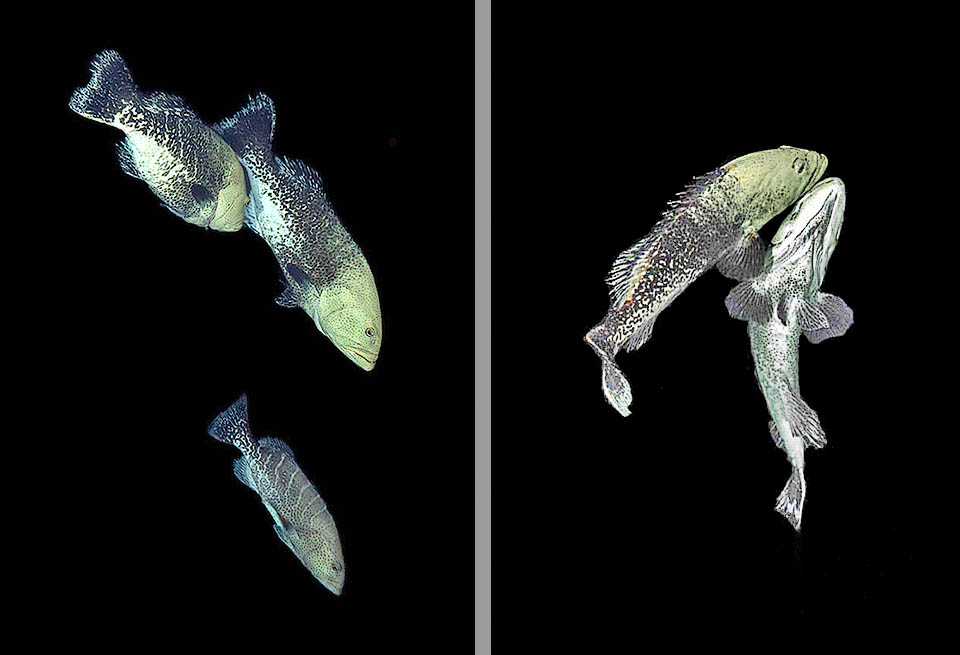
Two males chase a female and mating starts © www.carlosestape.photoshelter.com (left) © Mickey Charteris (right)
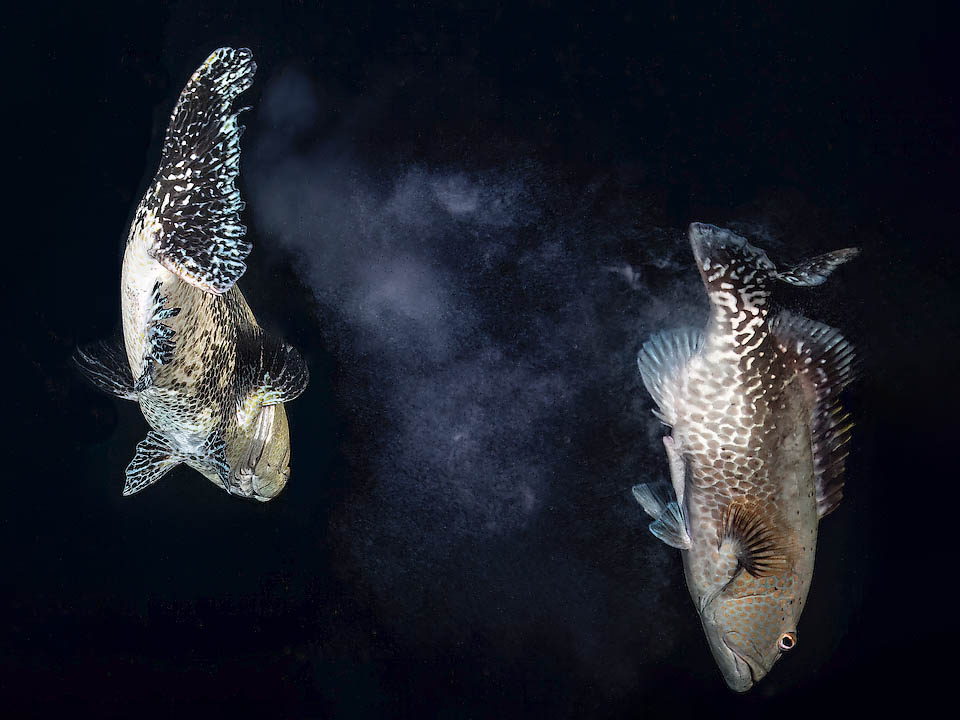
Clouds of gametes are freed and in gatherings males may fecundate about 6 million eggs per night, leaving them to currents like the larvae © www.carlosestape.photoshelter.com
Mycteroperca tigris is a protogynous hermaphroditic species, that is with females who, growing, may transform into males. A study done in Bermuda has in fact has highlighted that all specimens smaller than 37 cm were females, whilst those longer than 45 cm were males.
Like other groupers, Mycteroperca tigris forms reproductive gatherings. These were not the massive gatherings of Epinephelus striatus who travel up to 250 km to meet in known locations, even 30.000 individuals, but modest groupings. Also here the males chase the females in the surface where they may fecundate about 6 million eggs per night.
These are entrusted to the currents, like the planktonic larvae that upon hatching measure 1,4-1,7 mm, and this explains the vast diffusion of the species.
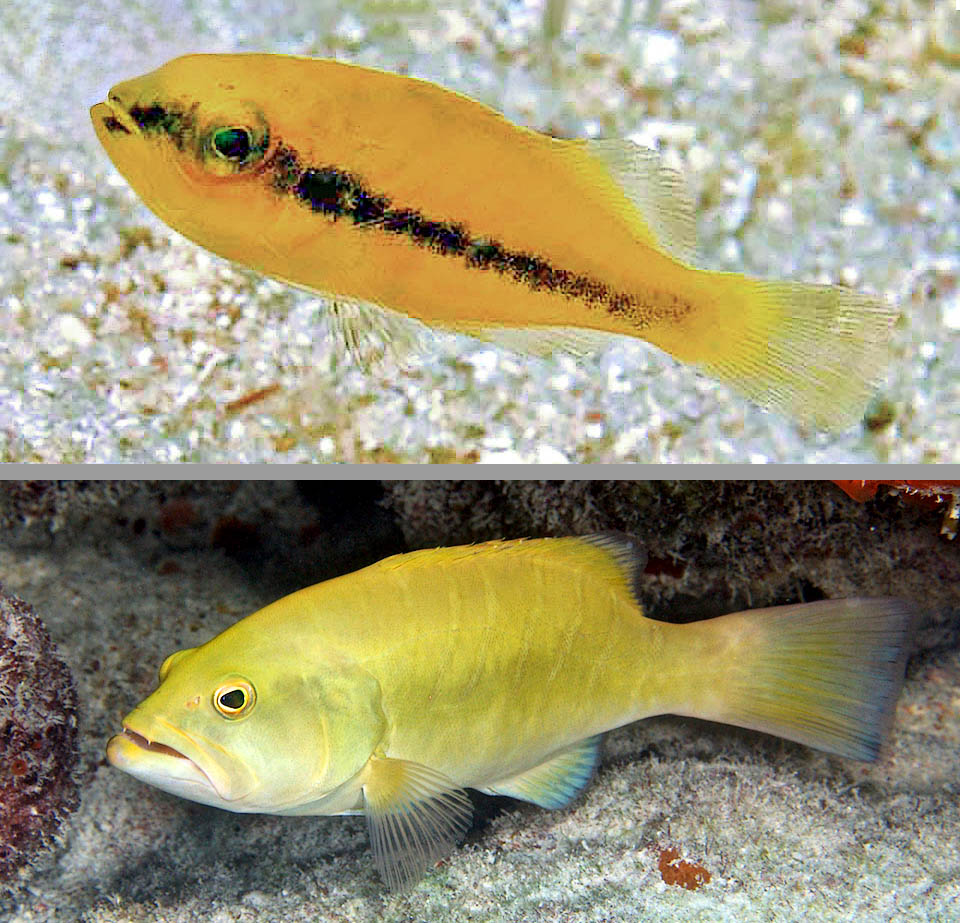
Juveniles are almost wholly yellow. Initially a longitudinal dark stripe on the sides hides the eye reaching the snout © Mickey Charteris (over) © www.carlosestape.photoshelter.com (below)
Juveniles are almost completely yellow, with a dark longitudinal stripe along the sides that starts from the caudal peduncle and hides the eye reaching the snout.
Unluckily the resilience of the Tiger grouper is low, because for doubling the populations are necessary 4,5-14 years, and the fishing vulnerability, high, marks 64 on a scale of 100. There is not enough data for evaluating the trend of the populations and from 2018 Mycteroperca tigris hence appears as “DD Data deficient” in the IUCN Red List of the endangered species.
Synonyms
Serranus tigris Valenciennes, 1833; Serranus camelopardalis Poey, 1860; Serranus felinus Poey, 1860; Serranus repandus Poey, 1860; Trisotropis reticulatus Gill, 1865; Mycteroperca hopkinsi Jordan & Rutter, 1897.
→ For general information about FISH please click here.
→ For general information about BONY FISH please click here
→ For general information about CARTILAGINOUS FISH please click here.
→ To appreciate the BIODIVERSITY of BONY FISH please click here.
→ To appreciate the BIODIVERSITY of CARTILAGINOUS FISH please click here.