
Family : Orchidaceae

Text © Prof. Pietro Pavone

English translation by Mario Beltramini
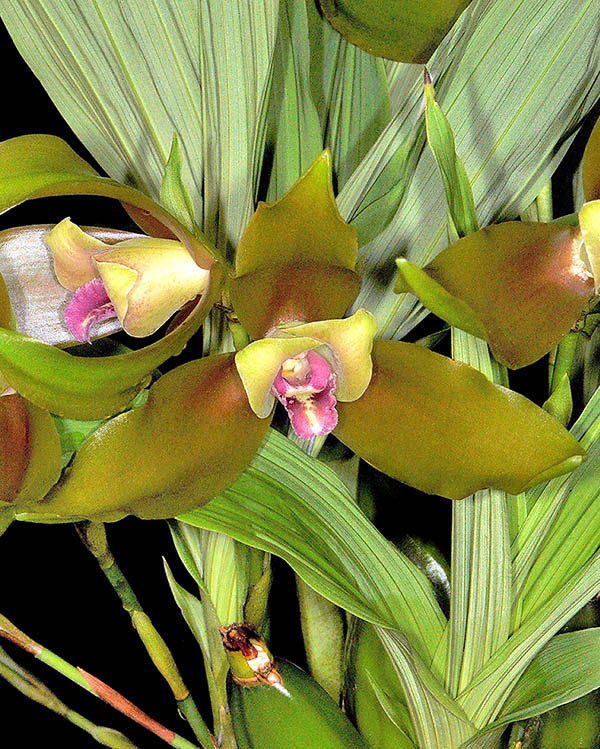
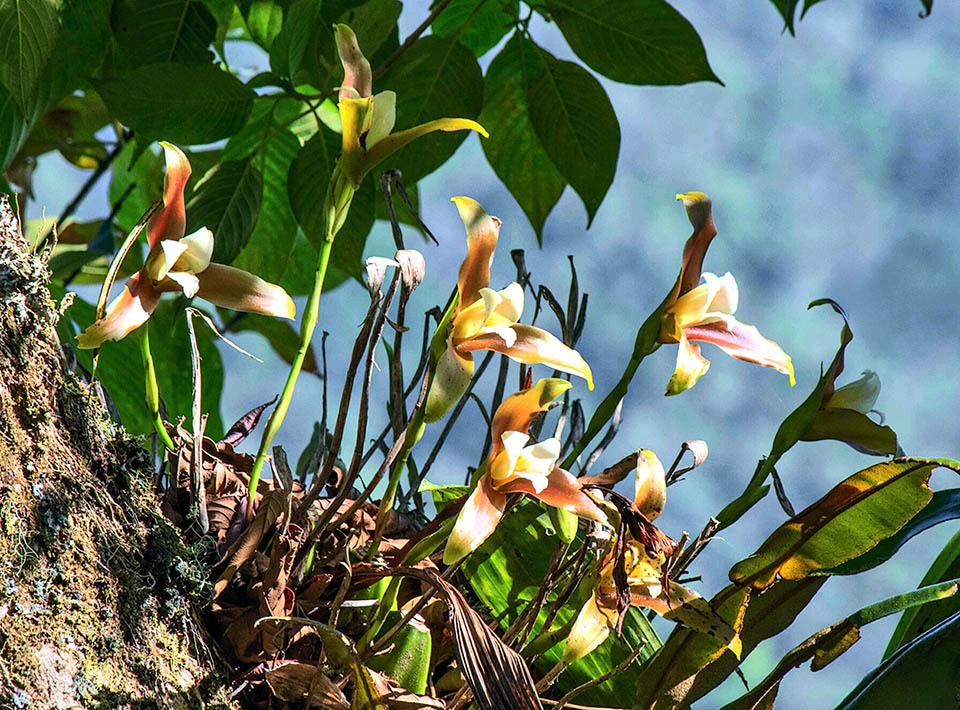
Lycaste schilleriana is found in the rainforests of the humid tropical biome of Panama, Colombia, and Ecuador, at altitudes usually between 1250 and 1800 metres above the sea level © Ron Parsons
Lycaste schilleriana Rchb.f is a species belonging to the family Orchidaceae, subfamily Epidendroideae,
tribe Cymbidieae, subtribe Maxillariinae, section Fimbriatae.
The species has been described by Heinrich Gustav Reichenbach (1824-1889), German botanist and ornithologist, professor of botany and director of the Botanical Garden of Hamburg University. Reichenbach at his time was considered as the world’s highest authority on the plants having identified and described as many as 5396 new species of botanical families from around the world. He is known also for having left his orchids herbarium, with about 70.000 specimens, and all his manuscripts, to the Vienna Natural History Museum (Naturhistorisches Museum) with the clause that nobody could consult them for the next 25 years, probably fearing that the botanists of the Kew Gardens, particularly Robert Allen Rolfe (1855-1921), might consult the “types” on which he had done the botanical descriptions or could steal his notes to get the credit for discoveries he had not been able to publish.
Lycaste is a genus of Central and South America, from Mexico to Brazil that counts about 36 epiphytic, lithophyte or terricolous species, known for their big flowers, waxy and triangular (8-15 cm broad) with various colours: white, pink, yellow, green. They have ovoid pseudobulbs, up to 7 cm large, often with sharp thorns, on whose tips form 2-3 big (40-80 cm) leaves, thin and folded, that normally fall down during the winter. Blooming occurs from late winter to early spring.
Lycaste schilleriana grows in the rainforests of the humid tropical biome, at altitudes between 1.250 and 1.800 metres above the sea level. Its range extends mainly from Panama, Colombia up to Ecuador. In Panama it is mainly found in the province of Chiriquí, in the mountain areas close to Cerro Punta. In Colombia it is found in the departments of Risaralda and of Valle del Cauca. In Ecuador it has been reported mainly in the Amazon rainforest. Recently its range has been extended also to Peru, in various areas of the Andean region, as the specimens identified as Lycaste longisepala C.Schweinf. are nowadays considered as synonyms of Lycaste schilleriana. even if they are less common than the populations present in Colombia.
The name of the genus Lycaste assigned in 1843 by John Lindley (1799-1865), probably comes from the Greek mythology, in fact, Lycaste is one of the Bacchantes or Maenads, women into a state of ecstatic frenzy (from the Greek mainàs, “furious” or “mad”), followers of Dionysus in his expedition to India, to bring the Indians the knowledge of viticulture and of wine, to teach them how to cultivate land. The conquest of India, the most remote and mysterious land known by the ancients, was to obtain a place of honour on Olympus because he was son of Zeus and of a mortal woman, Semele, Princess of Thebes.
The specific epithet is honoured to the Consul Gustav Wilhelm Schiller (1803-1870), important German dealer and orchid collector who gave Reichenbach the specimen he had purchased at an English auction.
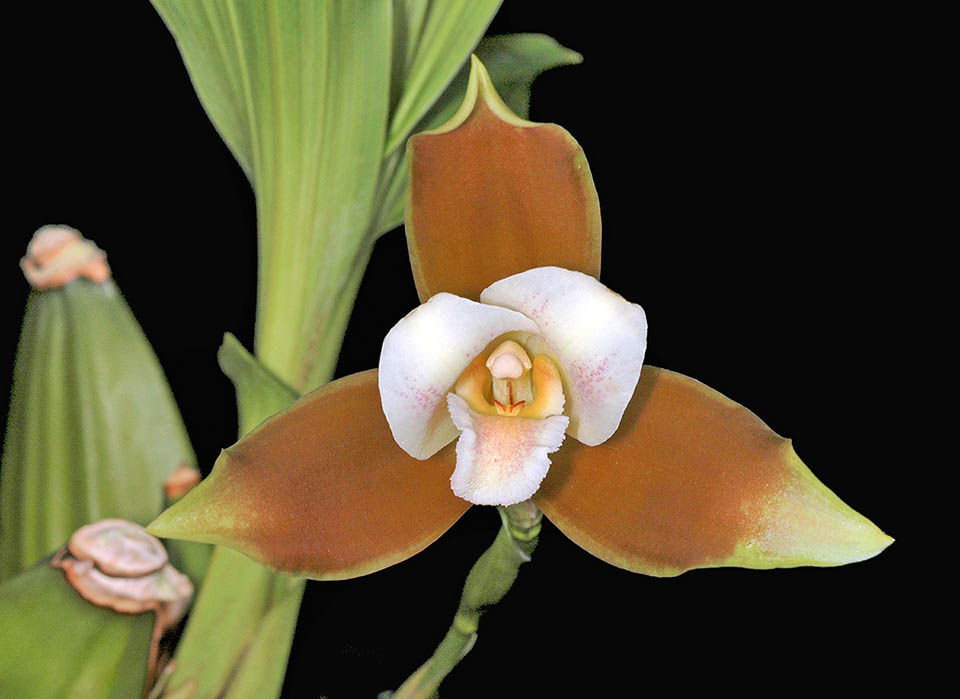
It’s a big epiphyte, lithophyte and terricolous orchid. Flowers have brown-greenish sepals and petals of colour varying from white to cream with pinkish shades © Eric Hunt
Schiller held the function of Consul of Venezuela in Hamburg and this position allowed him to be able to import several rare botanical species from South America. Common name: Schiller’s Lycaste.
Lycaste schilleriana is a big epiphytic, lithophytic and terricolous orchid with largely cylindrical or oblong-ovoid, compressed, up to 7 cm long pseudobulbs, furrowed or wrinkled with age, at the end of which usually carry 2-3 deciduous leaves. The leaves are oblong-elliptic or oblong-lanceolate, sharp or pointed, with folded (plicate) lamina and long petioles.
From the base of the pseudobulb, ripe in spring and summer, gets out an erect inflorescence, subtended by few sheathing bracts, big, loose, tubular. It is up to 30 cm long, with only one single scented flower that may reach a breadth of 12-18 cm. The sepals are obovate, acute, minutely velvety, 8-9 cm long, each olive in colour. The petals are shorter than the sepals, measuring 5-6 cm, usually white-cream or yellowish, at times shaded of pink at the base, partially covering the central column and the labellum giving the flower a cup-like appearance. The labellum is trilobed, erect, 3 or 4 cm long, of white-cream colour, sometimes pink-shaded, with small and erect lateral lobes, and elongated median lobe, semi-ovate, minutely denticulated and facing downwards. In the centre of the labellum is present a “callus”, often of yellow or white colour.
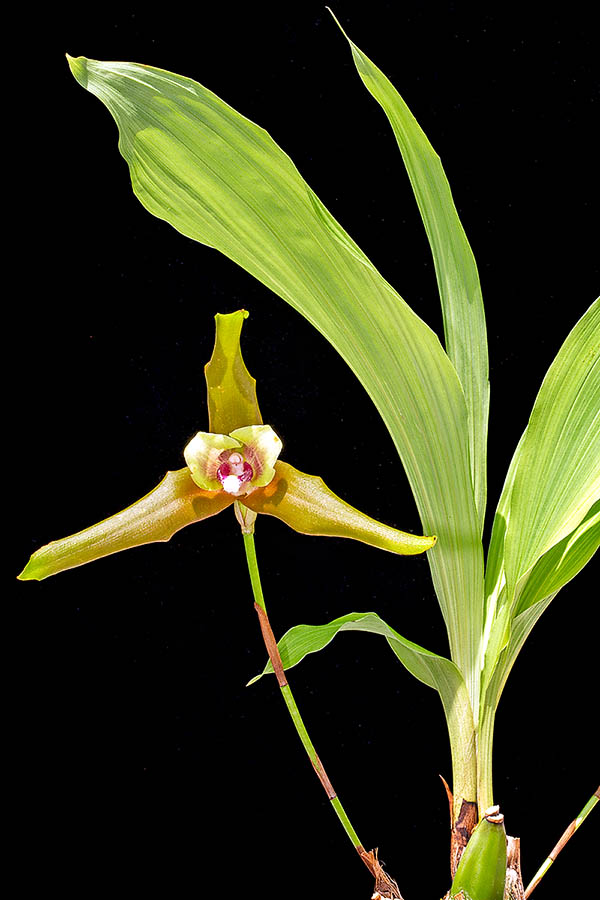
Its ovoid pseudobulbs usually bear 2-3 deciduous, oblong-elliptic or oblong-lanceolate leaves, with folded lamina and erect, up to 30 cm long, inflorescences with only one scented flower © Dr. Giuseppe Mazza
The gynostemium is hairy, white and orange at the base. The surface, minutely hairy, almost velvety, serves to hold the odorous substances and to offer a surface of support and of orientation to the males of the bees of the orchids (tribe Englossini) who are interested in collecting the odorous substances the flower emits, formed by various aromatic compounds. Thanks to their special brushes on the front legs the substances collected are then stored in hollow structures on the rear legs and utilized to condensate pheromones for the courting of the female bees. During the collection of these substances the whole pollinarium, thanks to the viscidium, adheres instantly to the head or between the wings of the bee that unwittingly will bring on the stigma of another flower thus implementing the cross-pollination. After the fecundation, the ovary transforms in an initially green and fleshy capsule inside which many microscopic powdery seeds do ripe. When the capsule becomes brown and dry, it opens, through longitudinal slits, freeing the seeds that will be dispersed by the wind.
Since the seeds have no nutritional reserves (endosperm), to germinate they need to enter into symbiosis with mycorrhizal fungi.
A recent cariological study has reported for Lycaste schilleriana 2n = 40 (the typical diploid number of the genus) and 2n = 48, the two different numbers indicate a phenomenon linked to the evolution of the genome for diploidy (increase or decrease of the number of chromosomes without the duplication of the whole cariological structure). The increase of the size of the genome may be considered as an evolutionary success and the individuals who have done it are able to colonize new ecological niches increasing its range and possibly originate new species.
In nature various hybrids of Lycaste schilleriana do exist. Lycaste × niesseniae Oakeley is a hybrid officially registered and recognized in the lists of the Royal Horticultural Society (RHS). It is obtained in nature by crossing between Lycaste occulta × Lycaste schilleriana. It is an epiphyte mainly growing in the humid tropical biome at about 1400 m of altitude, in the meadows and on the grassy embankments of south-western Colombia.
In the horticultural field has been identified the variety Lycaste × niesseniae var. rosea characterized by the intense pink coloured labellum, however it is not recognized being considered a synonym of Lycaste × niesseniae. The hybrid Lycaste schilleriana × Lycaste skinneri (the latter presently called Lycaste virginalis Linden) combines two species known for big, waxy and long lasting flowers, with a blooming usually occurring between late autumn and spring. This union produces an orchid with fleshy pseudobulbs and longer leaves. It presents pale green sepals with several pink spots and white petals and labellum with small pink spots. The flowers bloom at the base of the ripe pseudobulbs, usually from November to April. This hybrid does not have an “accepted” name but is appreciated for the quality of the flowers and the robustness of its plants in line with the characteristics of its parents. Moreover it may be grown in the warmest climates, up to 30 °C in summer.
The cross between Lycaste schilleriana × Lycaste xanthocheila produces a hybrid characterized by flowers with pink sepals and red petals. There are also several cultivars such as Lycaste schilleriana ‘Pincelada’ having erect 20 cm long inflorescences with one single flower of brown colour with yellow-tinged petals and pink labellum. The blooming lasts many months with a peak from March to May in the northern hemisphere.
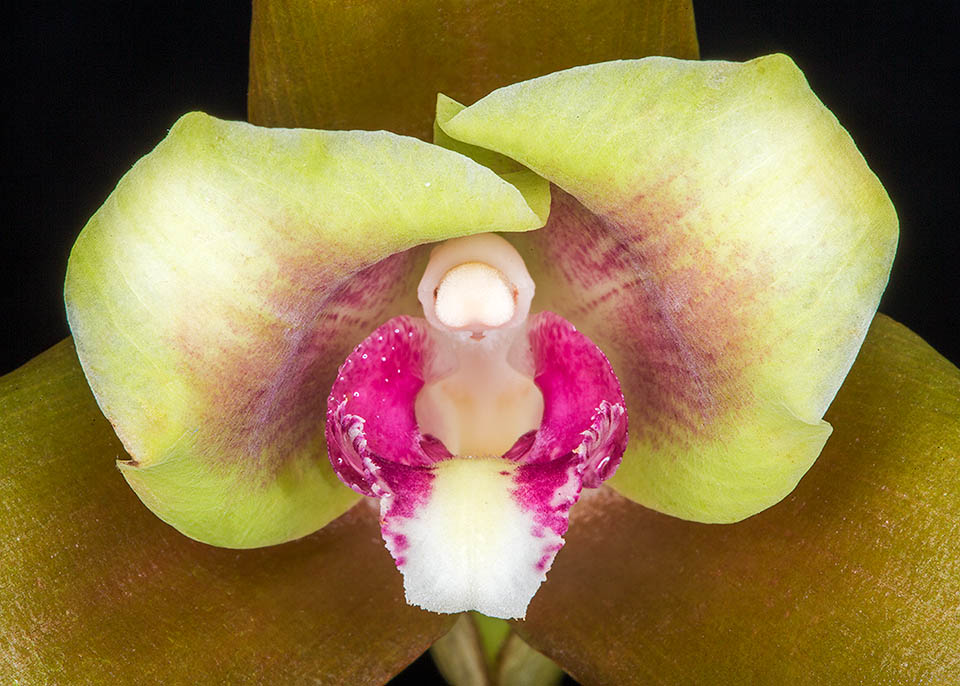
Lycaste schilleriana var. rosea has flowers with olive sepals and yellowish petals with intense pink labellum © Dr. Giuseppe Mazza
Recently the Royal Horticultural Society (RHS) has assigned the Award of Merit (AM) to the cultivar Lycaste schilleriana ‘Rosea’ (2024) of the international nursery Andy’s Orchids of Encinitas (California). Other cultivars have been awarded by Deutsche Orchideen-Gesellschaft like Lycaste schilleriana ‘Franz’ (2017) and Lycaste schilleriana ‘Boldi’ (2017).
The American Orchid Society has awarded: Lycaste schilleriana ‘Huntington’s Copper Schilling’ (2016); Lycaste schilleriana ‘Granny Smith’ (2011); Lycaste schilleriana ‘Hot Spots’ (2010); Lycaste schilleriana ‘Apaulo’ (2010); Lycaste schilleriana ‘San Isidro’ (2009); Lycaste schilleriana ‘Doug’s GIant’ (2008); Lycaste schilleriana ‘Max’ (2007); Lycaste schilleriana ‘Woodstream’ (2005); Lycaste schilleriana ‘Ann’ (2004); Lycaste schilleriana ‘Sunset Giant’ (2004); Lycaste schilleriana ‘Our Tropics Daiquiri’ (1997 and 2002); Lycaste schilleriana ‘Meadow’ (1964).
Lycaste schilleriana is a species present in the CITES Appendix II that regulates international trade in order to prevent the overexploitation of wild specimens. It is a very sought-after orchi by the collectors due to its aesthetic value, in particular for the waxy flowers, very fragrant, large flowers, that may erach 12-18 cm.
In cultivation this plant requires a bright exposition but not direct light and a cool and humid environment, with a drier resting period in winter.
Lycaste x niesseniae is a natural hybrid of Lycaste occulta x Lycaste schilleriana. Flowers have petals and sepals with shades going from green-yellowish to pale brown. In cultivation this hybrid requires day temperatures from 20 °C and 30 °C and night ones from 13 °C and 16 °C. The thermal shock is essential for blooming © Julian Alzate
The substratum must be draining that can be placed inside capacious pots or baskets with a good air movement to prevent diseases. It is suggested a substratum formed per 70% of fragments of maritime pine bark, with a granulometry between 10 and 18 mm, and 30% of pumice. Waterings must be abundant during the growth period (from March to October), reduced to a minimum during the winter rest, without allowing the substratum to dry up completely. Temperature should be standing between 15 °C and 18 °C the night and 20 °C and 25 °C the day. Some hybrids also adapt to summer temperatures of 30 °C. Humidity must stand between 50% and 70%. It is good to administer a ternary fertilizer Nitrogen (N), Phosphorus (P), and Potassium (P) in the measure of NPK 30-10-10 during the vegetative recovery in spring. Whilst during the blooming time it is good to increase the phosphorus (NPK 10-30-20). In the other periods it is better to balance all three elements (NPK 20-20-20).
For the multiplication we proceed to the division, leaving at least three pseudobulbs per portion. The cuts must be disinfected by sprinkling cinnamon powder due to its fungicidal and antibacterial properties, but must be avoided to spread it on the healthy roots. Can be used also baking soda to hinder the proliferation of fungi and bacteria after the cuts. Repotting must be done not immediately but the day after.
Synonyms: Lycaste hennisiana Kraenzl. (1906); Lycaste longisepala C.Schweinf. (1952); Lycaste schilleriana var. alba Oakeley (2008); Lycaste schilleriana var. lehmannii Regel (1890); Lycaste schilleriana var. rosea Oakeley (2008).