
Family : Orchidaceae

Text © Prof. Pietro Pavone

English translation by Mario Beltramini
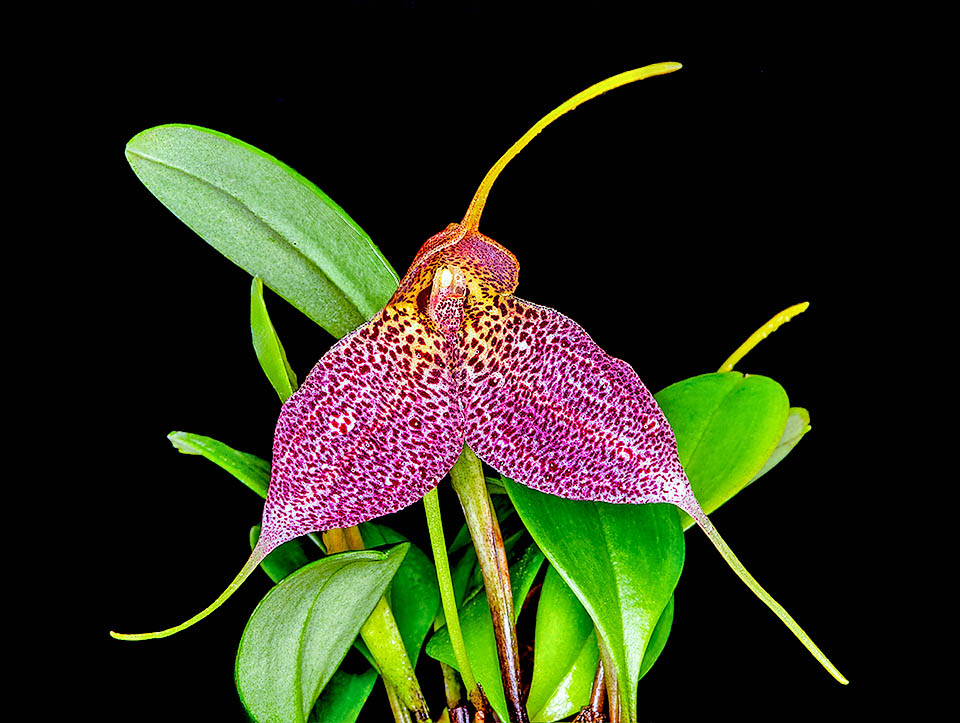
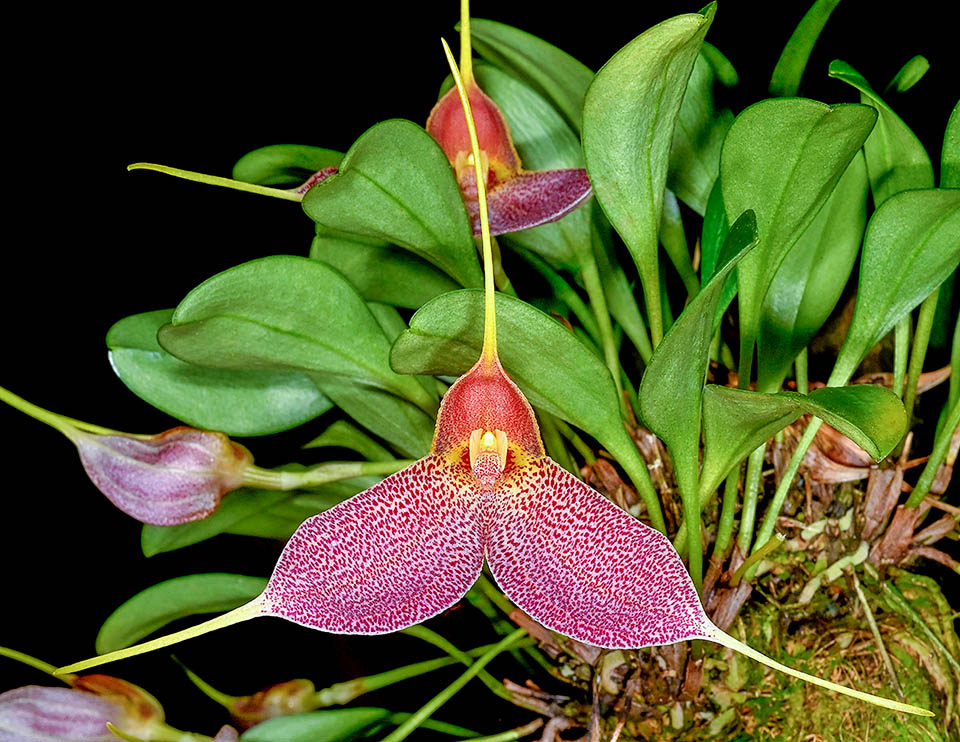
Masdevallia decumana is an epiphyte endemic to south-east Ecuador and north-east Peru whee grows in cloud forests, at altitudes from 1.000 to 2.500 m © Dr. Giuseppe Mazza
Masdevallia decumana Koniger belongs to the family Orchidaceae, to the subfamily Epidendroideae, to the tribe Epidendreae, to the subtribe Pleurothallidinae, to the subgenus Masdevallia, section Masdevallia, subsection Caudatae.
Masdevallia decumana has been discovered by Dennis DAlessandro and Joe Portilla on November 11th, 1980 at an altitude of 2.100 emtres in Ecuador, in the province of Zamora-Chinchipe. The scientific description has been published in the magazine Die Orchidee, Hamburg-Othmarschen & Hamburg (Orchidee 33: 101, 1982) by Willibald Königer (1934-2022) who, together with his wife, Helga, has been travelling for decades from Germany to Andes, moving from Ecuador and Peru in often difficult conditions to collect alive specimens and exsiccata intended for nurseries and important international herbaria.
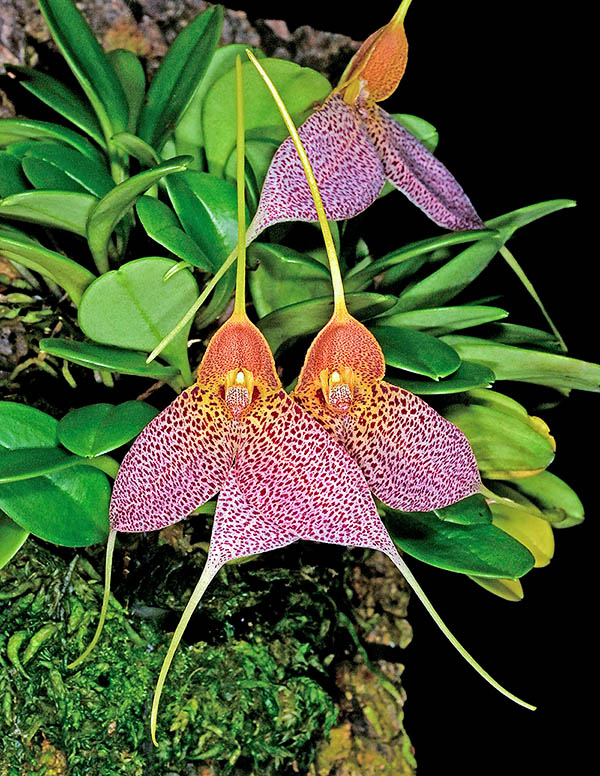
Is just 5 cm tall, but has spectacular dotted flowers © Ron Parsons
Helga Königer has also been a skilled farmer of difficult species coming from the cloud forests that, without her cares, would have never been flourishing in Europe.
In fact, the first flowering of this species did occur in the private collection of the Königers’ in Münich on September 7th, 1981, allowing Königer to describe it correctly. As a sign of esteem for his tireless work, in 1997, her husband and the Ecuadorian botanist José Portilla dedicated her the Masdevallia helgae: a small orchid of the eastern slopes of the Andes, found by Portilla at about 1.000 metres of altitude in the province of Morona-Santiago.
Masdevallia decumana is an epiphyte typical of the cloud forests, in altitudes between 1.000 and 2.500 metres, and is mainly found along the eastern slopes of the Andes in south-eastern Ecuador (provinces of Zamora-Chinchipe and Loja) and in north-eastern Peru (regions of Cajamanca and Amazonas).
The name of the genus Masdevallia pays homage to Josep Masdevall Terrades, famous Spanish physician and botanist, prominent figure of the public health of the second half of the XVIII century. The epithet decumana (from the Latin decumanus, “big”) refers to the extraordinarily large flowers compared to the size of the plant.
The common name is Large Flowered Masdevallia.
This species is a plant with bushy posture with short creeping rhizomes. The tufts are small, without pseudobulbs, a distinctive feature of the genus.
It reaches a height of about 5 cm, and consequently is considered a “mini-miniature” orchid because it occupies very little space in a greenhouse or in an orchidarium, but forms spectacular flowers standing among the biggest of the whole genus Masdevallia.
It displays small secondary stems (ramicauls), thin, erect and blackish, usually less than 1 cm long and wrapped at the base by 2 to 3 tubular sheaths. Each ramicaul bears one single apical leaf, erect and coriaceous, with elliptic lamina, obtuse or rounded apex, and cuneate base in a short petiole. The ramicauls grow densely along the rhizome, conferring the plant a compact appearance. The inflorescence develops at the base of the ramicaul and is composed by a thin scape, at times hanging, 5-6 cm long. The single flower, supported by the scape, may reach the height of the leaf.
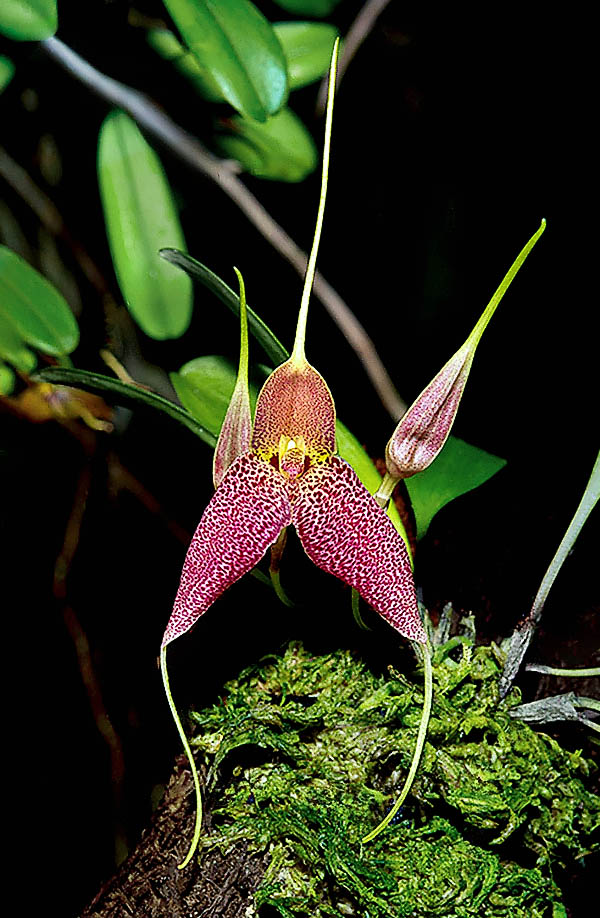
The dorsal sepal is hood-shaped, while the lateral sepals are spread apart and fused at the base to form a tube. The apices of the three sepals are contracted into elongated segments called tails © Eerika Schulz
The flowers are large, with a diameter of 4-6 cm. The dorsal sepal, slightly shorter, has the shape of a hood, whilst the lateral sepals are widely spaced and merged at the base forming a tubular structure.
The apexes of the three sepals are contracted in elongated segments called tails. The typical colouration is yellow-green with brown and lilac spots with purple flecks. The petals, almost invisible at the centre of the tube, measure about 2,5-3 mm, are white-greenish and display an external thickening. The lebellum, white or yellowish with light purple dots, is slightly bigger than the petals (4-5 mm), ligulate and flexible because articulated on the column. The latter is short, equipped with an anther with winged hood and a base extending in a foot thickened at the apex of the ovary.
The flowering occurs mainly in the winter months, but may continue the whole year, with single flowers lasting 1-2 weeks. The pollination is entrusted to small diptera (fruit flies of the family Drosophilidae), attracted by visual and olfactory signals towards the chamber between the labellum and the column. Under the weight of the insect, the mobile labellum bends, pushing it against the pollinarium that adheres to the head or to the back of the insect by means of the sticky viscidium. Visiting another flower, the insect lays the pollen on the stigma thus guaranteeing the fecundation and the genetic variability. The fecundated ovary enlarged forming a green capsule that, ripening in 2-4 months, becomes brown, cracks and freels tiny pulverulent seeds dispersed by the wind.
Masdevallia decumana, like the other species of the genus, is protected by the Appendix II of CITES that regulates international trade in order to prevent its over exploitation. In fact, all the genus is particularly vulnerable due to the destruction of the habitat, the climate change and the unlawful collection for collecting purposes. With the inscription in CITES the international trade of wild specimens is allowed only if accompanied by export permissions, aimed to ensure the survival of the species in nature.
Several hybrids of this species do exist.
Masdevallia Andean Peach is a primary hybrid obtained from the cross between Masdevallia hirtzii and
Masdevallia decumana. It was registered on Oct. 30th, 2023 by Ecuagenera at the Royal Horticultural Society (RHS). It has tubular flowers, for the sepals merged at the base, of warm and delicate hues varying from yellow-orange to peach orange colour.
Masdevallia Marquise, hybrid registered in RHS on March 2nd, 2012 by Patrick Nicolas of the Firm Patrick Buguel that has its headquarters in Brittany (France). The flowers display a quite beautiful colour going from intense orange to red-orange, at times with purple iridescence.
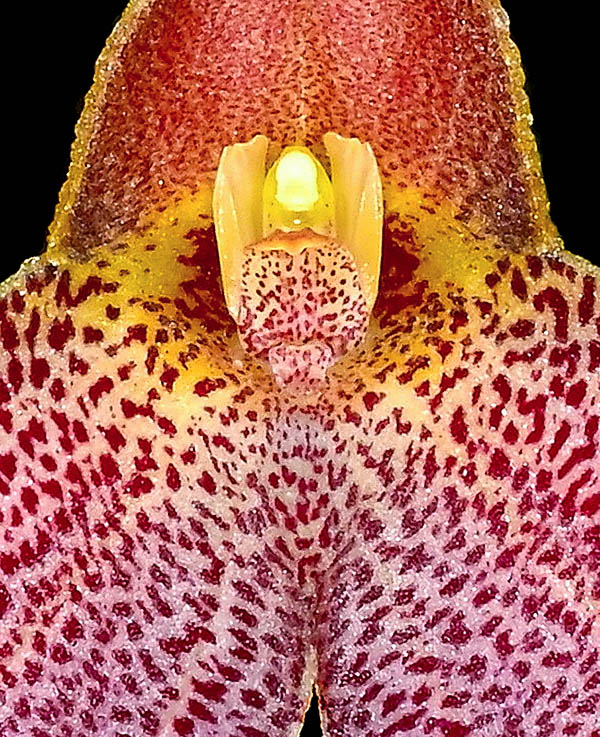
Sepals, almost invisible in the tube centre, measure ca. 2,5-3 mm, are white-greenish and have an outer thickness. Labellum is clear with purplish dots and tied to column that renders it mobile © Ron Parsons
Masdevallia Panama Stripes was obtained by cross between Masdevallia yungasensis and Masdevallia decumana registered on March 3rd, 2000 at RHS by Maduro’s Tropical flowers with main headquarters and nurseries in Panama. The flower white or pale cream with purple or violet longitudinal stripes.
Masdevallia Pixie Dust is a cross between Masdevallia uniflora and Masdevallia decumana, registered on November 22nd, 1991 at RHS by J & L Orchids, nursery of Easton (Connecticut) specialized in mini orchids. This hybrid has the flowers of a nice pink-magenta colour with darker spots and veins.
Masdevallia Tanja is another hybrid obtained by Egon Dreise by crossing Masdevallia.mendozae with Masdevallia decumana, registered on June 13th, 1991 at RHS. Egon Dreise is a well known hybridizer famous for having tried to combine the beauty of the flowers of the botanical species with a greater ease of cultivation. This hybrid presents flowers with lively colours from intense orange to gold yellow, often with darker veins.
Also several selected varieties (cultivars or clones) do exist.
Among those more recently awarded, we mention: Masdevallia decumana ‘Donauperle’ that has received 3 awards, from 2009 to 2015, by the Deutsche Orchideen-Gesellschaft (DOG); Masdevallia decumana ‘Nancy’ with 3 awards from 2011 to 2012 assigned by the American Orchid Society (AOS); Masdevallia decumana ‘Regina’ with 2 prizes given in 2015 by the DOG; Masdevallia decumana ‘Widderchen’ awarded in 2918 by the DOG; Masdevallia decumana ‘Huntington’s Starling’ awarded in 2016 by the AOS.
Masdevallia decumana is a species appreciated by the collectors looking for Andean miniature orchids.
In cultivation it loves the cold or temperate climates. The temperature must fluctuate with minimum night ones of 10-15 °C and maximum daytime of 15-22 °C, avoiding summer temperatures exceeding the 25 °C to prevent stress or fall of the buds. The plant requires diffused light and is to be avoided direct sun, which can quickly burn out the leaves.
The humidity must be maintained at 70% the day and 90% the night and morning, in order to replicate the foggy environment.
Pollination is carried out by tiny diptera of the family Drosophilidae, attracted by the visual and olfactory signals of the flower. When the insect lands on the labellum, it bends, pushing insect against pollinarium, which sticks to it thanks to the viscidium, to be then carried to another flower, thus ensuring cross-pollination © Ron Parsons
Waterings must be frequent with rainwater, distilled or by reverse osmosis, 4-5 times a week to maintain the substratum uniformly humid. To avoid rot it is good to get a good movement of air and to wait for a light drying up between the waterings.
Due to the reduced dimensions and the thin roots, it may be cultivated in small plastic or earthenware pots utilizing sphagnum with long fibre together with a mix of fine bark (3-6 mm) and perlite to guarantee an optimal drainage. It is essential that the base of the plant leans on the substratum and never be buried, because the ramicauls rot easily if immersed in the wet moss. Alternatively, it can be mounted on a cork or tree fern raft with a thin layer of sphagnum, a method that favours better ventilation and a faster drying up.
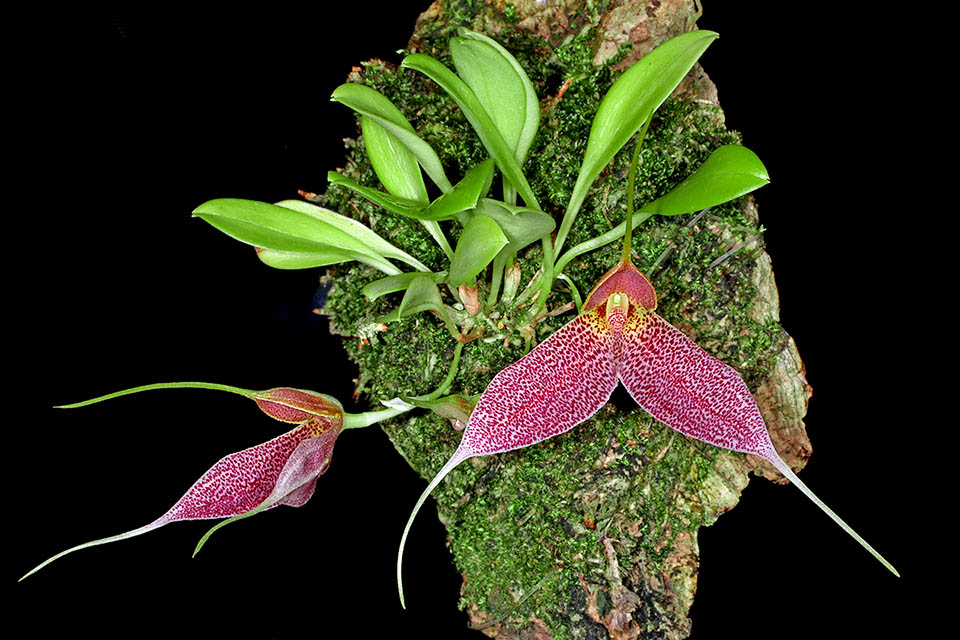
Masdevallia decumana is a species highly appreciated by the collectors who seek Andean miniature orchids. In cultivation, it prefers cold or temperate climates with high humidity and requires gently diffused light. It can be kept in small containers or mounted, as shown here, for rapid drying, on cork rafts with a thin layer of sphagnum moss © John Varigos
During the vegetative phase is suggested a fertilizer balanced for orchids, urea-free and highly diluted (1/4 of the suggested dosage) every 2-3 weeks. Periodically, it is good to rinse the substratum with pure water to avoid the mineral salts accumulation that would render the roots dark and soft.
Repotting must be done every 1-2 years, preferably in spring or autumn when the temperatures are cool (15-20 °C) and the new roots appear. If the plant has less than 15-20 leaves, it is to be totally repotted; if it has more, it can be divided ensuring that each section has at least 5-10 healthy leaves. The rhizome is to be cut with disinfected tools, treating the cut with a pinch of cinnamon as a natural fungicide.