
Family : Priacanthidae

Text © Dr. Giuseppe Mazza

English translation by Mario Beltramini
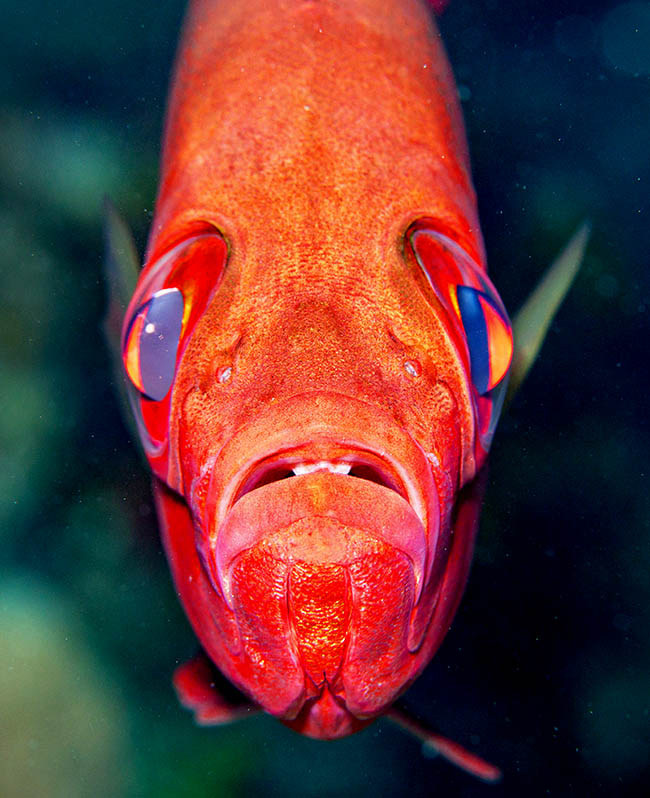
Due to its big eyeballs and a tapetum lucidum retina increasing the visual sensitivity in darkness, Priacanthus arenatus is a reef fish specialized in twilight and night activity to hunt prey © www.carlosestape.photoshelter
The unusual Atlantic bigeye (Priacanthus arenatus Cuvier, 1829) belongs to the class Actinopterygii, the ray-finned fish, to the order of the Perciformes, and, after some taxonomists, of the Acanthuriformes, and to the family of the Priacanthidae counting 4 genera and about twenty species.
The term Priacanthus, created by Oken in 1817 observing the characteristic serrated preopercular spine of Priacanthus macrophthalmus, nowadays synonym of Priacanthus hamrur, originates from the Greek “πρίων” (príōn), saw, and from “ἄκανθα” (ákantha), spine, sting.
The species arenatus, not explained by the author, should be instead probably referred, more than to a sandy environment, to the look of the specimen conserved in alcohol, that is described as “irregularly covered with small black dots”.
Zoogeography
Priacanthus arenatus is present in the northern Atlantic, from Canada, Bermuda, Florida, Bahamas, Gulf of Mexico and Caribbean Sea up to the Brazilian coasts with reports even in northern Argentina.
Carried by the North Equatorial Current, the larvae have colonized also the other side of the Atlantic and we then find it from Madeira to Namibia.
Ecology-Habitat
Priacanthus arenatus lives between 10 and 587 metres of depth in waters having temperatures of 16,7 to 27,8 °C.
It is a demersal species that may form during the day small schools but mainly rests sheltered in grottoes, deep wrecks, rocky pinnacles and ravines.
It goes out hunting in the evening, to explore individually the reef looking for benthic small fishes, squids, pelagic shrimps and small crabs it sucks in with its protractile mouth.
Morphophysiology
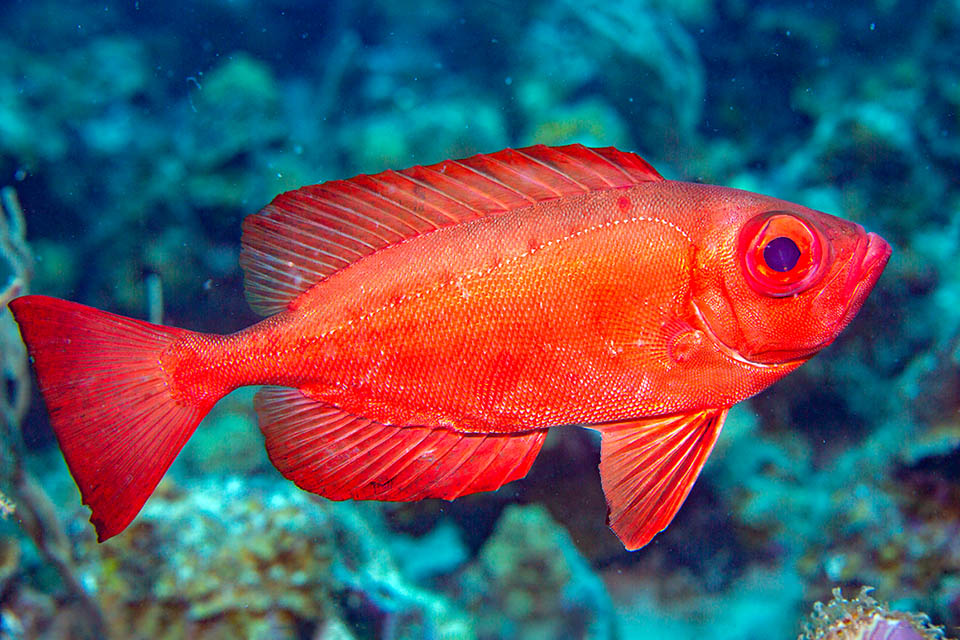
Even 50 cm long, it may reach 587 m of depth where the showy livery gets unnoticed as the red colour is absorbed by the water and the fish appears black or greyish © www.carlosestape.photoshelter
Priacanthus arenatus can reach 50 cm with a weight of 2,9 kg, but the current size is about 35 cm. The body, oval and laterally compressed, is protected by big ctenoid scales.
The large eyes, prominent, with very ample and silver iris pupil, have the retina equipped with a “tapetum lucidum” that increases remarkably the visual sensitivity during the night hours, and the showy flaming livery actually goes unnoticed because in the depth the red is the first colour to be absorbed by the water and consequently the fish appears black or dark grey.
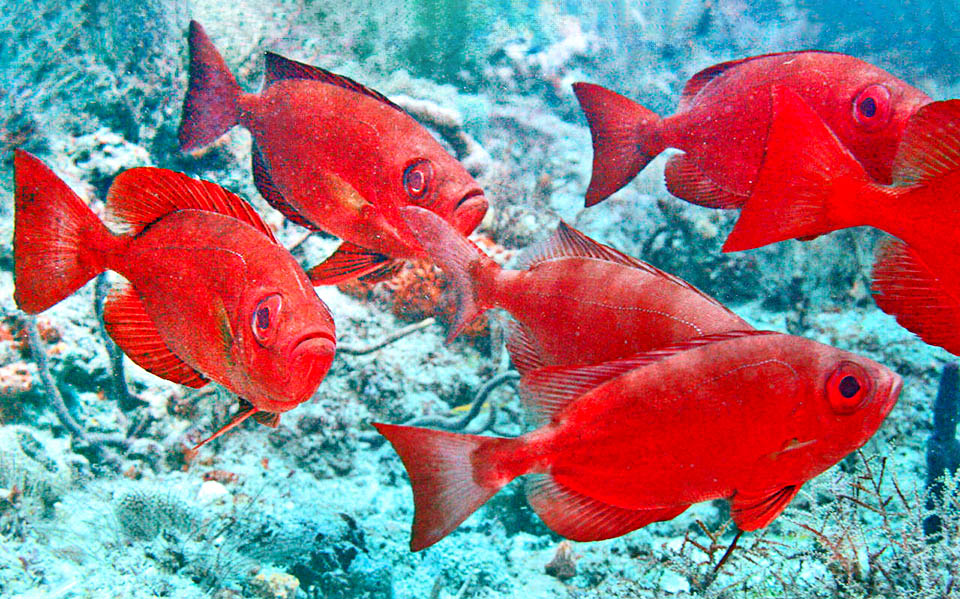
Can be seen in small schools during the day, but spends most of the daylight hours sheltered in grottoes and ravines, and gets out only after dark to hunt alone at night © Kevin Bryant
Moreover, acting on the chromatophores, can quickly lighten or darken the livery highlighting a black dotting along the lateral line or vertical red mimetic patches.
As in other Priacanthidae, this species specialized in the thilight and nocturnal activity can finally emit sounds produced by the swim bladder, probably used for communicating in total darkness.
The dorsal fin, which elongates towards the tail, has 10 spiny rays and 13-15 soft; the anal 3 spiny rays and 14-16 unarmed.
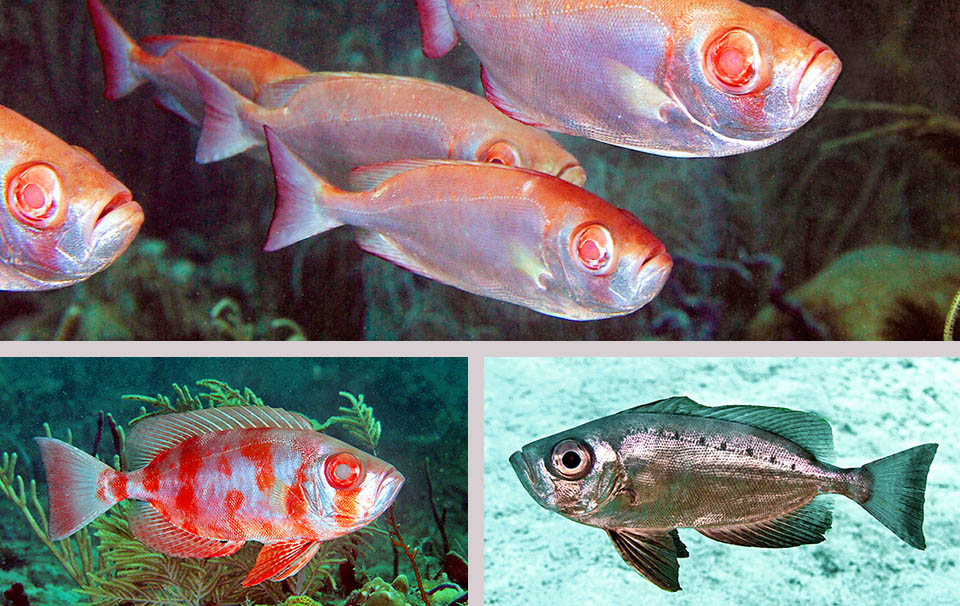
To surprise prey or for defense, it can act on the chromatophores lightening or darkening the livery with camouflage vertical red patches and black dottings © www.carlosestape.photoshelter
The pectoral fins have 18-19 rays and the pelvic ones, of moderate length, are strictly adherent to the belly. The caudal is weakly forked.
Ethology-Reproductive Biology
Priacanthus arenatus is an opportunist predator in turn preyed upon by bigger species: groupers like Epinephelus striatus, Lutjanidae like Lutjanus apodus, barracudas (Sphyraena barracuda) and coastal sharks.
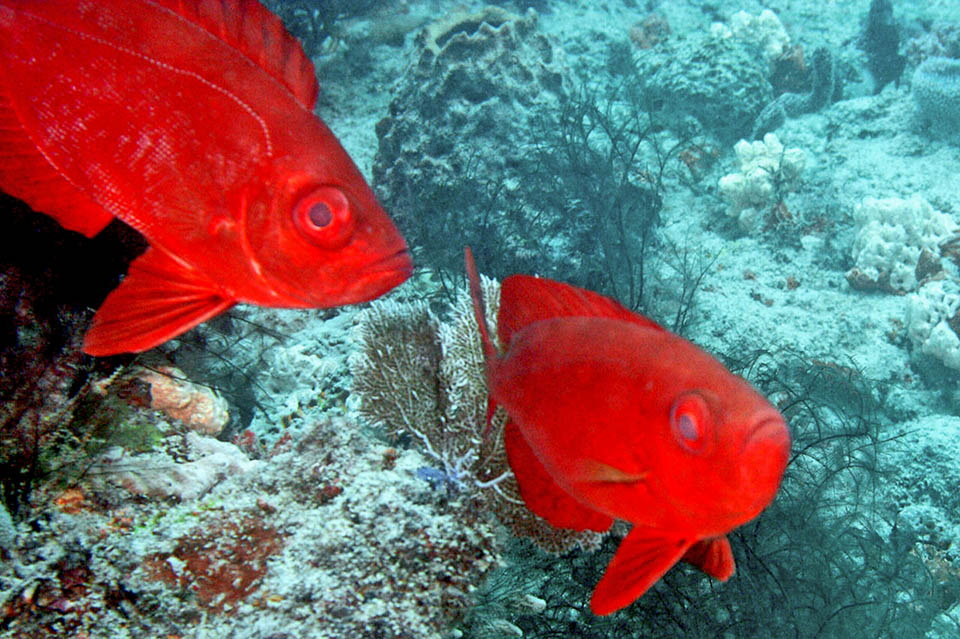
To reproduce, couples rise in the water column, where they free floating fecundated eggs they entrust to the currents © Kevin Bryant
The juveniles often appear in the moray eels menus.
Like most Priacanthidae the fecundation is external. For reproduction the couples rise through the water column entrusting the floating eggs to the currents. The larvae, pelagic too, hold relatively big eyes and long cephalic and preopercular spines that deter predators.
The resilience of the species is high, with a minimum doubling time of the populations less than 15 months.
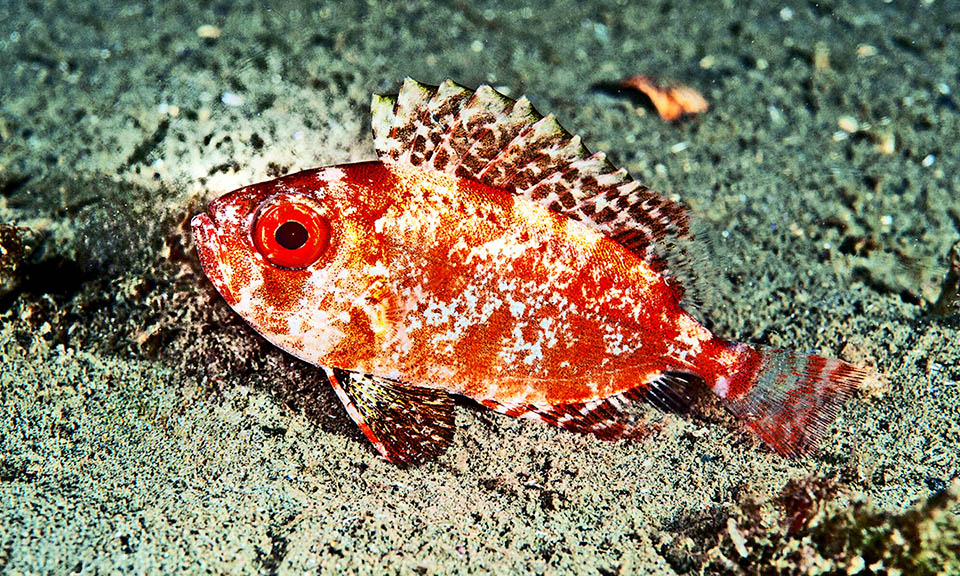
A juvenile. Native to the western Atlantic, Priacanthus arenatus has also colonized the eastern Atlantic, with larvae carried across the ocean by the North Equatorial Current © Asli Ertekin
The flesh of Priacanthus arenatus is tasty and sought-after, even if it may carry a risk of ciguatera when the species feeds on fishes that have stored over time the toxin produced by the dinoflagellate Gambierdiscus toxicus. The fishing vulnerability however keps low, marking only 25 on a scale of 100. The populations seem stable, the range is very vast and from 2013 Priacanthus arenatus appears as “LC, Least Concern” in the IUCN Red List of the endangered species.
Synonyms
Priacanthus insularum Johnson, 1862; Priacanthus catalufa Poey, 1863.
→ For general information about FISH please click here.
→ For general information about BONY FISH please click here
→ For general information about CARTILAGINOUS FISH please click here.
→ To appreciate the BIODIVERSITY of BONY FISH please click here.
→ To appreciate the BIODIVERSITY of CARTILAGINOUS FISH please click here.