
Family : Serranidae

Text © Dr. Giuseppe Mazza

English translation by Mario Beltramini
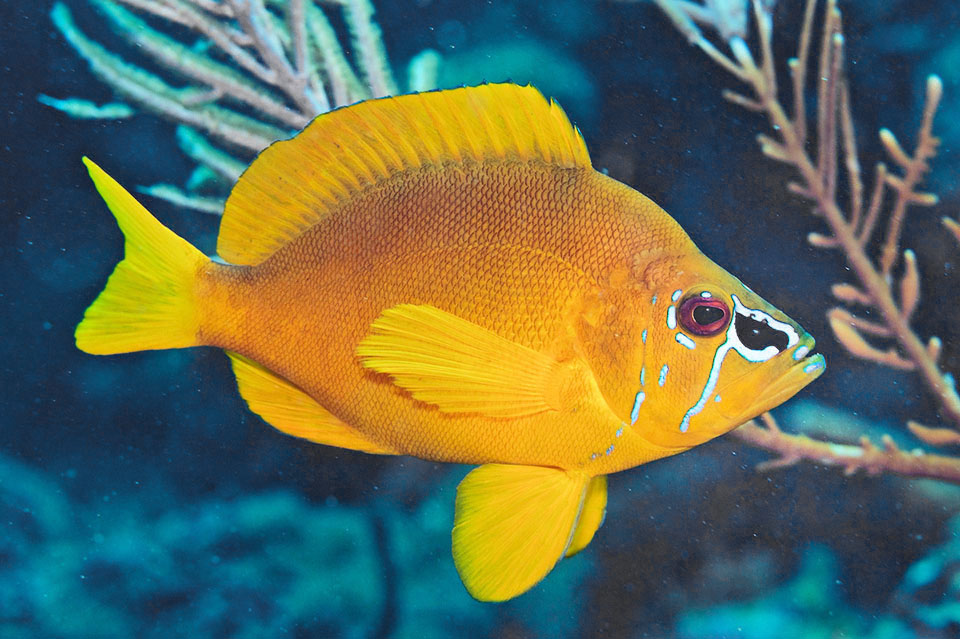
Two eyes per side? No, one is fake. Could confuse predators, that in many fishes instead expect the typical false eye near the tail © www.carlosestape.photoshelter
The “fake eyes” are frequent within the fishes, especially the juveniles, and are almost always located on the caudal peduncle, to induce the predator to attack the least vulnerable part of the body.
Hypoplectrus gummigutta (Poey, 1851) is no exception: the young displays an evident black ocellus at the base of the tail that disappears while growing.
Conversely, also in the adult remains a showy preorbital black spot, edged with iridescent blue, that gives the impression of two eyes close together on each side, an illusion that could surprise the predators. This feature, together with the bright yellow-orange livery, renders the species as one of the easiest to recognize in the genus Hypoplectrus, which includes about twenty species inserted, like the groupers, in the family of the Serranidae.
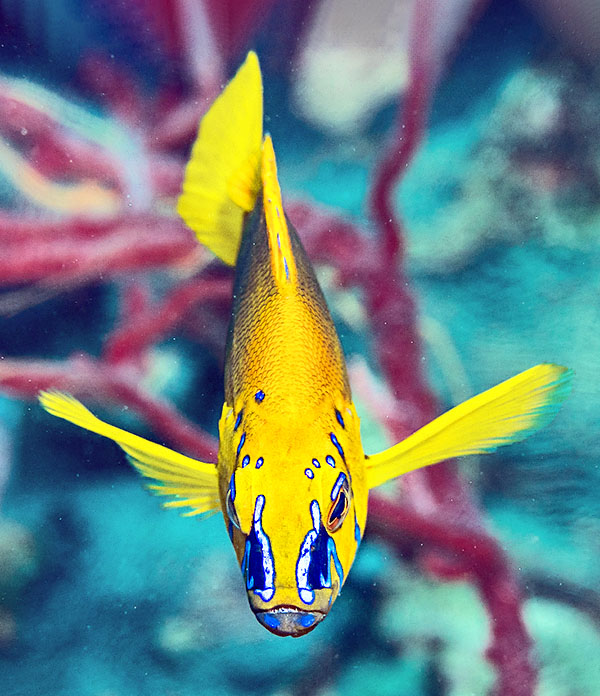
It’s more enigmatic from the front. The thin blue lines and the small blue-edged ocelli break the muzzle profile and thus might contribute to disorienting predators and prey © www.carlosestape.photoshelter
Created by Gill in 1861, the name of the genus probably comes from the Greek “hypo”, under, and from the Latin “plectrum”, in turn come from the Greek “pléktron”, spur, tip, with possible reference to the small forward-facing spines present on the lower edge of the preoperculum.
The specific name gummigutta probably refers to the fruits of Garcinia gummi-gutta, Asian species introduced in Cuba, whose yellow-orange colour reminds the bright livery of the fish.
Zoogeography
Particularly common along the coral barriers of the Antilles, Hypoplectrus gummigutta is present in the western Atlantic tropical waters, with temperatures included between 25,1 and 28,1 °C, from the Bahamas archipelago and from southern Florida across the whole Caribbean Sea, up to the northern coasts of South America.
Ecology-Habitat
It mainly lives on the coral reefs and along rocky cliffs rich in ravines, gorgonians and sponges, usually from 3 to 45 m of depth. It is a territorial species carrying on a solitary life or in couple; utilizing the substratum as shelter and also as observation point to surprise the preys, mainly formed by small fishes, crustaceans and other benthic invertebrates, seized with rapid jumps.
Morphophysiology
Hypoplectrus gummigutta attains about 13 cm of total length. The body is tall and strongly laterally compressed, covered by small ctenoid scales, rough to the touch due to the presence of tiny teeth on the rear edge, whilst the soft parts of the dorsal and anal fins are chiefly scaleless.
The well-developed lateral line follows the dorsal profile of the body has 48 to 53 scales.
The head is relatively short, with a slightly convex dorsal profile.
The relatively big eyes ensure a good vision also in the shaded areas of the reef. The mouth, ample and protractile, slightly oblique, allows rapid expansion of the oral cavity generating a powerful flow of suction sucking the prey during the attack.
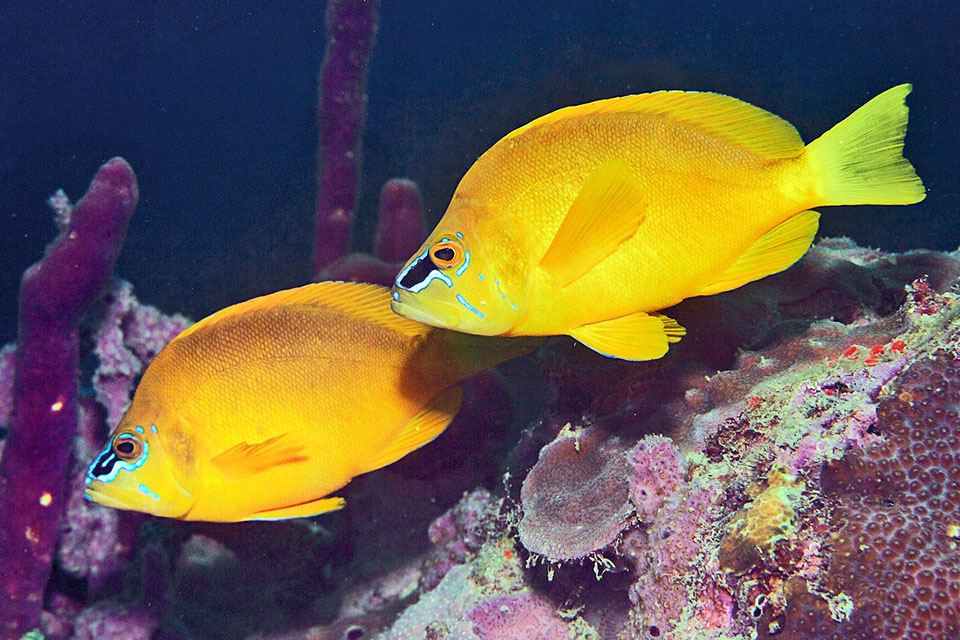
About 13 cm long, Hypoplectrus gummigutta is a small Caribbean grouper. The huge mouth opens creating a strong suction that sucks the poor unfortunate © www.carlosestape.photoshelter
The jaws, of almost equal length, have several small conical teeth arranged in bands, accompanied in front by some more developed caniniform teeth, particularly effective in grabbing small fishes and crustaceans. On the vomer and the palatine bones are present minute bands of teeth.
The long continuous dorsal fin, typical of serranids, has 10 spiny rays and 14-17 softones. The anal fin, shorter, displays 3 robust spiny rays followed by 7 soft rays.
The showy pelvic fins, rounded and long enough to reach, and sometimes, exceed, the origin of the anal fin, are supported by a spiny ray and five soft rays, whilst the wide pectoral fins usually count 13-14 of them.
The caudal fin, almost truncated or slightly rounded, allows rapid leaps for surprising the prey.
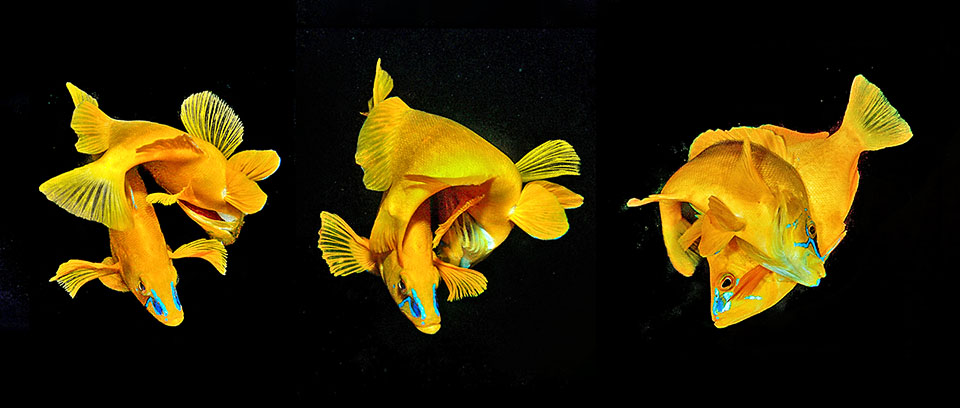
It’s a simultaneous hermaphrodite species: each individual is male and female the same time. While depositing the eggs the pair alternates reproductive roles © www.carlosestape.photoshelter
The flashy livery probably induces the small fishes to mistake it for a harmless butterflyfish or for a Caribbean damselfish like Stegastes planifrons.
Ethology-Reproductive Biology
Like the other members of the genus, Hypoplectrus gummigutta is a territorial predator that alternates long waiting periods with short and fast chases.
Reproduction is one of the most interesting aspects of its biology. In fact the species is simultaneously hermaphroditic: every individual owns simultaneously functional male and female gonads. At sunset the couples perform repeated climbs in the water column culminating in a reproductive embrace; during which they release eggs and spermatozoa.
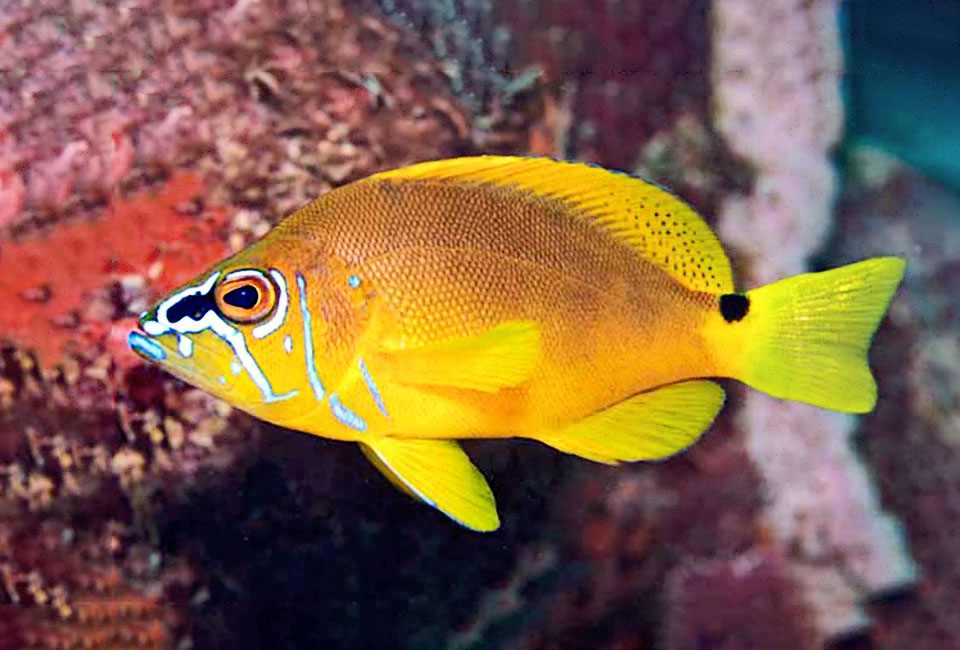
Juveniles also display the traditional fake eye on the tail, but lose it while growing. The one on the snout, conversely, remains the species distinctive trait © www.carlosestape.photoshelter
During the subsequent ascents the partners alternate in the male rôle, reciprocity strategy that guarantees both an equivalent reproductive investment and limits the risk that one of the partners benefits from the fertilization without sustaining the energy cost of the production of the eggs.
Resilience is high, with a minimum time of doubling the populations of less than 15 months, whilst the fishing vulnerability is very low: only 10 on a scale of 100. From 2012 Hypoplectrus gummigutta consequently appears as “LC, Least Concern“ in the IUCN Red List of the endangered species.
Synonyms
Plectropoma gummigutta Poey, 1851.
→ For general information about FISH please click here.
→ For general information about BONY FISH please click here
→ For general information about CARTILAGINOUS FISH please click here.
→ To appreciate the BIODIVERSITY of BONY FISH please click here.
→ To appreciate the BIODIVERSITY of CARTILAGINOUS FISH please click here.