
Family : Sciaenidae

Text © Dr. Giuseppe Mazza

English translation by Mario Beltramini
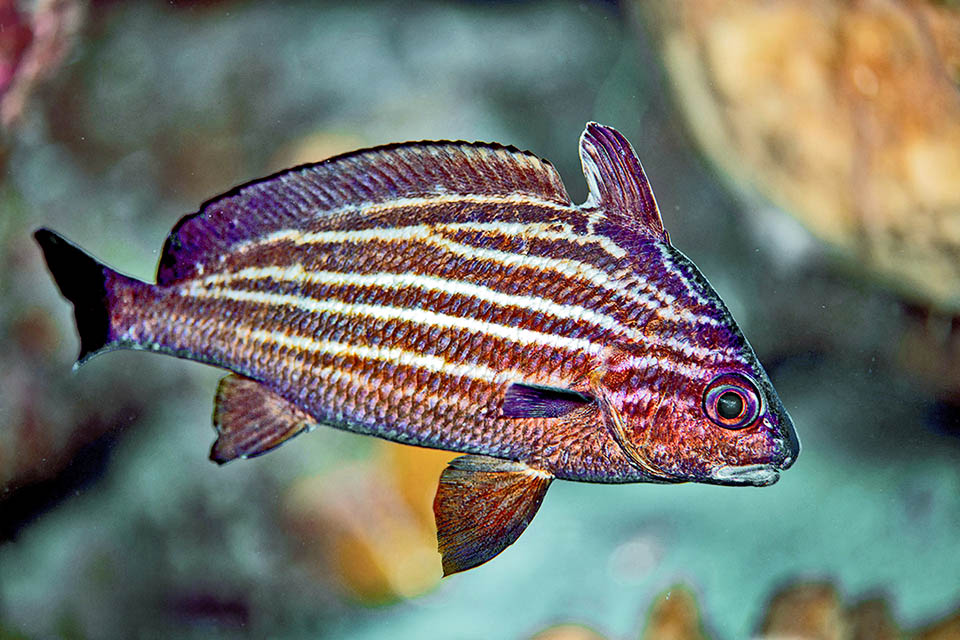
Adult Pareques acuminatus. Like Eques lanceolatus and Eques punctatus surprises for the first dorsal fin very long when young © Frank Krasovec
Eques acuminatus (Bloch & Schneider, 1801), little “knightfish” of the western Atlantic reefs, might seem at first glance one of the many streaked Sciaenidae frequenting these environments. But it is enough to observe its silhouette, especially in the juveniles, to discover a fish decidedly particular: in fact the first dorsal fin develops in a spectacular way, granting it an almost flag-bearing appearance.
It is rightly this characteristic to recall the image of the “knight”, present in the nomenclatural history of these fishes. The genus Pareques is in fact historically linked to Eques, whilst the epithet acuminatus, pointed in Latin, recalls the particular structure of the dorsal fin.
The comparison with Eques lanceolatus and Eques punctatus shows how amazing the transformation of the dorsal during the growth may be.
But what distinguishes Pareques acuminatus from the other knightfishes?
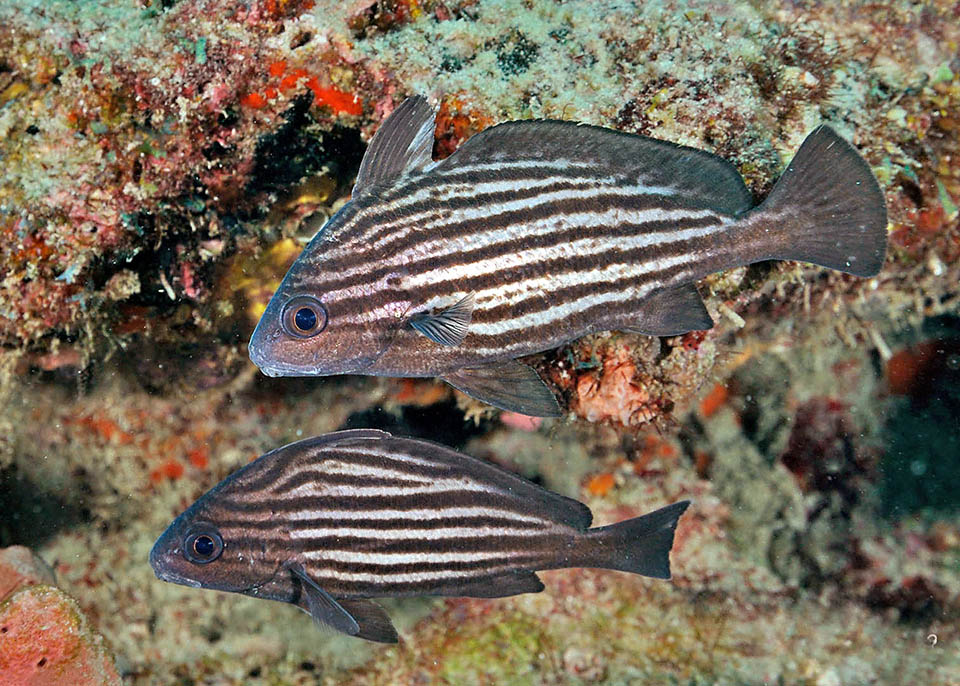
It was once thought to inhabit a vast area of western Atlantic, but today, following the 2022 taxonomic revision, it is known mainly along the eastern USA coast, in the Gulf of Mexico and Caribbean waters, while Brazilian populations are mainly referred to another species, Pareques lineatus, further narrowing its known range © Frank Krasovec
The answer does not stand in one single character. Must be observed together with the shape of the body, the drawing of the band, the structure of the dorsal, the age of the animal and, above all, the geographical origin.
It is a little fish with a whitish or silvery body, crossed by dark longitudinal bands. During the day it tends to remain hidden among rocks, corals, protrusions and cavities of the reef; with the darkness it gets more active and moves on the surrounding seabeds looking for small animals. In English it is rightly known as “High-hat”, name recalling once again the particular shape of the dorsal fin. In the French-speaking Caribbean it is known also as “Dragonnet”.
The species belongs to the Sciaenidae, family where numerous members produce sounds by means of specialized muscles associated with the swim bladder. Also Pareques acuminatus is a fish producing sounds through the vibration of the swim bladder. Their precise behavioural meaning is still not yet completely clarified.
Zoogeography
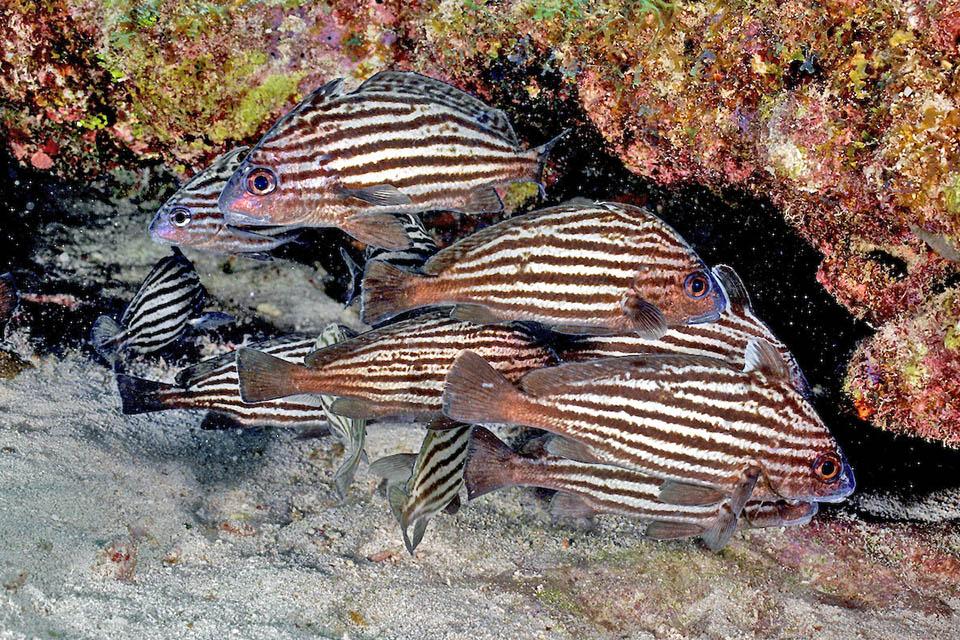
23-25 cm long, is active at night and spends the day hours, at times in schools, sheltered by madreporic ravines © www.carlosestape.photoshelter
Pareques acuminatus belongs to the tropical and subtropical western Atlantic. However, its distribution has been long interpreted too broadly. For many decades the species has been considered present from North America to the Caribbean and up to Brazil. The taxonomic revision published in 2022 by Carvalho-Filho and collaborators has however re-validated Pareques lineatus (Cuvier, 1830) as a distinct species and has redefined the geographic limits of the two entities.
Pareques acuminatus is presently known along the eastern coast of the USA, in the Gulf of Mexico and in the Caribbean, whilst the Brazilian populations are mainly referred to Pareques lineatus. In the West Indies and in the southern part of the Caribbean the situation can be more complex, with possible areas of overlapping.
Therefore the change does not concern only the name. The location where one specimen has been photographed or collected may become an important element for its identification. For instance, an old Brazilian photo attributed to
Pareques acuminatus, cannot be transferred automatically to the present taxonomic concept of the species. Same thing applies to part of the old literature and for the distribution maps preceding the revision.
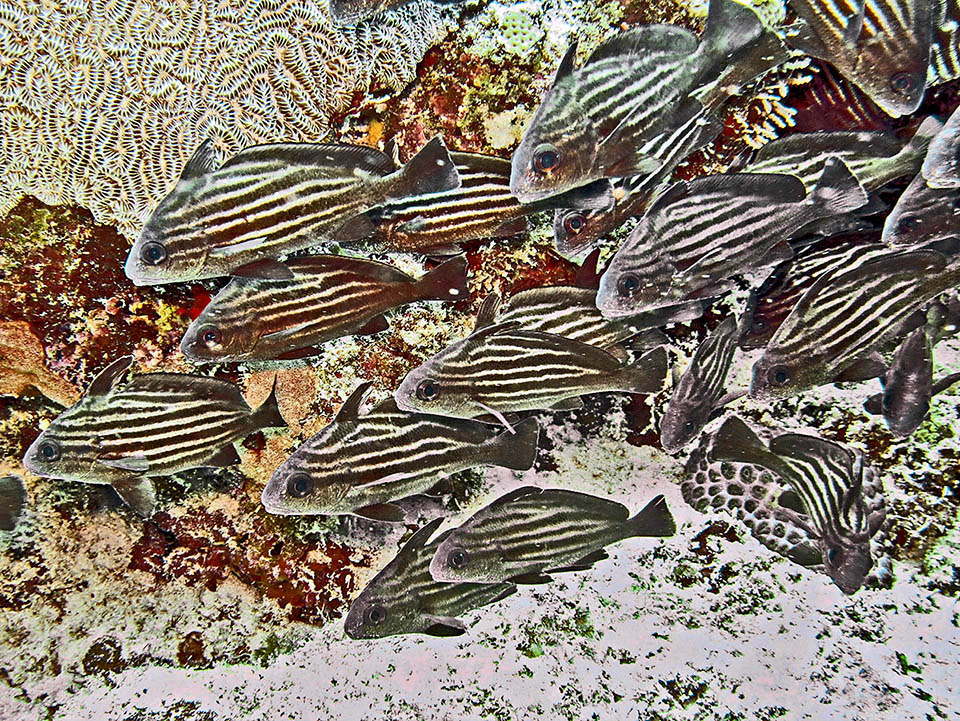
Like the eques, Pareques acuminatus is oviparous with pelagic eggs, but data on courting and laying eggs modalities are not sure © Sylvain Le Bris
The 2022 revision has also designated a neotype for Pareques acuminatus, helping to fix more precisely the identity of the name and to separate it from that of Pareques lineatus. In this way, a species that seemed to have a very simple range becomes an interesting example of how much the biogeography can influence the taxonomy.
Ecology-Habitat
Pareques acuminatus is strictly associated with the reef environments and to the structures of the bottom offering shelter. Rocks, corals, protrusions, cavities and small grottoes form the environments where the individuals may remain during the light hours. The species lives mainly in relatively shallow waters even if it can attain greater depths. The known bathymetric distribution indicatively goes from a few metres up to more than 100 m, with a particularly frequent presence in the most superficial bands. The day-night rhythm is very evident. During the day Pareques acuminatus tends to keep inside or in the immediate vicinity of the structures of the reef. With the arrival of darkness the. activity increases and the individuals may move on the sandy, muddy, or detrital surrounding seabeds.
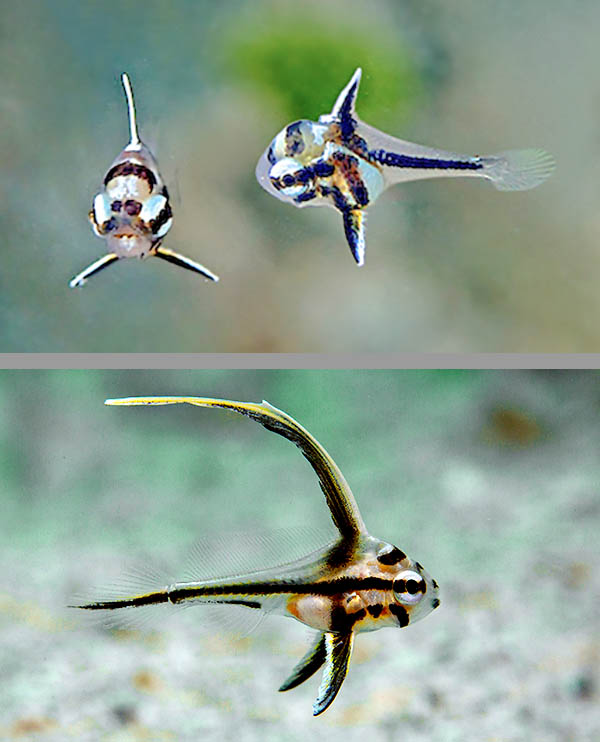
Very young and one young with their showy knight’s plume www.carlosestape.photoshelter
The diet includes small animals, including crustaceans, polychaetas, small fishes and zooplankton. The species therefore exploits prey associated with the substratum as well as organisms present in the water column.
The juveniles may be observed in small schools of individuals of similar size, whilst the adults usually are more closely linked to strictures of the bottom.
It is rightly this alternation between the hidden fish during the day and the predator active at night to render interesting its observation in the natural environment.
Morphophysiology
The body is relatively short, tall and compressed laterally, with the back strongly curved.
The head is low and the mouth is relatively small. On the chin are present five mentum pores, but not barbels; other sensory pores stand on the snout.
The dorsal fin is the most spectacular character.
The first part, formed by spiny rays, is particularly developed in the young and determines the typical silhouette that unites Pareques acuminatus to the other “knightfishes”. However, with the growth, proportions change and the animal gradually takes on the adult’s more compact appearance.
The phenomenon is evident also by comparing Pareques acuminatus with Eques lanceolatus, where the transformation of the first dorsal during the growth is equally spectacular. Also Eques punctatus displays a similar transformation.
In any case, the resemblance does not mean that the three species are interchangeable.
As a matter of fact, the livery is one of the most evident elements. The body displays a whitish or silver background crossed by dark longitudinal bands, whose number, width and regularity may help in distinguishing Pareques acuminatus from Pareques lineatus. It is therefore not sufficient to observe generally the presence of “bands”: it is necessary to consider their drawing together with the overall size of the body and the geographical origin.
Also the age of the animal must be considered. In the juveniles the drawing may appear more complex and the first dorsal is much more evident; while growing do change the proportions of the body as well as the general look of the livery. The comparison with the young of Eques punctatus is particularly useful rightly for this reason: in these fishes the youthful appearance can be surprisingly different from that of an adult, making risky an identification based only on the silhouette. The species attains relatively small size, with maximum values reported by various sources around 23-25 cm of total length.
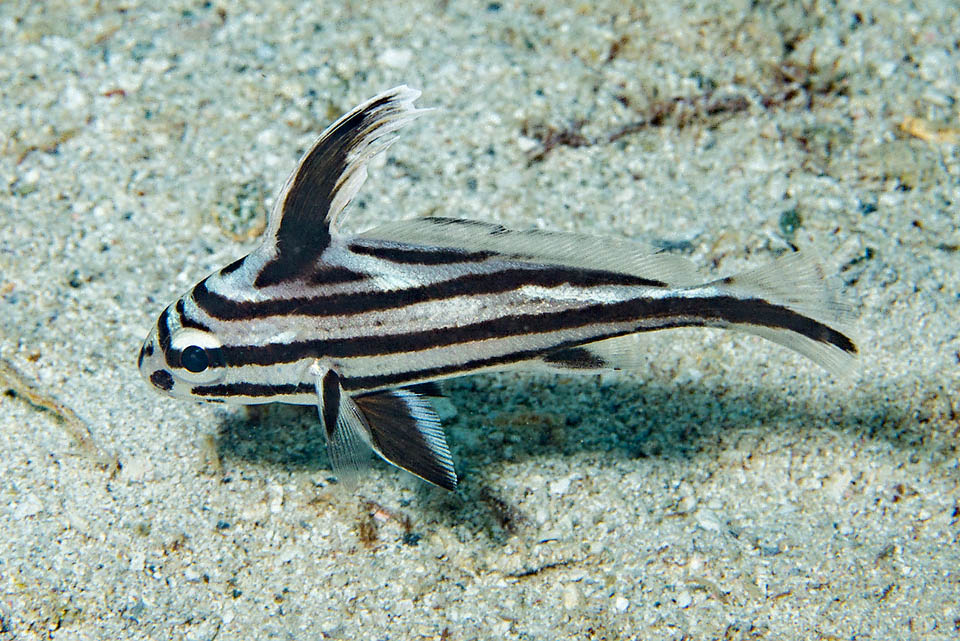
Intermediate phase. The plume is visibly reduced and appears, even if with different drawing, the stripes of the adults © www.carlosestape.photoshelter.com
Ethology-Reproductive Biology
The life of Pareques acuminatus follows in large measure the rhythm day-night of the reef. During the day the animal remains associated with the shelters and on the structures of the substratum; at dusk the food-seeking activity increases. This behaviour explains also why a day photo may give a quite different image from that of an individual observed during the phase of night activity.
Juveniles can be more gregarious and merge in small groups of individuals of similar size. The adults are usually more associated with the shelters and to the structures of the bottom.
For what the reproduction is concerned, Pareques acuminatus is oviparous and the eggs are pelagic. There is also data on the gonadal maturation of Caribbean populations, but it is better not to attribute to the species a precise courtship ritual or a certain way of laying eggs in absence of direct behavioural observations.
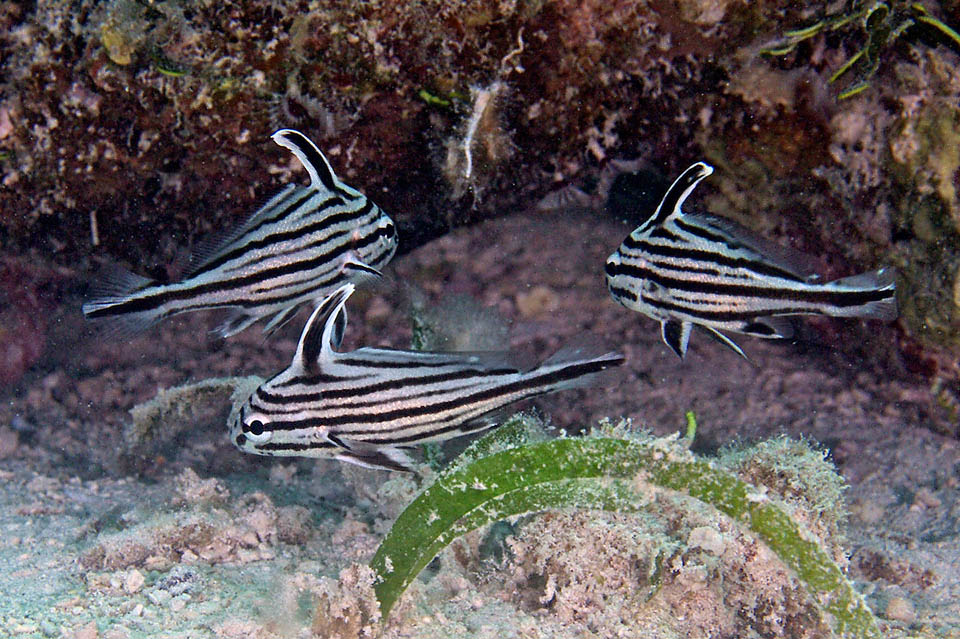
Small group in intermediate phase. The dark lines are more evident, bur still remains the ocular masking accompanying the juvenile livery © www.carlosestape.photoshelter.com
For the same reason, a photo where two individuals appear close or oriented in the same way must be described at one for what it really shows. The proximity may be interesting and compatible with a social or reproductive behaviour, but does not constitute by itself proof of courting or of lying.
On the conservation level, Pareques acuminatus is classified LC, Least Concern by the IUCN Red List. The evaluation considers common species and amply distributed and does not identify globally, threats such to justify a category of major risk. Also some biological parameters contribute to outline a relatively favorable picture: the resilience is considered high, whilst the fishing vulnerability is evaluated low. The species in any case has a limited commercial value and can appear in the catches, so the absence of a significant global risk must not be interpreted as a total absence of pressure.
Finally, Pareques acuminatus is nowadays a small reef fish without known particular conservationist emergencies, but remains an interesting species rightly because its natural history unites a very particular morphology, a distribution that had to be redesigned by the taxonomy and a surprising transformation of its look while growing.
→ For general information about FISH please click here.
→ For general information about BONY FISH please click here
→ For general information about CARTILAGINOUS FISH please click here.
→ To appreciate the BIODIVERSITY of BONY FISH please click here.
→ To appreciate the BIODIVERSITY of CARTILAGINOUS FISH please click here.