
Family : Orchidaceae

Text © Pietro Puccio

English translation by Mario Beltramini
The species is native to Borneo where it lives in the humid forests between 800 and 2200 m of altitude.
The genus name is a combination of the Greek adjective “κοῖλος” (koîlos) = hollow and the noun “γυνή” (gyné) = female, referring to the concave stigma; the species is named after the English botanist and collector Lilian Suzette Gibbs (1870–1925), who spent her professional life leading botanical expeditions to unexplored areas of the earth.
Common names: Gibbs’s Coelogyne
Coelogyne gibbsiae (Rolfe) M.W. Chase & Schuit (2021) is a rather variable epiphytic species with creeping rhizome and close oblong pseudobulbs, 1,5-4 cm long and of 0,5-1 cm of diameter, provided at the apex of a single leaf, on a 1,5-3 cm long petiole, linear-lanceolate with acute or obtuse apex, 10-30 cm long and 1-2 cm broad, of pale green colour, coriaceous. Inflorescences, on an erect peduncle, 8-12 cm long, racemose, arcuate, 10-20 cm long, with numerous tiny flowers of cream colour with a spot on the labellum usually of brownish colour, more or less fragrant.
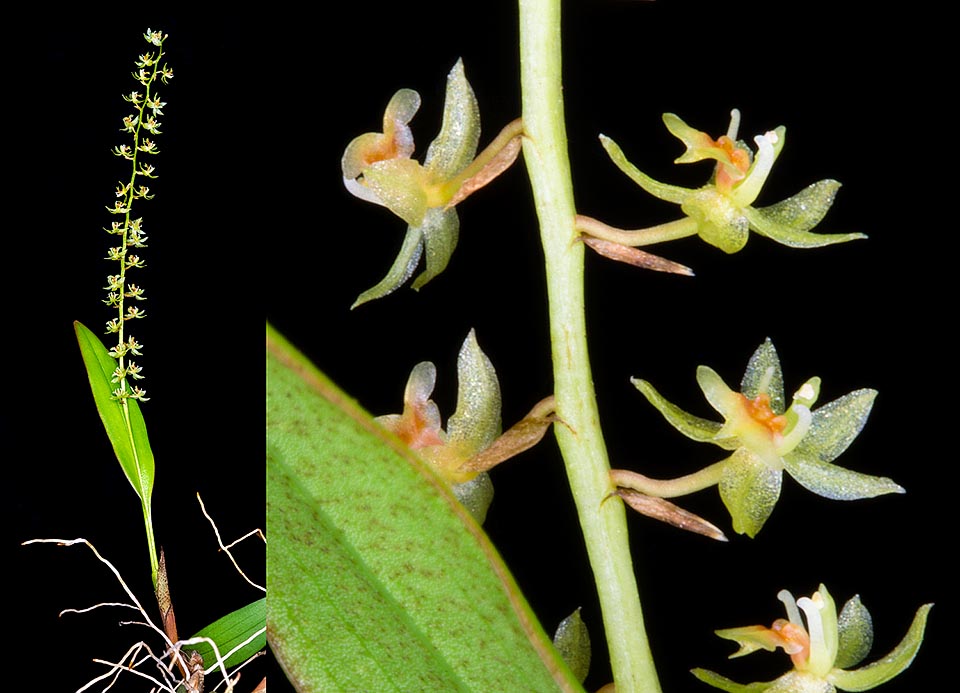
Miniature orchid, little known in cultivation, the Borneo Coelogyne gibbsiae is an epiphyte with 10-20 cm inflorescences and several tiny flowers © Dr. Giuseppe Mazza
Lanceolate floral bracts, concave, 2,5-3 mm long, pedicel and ovary 2-3 mm long. Oblong-ovate sepals with apiculate apex, 2-3,5 mm long and 1-1,5 mm broad, oblong-elliptical petals with obtuse or apiculate apex, 2-3,5 mm and about 1 mm broad, trilobed labellum, 2-3 mm long and 3-4 mm broad, with oblong lateral lobes with obtuse apex and median lobe also trilobed, with oblong lateral lobules and cuspidate median lobule; the column is 1-2 mm long.
Miniature orchid, little known in cultivation, requires a slight shade, intermediate temperatures, 22-32 °C, in summer, slightly cooler in winter, with lowest night ones not under the 15 °C, high humidity, 70-85%, and good ventilation. Frequent waterings from spring to autumn, more spaced in winter allowing the substratum to partially dry up before giving water again, utilizing rain water, demineralized or by reverse osmosis. Monthly fertilizations with a balanced hydrosoluble product, with microelements, at 1/4 the dosage shown on the package. It can be mounted on small logs, pieces of bark or rafts of cork covered by sphagnum, or cultivated in pots or baskets with a compost based on medium sliced bark fragments. The repottings are to be done, when necessary, after the blooming at the appearance of the new roots.
The species is reported in the appendix II of the CITES (species whose trade is internationally ruled).
Synonyms: Dendrochilum gibbsiae Rolfe (1914); Dendrochilum kinabuluense Rolfe (1914); Dendrochilum quinquelobum Ames (1920).
→ For general notions about ORCHIDACEAE please click here.