
Family : Gobiidae

Text © Dr. Giuseppe Mazza

English translation by Mario Beltramini
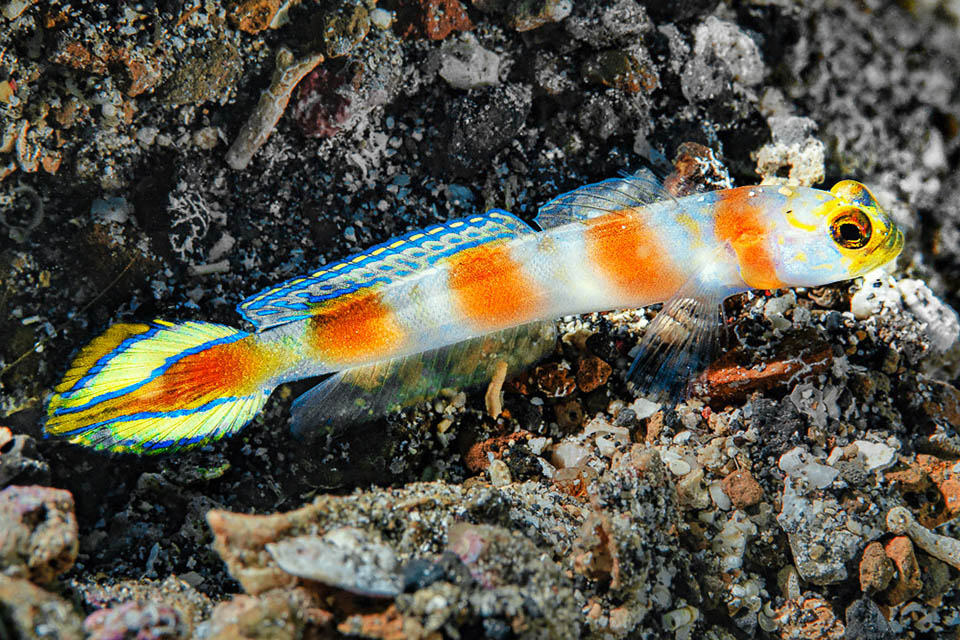
Inserted due to its showy tail into the flagtail gobies, the Flagtail shrimpgoby (Amblyeleotris yanoi) lives in West Pacific © François Libert
The Flagtail Shrimpgoby, Amblyeleotris yanoi Aonuma & Yoshino 1996, belongs, due to its showy caudal fin, yellow and orange with blue edges, to the group of the flag gobies, inserted in the class of the Actinopterygii, the ray-finned fish, in the order of the Gobiiformes and the family of the Gobiidae, one of the richest in the marine world, that boasts over 200 genera and almost 2000 species mainly present in the tropical and temperate seas, but also in brackish and fresh waters with fishes that at times spend all their life in the rivers reaching the sea only for the reproduction.
The genus Amblyeleotris, which includes presently about forty species, was created by Bleeker in 1874 for Amblyeleotris periophthalma, starting from the Greek “amblys”, obtuse, due to its truncated snout, and Eleotris, the old. generic name then taxonomically used for these fishes.
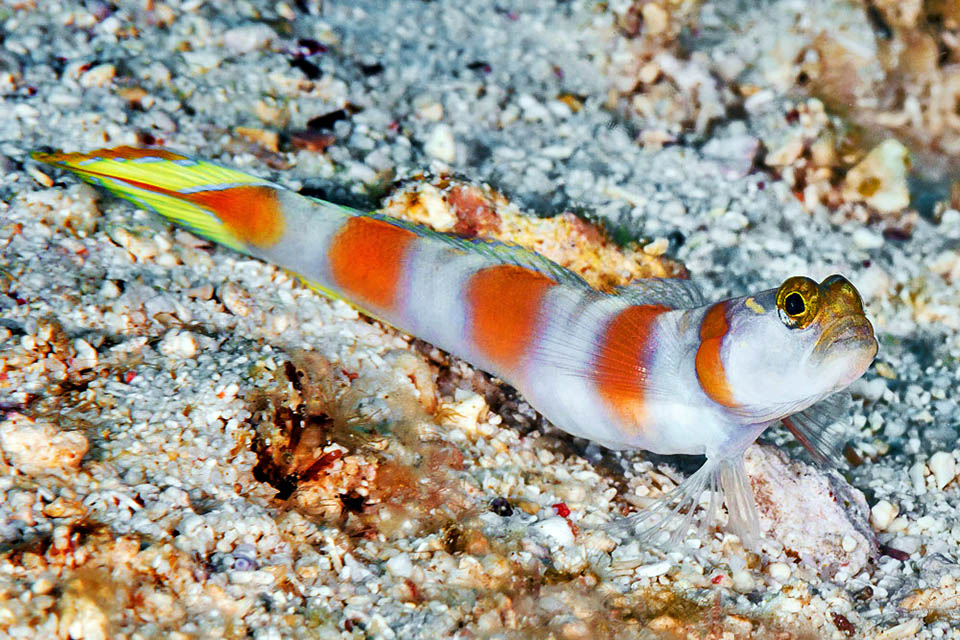
Maximum 13 cm long, it has a striking livery with 5 red-orange bars on a light background, interspersed with narrow brown saddles © François Libert
The specific term yanoi, of Yano in Latin, is conversely a clear homage to Korechika Yano, Japanese underwater instructor and photographer, who furnished the material necessary for the description of the species.
Zoogeography
Amblyeleotris yanoi is a fish present in the western Pacific from the Ryukyu Island, south to Taiwan, to the Philippines and INdonesia, up to Papua New Guinea.
Ecology-Habitat
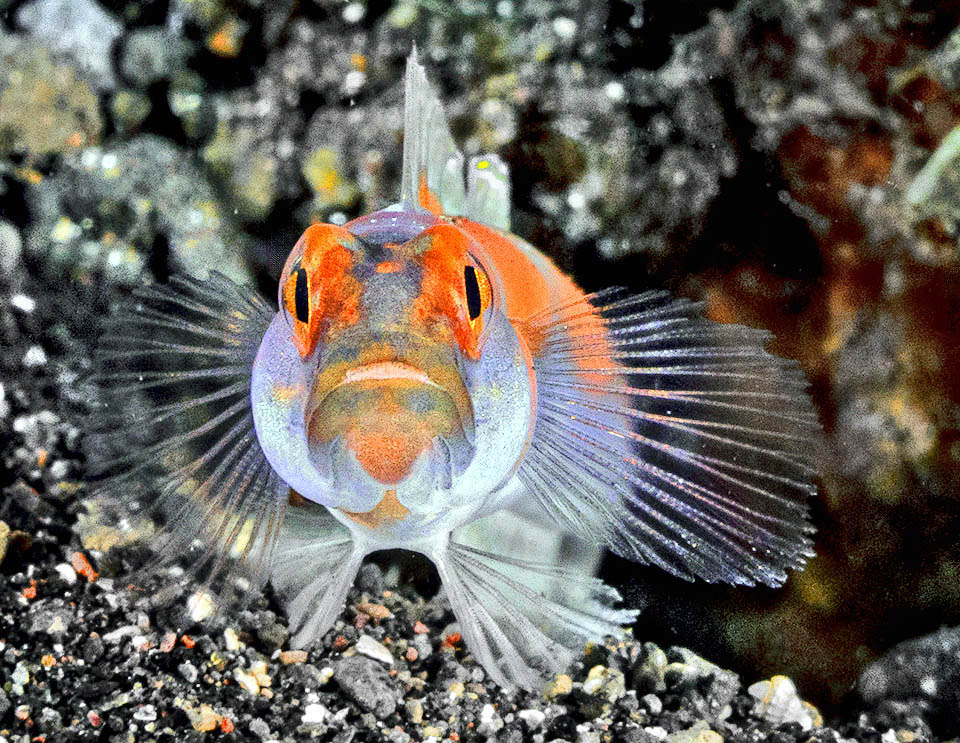
Spends the light hours at den entrance, dug on the bottom by the symbiont shrimp Alpheus randalli, eating on the fly krill and small crustaceans of the genus Mysis © mattdowse
It mainly lives in a madreporic environment, between 3 and 35 m of depth, preferably at temperatures standing from 26,9 and 29 °C, together with Alpheus randalli, a shy and poor-sighted who digs its den on the soft bottoms and keeps the burrow in shape with a vast series of tunnels.
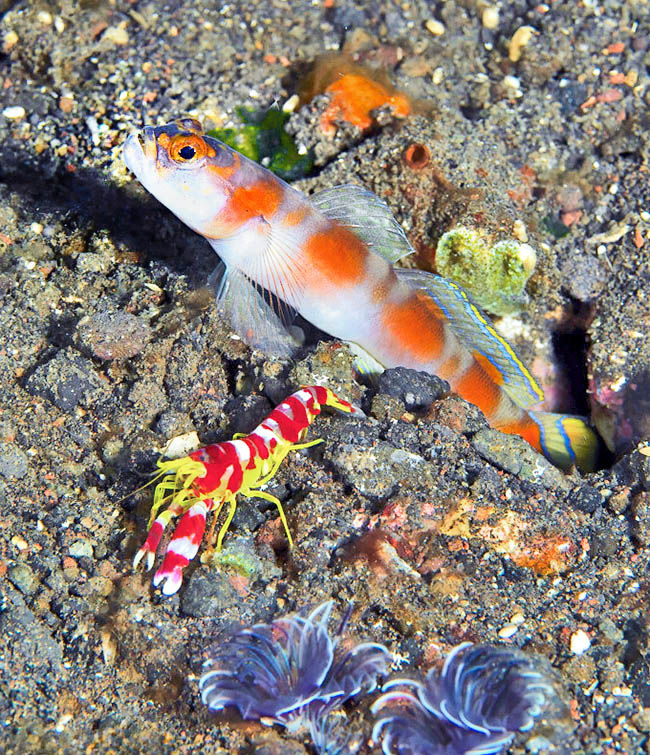
Like a sentry, the Flagtail shrimpgoby surveys the surroundings motionless, from the front door, signalling to the crustacean with sudden and known movements the possible presence of predators, whilst this keeps clean the accommodation, coming out into the open only when it is very sure of not taking any risk.
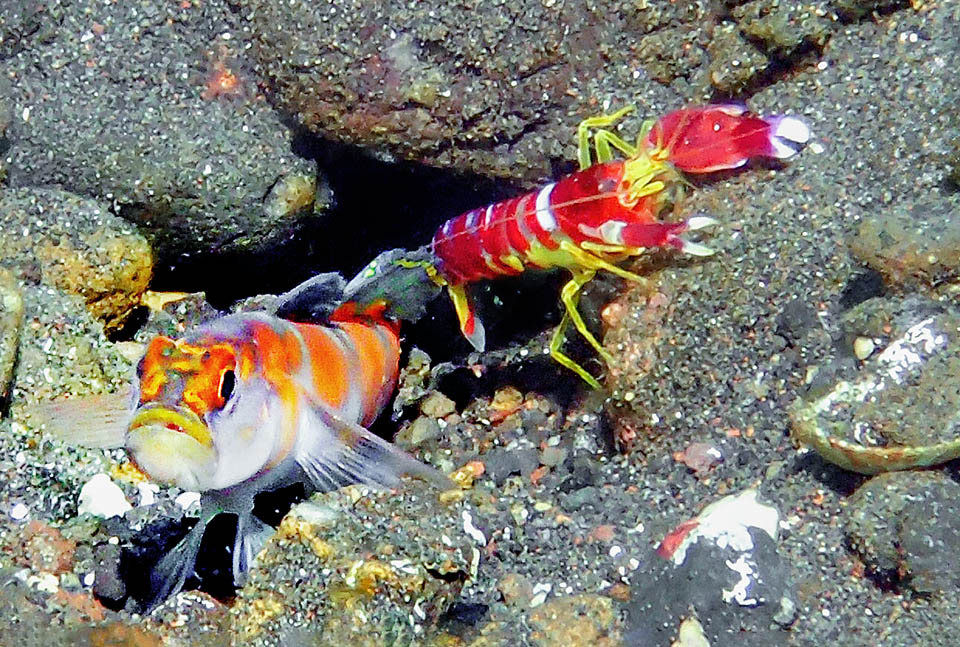
Here with its shy and poor sighted guest, who gets out in the open to feed on debris only when the goby doesn’t advise the predators presence © Bryan J
It feeds on debris, whilst the goby, in addition to the invertebrates flushed out by the shrimp during its continuous home maintenance works, bases its diet mainly on krill and the small crustaceans of the genus Mysis.
At night then fish and shrimp retreat, as good friends, to the bottom of the den to sleep peacefully, after having closed well, walling it up, the front door.
An absolutely analogous symbiosis to the Caribbean one of Nes longus, a goby living, on the other side of the world, together with Alpheus floridanus, providing us a classical example of convergent evolution.
A mutual interest evolution convergence, as is case in Caribbean between Nes longus and Alpheus floridanus © Craig Lewis
Morphophysiology
Amblyeleotris yanoi reaches a maximum length of 13 cm.
The body, elongated and slender with circular section, has 97-103 series of longitudinal scales which are absent on the nape.
The dorsal fin has 6-7 spiny rays and 13 soft; the anal 1 spiny ray and 13 unarmed and the pectoral ones 18 soft rays.
The pelvic fins, which in the gobies merge to form a suction cup, here do not have frenulum, united by a low membrane.
The colourful yellow caudal fin with small blue edges and the reddish orange central part, is lanceolate and is longer than the head.
The livery displays 5 orange red bars on a pale background, spaced by narrow brown saddles.
They are the same colours, apart from the blue, that we find also on the friendly shrimp, about 3 cm long, with body and chelipeds red-banded, whilst the legs, the first part of the tail and the joints of the head are yellow.
Ethology-Reproductive Biology
In the den there is room also for the couples.
It is there that Amblyeleotris yanoi secures its egg masses, whilst for reproducing Alpheus randalli connects its home with a tunnel to that of a possible partner in the surroundings and its females do protect them until hatching by bluing them under their belly.
The resilience of the Flagtail shrimpgoby is excellent, with a possible doubling of the populations in less than 15 months and the fishing vulnerability marks only 10 on a scale of 100.
Even if caught often for the domestic aquaria, Amblyeleotris yanoi appears therefore from 2020 as “LC, Least Concern”, in the IUCN Red List of the endangered species.
→ For general information about FISH please click here.
→ For general information about BONY FISH please click here
→ For general information about CARTILAGINOUS FISH please click here.
→ To appreciate the BIODIVERSITY of BONY FISH please click here.
→ To appreciate the BIODIVERSITY of CARTILAGINOUS FISH please click here.