
Family : Charadriidae

Text © Dr. Gianfranco Colombo

English translation by Mario Beltramini
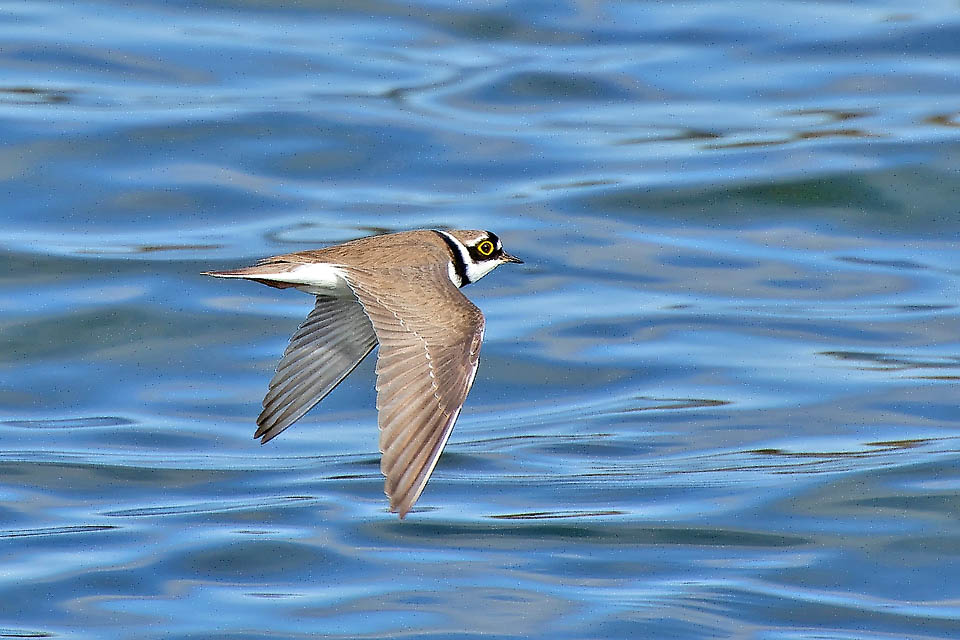
Little ringed plover (Charadrius dubius) has a very vast range covering all Asian continent touching the northern part of Oceania and Europe © Dmitry P.
It is not easy to verify on the field the difference in size between the Little ringed plover and the Common ringed plover, much less to distinguish them immediately, due to the high degree of camouflage that both display when on the soil and the strong similarity between the species.
The problem of the separation between these two small birds had already arisen a few years after that Linnaeis had classified the Common ringed plover (Charadrius hiaticula Linnaeus, 1758) the most common species in the north Palearctic, when Sonnerat in 1776, in his report “Voyage à la Nouvelle Guinée”, described for the first time that “Petit Pluvier à collier de l’île de Luzon” (Little ringed plover of Luzon island – Philippines) so similar to the one he usually met in the European Palearctic and that his predecessor had already described.
The doubt he expressed was so strong, supported by the idea that they were the same species and that the minor noted variations should come only from the tropical climate conditions specific to those areas, that Scopoli, the official classifier of this species, thought it appropriate to make this dilemma official by calling it Charadrius dubius Scopoli, 1776.

Is very similar and often mistaken with Common ringed plover (Charadrius hiaticula) hence the specific name of dubius, doubtful in Latin © Gianfranco Colombo
The Little ringed plover is a small limicolous belonging to the order of the Charadriiformes and to the family of the Charadriidae and, as its vulgar name states, a very fast runner when on the ground.
In fact it is a very little bird developing by running at an incredible speed even if the usually frequented ground is stony, with loose gravel and full of obstacles that would render difficult everybody’s movement.
Nevertheless, in this environment the Little ringed plover feels at ease enough to live and nest there, hidden by a livery that renders it absolutely invisible and by such a small size that it is almost impossible to find it even if knowing its presence.
Conversely, it gets noisy when flying, in particular during the summer months, when with very fast and circular flight, it flies over its own area emitting that “piuu piuu piuu” annoying and buzzing like a crazy bumblebee, audible from a considerable distance that renders it easy to distinguish even if not seen, to then land on the stony shore, a few metres from the observer and disappear from sight again.

Even if nesting may occur far from water, it is a wader who looks for food along the banks of rivers, lakes and swamps © Gianfranco Colombo
Frequenting the banks of rivers and of lakes as well as of the seas when migrating, Charadrius dubius is a bird subject to significant anthropic disturbance, particularly during the summer season when it coincides its nesting period with that poorly managed Sunday tourism, a hit-and-run tourism that often exploits isolated and out-of-the-way sites, once inviolate homeland of this particular fauna.
So little families of improvised tourists, fully armed with the most varied equipment and complete with following dogs, unlawfully held in absolute liberty, find themselves invading and disturbing them during the most delicate period of their life, the nesting territories of this small bird, creating a nuisance such as to cause the abandon of the brood in progress and even that of the whole area.
Photos of brooding birds have often been seen at two metres from the wheel of an off-road vehicle, rightly vehicles unlawfully taken out from the normal road, to then discover the abandonment of the nest if not even the overturning of the same.
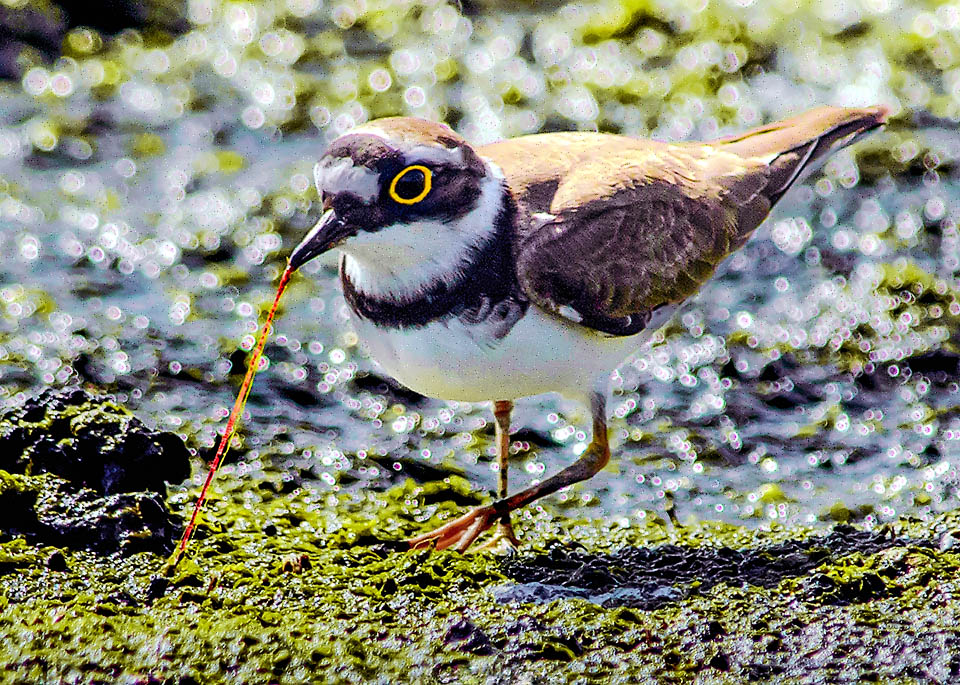
Here has found a worm, but feeds also on small mollusks, small crustaceans and any sort of insects, either terrestrial or aquatic © Matt Vincent Leonoras
Being a bird common in Italy, Charadrius dubius in every region has gathered many dialect names such as pieri, pivierina, munegheta, tzurliotèddhu, tzurrulìu currulus, pivlot, curiren and others.
The etymology of the scientific binomen originates from the old Greek that identified in Charadrius from “kharadria”, ruins, rocks, a small bird frequenting a ground strewn with rocks and stones whilst from the Latin, dubius, doubtful, the concept already previously expressed concerning the characteristics of the species.
In Europe it is commonly known as Corriere Piccolo in Italian, Flussregenpfeifer in German, Chorlitejo Chico in Spanish, Pluvier petit-gravelot in French and Borrelho pequeno de coleira in Portuguese.
Zoogeography

There is no sexual dimorphism but this is one of the typical positions taken by a male when courting among chirps and unbridled runs © Gianfranco Colombo
Charadrius dubius has a very vast nesting area covering intensively the entire Asian continent touching also the northern part of Oceania and Europe, where it is widely present but never in large numbers.
In fact if in Asia its range covers an uninterrupted belt bounded to the north by the Arctic Ocean, to the south by India and by the Indochinese Peninsula wets from the boundaries with Europe and to east by the Pacific Ocean, is absent only in the central part of China, in our continent is present in the central part in a patchy way, with wide spaces without populations and in the Mediterranean one particularly in the islands, at times in a rarefied or totally absent way.
To the north it gets to occupy the southern part of the Scandinavian Peninsula, part of England and all European Russia, leaving the whole northern part of the continent to its congener Charadrius hiaticula. Actually this last species is the northern correspondent of the Little Ringed Plover and occupies all the territory sited north to the described one, up to the extreme and unlivable Arctic zones.

Mating. Charadrius dubius measures 15 cm maximum, a sparrow size. The 35 cm wingspan is not surprising as it is a migratory bird © Gianfranco Colombo
Charadrius dubius is present as nesting also in the north-western part of Africa, from Morocco up to Tunisia. The species is largely a long-distance migrant even if some populations, particularly those of the Indian basin, undertake a simple and short seasonal transfer that takes them to slightly lower latitudes than thos frequented in summer. The winter quarters, for all European and Eastern Asian populations, are found in south-Saharan Africa whilst are in India, in the Indochinese Peninsula and in the Indonesian islands for the Siberian ones. The population of the Philippines and of New Guinea would instead be sedentary.
Ecology-Habitat
Charadrius dubius is linked to the aquatic environments even if the nesting may take place very far away from any body of water. It loves sandy and clayey soils, banks of rivers and lakes and their islets, dried up riverbeds, marshy shores but also human artifacts like quarries, large dirt areas, cleared and bare lands, road construction sites and, not rarely, particularly in the Po Valley, plowed fields ready for growing corn. It doesn’t like altitude and rarely reaches altitudes of more than 1000 m above the sea level.
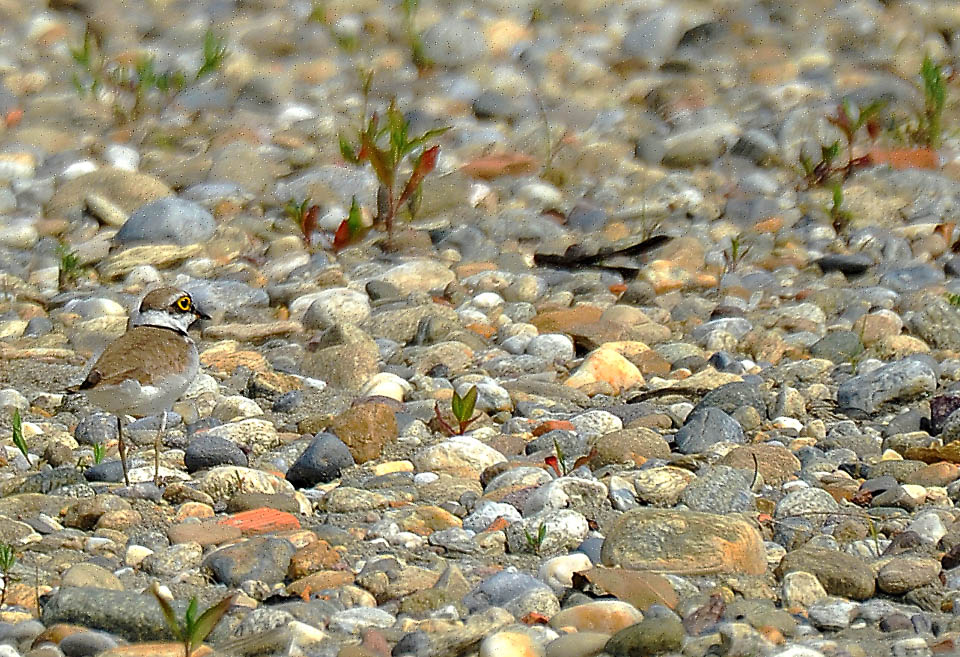
Charadrius dubius livery is very mimetic in the dry riverbeds, often used for nesting © Gianfranco Colombo
The Little ringed plover practically spends its life in environments humid and without vegetation, among the rocks and gravel, but always in close contact with water but river and lake, only occasionally sea water. In the winter quarters it finds the same environments frequented during the nesting period, often also accepting semi-desert or conversely desert sites, purely marshy territories.
Morphophysiology
Charadrius dubius is a small bird with dimensions even equal to those of a house sparrow. It measures a maximum of 15 cm in length, weighing less than 40 g and a wingspan of over 35 cm, demonstrating with this last measure its characteristics of a real migratory bird. In fact the wings are narrow and falcate and easily develop a remarkable speed in flight.
The livery colouring in both sexes is ash-brown in the upper part of the body and completely white in the lower, with a very black band surrounding the neck and joins in the nape, forming a wide necklace that leaves the throat and nape of a snow white colour.

Now the male, bent forward with the tail fanned put, shows the female the place where to lay the eggs © Erik Eckstein
One band parallel to this, always very black, surrounds the head starting from the nape until it rejoins on the fore part of the head and separates in two parallel and distinct bands just in the frontal part, where appears a very white bar, forming the typical mask specific to both species. This characteristic mask is always well visible and renders these birds easy to distinguish from any other limicolous.
On the upper part of the head it has an ash-coloured hood of the same shade of the wing colour. The black eye displays a bright yellow periocular edge missing in the Common ringed plover. Also the bill is totally black unlike that of the congener that instead is orange with black tip. The legs are dark greenish unlike the bright orange shown by the Common. The tail is not very pronounced and when the bird is resting with closed wings, has the same length as the primary remiges.
The chicks have a livery totally greyish on the upper part and whitish in the lower one and have only a faded hint of what will be when adult the black necklace band on the chest.
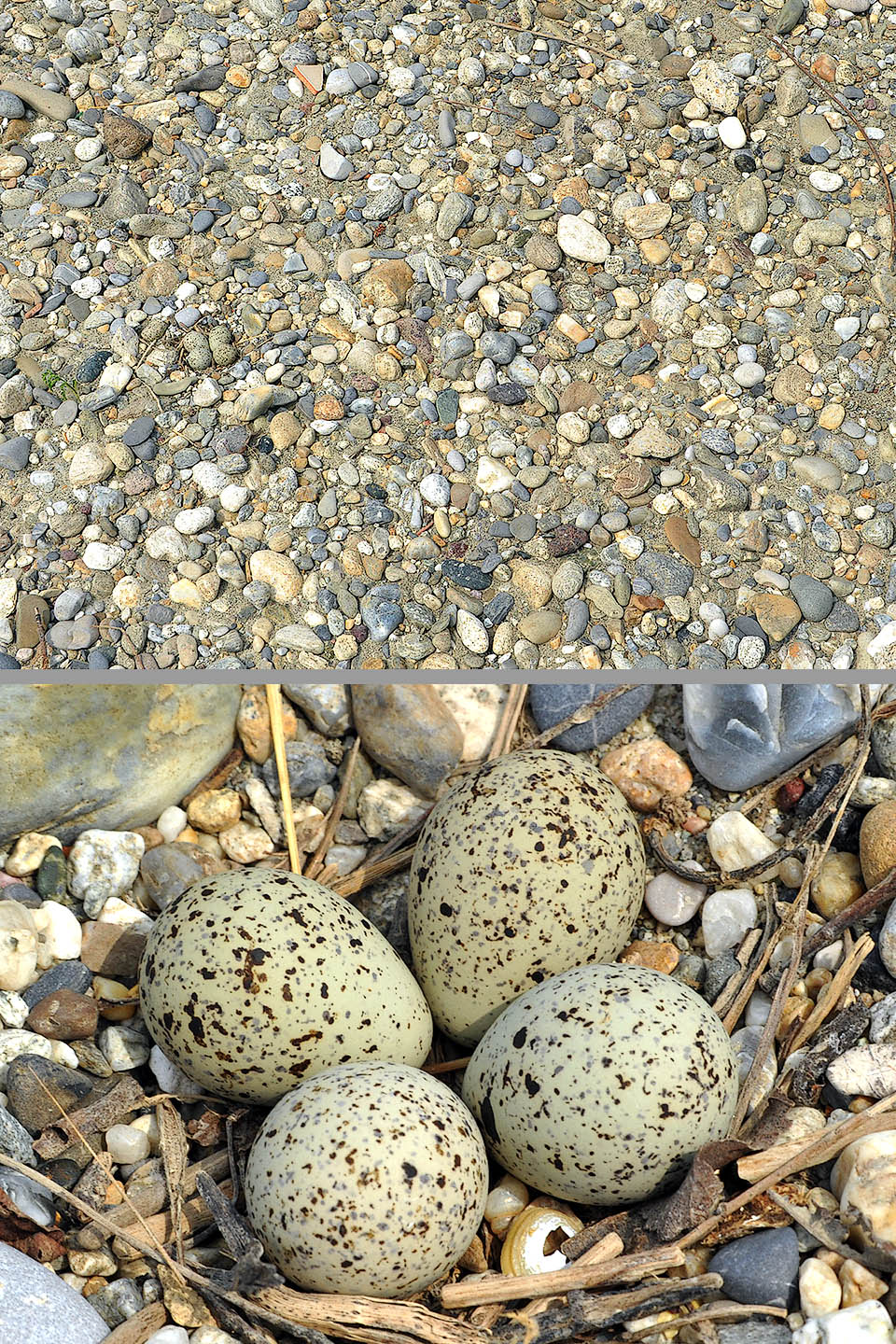
The nest usually with 4 eggs is a small depression dug by the male on the stony riverbed, hardly visible in the overview above © Gianfranco Colombo
Also on the head there is no hint yet of the characteristic black mask, rendering this species difficult to distinguish on the field, from the Common ringed plover as well as from the Kentish plover (Charadrius alexandrinus Linnaeus, 1758), another congener quite resembling in livery and behaviour.
Three subspecies have been identified, they represent the three large groups that form the whole world population of this species: Charadrius dubius jerdoni typical to the Indian subcontinent and Southeast Asia, Charadrius dubius curonicus of Europe, North Africa and Asia up to the Pacific and finally Charadrius dubius dubius of Philippines and north Oceania, the holotype determined by Scopoli in 1786.
Ethology-Reproductive Biology
Nuptial phase courtship is fairly assiduous and persistent for a long time.
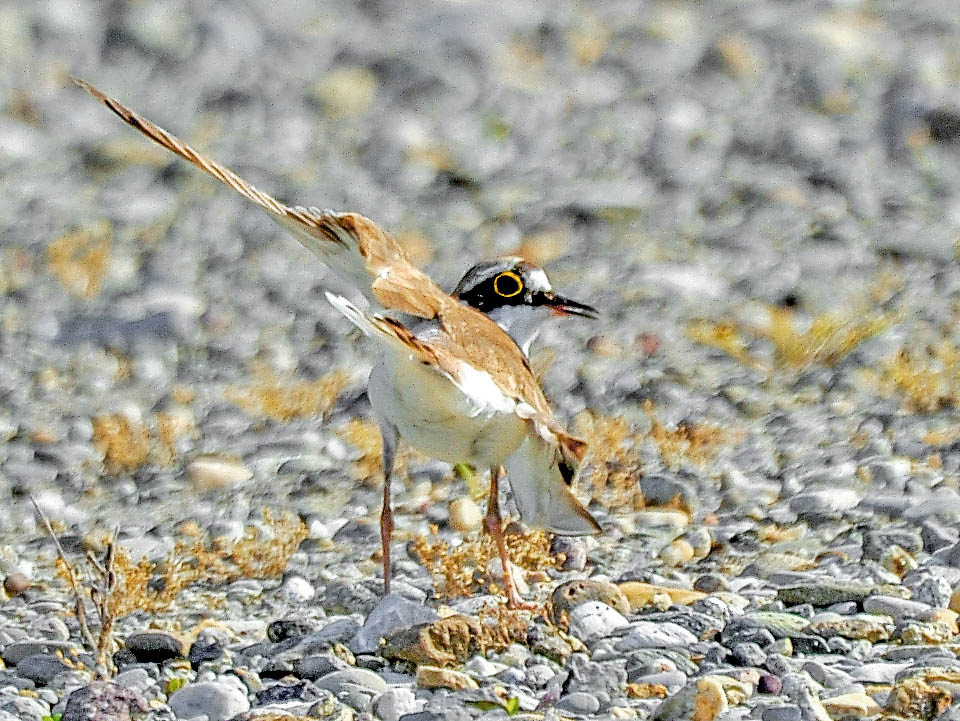
If a predator approaches, females attract it often far from the nest pretending to have a broken wing, and after having led it astray fly away with a lightning leap © Gianfranco Colombo
Also when the couple is formed, the male loves to often repeat the same behaviour perhaps for consolidating the couple’s bond and also for limiting the territory even if already occupied since time. Long chases among the rocks at unthinkable speed, with a rather curved posture, spreading of the wings and of the tail and continuous and boring chirps.
The Little ringed plover is a solitary bird while nesting, even if at times shares, for logistical needs, the same corner of gravel still maintaining a good distance of respect from other couples. Chosen the place where to lay the nest, by the male are dug various and very light depressions between the pebbles and without any material contribution, small lowerings among which the female will choose the preferred one, laying on the bare ground, the usual 4 eggs of cream colour, finely speckled by round small spots of various colour.
Only when on the nest, the partners, both in charge of hatching, add around the depression small pebbles, tiny pieces of wood or even wild rabbit dung, giving a vague but still unthinkable semblance of a nest.
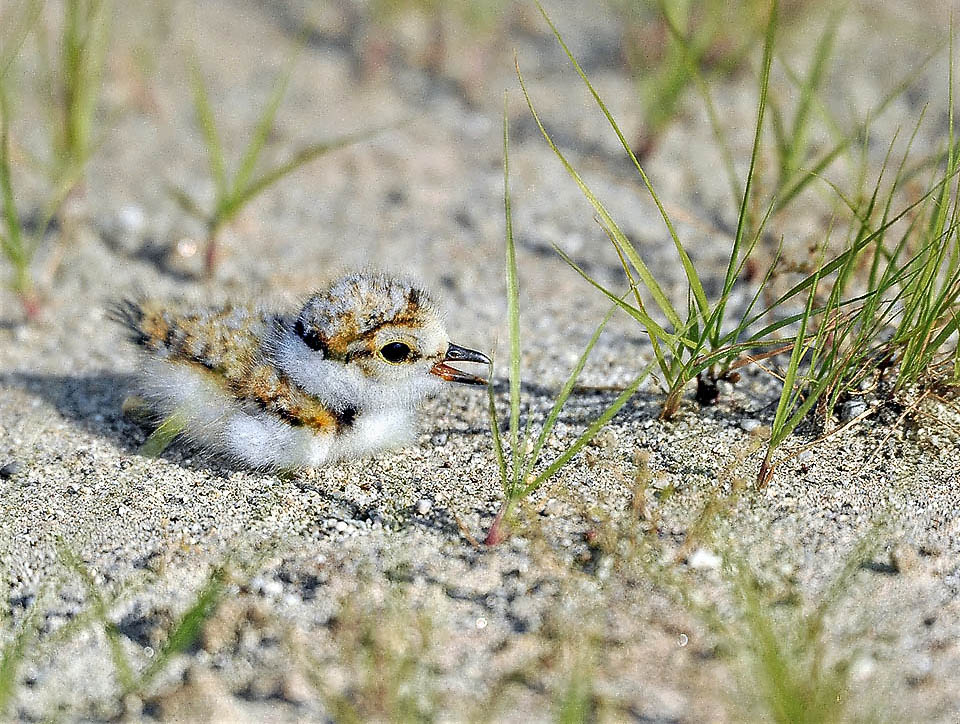
The nidifugous chicks go away immediately just after birth in the surroundings hiding in the vegetation © Gianfranco Colombo
The camouflaging of the nest of a Little ringed plover is incredible! With extreme difficulty and only by observing one of the partners while going to brood, it is possible to discover it. Four little eggs looking exactly like stones, resting on a bed of pebbles having the same colour.
Brooding lasts about three weeks and the chicks leave immediately the nest scattering all around and hiding sheltered by a bigger rock or by one of the few tufts of grass present in these environments. Also the livery of the nidifugous is perfectly integrated into the environment where they hide, rendering them practically invisible and untraceable. In the temperate zones Charadrius dubius may carry out even two nestlings per year whilst in the north of the range it limits to one single brood. The nestlings are followed for some weeks, even if now independent in feeding but not yet able to fly, after which they are abandoned.
A characteristic of this bird is the defense of the nest against land attackers. Once sighted the alleged predator, the Little ringed plover flies practically a few steps far from him and with short jumps and loud voice, drags badly on the ground imitating a bird wounded in a wing, thus attracting the attention of the attacker and taking it far from the nest. After which takes flight with a quick leap and goes away. A trick that in most cases gets the wanted result.
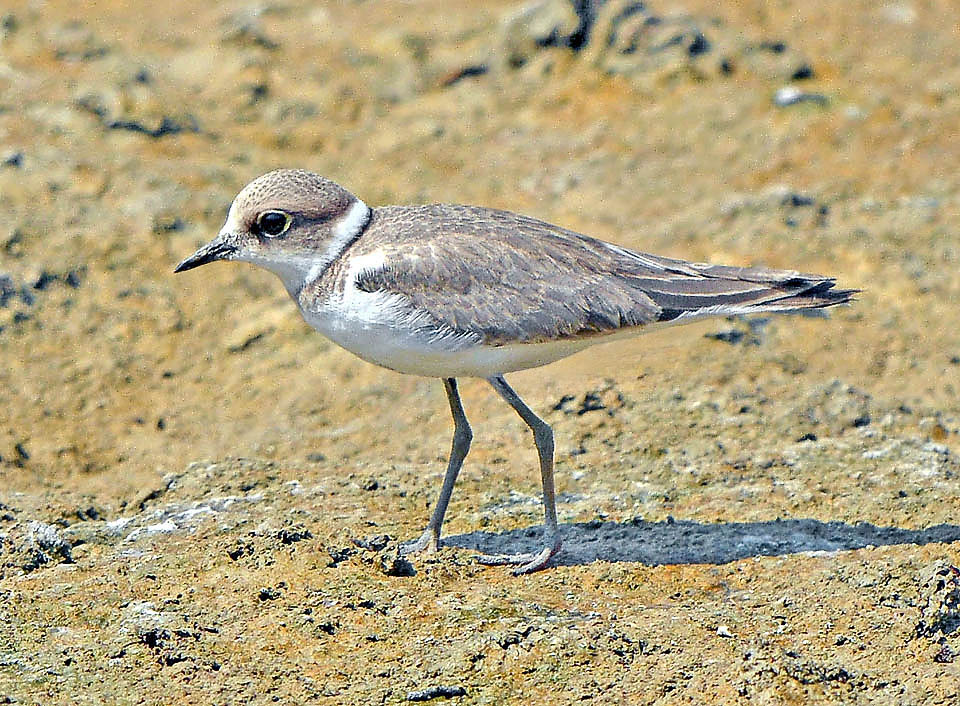
When they learn to fly the juveniles look already like adults, but with a toned down livery © Gianfranco Colombo
Often nesting in apparently dry riverbeds or rivers with limited water levels, frequently the nest is destroyed by sudden overflows and floods, to which, with equal speed, the Little ringed plover provides for a new laying with a replacement clutch.
The main diet of this bird is based on insects, terrestrial or aquatic, small mollusks, micro crustaceans and larvae and only rarely, germinates seeds and plant material.
The population of Charadrius dubius is decreasing of 10% every ten years, but due to the vastness of the territory occupied and the strong consistency of the Russian and Asian populations, from 2025 it appears as “LC, Least Concern”, in the IUCN Red List of the endangered species.
Synonyms
Thinornis dubius Scopoli, GA 1786.
→ For general information about the Charadriiformes please click here.
→ To appreciate the biodiversity within the CHARADRIIFORMES please click here.