
Family : Dermochelyidae

Text © Dr. Giuseppe Mazza

English translation by Mario Beltramini
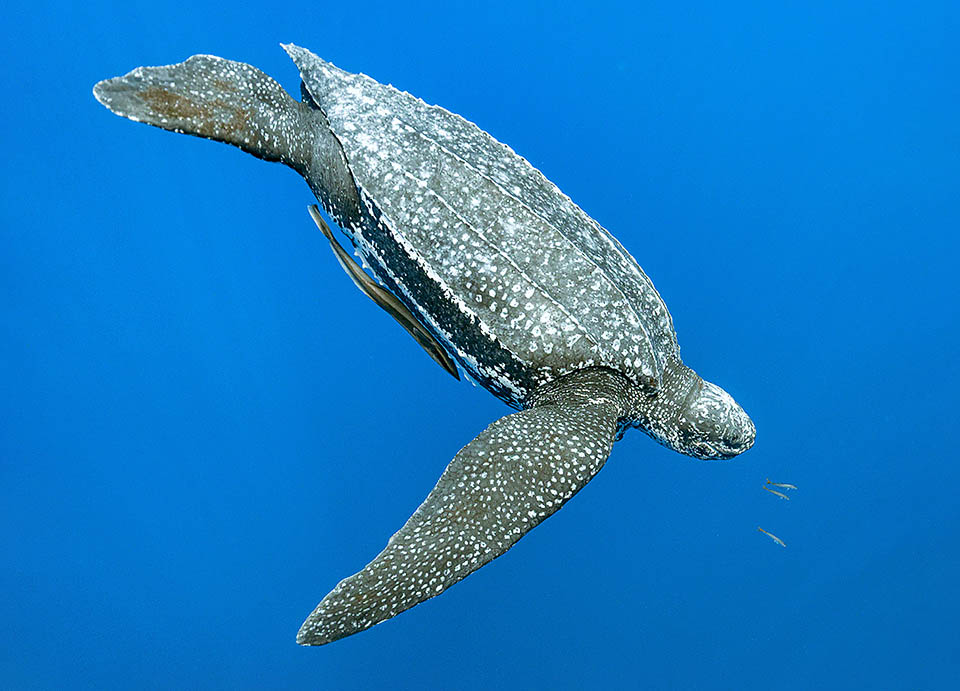
Present in all seas, Dermochelys coriacea is called Lute turtle due to its outline recalling this musical instrument © azure27014
Among the key figures of the oceans exists a reptilian that seems to belong to another evolutionary time. This is the Lute turtle Dermochelys coriacea (Vandelli 1761), the largest extant chelone, able to cross entire ocean basins, to dive to considerable depths and to frequent temperate and cold waters, far from the traditional tropical regions.
Its appearance is immediately recognizable: massive and hydrodynamic body, large front fins and characteristic dorsal covering, that, unlike that of the other marine turtles, does not display the typical rigid horny plaques. The back is covered by a thick coriaceous skin, supported by a structure of small bony elements and crossed by seven evident longitudinal ridges.
The scientific name rightly describes this peculiarity. Dermochelys comes from the Greek “derma”, skin, and “chelys”, turtle; the specific epithet coriacea instead recalls the Latin “corium”, leather, referring to the consistency of the body covering, whilst the common name of Lute turtle associates with this musical instrument its elongated shape, quite different from the other chelones.
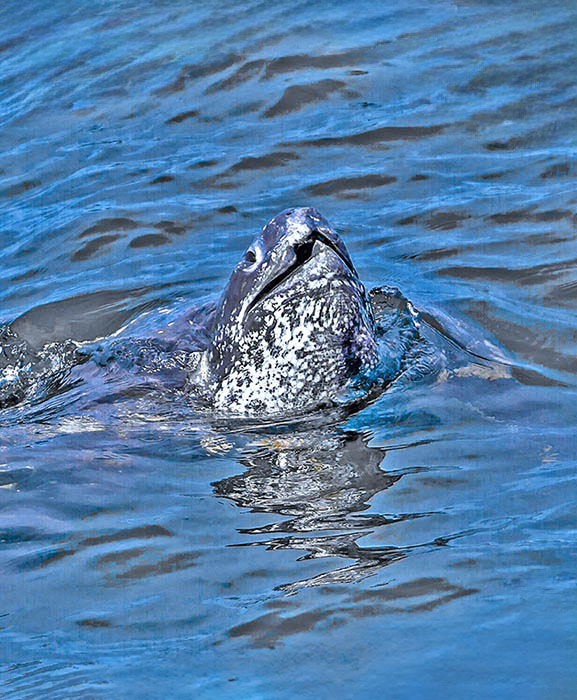
Like all reptiles breathes with lungs and therefore must periodically come to surface for air © Audrey Whitlock
From the evolutionary point of view, it represents a particularly old and distinct line. In fact, it is the only extant species of the family of the Dermochelyidae, separate from the family Cheloniidae, to which belong the other present marine turtles.
Originally the species was described by Domenico Agostino Vandelli with the name Testudo coriacea. The presently accepted denomination maintains the genus Dermochelys, established subsequently, and the original specific epithet.
The distinction of the family Dermochelyidae underlines an independent evolutionary history, characterized by anatomical and physiological adaptations that have allowed this turtle to occupy a particularly ample ecological niche in the oceanic environments.
Zoogeography
Dermochelys coriacea presents a cosmopolitan distribution, extended to the Atlantic, Pacific and Indian oceans. It frequents tropical subtropical and temperate waters, even reaching high latitudes, where the sea temperatures are relatively low.
This exceptionally wide distribution is strictly linked to its migratory capabilities and to the physiological adaptations that allow it to retain its body heat.
The feeding areas do not necessarily coincide with the reproductive ones. The adults may cover thousands of kilometres between the nesting tropical regions and the temperate oceanic zones, following the seasonal distribution of the prey.
The main reproductive areas are located on the coasts of western Atlantic, western Africa and of Pacific. The populations belonging to the different oceanic basins present different migratory routes and genetic characteristics, important for their conservation management.
In the Mediterranean the species is present with occasional reports, but does not constitute a nesting population comparable to those of the main tropical regions.
As a consequence its distribution is strictly linked to the food availability, the marine currents and to the oceanographic conditions. The Liuto turtles can move towards cooler regions rightly for exploiting the concentrations of gelatinous organisms that form the main component of their diet.
Ecology-Habitat
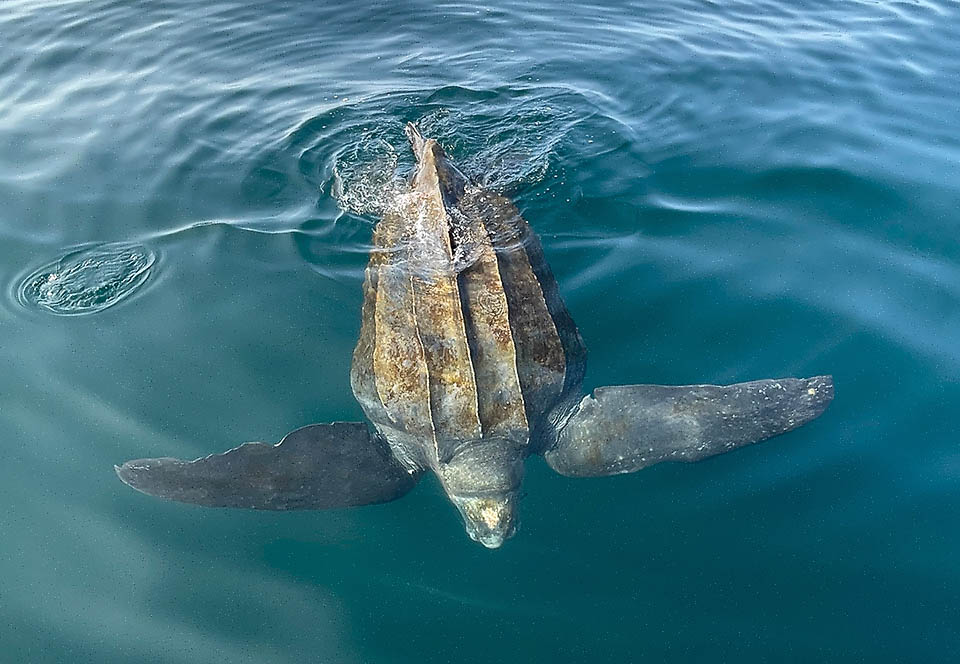
The adults carapace exceeds 150 cm. The spreading of the fins may attain 2,7 m and the thick coriaceous skin is crossed by seven showy longitudinal keels © gretchenmcp
Dermochelys coriacea is a mainly pelagic species, especially linked to the oceanic environments. It spends most part of its life in the open sea, but also frequents the coastal waters, especially where the prey do concentrate.
Its diet presents a marked specialization to the gelatinous organisms. The main prey are represented by jellyfish, ctenophores and pelagic tunicates. This specialization clearly distinguishes the species from many other marine turtles, characterized by more diversified diets.
The jellyfish form a particularly important food resource, despite their relatively low energy content. In order to satisfy its own metabolic requirements, the Lute turtle must ingest considerable quantities of them, following the areas of greater availability. In this regard is interesting the connection with Cyanea capillata, the spectacular Lion’s mane jellyfish.
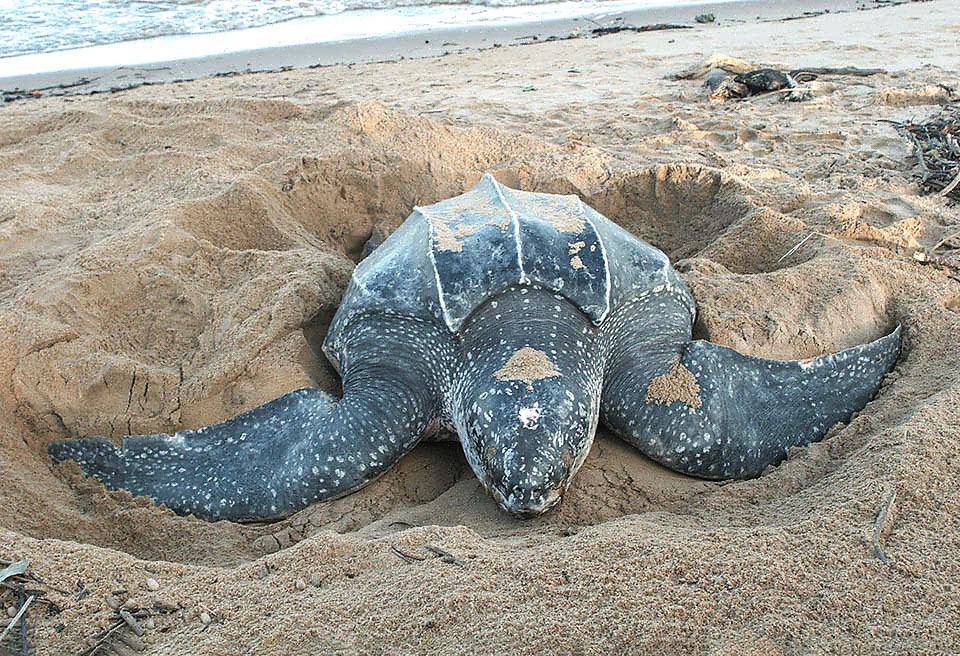
Matings occur at sea and the females reach for deposition the sandy tropical and subtropical beaches © Kristof Zyskowski
This great species of cnidarian, widespread especially in the cold waters of the northern hemisphere, has been documented among the prey of the Lute turtle. Studies done by means of video cameras attached to the animals have highlighted the importance of this species in the diet of some individuals observed in the waters of Nova Scotia.
It is a particularly significant ecological connection: two organisms belonging to quite different zoological groups, a planktonic cnidarian and a large marine reptilian, result directly associated by a dietary relationship.
The search of prey may take place at different depths. Dermochelys coriacea is in fact an excellent swimmer and can perform deep dives, even exceeding 1.000 metres. During these excursions it explores different levels of the water column, by taking advantage of the vertical distribution of the gelatinous organisms. Its dietary specialization, however, entails a vulnerability: the floating plastic bags can be confused with the jellyfish and accidentally ingested, causing serious consequences.
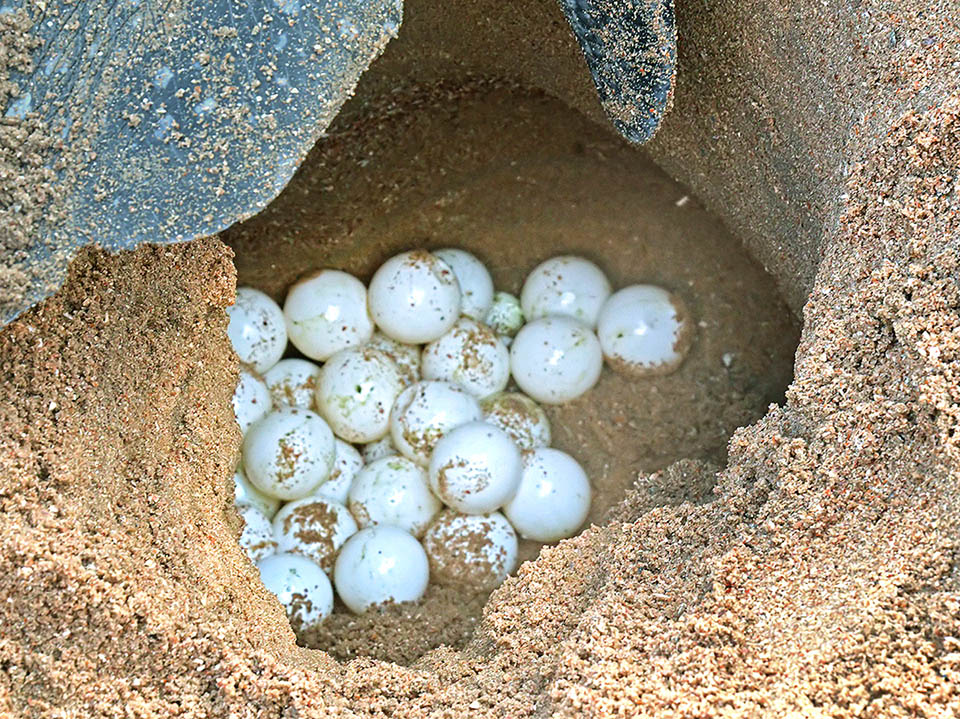
They dig a hole that then is carefully closed to protect dozens of eggs and to keep them at ideal temperatures for incubation © Hans Hillewaert
Morphophysiology
Dermochelys coriacea is the biggest extant chelonian. The adults attain common lengths of the carapace of more than one metre and a half and may exceed 500 kg of body mass, with exceptional dimensions even greater.
The body is elongated and hydrodynamic, suitable for sustaining long journeys in a pelagic environment.
The most evident anatomic characteristic is the carapace, which does not display the hude horny plaques typical of the other marine turtles. The dorsal structure is formed by several small bony elements embedded in a connective tissue matrix, covered by a thick resistant skin. On the surface we note seven longitudinal ridges running along the back.
The colouration is generally dark, from black to bluish-grey, with paler dots irregularly distributed on the body.
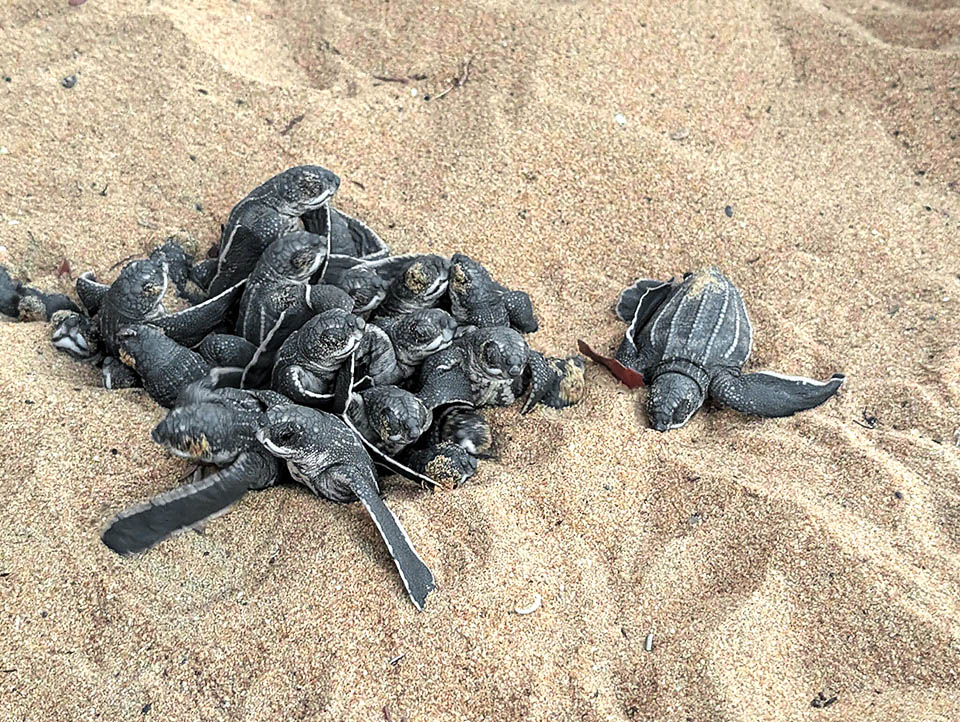
They hatch suddenly all together and the babies head quickly toward the sea © uzluz
The forelimbs are transformed into large swimming fins, clawless, that form the main propulsion system. The overall wingspan may attain about 2,7 m. The hind limbs, smaller, contribute to the stabilization and to the control of the direction.
Also the digestive system presents specific adaptations. The jaws are equipped with pointed margins, whilst in the oral cavity and in the esophagus are located posteriorly directed horny papillae. These structures facilitate the seizing and the swallowing of the gelatinous prey, preventing them from easily sliding outward.
A particularly interesting physiological aspect is the capacity of maintaining a body temperature higher than that of the surrounding water. Despite being an ectothermic reptilian, the Lute turtle has characteristics that favour the conservation of the metabolic heat.
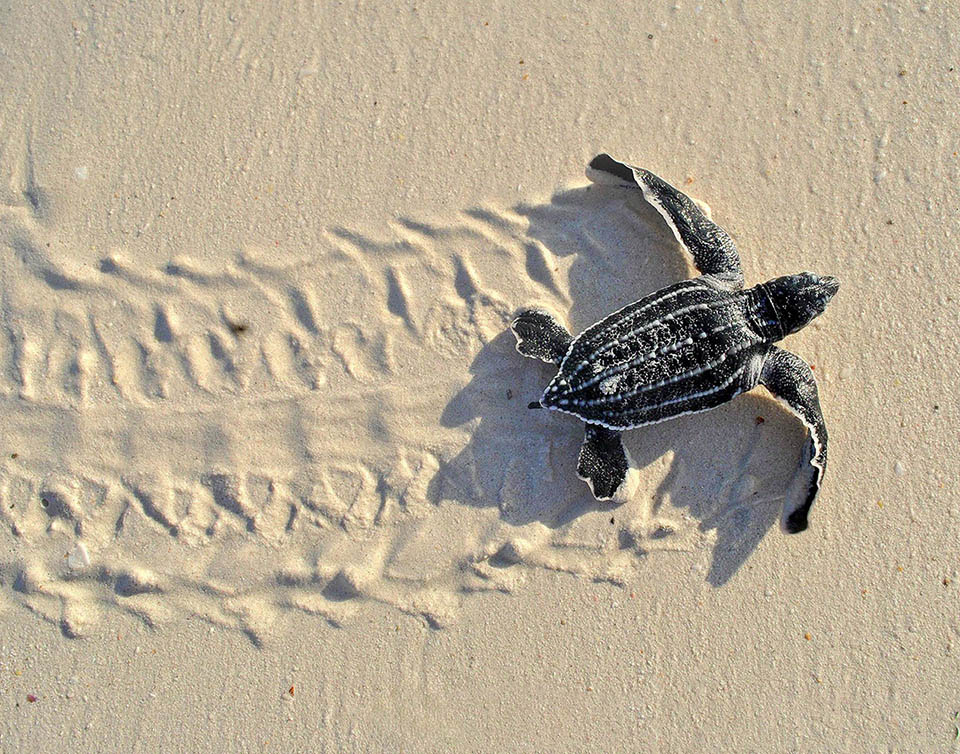
While crossing the beach is in fact high the risk of being preyed upon © Luis Díaz-Gamboa
The large body size reduces the ratio between surface area and volume, limiting the heat loss. To this we have to add a thick layer of adipose tissue and countercurrent heat exchange mechanisms in the peripheral tissues. These adaptations associated with the metabolic and muscular activity, allow the species to frequent relatively cold waters, expanding significantly its ecologic range. Like all reptilians, it breathes using lungs and must periodically reach the surface. The capacity of storing oxygen and of regulating metabolism during the dive however allows it to remain underwater for extended periods.
Ethology – Reproductive Biology
The life of Dermochelys coriacea is characterized by long oceanic movements and by periodic returns in the nesting beaches. The adults carry on mainly a solitary life, meeting at sea during the reproductive period.
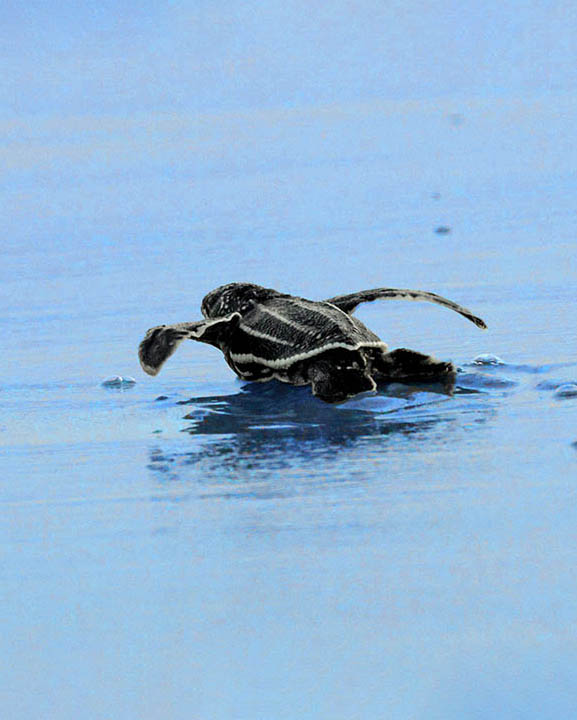
But even among the waves they are not completely safe © Kevin
Matings occur in a marine environment. Later on, the females reach the sandy tropical and subtropical beaches where the deposition will take place.
Sexual maturity is reached after a long growth period, usually over the course of several years, with differences linked to the populations and to the environmental conditions.
Usually the female reaches the beach during the night hours, crosses the water’s edge and locates a sandy area suitable for the construction of the nest. Utilizing the hind limbs, digs a cavity deep enough for protecting the eggs during the incubation.
Every deposition usually includes several dozen eggs, often around a hundred, to which add some smaller yolkless eggs. A female can lay several depositions during the same reproductive season, separated by intervals of aboud nine-ten days.
Once the deposition is completed, the turtle carefully covers the nest and gets back to sea.
Incubation usually lasts about two months, but its duration depends on the environmental conditions, especially on the sand temperature.
As occurs in numerous reptilians, the sex of the babies is determined by the temperature of incubation. Relatively high temperatures favor the development of females, whilst lower temperatures favour that of the males.
This mechanism renders the species particularly sensitive to climate changes. The increase of the temperatures in the nesting beaches may alter the ratio between the sexes and, under extreme conditions, compromise embryonic development.
At hatching time the babies break the shell and begin to ascend collectively toward the surface. Once emerged from the sand, they orient themselves towards the sea, starting one of the most difficult stages of their existence.
The walk towards the water’s edge exposes them to numerous predators. Also after having reached the water, teh mortality keeps high. Fish and frigatebirds are, in fact, lying in wait.
The surviving juveniles move progressively further away from the coast and reach the oceanic environments, where they will continue to grow until maturity. The early stages of their life are still relatively poorly known, especially for what concerns the movements and the use of the habitats.
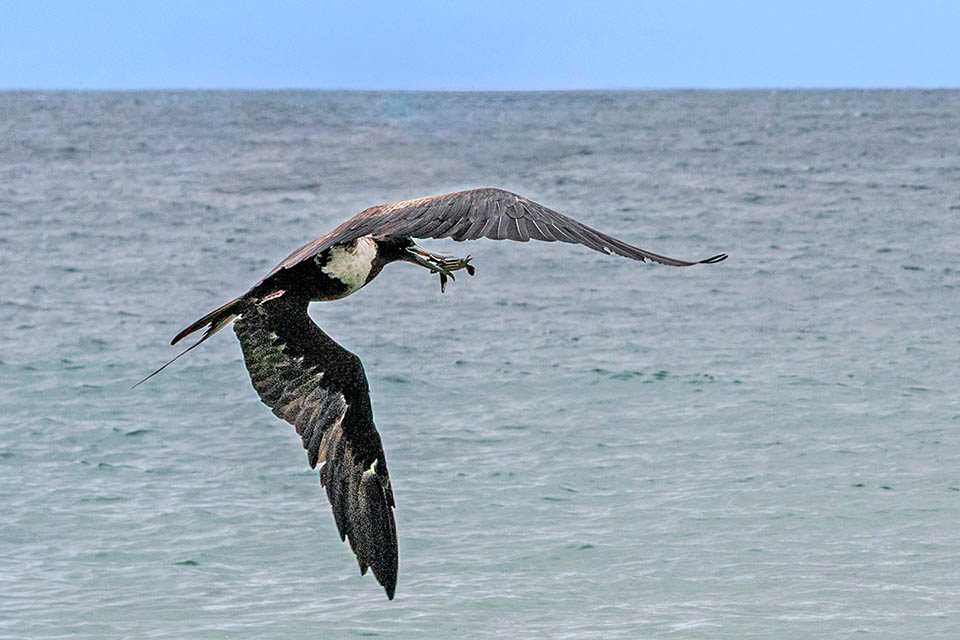
Seabirds are on patrol and this Fregata magnificens has just seized an unfortunate © Breathe Sail Dive – Jason Spitz and Monica Schandel
After many years, the adult females will come back to the reproductive areas to give rise to a new generation.
Nowadays the species must face numerous threats of anthropic origin: accidental catches in the fishing nets, alteration of coastal habits, artificial lighting of beaches and climate changes. The conservation of Dermochelys coriacea consequently requires an integrated protection of the oceanic environments and of the reproductive beaches, two inseparable components of its biological cycle. Populations are declining, and it is classified as “EN, Endangered“ on the IUCN Red List.
Synonyms
Testudo coriacea Vandelli, 1761; Testudo arcuata Catesby, 1771; Testudo lyra Lacépède, 1788; Chelonia lutaria Rafinesque, 1814; Sphargis mercurialis Merrem, 1820, Sphargis coriacea Gray, 1831, Dermochelys coriacea schlegelii Garman, 1884.
The previous subdivisions in subspecies, in particular those referred to the Atlantic and Indo-Pacific populations, are not currently recognized in the present classification.
→ For general notions about Testudines please click here.
→ To appreciate the biodiversity within the TURTLES please click here.