
Family : Plantaginaceae

Text © Prof. Pietro Medagli

English translation by Mario Beltramini
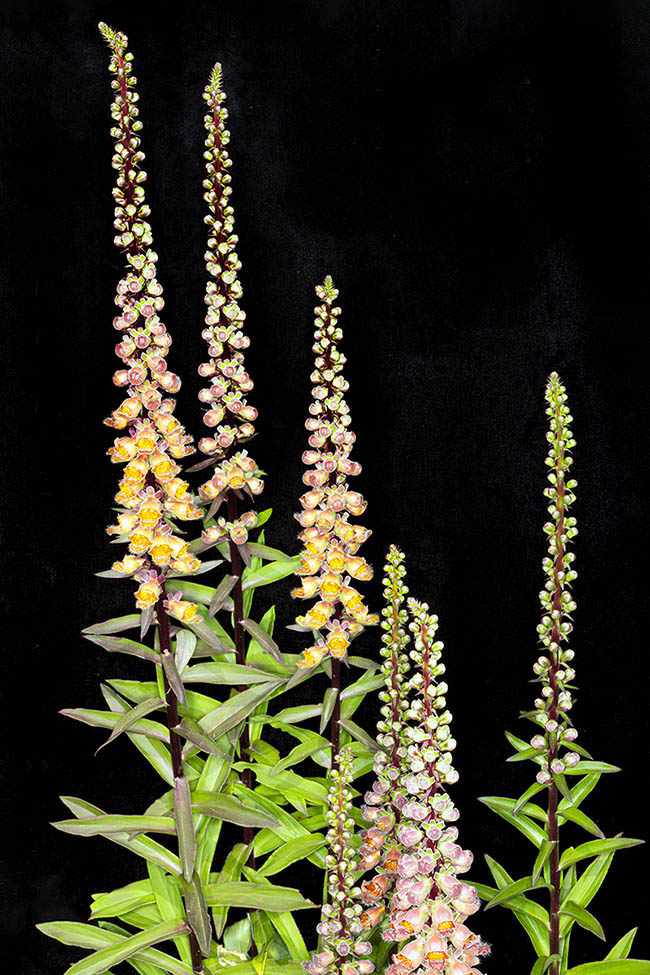
Digitalis ferruginea grows from 500 to 1700 m of altitude in north-eastern Mediterranean © Dr. Giuseppe Mazza
Digitalis ferruginea L. Sp. Pl.: 622 (1753) is a scapose hemicryptophyte, that is, a perennial grass with the aerial part drying up every year keeping alive only the basal parts, it’s consequently a perennial species with buds located at the level of the ground.
From the distribution point of view it is a perennial orophyte present at altitudes between 500 and 1700 m with north-eastern Mediterranean range and distribution.
It grows in coppices, forest clearings, pastures and among the ferns that occupy the abandoned lands of the mountain range.
All species of Digitalis contain a group of cardiac glycosides (digitalin) as strong as the digitoxin, lanatoside C and others, used in cardiology for heart failure and for rhythm disturbances, but extremely poisonous if used incorrectly, requiring medical caution.
These compounds in fact influence the cardiac contractility with cardiotonic effect, but excessive dosage may lead to serious poisonings, even fatal.
Presently they are active ingredients synthesized in the laboratory used in the pharmaceutical industry.
For what concerns the etymology the generic name Digitalis in Latin means “of the finger” due to the shape of the corolla.
The specific term ferruginea, “of rusty colour” in Latin, is a clear reference to the red-brownish look of the flowers.
Also the common names evoke this colouration: in Italian, Digitale bruna; in German, Rostfarbirger Fingerhut; in English Rusty foxglove; in Spanish Digital roja and in French Digitale ferrugineuse.
Digitalis ferruginea is a biennial herbaceous plant with erect stem, glabrous or very little ramified, usually reddened, from 50 to 120 cm tall, emitted during the second year of life.
The roots consist of a main taproot and of other secondary smaller ones.
During the first year the leaves of the Rusty foxglove are merged in a basal rosette, whilst during the second develop also the caulines.
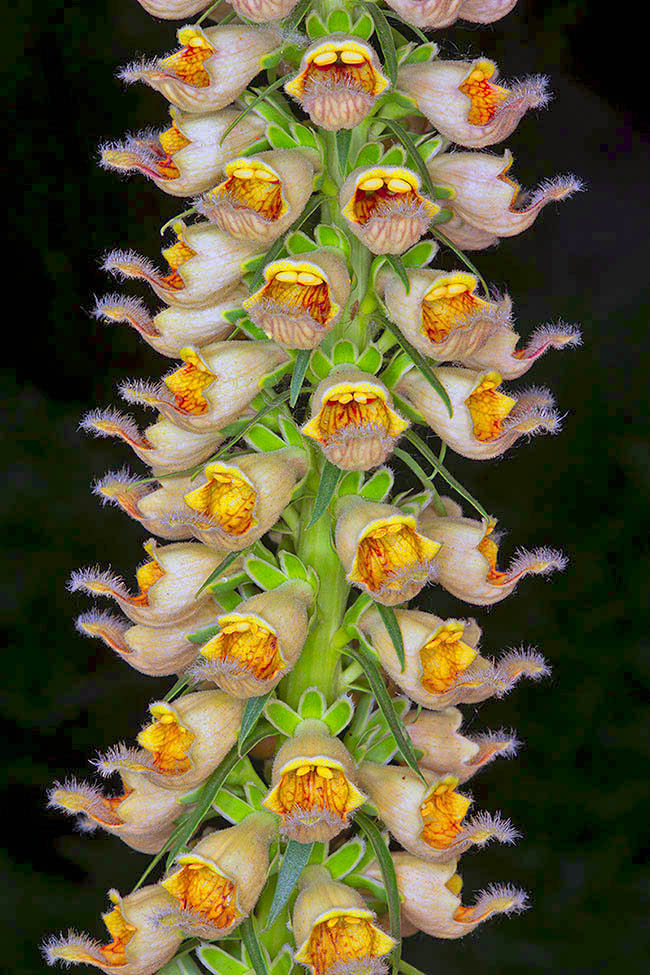
The flowers, sited at the bracts axilla, are hermaphrodite and only partially at bilateral symmetry © Dr. Giuseppe Mazza
The first ones are linear-spatulate, with base gradually narrowed into a petiole, 2-3 cm broad and 10-20 cm long, with sharp edge, with 7-9 well evident veins and almost subparallel, evident also in the upper pagina of the leaf.
They are characterized by an entire or toothed margin, with fne down on the borders and on the veins of the lower pagina.
The cauline leaves are similar to the basal ones, but gradually result smaller proceeding upwards and without petiole.
In the inflorescence the floral leaves get the function of green bracts, long and linear.
The flowers are located at the axilla of the bracts.
They are hermaphrodite and only partially zygomorphic, that is with bilateral symmetry.
They appear inserted, individually and on every side of the stem, by means of a short peduncle accompanied by a lanceolate bract, arranged in a very long raceme and arranged horizontally.
The petals are merged in a bell-shaped 13-16 mm corolline tube that presents, at the fauces, some free lobes.
One of the main characteristics of Digitalis ferruginea is the ochre colour of the corolla displaying a brownish reticulum.
Therefore, overall, the ochre colour and the reticulum confer the flower a rusty appearance.
The corolla displays some very small hairs.
The calyx has 5 sepals merged at the base ad presents elongated teeth, with truncated or rounded apex and with whitish and purple edge and the median lobe of the lower side of the corolla is remarkably protruding from the sides and is completely barbate and 9-12 mm long.
Every flower of Digitalis ferruginea has four stamens carried on the top of a reddish filament that gets whitish at the apex, inserted on the corolla at the base of the ovary.
The anthers are yellow and the filament, presenting a knee in the lower third, is of wine red colour turning white towards the apex.
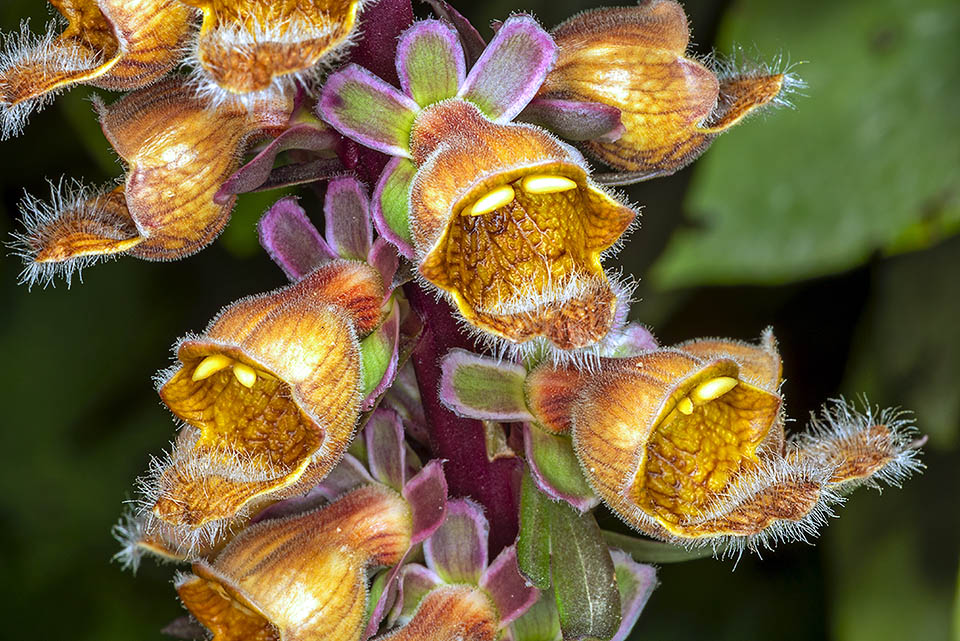
The corolla has tiny hair, and the calyx 5 sepals with whitish or purple edge. The low side of the corolla, wholly barbate, is remarkably protruding compared to the laterals © Dr. Giuseppe Mazza
The greenish ovary is surmounted by a whitish style getting thinner towards the stigma. The stamens and the style with the stigma are wholly contained inside the corolla without protruding externally.
The blooming takes place in June-July and the flowers are pollinated by the insects, originating, when ripe, one fruit formed by one conical capsule with apical rostrum, formed by two valves containing numerous seeds.
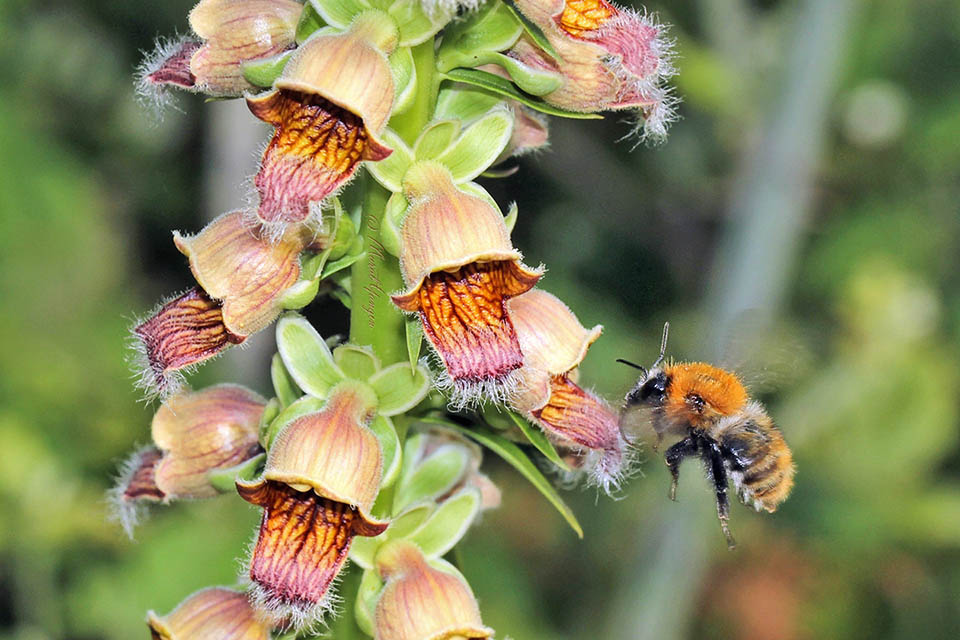
Blooming occurs in June-July and pollination is entrusted to insects, like this bumblebee © mrtyngn
It is a species that gives rise to confusion, in fact similar to Digitalis ferruginea stands only Digitalis laevigata W. et D. (Grecian foxglove) that, however, is very rare and is found in the Trieste Karst, in particular in the Rosandra Valley, from which gets the name of Rosandra foxglove.
The utilization in pharmacy and in popular medicine is surely linked to the Digitalis purpurea that is a plant to be handled with extreme caution and to be excluded from the popular utilization.
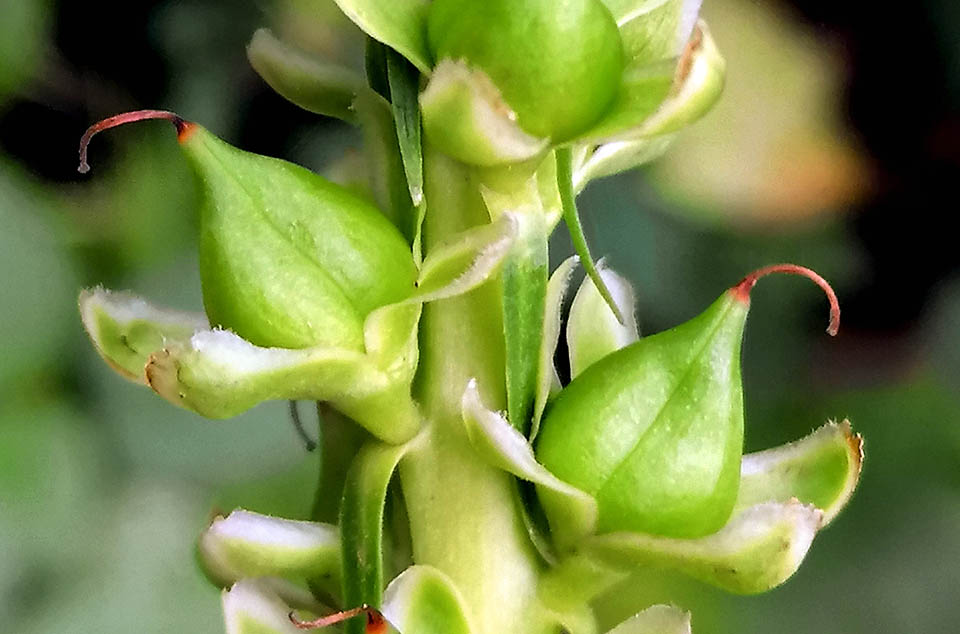
The fruit is a conical capsule with apical rostrum, formed by two valves full of seeds © Markus Ackermann
It seems that also Digitalis ferruginea has similar properties, but it should not be employed as medicinal plant and not even for other purposes, in fact several species of foxgloves are used as ornamental plants, above all Digitalis purpurea and Digitalis grandiflora Miller due to their tall and slender posture and the attractive colouring, whilst, conversely, Digitalis ferruginea, maybe due to its not too bright colours, doesn’t seem to attract a particular ornamental interest.
Among the 27 species belonging to this genus only 7-9 are commonly grown in the European gardens, but under different common names, usually erroneous and mainly referable only to two species, that is Digitalis purpurea and Digitalis grandiflora.
→ To appreciate the biodiversity within the PLANTAGINACEAE please click here.