
Family : Tetraodontidae

Text © Giuseppe Mazza

English translation by Mario Beltramini
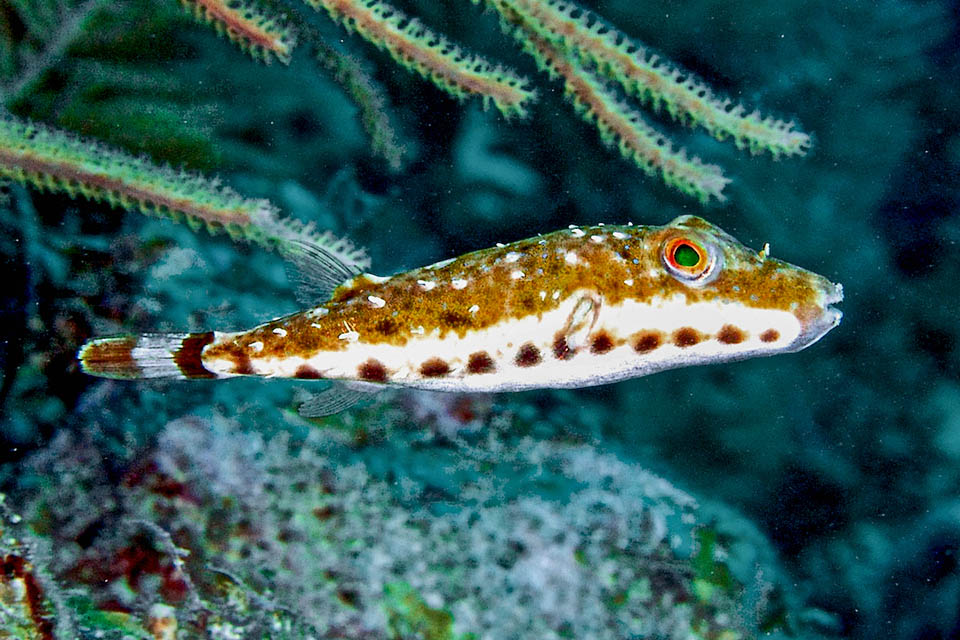
About twelve cm long, Sphoeroides spengleri is a small American fish having a vast range from Massachusetts coasts up to Santa Catarina in Brazil © www.carlosestape.photoshelter.com
It seems impossible that a fish having a slender and elongated profile like Sphoeroides spengleri ( Bloch, 1785 ) may swell suddenly transforming in a ball.
This incredible ability places it into the family of the Tetraodontidae counting about 200 species, mainly marine but with some freshwater exceptions, inserted in the vast order of the Tetraodontiformes, close to others, no less well-known like Aracanidae, Balistidae, Diodontidae, Molidae, Monacanthidae and Ostraciidae, that show well the biodiversity of these ray-finned fishes, belonging to the class of the Actinopterygii.
The genus Sphoeroides originates from “sphaera”, ball, sphere, and “oides”, having the shape of, with reference to this rounded appearance, when the fish swells with air or water.
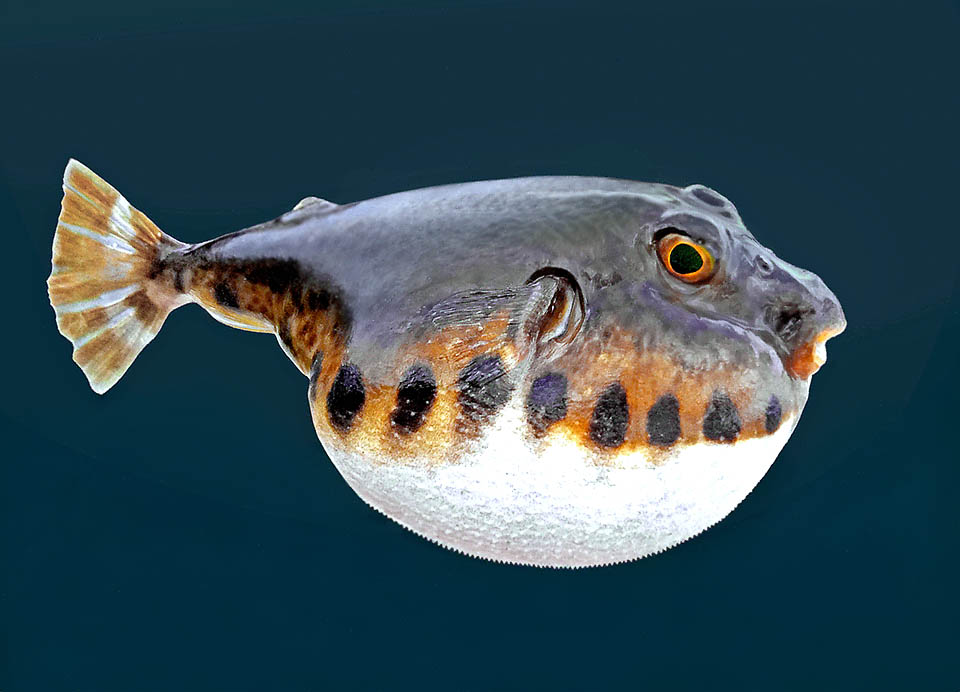
Slim when resting, it is actually a small puffer inflating in front of the predators for not being swallowed © Ronnie Blox
Conversely, the specific term spengleri, of Spengler, recalls the naturalist Lorenz Spengler (1720-1807) of Copenhagen, who sent the type specimen for the description to his friend and colleague Bloch.
Zoogeography
Replaced by the analogous Sphoeroides marmoratus of eastern Atlantic, Sphoeroides spengleri lives in the western Atlantic with a vast range from the Massachusetts coasts up to Santa Catarina in Brazil.
Ecology-Habitat
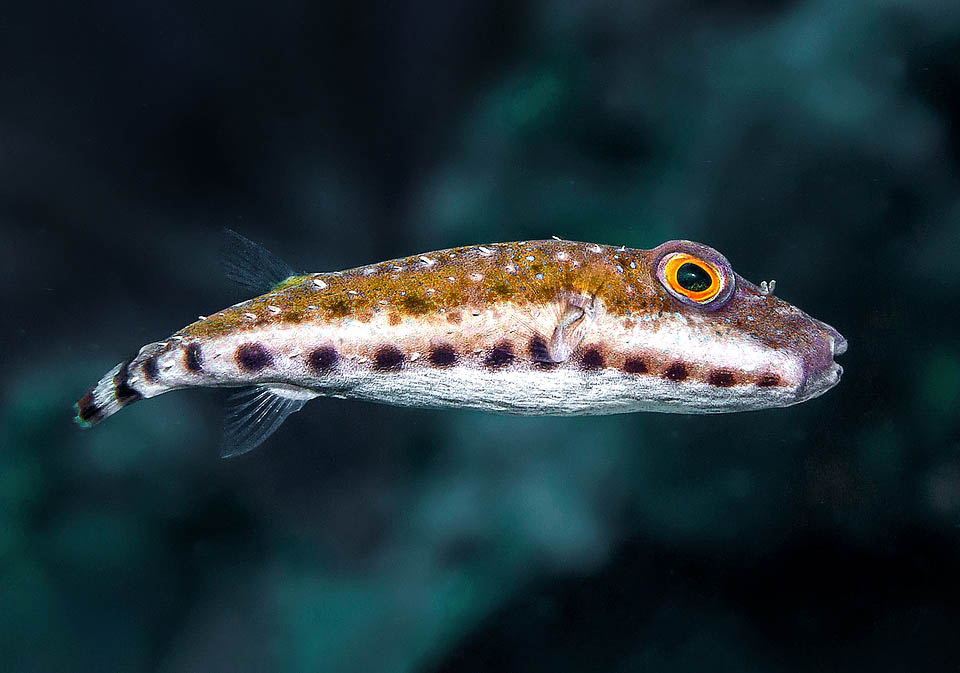
Its livery is very variable due to the chromatophores, but is recognized at first sight due to the typical black spots on the sides © www.carlosestape.photoshelter.com
Usually it is found between 2 and 70 m in depth, at temperatures between 22,5 and 28 °C, on sandy seabeds but more frequently sheltered by the large madreporic formations or among the roots of mangroves and submerged prairies of marine phanerogams that offer at the same time hiding places and preys.
Morphophysiology
Sphoeroides spengleri may exceptionally reach the length of 30 cm, with a current size of 12 cm.
The body, oblong and scaleless, is protected by dilatable hard skin and the head, short, has the eyes placed high on the sides.
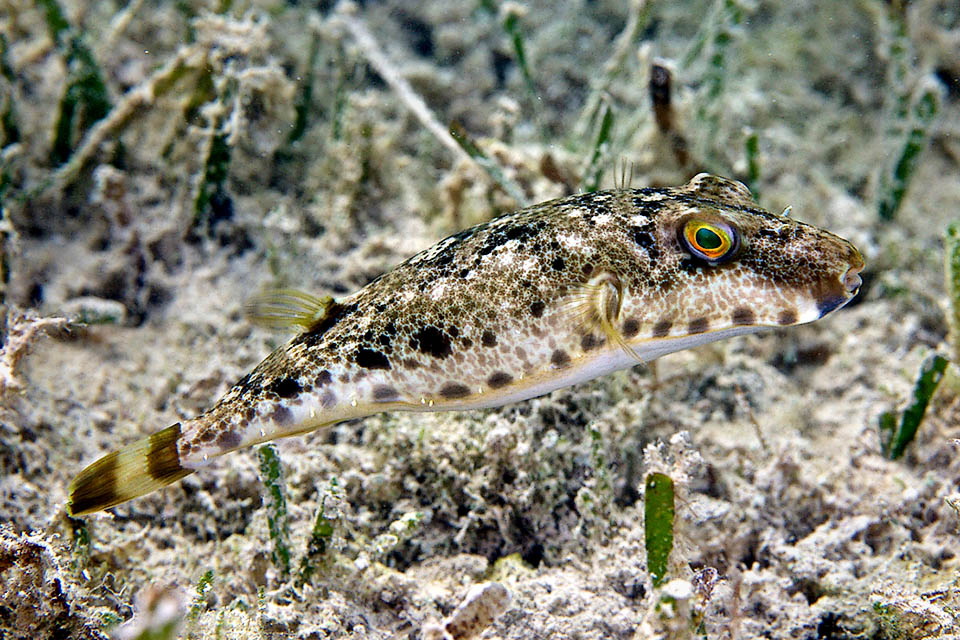
It mainly feeds on echinoderms, mollusks and crustaceans it by ambush seizes blending in the seabeds © www.carlosestape.photoshelter.com
The jaws end in the robust beak typical to the Tetraodontidae formed by 4 powerful teeth fused together, over and under, in 4 plates with a suture at the centre. The gill opening is a fissure close to the base of the pectoral fin.
There are no pelvic fins, and all fins are soft, which means spineless. The dorsal has 8 rays, the anal 7, the pectoral ones 13-14 and the caudal 10.
We note small prickles, present on the ventral side and part of the sides, and scattered flaps of skin that accentuate the camouflage effect of the livery. This is usually pale brown, grey or olive green on the back, with irregular bright or dark spots, and ventrally cream with lined up large dark dots that render unmistakable this fish. They go from the head to the caudal fin, often bent with two dark bars.
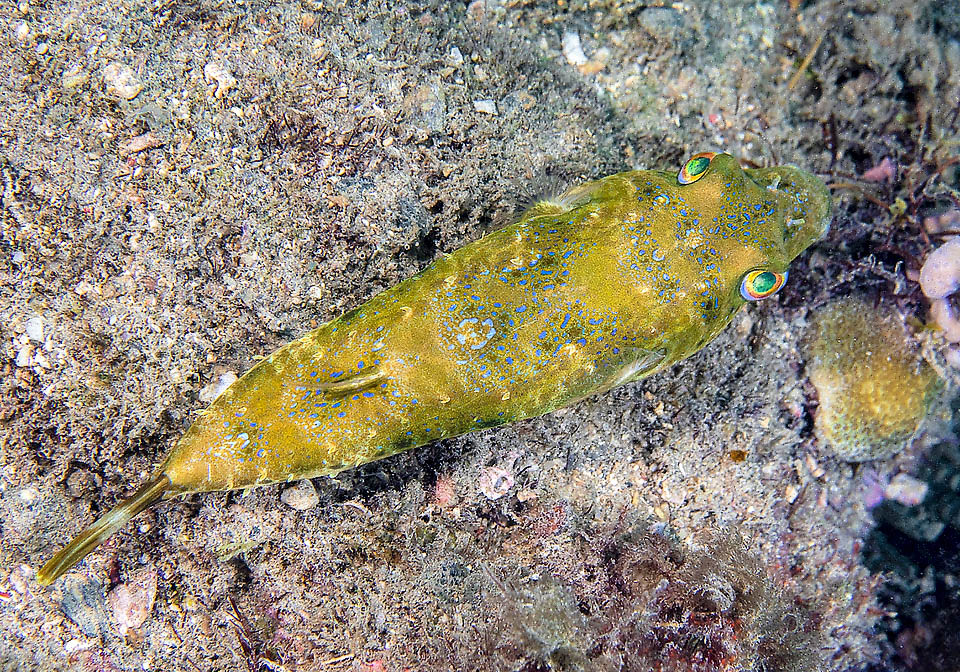
Unusual view from above. Snout is short with showy nostrils and eyes protruding above the head. Colours completely change due to the chromatophores © www.carlosestape.photoshelter.com
Moreover, Sphoeroides spengleri can change its colours quickly, contacting or dilating the chromatophores, the cells of the skin that contain the pigments, to go hunting camouflaged by ambush or hiding from the view of the predators avoiding, as soon as possible, to get puffed up as this surprising defense weapon has a high energy cost.
If, despite everything, it is swallowed, there is then a second very effective weapon. The internal organs and the skin are in fact soaked in a powerful poison, the tetrodotoxin that inhibits breathing, and if the predators that have swallowed them do not pass away, they at once learn to respect the species in order not to repeat such unpleasant experience.
Ethology-Reproductive Biology
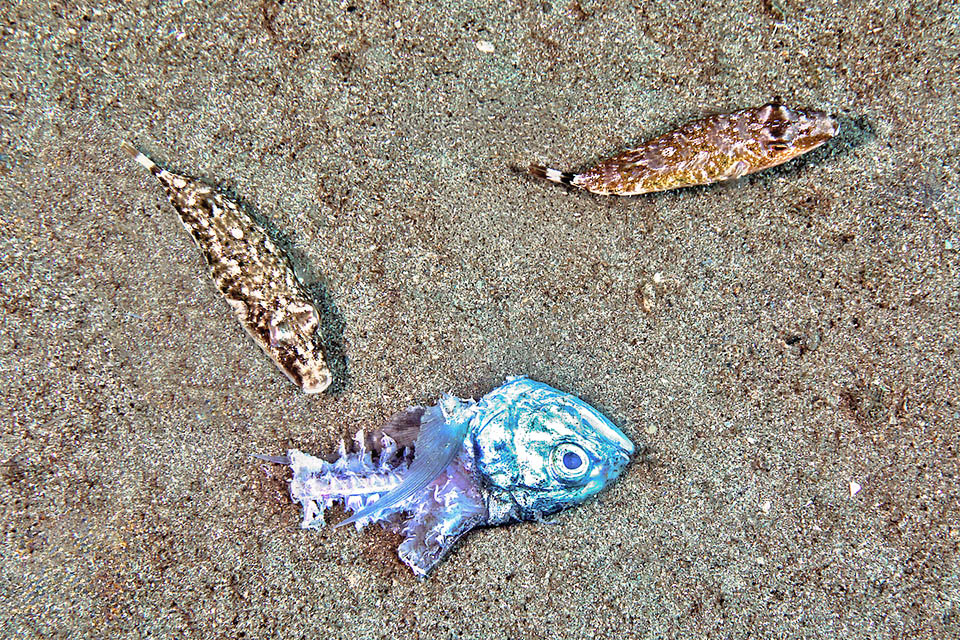
Sphoeroides spengleri feed also on dead fishes carcasses it finds on the seabeds, starting from the small worms often surrounding them attracted by odor © www.carlosestape.photoshelter.com
Sphoeroides spengleri feeds on echinoderms, mollusks and crustaceans it catches by ambush, but is also an opportunist that strips the flesh off of the carcasses of the dead fishes present on the seabeds, quite often surrounded by small worms, attracted by the odour, that are immediately devoured as appetizer.
The sexual maturity is reached 12-18 months after its birth when it is about 10-12 cm long. During the reproductive season, which coincides with the warmest months, the males become territorial and attract the attention of the females with intense colours and vibrations of the body.
The females, slightly bigger, repeatedly lay on the seabeds 200-500 spherical eggs which the male quickly fecundates as they are floating.
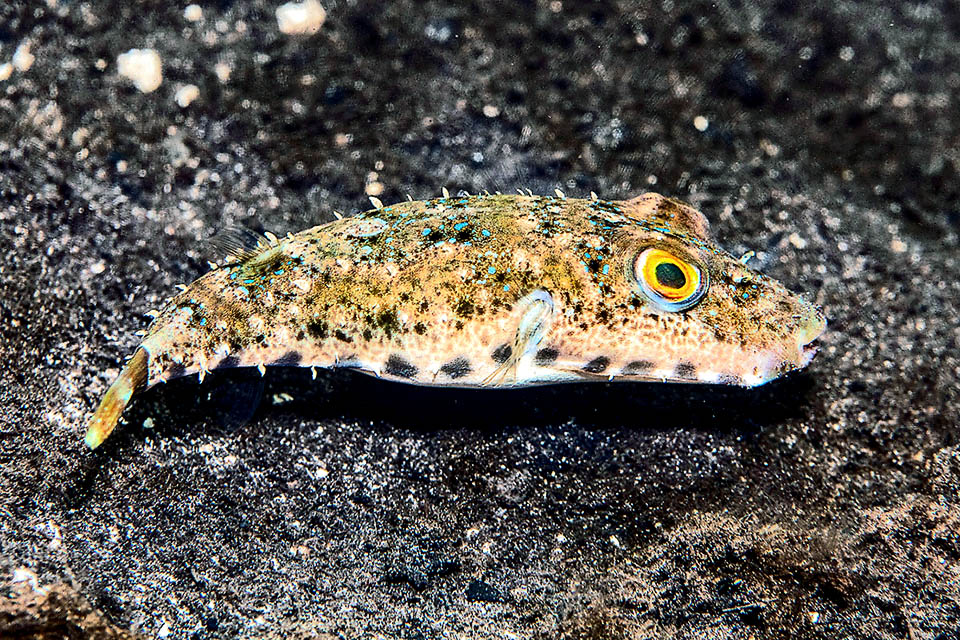
In reproduction time the males get territorial with intense colours. The eggs are laid and fecundated on the seabed but at once reach floating the surface © www.carlosestape.photoshelter.com
It makes us wonder why they do not spawn directly on the surface, fecundating them while flying as many fishes do. Probably because, seeing their relatively modest, Sphoeroides spengleri cannot afford to waste and also on surface, being a mediocre swimmer, they would be easy to prey upon without the camouflaging protection of the seabeds.
It is instead important for the diffusion of the species that the eggs quickly rise to the surface to be dispersed by the currents before hatching, occurring after 3-5 days depending on the water temperature.
During about one month the larvae feed on phytoplankton and on minute zooplankton. The transformation to the benthic juvenile stage usually takes place when they reach the length of 6-10 mm in length.
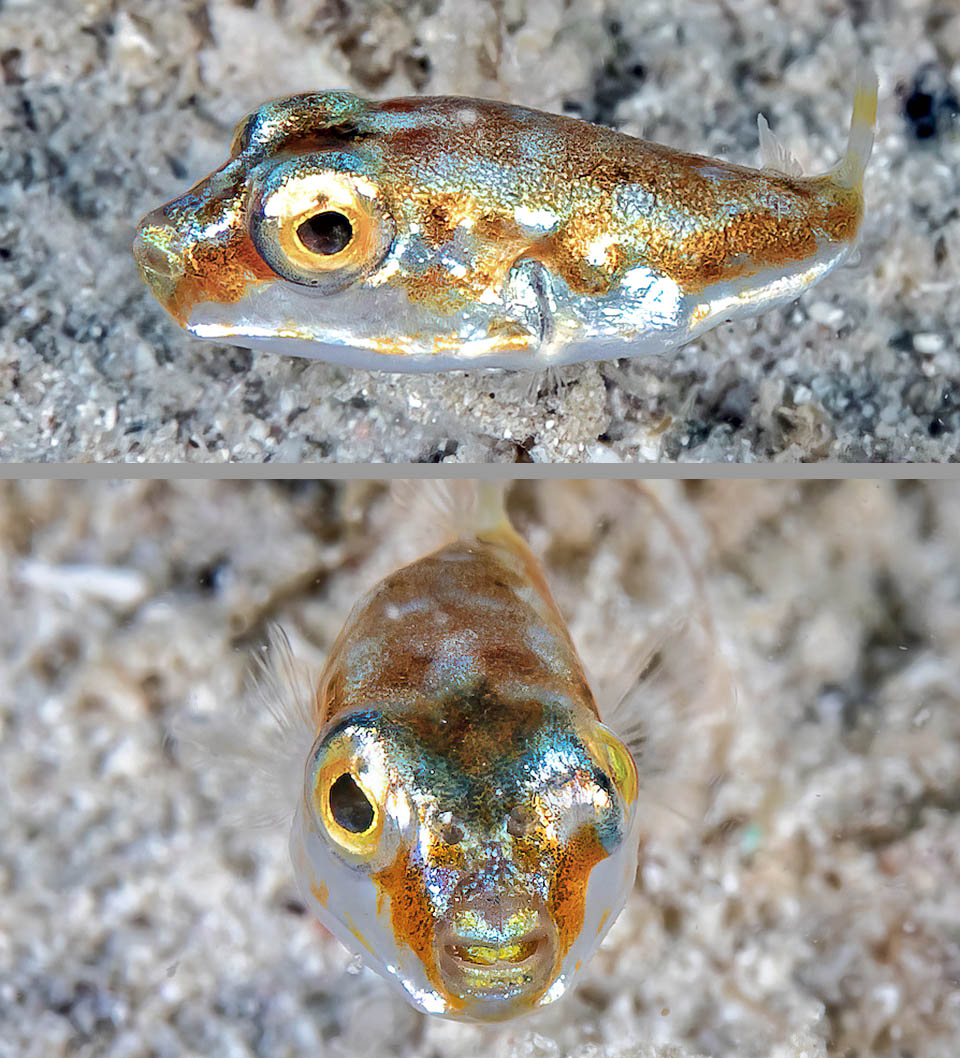
Two photos of a juvenile with iridescent mimetic livery. In front it already shows the typical plate teeth of the puffers © www.carlosestape.photoshelter.com
The juveniles then grow up on the seabeds protected by an iridescent livery.
The resilience of the species is high with a possible doubling of the populations in less than 15 months, and the casual fishing vulnerability due to trawl nets keeps anyway low, marking just 20 on a scale of 100. Since 2011 Sphoeroides spengleri appears consequently as “LC, Least Concern” on the IUCN Red List of the endangered species, keeping in mind also its vast range and its presence in protected zones.
Synonyms
Tetrodon spengleri Bloch, 1785.
→ For general information about FISH please click here.
→ For general information about BONY FISH please click here
→ For general information about CARTILAGINOUS FISH please click here.
→ To appreciate the BIODIVERSITY of BONY FISH please click here.
→ To appreciate the BIODIVERSITY of CARTILAGINOUS FISH please click here.