
Family : Orchidaceae

Text © Prof. Pietro Pavone

English translation by Mario Beltramini
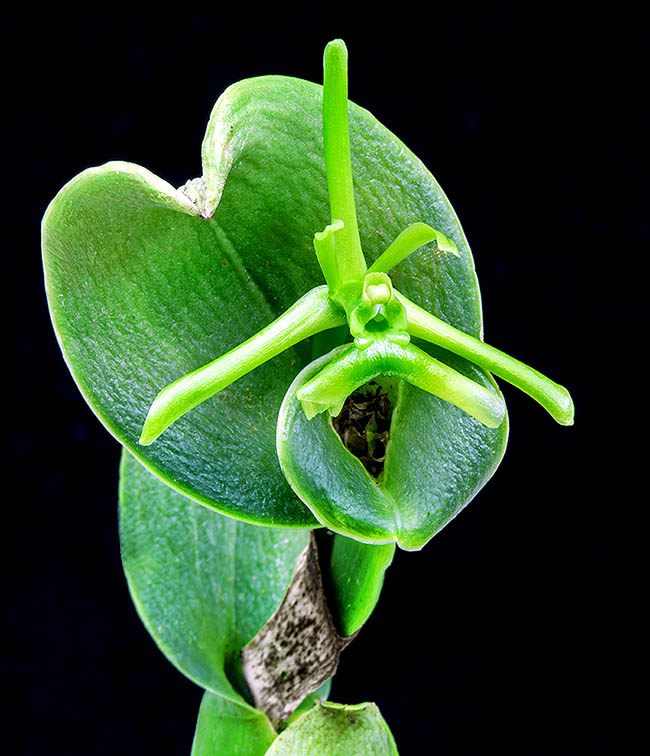
Described only in 1993, Epidendrum sympetalostele is an unusual epiphytic bushy orchid that may reach the height of 17 cm. It grows in Colombia, by the 1500 m of altitude, in the humid forests of the Department of Antioquia © Dr. Giuseppe Mazza
Epidendrum sympetalostele Hágsater & L.Sánchez is a species of the family Orchidaceae and subfamily Epidendroideae, tribe Epidendreae, subtribe Laeliinae.
This species has been found at San José del Nus, in the Department of Antioquia, in Colombia, in the humid tropical biome, at 1500 m of altitude, by Padre Pedro Ortiz Valdivieso (1926-2012), Colombian jesuit and botanist, together with Padre Sergio Retsrepo (1939-1989), Colombian religious man, known for his studies on the local flora.
The specimen they collected pn 1/12/1972 and conserved in the herbarium of Ortiz Valdivieso is the reference example (holotype), on which Eric Hágsater (1945-) and Luis Martín Sánchez (1966-2017), in 1993, have described this species on the magazine Icones Orchidacearum, Mexico (Icon. Orchid. 2: 191 fig., 1993).
The name of the genus comes from the Greek “επί” (epi), over, and “δένδρον” (dendron), tree, “on the trees”, with reference to its epiphytic posture. The specific epithet comes from the Greek πέταλο petal and στήλης stele, column, plus the prefix “sym- that indicates union or merger, with reference to the merging of the petals with the column that characterizes this species.
The common name is Epidendrum with a fused column.
Epidendrum sympetalostele is a bushy epiphyte, up to 17 cm tall with fleshy roots, 0,5-1 mm thick. The stem is simple, typically cane-shaped, compressed laterally, flexuous, up to 11 cm long.
The leaves are 3-4 on the stem with compressed sheath, smooth and foliar lamina, rigid and robust (sub-coriaceous), strictly elliptic, with entire margins, 3,5-7;5 x 1-3 cm).
The inflorescenc forms on the stem, is terminal and sessile. The 1-3 flowers do open simultaneously and are resupinate, yellow-greenish, often with translucent shades. The ovary has a circular section, is slightly enlarged in the upper part, and is 28-37 mm long.
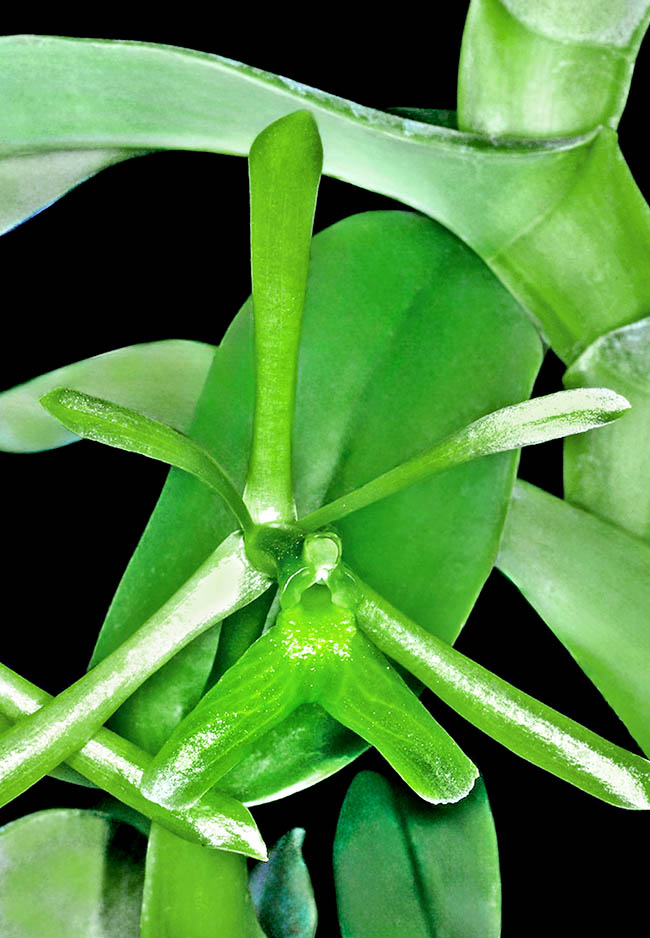
The terminal, sessile inflorescence forms on the stem and at maximum has 3 greenish flowers opening together. Doesn’t appear in IUCN Red List but it is a rare species and vulnerable to habitat destruction © Ron Parsons
The sepals are sub-coriaceous, are free from each other, slightly folded backwards (reflexed), glabrous, with 5 main veins.
The dorsal sepal has entire margins, rounded (revolute), and is wider at the apex (oblanceolate), 35-42 x 3-5 mm.
The lateral sepals, oblanceolate too, have entire margins, revolute, 35-42 x 3-5 mm.
The petals are membranous, adnate to the column, linear-spatulate, sharp, with entire and a little spread out margins, 27-30 x 1-2 mm.
The labellum is fused to the column, trilobed, with two small calli, cordate base, disk with three keels, the lateral ones are continuous with the calli, 10 x 26 mm. The lateral lobes have a marginal incision towards the base. The median is short and very wide, with an inconspicuous mucro at the apex. The clinandrium ( or androclinium) is very prominent and irregularly laciniated. The anther is sub-spherical, 4-locular. The column is straight, 20-27 mm long. The pollinia are four, petiolate. Blooming appears to be present the whole year.
Epidendrum sympetalostele is a rare species and its limited distribution renders it vulnerable to outer factors such as habitat destruction. Consequently it is included, like almost all orchids, in the Appendix II of CITES. Its trade is strictly monitored and requires specific export permits in order to guarantee that the collection in nature does not threaten its survival. Whilst it is not yet listed in the IUCN Red List.
In cultivation this plant requires a light exposure but not direct. The insufficient light prevents flowering whilst the direct sun may burn the leaves. It grows well with temperature going from about 11 °C to about 27 °C. During the vegetative rest, cooler temperatures (about 13-16 °C) can stimulate the following blooming.
As substratum it is good to utilize a draining mix formed by bark, perlite and sphagnum. Fertilization is to be done every two weeks during the growth with a balanced fertilizer (20-20-20) diluted in water.
The watering must be frequent with the caution, before repeating them, of letting the substratum to dry up. In winter the frequency is to be reduced. The environmental humidity must be high (50-70%) by means of nubelizations or with a humidifier and with good ventilation in order to avoid rots. It can be multiplied by cutting of stems having aerial roots.