
Family : Orchidaceae

Text © Prof. Pietro Pavone

English translation by Mario Beltramini
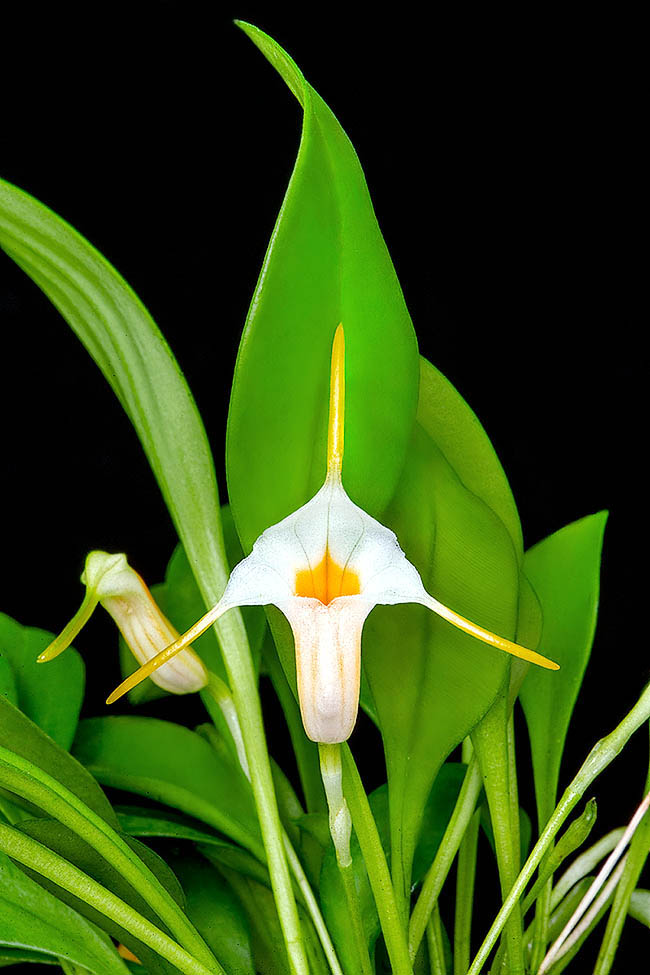
Masdevallia fuchsii is an orchid of central Peru nebular forests, at altitudes between 1400 and 1700 m © G. Mazza
Masdevallia fuchsii Luer belongs to the family of the Orchidaceae, and to the sub -family Epidendroideae, to the tribe Epidendreae and to the subtribe Pleurothallidinae, to the subgenus Masdevallia, section Masdevallia, sub-section Saltatrices.
The species has been described by Carlyle August Luer (1922-2019) in 1978 in the magazine Phytologia published in New York (Phytologia 39: 203, 1978).
This species is known only in the region of Huánuco, between Tingo Maria and Pucallpa (Peru), where has been found at 1700 m of altitude in March 1975 by Mr. Fred J. Fuchs, Jr. (1023-1990) of Naranja (Florida) and by Mrs. Janet Kuhn of Easton (Connecticut).
Fred J. Fuchs, Jr., great orchid collector, has obtained for his nursery more than 1.100 awards of the American Orchid Society (AOS) since 1985, among which more Certificates of Cultural Merit (CCM/AOS) than any other grower in the world.
Mrs. Janet Kuhn and her husband Leroy Kuhn, professional chemists but great travellers and orchid enthusiasts, founded in 1969 at Easton, the known nursery J&L Orchids, still existing, but presently owned by the family Ines and Alejandro Carreno.
This species is diffused in the nebular forests at altitudes between 1400 and 1700 metres in central Peru.
The name of the genus is honoured to José Masdevall Terrades, famous Spanish physician, botanist and scientist, an important figure in the Spanish healthcare of the second half of the XVIII century.
The specific epithet pays homage to one of its discoverers: Fred J. Fuchs, Jr.
The common name is Fuchs Masdevallia.
Masdevallia fuchsii is a small epiphytic, caespitose orchid with thin roots and secondary stems (ramicauls) also thin, erect, 15-27 mm long, wrapped at the base by 2 or 3 loose tubular sheaths on whose base forms only one leaf.
The leaf is erect, coriaceous, strictly elliptic-obovate, petiolate, 4,5-11,5 cm long with a 2-4 cm long petiole, 13-17 mm broad. The apex is subacute denticulate and the base gets gradually narrowed in the keeled petiole.
The inflorescence originates from the lower part of the ramicaul and bears only one flower, on a 4-4,5 cm long thin petiole, with one basal bract.
The ovary is green, slightly dotted, 5-6 mm long.
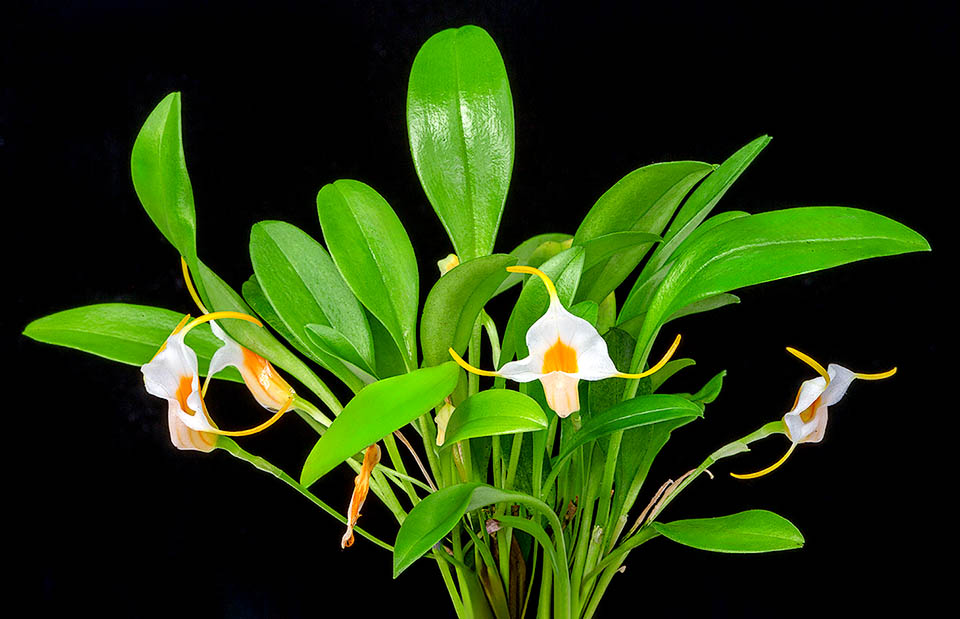
It’s a small epiphyte cespitose orchid, with elliptic-obovate erect leaves, coriaceous and petiolate, that may reach 11,5 cm © Dr. Giuseppe Mazza
The sepals are glabrous on the outside, hairy only in the inner half, of white colour, veined with orange and, towards the base, suffused with orange.
The dorsal sepal is obovate, 23 mm long and 10 mm broad, connate at the inner sepals per 17 mm in a tube with opening ample when open. The free part is ovate with apex having a curved tail, yellow, 10-12 mm long.
The lateral sepals are obliquely obovate, 20 mm long, connate and narrowed in a concave tube. The free portions are amply ovate, each 9 mm broad, the apexes are elongated in tails similar to that of the dorsal sepal. The petals are white-yellowish translucent, 7,5 mm long, 2 mm wide.
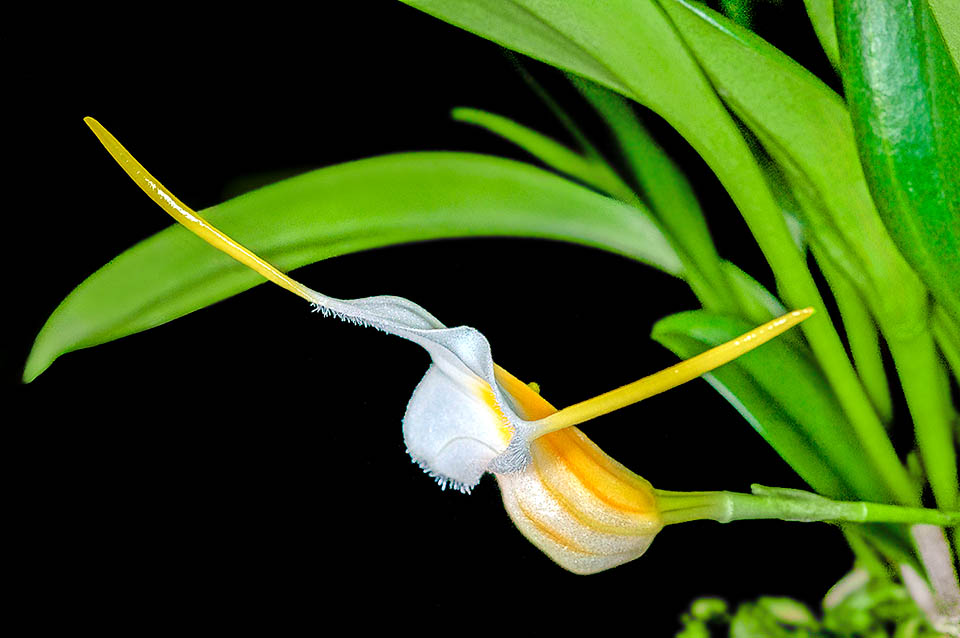
The dorsal sepal is obovate, 23 mm long, 10 mm broad and connate at the lateral sepals in a tube stretching with an ample opening. The yellow tail measure 10-12 mm © Eric Hunt
The labellum is oblong-ligulate, 5 mm long, 2,5 mm broad, white, green towards the apex and purple at the base. The column, with circular section, is yellow-pale green, 5 mm long, with pûrple margin and with short, briefly curved, foot. The plant blooms usually in any period of the year.
Masdevallia fuchsii is included in the Appendix II of CITES (Convention on International Trade in Endangered Species of Wild Fauna and Flora), therefore its trade is ruled to avoid the risk of extinction asking for export and reimport permission.
Masdevallia fuchsii is an orchid having the flowers with long “tails” that arouse great interest in the collectors. It is a cold greenhouse plant because it prefers cool temperatures and constant humidity.
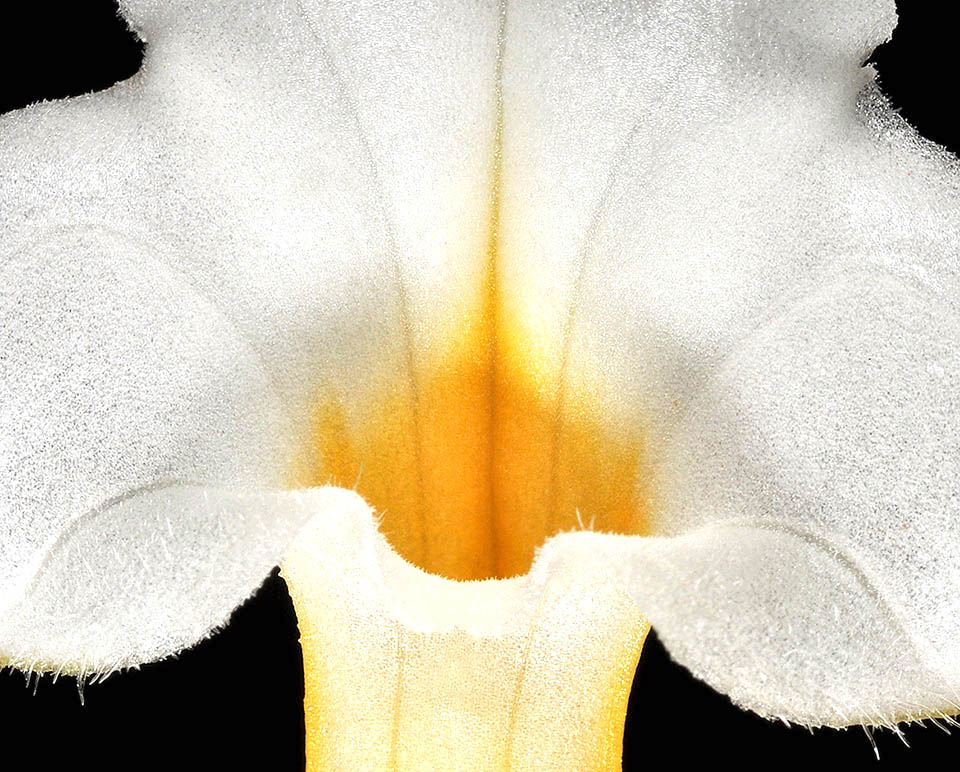
The sepals are glabrous outside and with down only in the inner half, of white colour, veined and suffused with orange towards the base © Ron Parsons
The ideal temperature fluctuates between 15 °C and 20 °C. It does not. tolerate the excessive heat (over 25-30 °C) and the sudden thermal changes. It loves a shady position or with filtered light. The direct exposition to the solar rays may burn the leaves.
Indoors, it is very good to place it near a window, luminous, but protected by curtains. It requires a very high humidity level, ideally over 70%. It is useful to nebulize the leaves regularly or to utilize a tray with wet gravel in order to keep the environment humid.
It may be cultivated in small plastic pots, even transparent, or in baskets in order to help the roots ventilation.
The most suitable substratum is the pure sphagnum or a mix of bark and perlite that holds the humidity even if guaranteeing the draining.
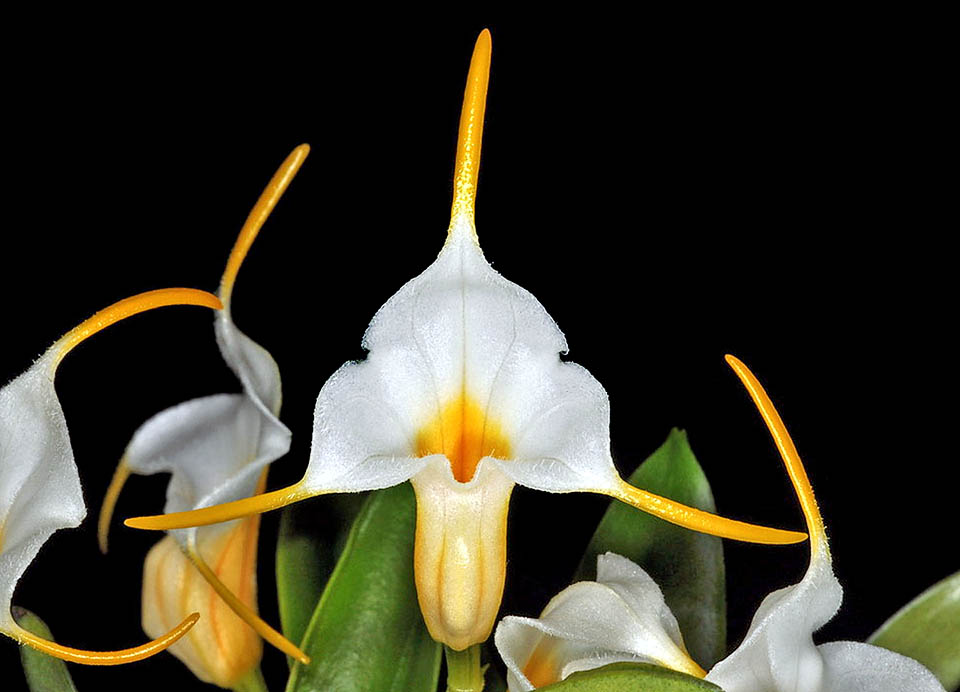
It’s a cold greenhouse plant that, having no pseudobulbs for storing the water, requires great environment humidity and dimmed light © Ron Parsons
Having no pseudobulbs for storing the water, the substratum of this species must never dry up completely. The best are the rain water or the demineralized one.
For a good growth to the irrigation water, may be added a balanced fertilizer for orchids very diluted (1/4 of the suggested dosage) every 2-3 weeks during the vegetative period (April-October).
The plant must be repotted every 1-2 years, at the beginning of spring, before the substratum deteriorates too much.
Synonyms: Masdevallia saulii Königer 1999.