
Family : Orchidaceae

Text © Prof. Pietro Pavone

English translation by Mario Beltramini
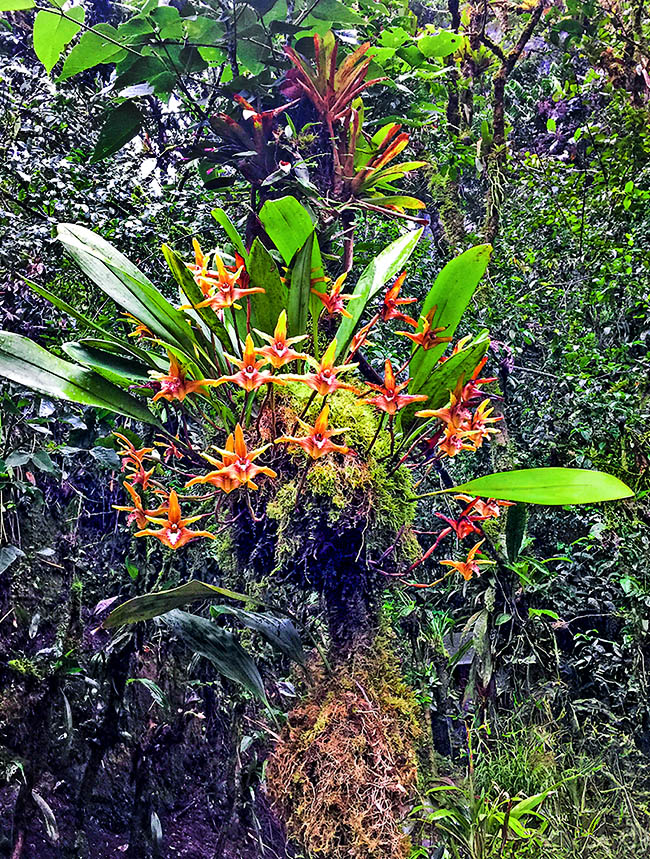
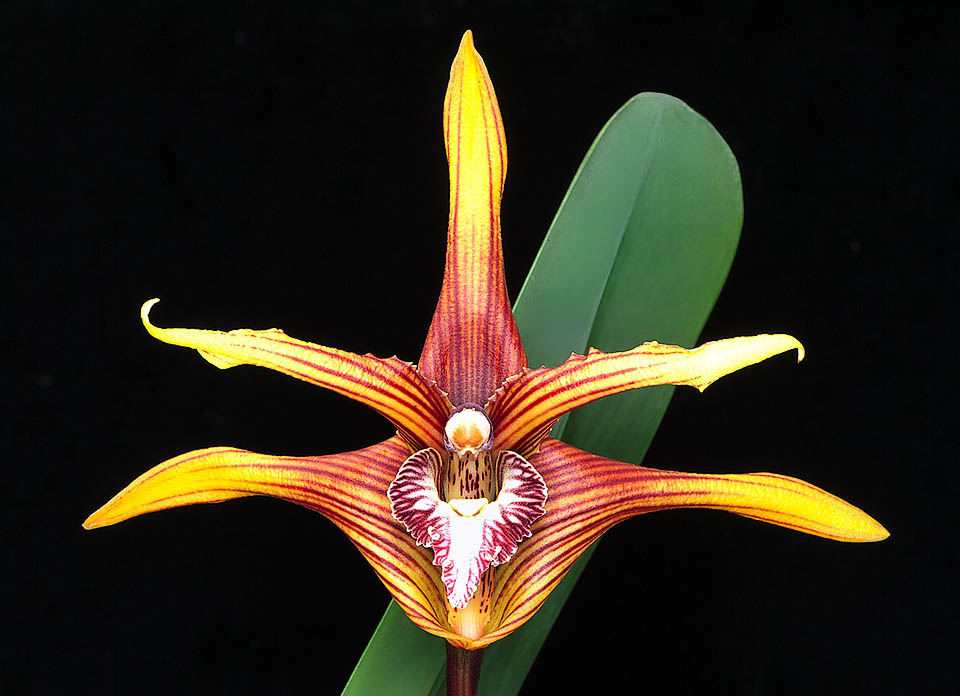
Maxillaria striata is a humid mountain forests epiphyte on the Andes eastern side in Peru, Ecuador and Colombia © TBauer
Maxillaria striata Rolfe is a species belonging to the family Orchidaceae subfamily Epidendroideae, tribe Cymbidieae, subtribe Maxillariinae.
It is present in Colombia, Ecuador and Peru.
The genus Maxillaria was created in 1794 by Hipólito Ruiz López (1754 –1816) and José Antonio Pavón Jiménez (1754 –1840).
During the years in this genus were included very many species distributed in the tropical and subtropical regions of Central and South America, present at high altitudes, up to 3500 metres above the sea level.
In a recent molecular phylogenetic study it was discovered that many of these species, embedded in Maxillaria, make the genus polyphyletic and therefore they must be separated.
However to date not all taxonomists have followed up on these studies keeping in Maxillaria 653 valid species.
They are splendid epiphytic, terrestrial and lithophyte plants whose flowers have different sizes, from a few centimetres to more than fifteen centimetres of diameter. Their colours vary from red, yellow, purple, white and almost black. Some orchids display stripes (Maxillaria striata) or spots (Maxillaria picta).
Also the inflorescence varies from species to species, single or in racemes, all with scented flowers.
Maxillaria striata has been described in Orchid. Rev. 1: 266 (1893) by Robert Allen Rolfe (1855-1921), English botanist specialized in orchids, key figure at the Royal Botanic Gardens of Kew for more than forty years.
Throughout his career, Rolfe described 2234 taxa, of which more than 200 were orchids, on specimens coming from various tropical regions of the world. He wrote several works such as “Revision of the Genus Phalaenopsis” (1886), “A Revision of the Genus Vanilla” (1896) and, in collaboration with C.C. Hurst, “The Orchid Stud-Book” (1909). In 1893 he founded and directed Orchid Review, a magazine wholly dedicated to the orchids, now managed by the Royal Horticultural Society.
During his career, Rolfe got several important awards for his expertise in the plant taxonomic field.
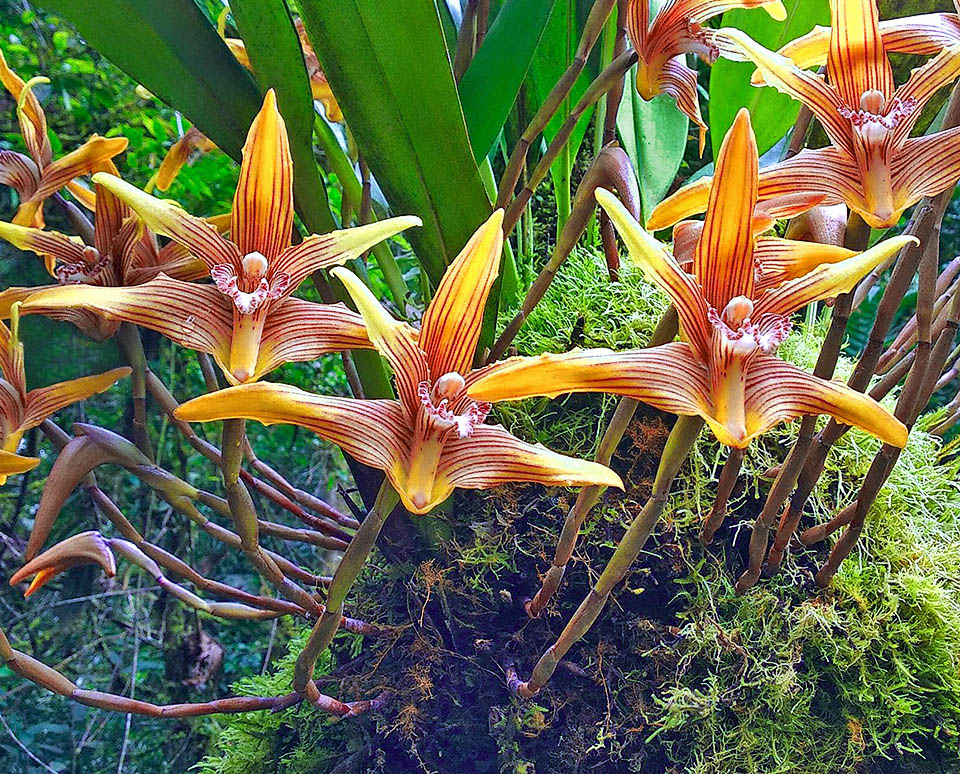
The long-lasting flowers with showy streaks as the specific name states, measure even 12 cm and are strongly scented © Bodo Nuñez Oberg
We mention the gold medal of the Académie Internationale de Botanique in 1917 and the Victoria Medal of Honour by the Royal Horticultural Society in 1921, one of the highest honours thanks to the results obtained in the horticultural field.
The name of the genus comes from the Latin “maxilla”, jaw, and refers to the column and the labellum of the flower that, together, resemble a jaw. The specific epithet comes from Latin “striatus”, striped, due to the prominent stripes present on the sepals and on the petals of the flower.
The common English name is Striped Maxillaria.
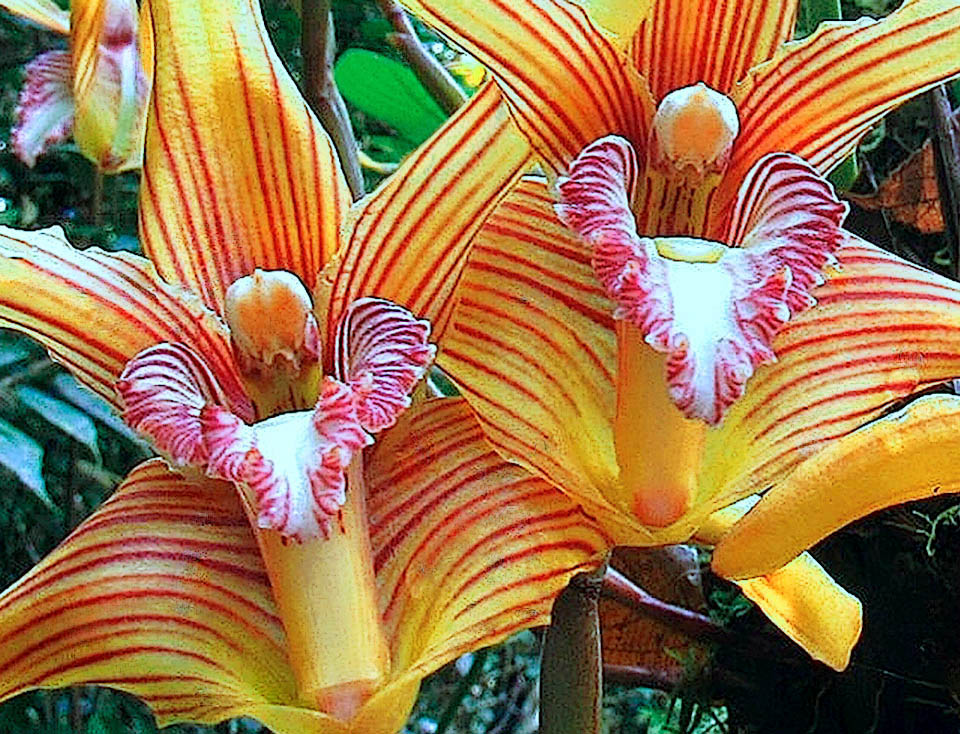
The about 3,5-4 cm long trilobed labellum, in strong contrasting shade with the petals colour, is typically pale white with purple stripes and curved sub-crenulate margin © Nelson Apolo
Maxillaria striata is a species widespread in Peru, Ecuador and Colombia in the very humid mountain forests at altitudes between 700 and 2200 metres on the eastern side of the Andes.
It is a sympodial epiphyte, with grouped pseudobulbs, ovoid to oblong-cylindrical and compressed, wrapped at the base by several imbricate distichous sheaths and bearing one single apical leaf, oblong-elliptic, coriaceous, up to 30 cm long, and equipped with petiole. The big (up to 10-12 cm) flowers and showy above the leaves, are solitary on an erect inflorescence, up to 30 cm long, which forms at the base of one ripe pseudobulb. The flowers do open mainly in summer and are usually scented and long-lasting.
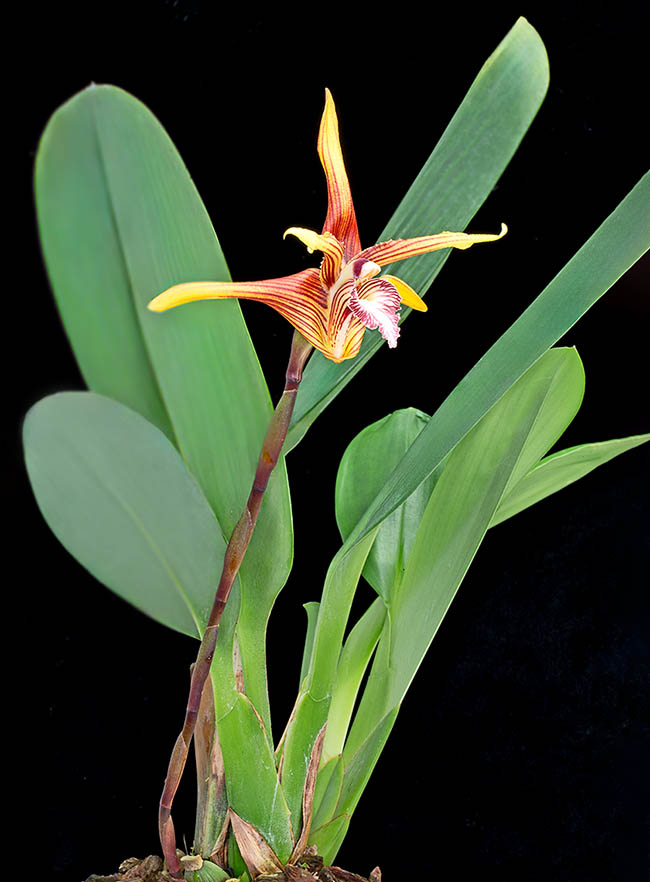
Obviously Maxillaria striata is a highly sought after by collectors species. But its habitat is in danger, and therefore it appears in CITES Appendix II, that rules the international trade, thus guaranteeing its survival © Dr. Giuseppe Mazza
The sepals and the petals are yellow or yellow-greenish with dark red or purple brown stripes that run longitudinally, characteristic this to which the name of the species refers.
The labellum, with shade contrasting to the colour of the petals, is typically pale white with purple stripes and with curved sub-crenulate margin.
It is trilobed, about 3,5-4 cm long.
Its lateral lobes are sub-erect and the middle lobe has wavy edges.
The callus is oblong and extends for 2/3 of the length of the labellum. To microscopic observation the surface of the labellum displays villiform conical papillae arranged in rows.
Because of its vulnerable habitat, this species is included in the Appendix II of CITES. This means that the international trade is ruled in order to ensure its survival, requiring special permissions for its import/export. However, it is not specifically listed as a species at high risk of extinction in the IUCN Red List.
Maxillaria striata is a spectacular collection orchid due to its intense scent, its large size and its thick streaking on the sepals and on the yellow petals.
In cultivation it requires high and constant (80%) humidity, along with an excellent air circulation to prevent the diseases, better if cultivated in a cool and humid greenhouse, with intense and filtered light.
This plant grows very well in suspended baskets or pots. Can be also used cork sheets, or tree ferns.
The loam must be coars, well draining and must leave room to the air for the growth of the roots. Can be utilized a mix formed by bark, coal and perlite that must be kept constantly humid and must never dry up completely as the pseudobulbs can rapidly wrinkle.
The best day temperature is 18-23 °C and the night one 12-16 °C. Fertilization must be done regularly with liquid fertilizer for orchids. The plant benefits from a fertilizer rich in phosphates before blooming, rich in nitrogen when the new buds do appear and balanced (NPK 20-20-20) during the other periods. Depending on the conditions of its roots, it may be repotted every 2-3 years. The best period is by the end of winter, when the new buds begin to appear, but repotting must be avoided during the dry season.
In cultivation needs intense filtered light, high humidity and constant good air circulation, and if possible, a day temperature of 18-23 °C and a night one of 12-16 °C © Dr. Giuseppe Mazza
The presence of unnatural dark spots on the flowers indicates the presence of Botrytis, a fungus caused by excessive humidity and poor ventilation.
Several cultivars do exist, among the most recently awarded we mention: Maxillaria striata ‘Kiel’ (2018), Maxillaria striata ‘Robin Jane’ (2017), Maxillaria striata ‘Hansi’ (2016), Maxillaria striata ‘Isabel’ (2015), Maxillaria striata ‘Amelia’ (2014), Maxillaria striata ‘Alfons’ (2014), Maxillaria striata ‘Excalibur” (2013), Maxillaria striata ‘Orquivalle’ (2013), Maxillaria striata ‘Heinz’ (2012), Maxillaria striata ‘King Tut’ (2012).