
Family : Orchidaceae

Text © Prof. Pietro Pavone

English translation by Mario Beltramini
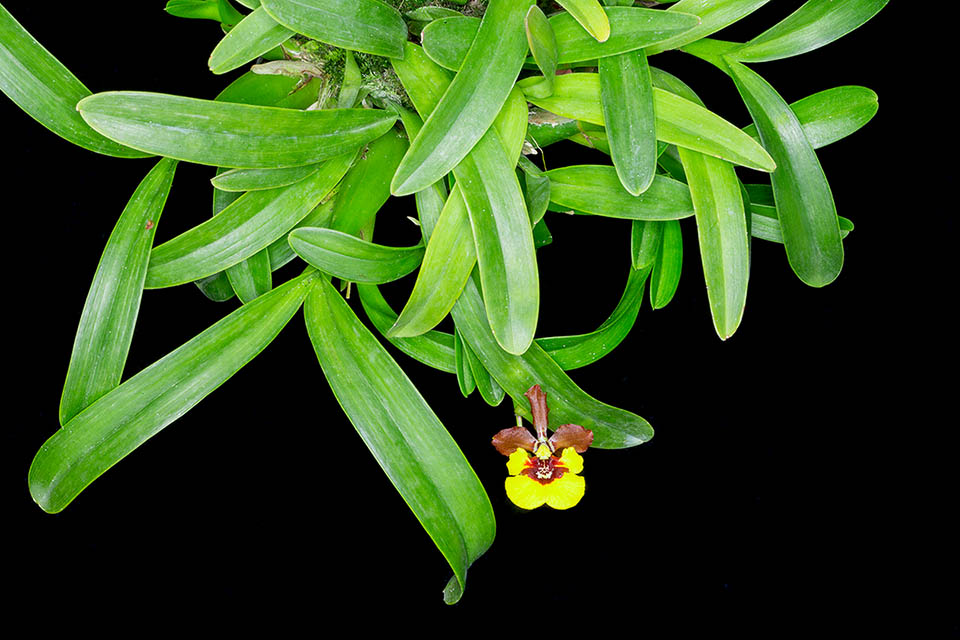
Gomesa croesus grows in the Brazilian coastal, hilly or mountain rainforests between 400 and 600 m of altitude © Dr. Giuseppe Mazza
Gomesa croesus (Rchb.f.) M.W.Chase & N.H.Williams is a species belonging to the family Orchidaceae, subfamily Epidendroideae, tribe Cymbidieae, subtribe Oncidiinae, section Barbata.
It was initially described as Oncidium croesus on the magazine Hamburger Garten-Blumenzeitung 13:314 (1857) by Heinrich Gustav Reichenbach (1824-1889), German botanist and ornithologist, professor of botany and director of the Botanical Garden of the University of Hamburg. At his time Reichenbach was considered as the greatest world authority about the knowledge of the plants as he had identified and described as many as 5396 species of botanical species coming from the whole world.
In the botanical description the author compares the labellum of this species with that of Oncidium formosissimum (presently Oncidium cultratum Lindl.) that Gustav Wilhelm Schiller (1803-1870) did grow in the garden of his residence “Schillerburg” at Ovelgönne, close to Hamburg, in Germany.
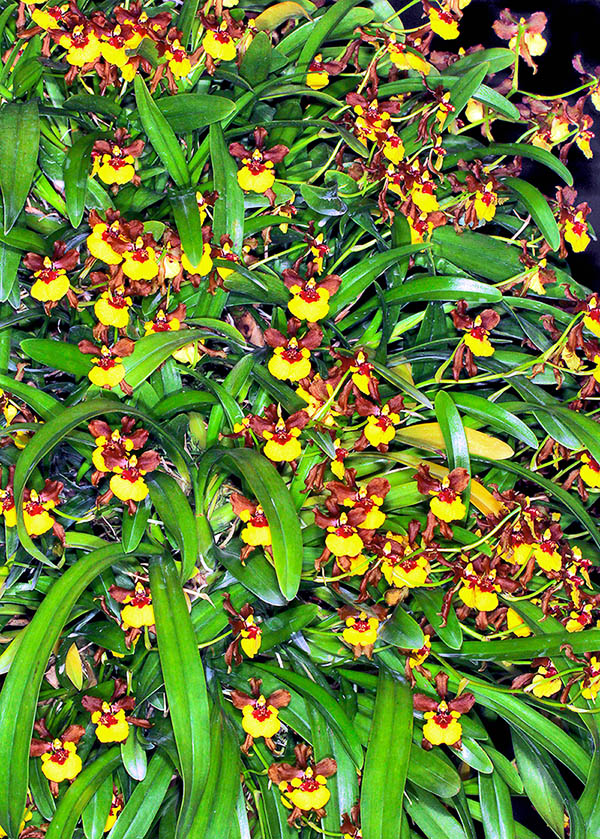
It’s a richly blooming epiphyte, hence the specific name creseus, from Croesus, king known for his wealth © John Varigos
The garden and the greenhouses were under the care of his head gardener Friedrich Stange who at the time was highly esteemed for his ability to flourish rare species that were coming from the Americas. Gustaw Wilhelm Schiller was consul and vice-consul of the Republic of Venezuela in Hamburg and co-owner with his brother of the shipping company Gebr. Schiller & Co.
The diplomatic status and the ownership of the vessels, used for transporting plants without intermediaries, did allow him to have a rich collection of tropical plants in his greenhouses from which several scholars of that time drew for seeing and describing them. In fact, besides Reichenbach f., other scholars like Carl Friedrich Edueard Otto (1812-1885) and Berthold Carl Seemann (1825-1871) transformed this private collection in a real and true international research centre where the taxonomy of many species of orchids was defined.
In 2006 the Sao Paulo botanist Dalton Holland Baptista (1962-), in collaboration with the biologist Americo Docha Neto (1946-), published the first photographic encyclopedia of the Brazilian orchids (Project Orchidstudium).
Holland Baptista is an architect by profession but eminent botanist, specialized in Brazilian orchids, consultant for Orchid Conservation Coalition and collaborator of the American Orchid Society.
In the publication on the magazine Coletânea de Orquídeas Brasileiras (Colet. Orquídeas Brasil. 3: 88, 2006) Baptista has established new combinations, transferring several species of Oncidium to the new genus Alatiglossum species and has called the species described by Reichenbach f.: Alatiglossum croesus (Rchb.f.) Baptista.
However, recent molecular studies on the genus Oncidium have questioned what previously established from the taxonomy of the subtribe Oncidiinae because, after the molecular evidence, the genera in them come from separate evolutionary lines and have been grouped together due to their morphological resemblances, rather then for a real direct genetic parentage. In fact, many genera of this subtribe were considered similar because having similar flowers and in particular due to the relations between labellum and column.
From molecular evidence these characters are, instead, to be considered convergence phenomena related to the preferences of the pollinators and not to real genetic similarities. From this it follows that they are characters not reliable for a correct taxonomy and for the confirmation of monophyletic genera.
Mark Wayne Chase (1951-) and Norris H. Williams (1943-), thanks to phylogenetic studies based on the DNA analysis, have highlighted other morphological and floral characters, inflorescence included, which are specific to the different taxa with mainly Brazilian distribution.
Consequently they thought to reunite them under the most ancient available name, Gomesa, created in 1815 by Robert Brown (1773-1858).
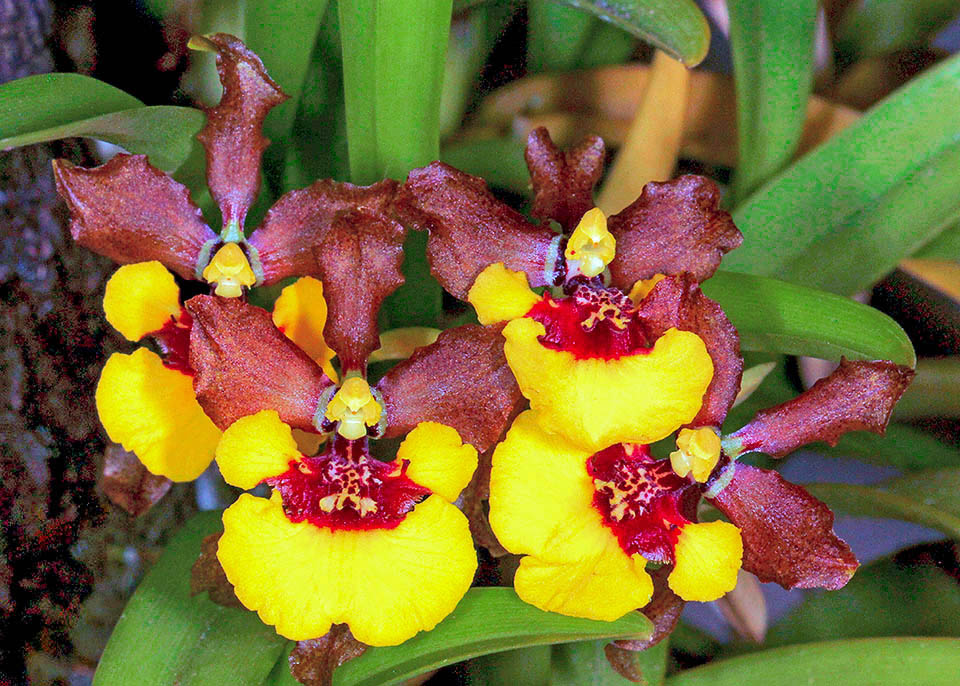
Gomesa croesus petals and sepals are dark coloured with brown to brown-purple shades. The bright gold yellow labellum appears trilobed, with small lateral lobes rounded at the base and a huge central lobe. At the base and centre of the labellum stands a white raised callus with dark red spots, strikingly detailed and visually captivating © John Varigos
In this way the whole group is monophyletic, that is having inside the common ancestor and all its descendants Gomesa has changed, therefore, from 11 species to 127 accepted ones.
This expansion was achieved by detecting genetic resemblances of species included before in other genera of the subtribe Oncidiinae and in the meantime has been necessary also the change of nomenclature of many genera including Alatiglossum.
Presently Gomesa croesus is a species accepted and inserted in Plants of the World Online (POWO) that is the digital database of the world flora managed by the Royal Botanic Gardens of Kew.
The genus Gomesa owes its name to Bernardino Antônio Gomes (1768-1823), Portuguese physician and botanist author of the volume “Observationes botanico-medicae de nonnullis Brasiliae plantis” published on commission of the Royal Academy of the Sciences of Lisbon in 1803, where were described many species of Brazil from the botanical and medical point of view.
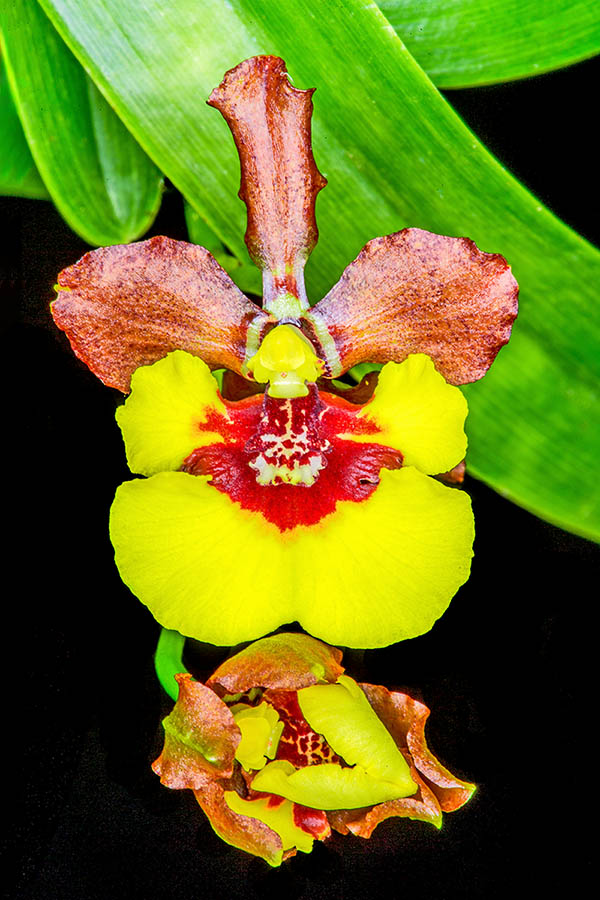
Between labellum and column base stands a calloused swelling called “tabula infrastigmatica” that, with the callus, simulates by visual and tactile deception, an elaiophore full with oil to attract Centrifdini bees © Dr. Giuseppe Mazza
Gomes has also contributed to the writing of the “Catalogus Plantarum Horti Botanici Medico-Cirurgicae Scholae Olisiponensis (1851)” and has also supervised the works of the committee of doctors and chemists for the creation of the Portuguese pharmacopoeia in 1876.
The specific epithet comes from the Latin Croesus, in turn derived from the old Greek Kroisos (Κροίσος). This was the name of Croesus, last king of the Lydia (old region of Turkey) on which he reigned from 560/561 BC until his defeat, around the 546 BC, at the hands of the Persians.
This king was famous for his immense wealth, symbol of prosperity, and Reichenbach chose it for the strong symbolic value linked to the richness of the flowering of this species.
The common name is “The rich blooming Oncidium”. It is also called “Ballerina orchid” due to the shape of the labellum, which resembles a skirt, and for the movement of the inflorescence when moved by the wind.
Gomesa croesus is an orchid mainly found in the states of Pernambuco and Rio de Janeiro (eastern Brazil) where lives in the Atlantic coastal rainforests of the Serra do Mar, in hilly or mountainous areas at an altitude from 400 to 600 metres above the sea level.
It is an epiphyte forming compact tufts due to the grouped pseudobulbs of ovate shape, laterally compressed, partially wrapped and protected by dry scarious sheaths, from whose summit take form 1 or 2 leaves, of glossy green colour, slightly coriaceous, linear-oblong, conduplicate at the base.
The inflorescence forms from the axillae of the basal sheaths wrapping the pseudobulb. It is erect, zigzaggy, up to 15 cm long, and bears 3 to 5 scented long-lasting flowers.
The flowers do have a diameter of about 4,5 cm. Petals and sepals are of dark brown or brown-purple colour.
The dorsal sepal is 1 cm long and 4-5 mm broad, cuneate, oblong, wavy and the lateral sepals are subequal, longer (about 1,5 cm) with wavy edges and sharp tips, slightly connate at the base.
The petals are oblong, about 1 cm, and wider than the sepals (5-6 mm). They often appear glossy or slightly coriaceous.
The labellum is of bright golden yellow colour in stark contrast with the other floral elements. It is about 1,7 cm wide, trilobed with small lateral lobes rounded at the base and one central lobe very big, expanded, reniform (fan-shaped). In the centre, close to the base, there is a raised callus of white colour with dark red, purple or velvety black spots.
It is also present a structure called “tabula infrastigmatica” that together with the callus is essential for guiding the pollinators so that the viscidium may adhere to their head or to the thorax. The column (or gynostemium) is short and thick and has small lateral appendages similar to wings. At the top the anther has two waxy pollinia shaped like a pear. On the lower part stands the cavity of the stigma intended to receive the pollen.
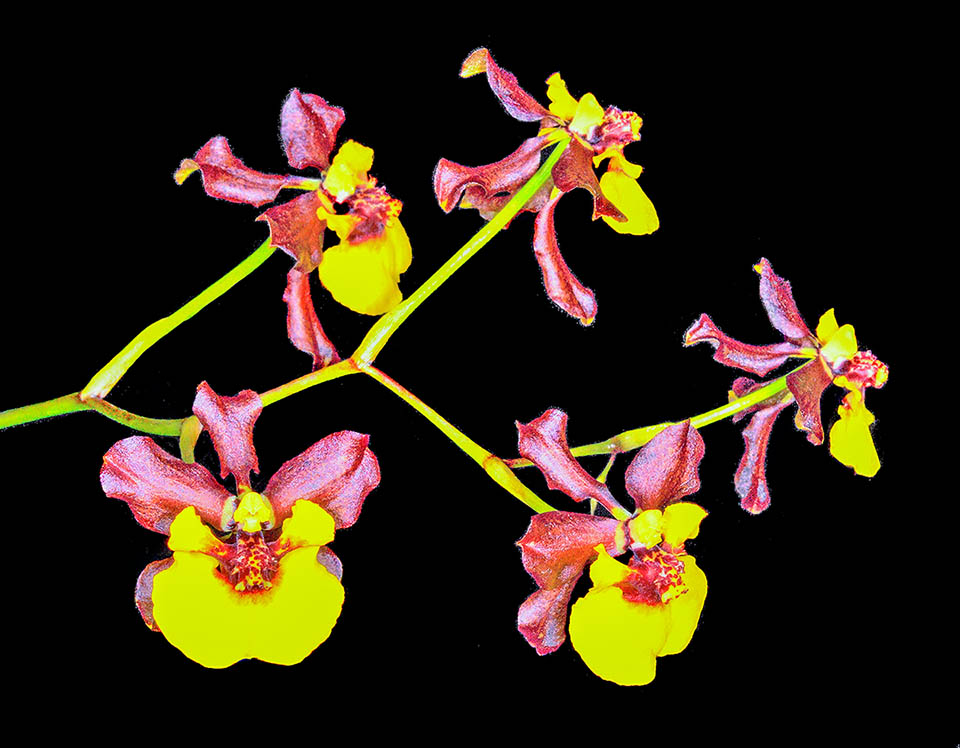
The inflorescence forms from the axils of the basal sheaths of the pseudobulb. It’s erect, zigzaggy. May reach 15 cm and bears 3 to 5 long-lasting scented flowers © Ron Parson
The flowering takes place in spring and in early summer and the pollination is done by small bees of the genera Centris and Epicharis, (family Apidae, tribe Centridini). These bees are known as “oil-collecting bees”because with specialized brushes (elaiophore combs) on the tarsi of the legs they collect floral oils to nourish their larvae and waterproof the walls of the cells of the nest.
The flowers of Gomesa have evolved colours (yellow and brown) and look that imitate the visual signals of the family Malpighiaceae that have specialized glands, called elaiophores, secreting non-volatile oils and are the main reward for the bees like Centridini. In fact,the callus and the tabula infrastigmatica simulate the elaiophores to attract the insect who lands on the labellum convinced of finding oil by while trying to extract the oil it does not find or perhaps present in a minimal part (after some studies on other species of the genus) hits the pollinarium that immediately gets attached to it by means of the viscidium. This phenomenon of visual deception is known as floral mimicry. When the bee goes on another flower makes the cross-pollination. Once done the fecundation, the ovary inflates while the petals and the sepals wither remaining often attached to the fruit inside which form many very small seeds, pulverulent and having no reserve substances.
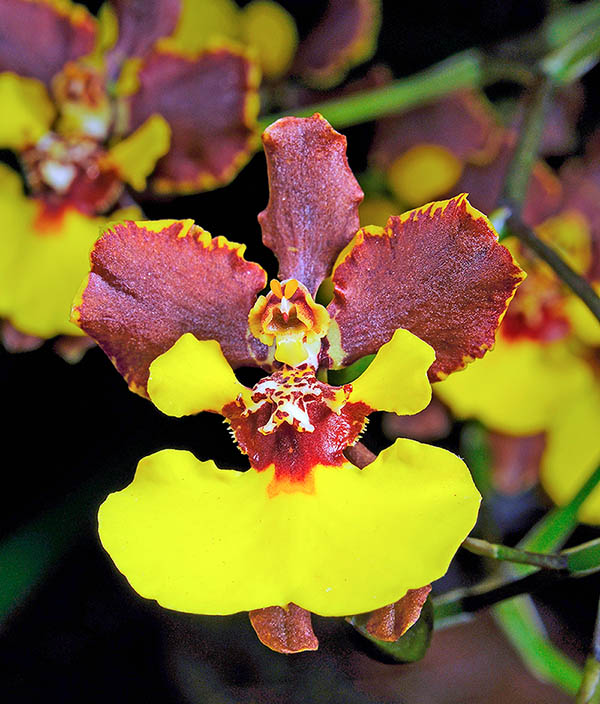
Also some artificial hybrids exist good for home cultivation. They need adequate light and temperatures, in a well ventilated environment to avoid parasitic attacks and prevent the fungal diseases © Norbert Dank
The ripe fruit (capsule) changes colour from green to brown, cracks longitudinally to allow the wind to disperse the seeds that, for germinating, need the presence of mycorrhizal fungi.
Like all species belonging to the family Orchidaceae, Gomesa croesus is included in the Appendix II of CITES (Washington Convention) to guarantee that international trade does not jeopardize the survival in the wild.
Gomesa croesus is a very sought-after species by the collectors of orchids due to its exuberant flowering, the lively colours and its compact dimensions with an overall height of about 15-25 cm.
Natural hybrids are not known and few are the artificial ones recognized as valid by the Royal Horticultural Society (RHS).
Oncidesa Kathy Jo Brown is a hybrid obtained in 2005 by I.N. (Ivan) Komoda, Maui (Hawaii) renowned hybridizer. It is a cross between Gomesa croesus and Oncidium noezlianum and displays flowers with orange or reddish shades and a compact habitus.
Another hybrid is Bramesa Enigma obtained in 2015 by John Dunkelberger, American hybridizer of orchids. This is an intergeneric hybrid and the species that have generated it are Brassia keiliana and Gomesa croesus. This hybrid combines the slender shape and the warm colours of Brassia with the prolificacy and the reduced size of Gomesa.
The hybrid Gomesa Rainer, registered in 1989 by H. Mederer at the Royal Horticultural Society (RHS), has been obtained by cross between Gomesa croesus and the hybrid Gomesa Oriflame created in 1951 by the English firm Charlesworth Ltd. It has flowers with ample and yellow of the species labellum and with darker and warmer colours typical to the hybrid progenitor.
Conversely, several cultivars of Gomesa croesus, exist, many of which have been awarded by important associations or companies dedicated to orchids. Here are the most recently awarded.
Gomesa croesus ‘Herrenhausen’ (3 awards from 2012 to 2013), Gomesa croesus ‘Alfons’ (2017) and Gomesa croesus ‘Wasen’ (2012), cultivars awarded by the Deutsche Orchideen-Gesellschaft e. V. (DOG).
Gomesa croesus ‘Lilly’ (2012), Gomesa croesus ‘Gloria’ (2011), Gomesa croesus ‘Taikura’ (2009) awarded byOrchid Council of New Zealand (OCNZ).
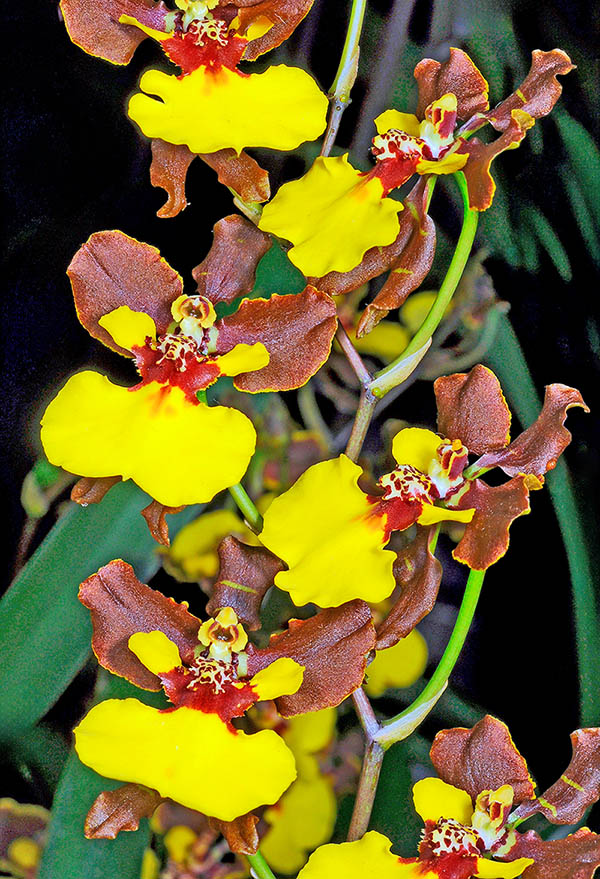
Gomesa Rainer comes from cross of Gomesa croesus with hybrid Gomesa Oriflame, registered at RHS in 1989. The flower has ample and yellow labellum with dark and warm colours typical of hybrid progenitor © Norbert Dank
Gomesa croesus ‘Irene’ (2 awards from 1996 to 2001), Gomesa roesus ‘Pololei’ (2004), Gomesa croesus ‘Midas Touch’ (1999), Gomesa croesus ‘Ben Berliner’ (1997), Gomesa croesus ‘Rio’ (1997) and Gomesa croesus ‘Willow Pond’ (1991) awarded by American Orchid Society.
Gomesa croesus ‘Swarm of Bees’ (1999) is a cultivar awarded by the South African Orchid Council (SAOC).
In cultivation Gomesa croesus requires good luminosity (shading from 60 to 70%) and, in summer, day temperature of 23-25 °C and night of 15-16 °C.
In winter it is good that the day temperature is about 19-21 °C and the night one 11 °C.
This species is also suitable for home cultivation, but requires a lighted and well ventilated environment in order to avoid parasite attack and to prevent fungal diseases.
The plant grows well on bark or raft of cork or in baskets having a well draining substratum such as shredded bark, sphagnum moss or a combination of both.
It also adapts to the cultivation in pots that will have to be relatively small (ca. 9 cm) and with loose and aerated substratum.
Use is recommended of medium sized fibre of tree fern use with the addition of perlite (10%) or pumice and of charcoal (10%) in order to retain moisture without over-soaking the substratum.
If the plants are cultivated in arid locations, sphagnum moss can be added at a rate of 10%.
The plant is to be regularly watered because its thin roots may dry up rapidly if left dry too long.
In summer between one watering and the next it is good to let the substratum to dry up for 2-3 days as too much water might cause a condition of asphyxiation and parasitic attacks. In winter, waterings are to be reduced but without allowing the roots to get completely dry. During the active growth period, it is a good practice to fertilize every 7 or 15 days with 1/4 or 1/2 the recommended dosage of orchid fertilizer. In winter fertilization is to be reduced or completely eliminated.
The repotting can be done every 2-3 years and the best moment is by the end of winter, as soon as the new growths begin to appear. It is easily done through the division of the tufts so that each stump has at least 3-4 adult pseudobulbs to guarantee the energy sufficient for the recovery.
Synonyms: Alatiglossum croesus (Rchb.f.) Baptista (2006); Kleberiella croesus (Rchb.f.) V.P.Castro & Cath. (2006); Oncidium croesus Rchb.f. (1857); Oncidium longipes var. croesus (Rchb.f.) A.H.Kent (1892).