

Text © Prof. Angelo Messina

English translation by Mario Beltramini
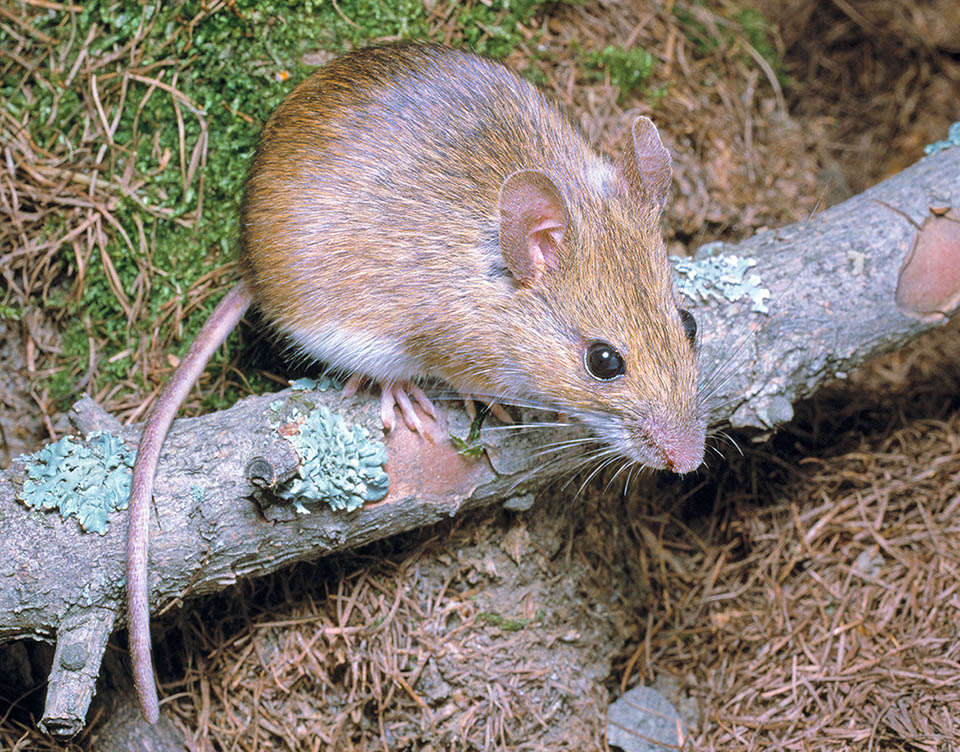
The Mammals class hosts species with very variable size: here an Apodemus sylvaticus which reaches a maximum of 20 grams © Giuseppe Mazza
The mammals (Mammalia) form a class of Vertebrates whose members are characterized mainly for the presence of mammary glands, hence the name, and for being equipped with an internal metameric skeletal structure, bony and/or cartilaginous (vertebral column).
The mammals gather warm-blooded species (homeothermic), being animals that maintain constant their body temperature, regardless of the variations of the ambient temperature.
Another characteristic typical of almost all mammals, is that of having the body covered with hairs, exclusive structures of these animals, of very varied constitution and that form a fur.
From the taxonomic and systematic point of view, the class includes very varied and well known forms, such as Mice, Cats, Dogs, Horses, Sheep, Bats, Deer, Lions, Elephants, Kangaroos, Whales, Seals, Monkeys, Man and many other forms, as well as a high number of extinct species and orders.
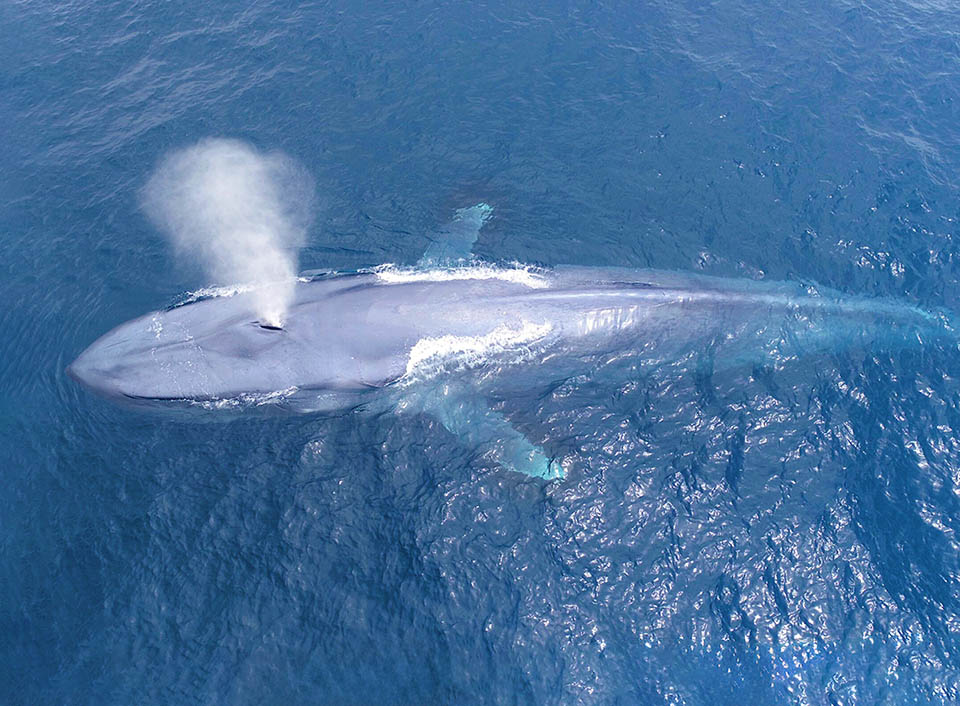
Whilst the Blue whale (Balaenoptera musculus) can exceed 30 m in length and 200 tons © saintsfc
The dimensions of the members of the class of the mammals are extremely variable; some like Mice, Hamsters, Shrews, Bats, reach a comprehensive length, tail excluded, even less than 5 cm and a weight of only a few grams. Vice versa, among the Cetaceans, the Blue whale (Balaenoptera musculus, Linnaeus, 1758), with its 30 and more metres in length and a weight generally of around 120-130 tons and even more, is the biggest still existing known animal. Generally, however, most species reach small or modest dimensions. Typically tetrapod animals, that are four-limbed, in some cases modified or wholly disappeared in the course of the evolution, the mammals have differently shaped integument, usually thin, equipped with numerous sebaceous, sweat, odoriferous and mammary glands.
In most mammals, externally, the body is distinguishable in different main anatomic regions: head, neck, trunk, in turn subdivided in thorax, abdomen and pelvis, and tail if present. And still, as aforementioned, the body of the mammals is equipped with four limbs, one pair anterior and another posterior. We will systematically represent below the essential attributes that characterize the class of the mammals.
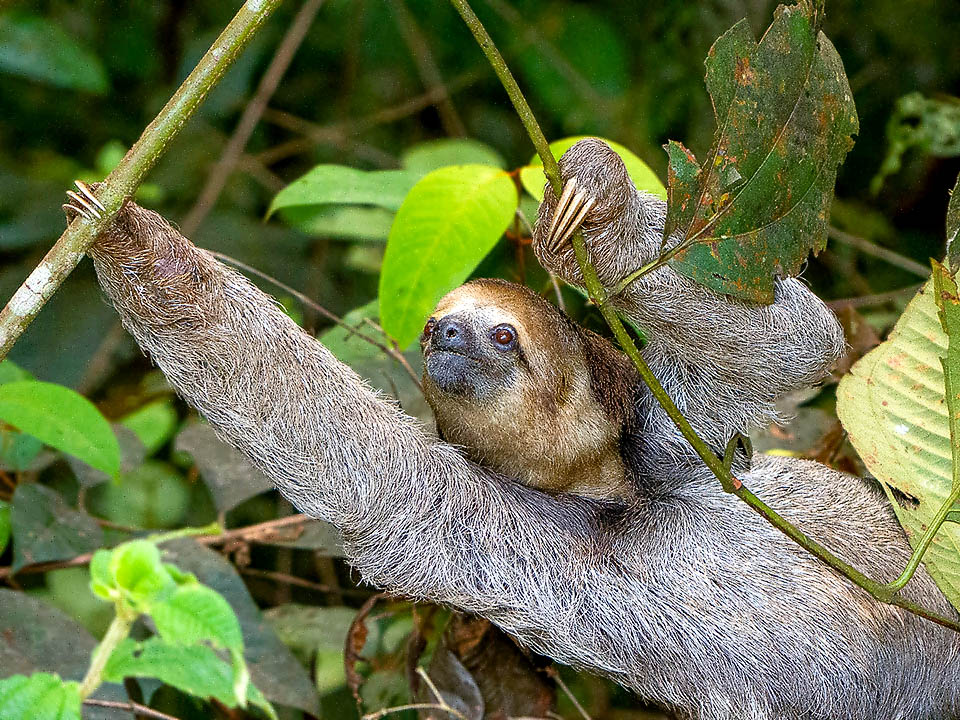
Mammals head is usually relatively big for the remarkable development of encephalon and displays a good mobility. Bradypus tridactylus can rotate it of almost 360° © Matheus Fernandes Moraes Silva
HEAD
The head of the mammals is provided with a well pronounced snout, usually large in size if compared to the remainder of the body. The size of the head is related to the volume of the encephalon, which in most species is well developed, especially the neocortex. In relation to defense or predation activities, the body usually has a good, at times very ample, mobility.
The three-toed sloth (Bradypus), genus of mammal of the order of the Pilosa living in the tropical forests of Central America, may have an almost 360° mobility of its head thanks to special joints in its neck.
In mammals, the skeletal structure of the head, skull is completely different from that of the Reptiles, with a significant reduction in the number of the bones, and is characterized by the tendency to extend over the bones of the face. The skull has two occipital condyles through which it articulates with the first cervical vertebra, the atlas.
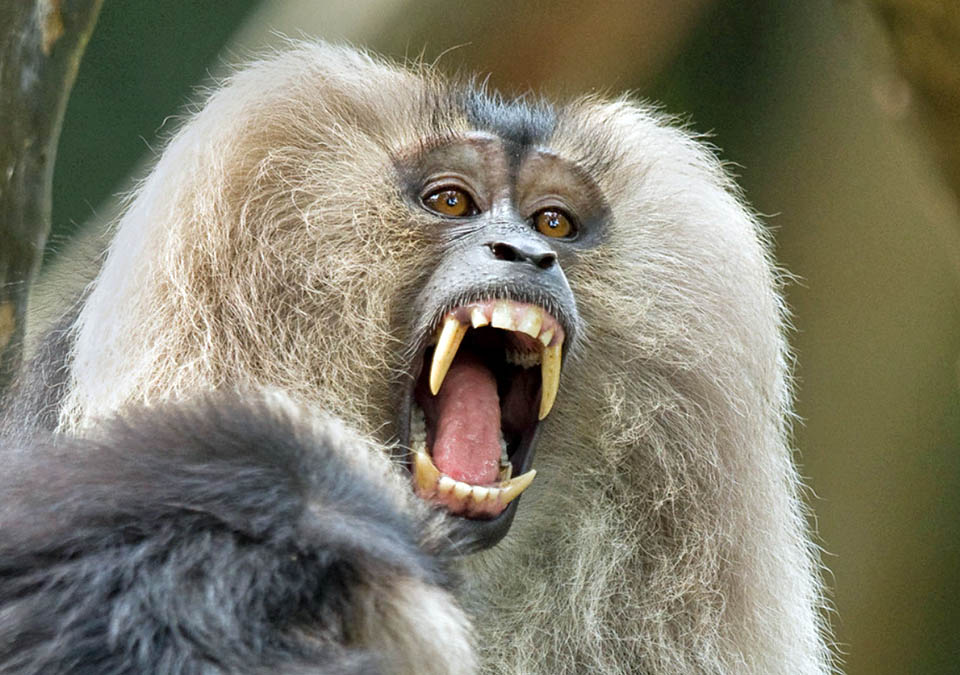
Macaca silenus with showy canines. The mouth has a definite number of teeth implanted in alveoli of the jaw and of the mandible © Benny Ng
Mouthparts
The mammals mouth is usually surrounded by fleshy lips, variously developed.
The mouth vault is composed of the secondary palate, which in its upper part is supported by the maxillary processes and of the palatines (hard palate), whilst in the back part does not have the bony support (soft palate): this allows breathing even while feeding.
The two branches of the mandible are formed by only one bone each (dental) and articulate directly with the squamous bone of the head, unlike the Reptiles where such articulation is realized through other bones. In the fore part of the mandible, the two dentals are merged through ligaments, cartilage or synostosis.
The Meckel’s cartilage disappears almost completely and usually is included in the middle ear originating one of the ossicles of the auditory system, the malleus.
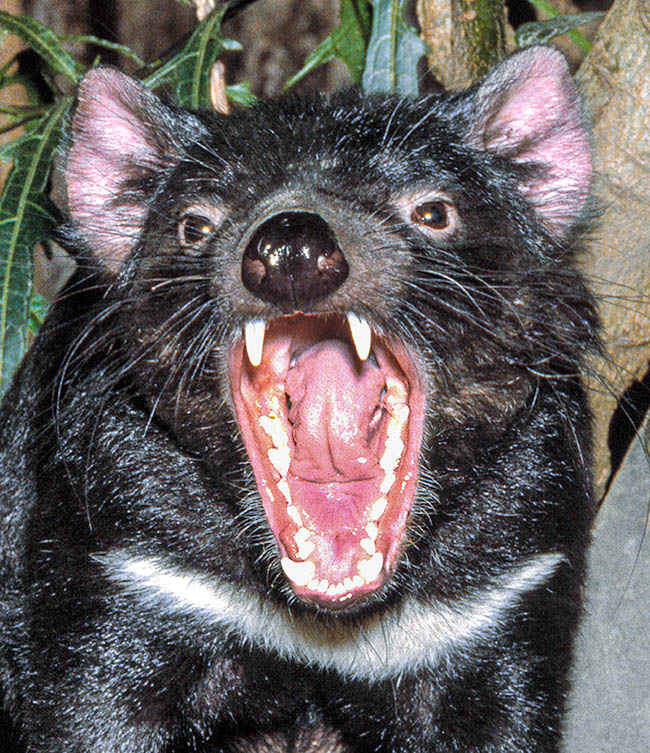
Marsupials count even 56 of them. Here the ferocious Tasmanian devil (Sarcophilus harrisii) © Giuseppe Mazza
Inside the mouth open the ducts of the salivary glands (parathyroid, sublingual, submandibular, infraorbital); very developed in the herbivores, these glands are reduced in the carnivores, whilst are totally absent in the forms living in an aquatic environment.
The mouth is usually equipped with a defined number of teeth (up to 56 in the Marsupialia) that are implanted in alveoli on the jaw and on the mandible (thecodont set of teeth).
The marked differentiation of the teeth (heterodonty), in form and size, in the various positions of the dental arches, reflects their functional specialization; in fact, in most mammals 4 types of teeth are recognizable: the incisors, placed in front, suitable for biting and cutting; the canines, long and pointed, suitable for grabbing and piercing; the premolars and the molars having the crown shaped for crushing the food.
The set of teeth of the various species of mammals is commonly is expressed with a dental formula, represented by a fraction on whose numerator are indicated the teeth of the upper hemiarch, on the denominator those of the lower hemiarch following the order: incisors, canines, premolars and molars.
A set of teeth presenting all four categories of aforementioned teeth is defined complete.
When the numerical reduction of teeth is accompanied by the disappearance of one or more of these categories, the set of teeth is called incomplete; in such cases the room (or the rooms) without teeth existing in the dental arches is called diastema.
The instances of teeth all the same (homodonty), as occurs in the Cetacea Odontocetes, as well as those of reduction or of total disappearance of the teeth, as occurs in the Armadillos, Anteaters and Sloths, for such reason called Toothless, Edentate or Badly toothed, are secondary evolutionary acquisitions, consequence of adaptations to particular diets.
In some mammals, like in the Platypus and in the Echidna (Monotremata) and in the Whales (Cetacea), the teeth are present only in the juveniles, whilst the adults present respectively a horny beak and baleens, laminar corneal structures suspended from the jaws.
The majority of mammals throughout their life cycle present two sets of teeth (diphyodont), a first juvenile set of teeth temporary or deciduous (“baby” or milk teeth), and a second permanent set of teeth, rightly, permanent.
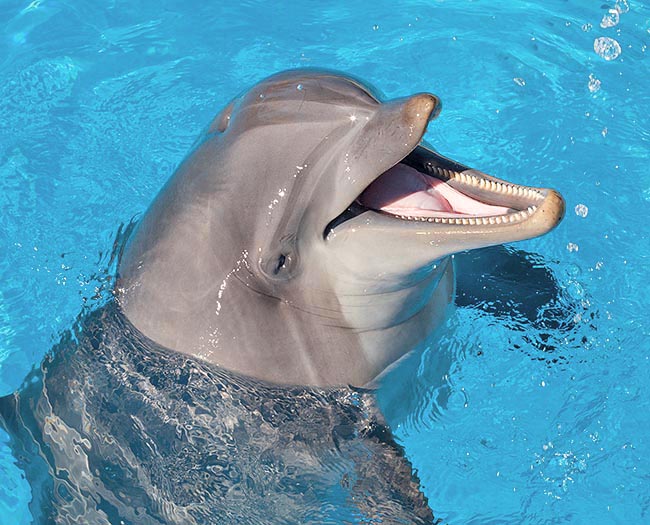
Tursiops truncatus has about 18-26 pairs of conical teeth per jaw. They are not used for chewing but to hold preys © Giuseppe Mazza
In any case, however, the molars are exclusive to the second set of teeth.
In some species, the disappearance of one of the two sets of teeth (baby or definitive) is a consequence of the passage from a primitive two sets of teeth condition (diphyodont) to a second one in which occurs only one tooth eruption (monophyodont); this situation is observed in the Cetacea Odontoceti.
Usually, the teeth have defined growth, however some species of the class have a continuously growing dentition, where the tooth wears down in its free portion whilst it grows at the base.
Are continuously growing the incisors of the Rodentia (Mice, Rats, Squirrels, Hamsters, Guinea Pigs, Beavers, Marmots, Coypus, Porcupines, etc.) and of the Lagomorpha (Rabbits and Hares).
Also the canines of the Suidae (Pigs, Wild boars, Warthogs, Babirusas) and the upper incisors of the Elephantidae (Elephants) are transformed into variously developed fangs, usually more in the males.
The canines of the Hippopotamus (Hippopotamus amphibius Linnaeus, 1758) are sharp and cutting and protrude outwards, constituting a terrible weapon.
Endowed with continuous growth, in the males of the Hippopotamus the canines may reach even the length of 50 centimetres per a weight of 3 kg, whilst in the females they are definitely smaller and usually weigh 1 kg.
The canines of the Walrus (Odobenus rosmarus Linnaeus, 1758) are very long and in the males they may reach even one metre in length and exceed the 5 kg in weight.
The tongue, located on the buccal floor, is a muscular organ more frequently mobile. and appears various in shape and size in the various groups.
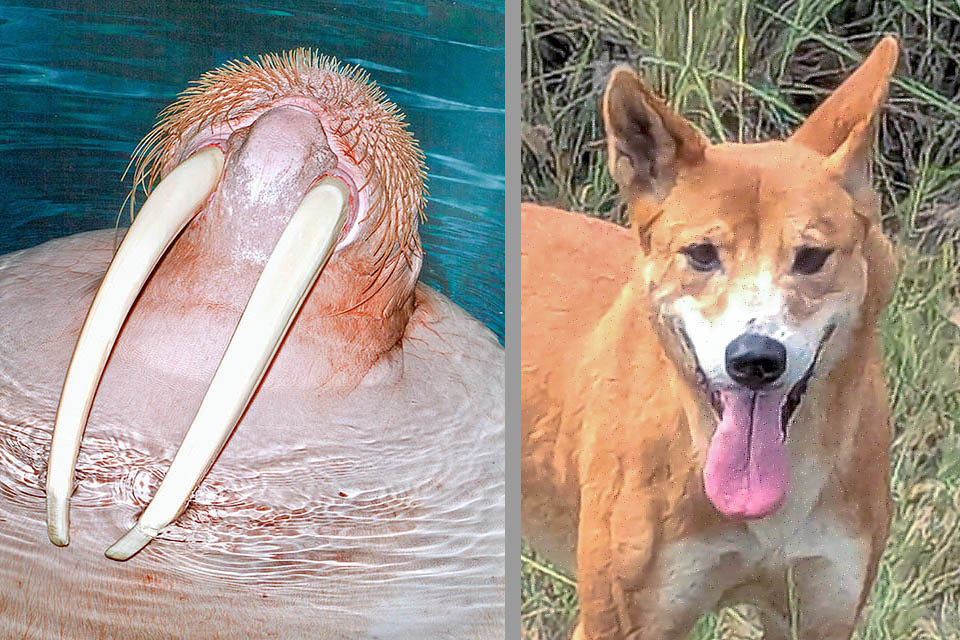
From the walrus’s (Odobenus rosmarus) mouth get out oversized teeth; the tongue of the dogs, here a Canis lupus dingo, can hang also with funtion of thermoregulation © Giuseppe Mazza (left) © jonathon love (right)
Several myrmecophagous species, like the Giant anteater (Myrmecophaga tridactyla Linnaeus, 1758), known also as Ant bear, are equipped with a long and sticky tongue in relation to the diet formed by Ants and Termites that they feed on in large quantities.
The surface of the mammals’ tongue is covered by taste buds of various shapes (corolliform, filiform, jeafy, etc.) that render it a very versatile organ for touch, taste and swallowing.
In several zoophagous species, the tongue is provided of rough papillae in particular utilized for the cleaning.
Several species, such as Dogs and Wolves (Canidae), when panting, utilize the tongue also as an organ of thermoregulation.
Horns
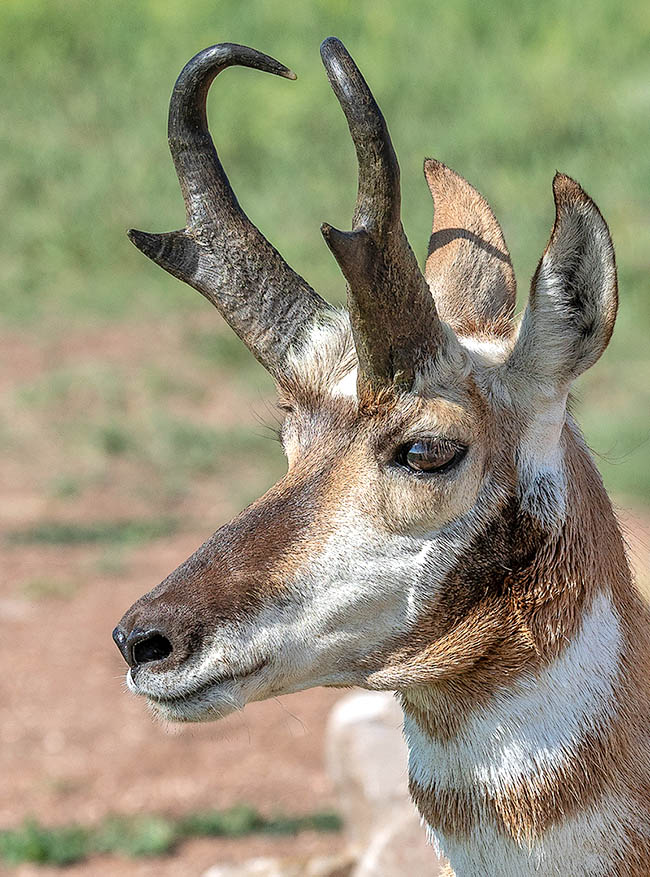
Horns have varied shape, often different in the two sexes or exclusive to males. In Antilocapra americana the bifid ones of the male are covered by a horny case that renews every year on a permanent bony nucleus © bwood708
Some mammals have on the head bone protrusions, called horns, that may be one or two uneven like in the Rhinoceroses (Rhinocerotidae) or, more frequently, a couple (Cervidae, Bovidae) and others.
Only the male of the antelope (Tetracerus quadricornis Blainville, 1816) is armed with two pairs of horns.
Depending on the species, the horns have various conformations (simple, ramified, smooth, girdled) and often different in the two sexes or exclusive of the males and having defensive and offensive functions.
The Rhinoceroses are armed with one or two median horns resting on a bone relief of the nasal septum and that are considered homologous to intimately merged hairs.
In the Cervidae the horns are ramified and originate starting from a dense connective tissue on the bumps of the frontal bones of the skull.
In most species the horns represent a secondary sexual character exclusive to males and usually are deciduous, as by the end of each reproductive season they fall to regenerate in the following year.
Conversely, in the family of the Bovidae (Antelopes, Goats, Sheep, Oxen, etc.) the horns are not deciduous and are formed by a persistent horny case, of epidermal origin, that covers a central part with ossified tissue originated from the proliferation of the central bones. The horns made like this are therefore called hollow and normally are present in both sexes and are not ramified.
And more, the horns are continuously enriching and in the species living in regions characterized by a marked seasonal cycle they display growth rings related to the seasons of the year.
In the Pronghorn (Antilocapra americana Ord. 1815), only membre of the Antilocapridae, the horns, bifid in the male, are formed by a perennial bony process covered by a deciduous bony case renewing each year.
In the Giraffe (Giraffidae) the horns are very short and are always covered by skin on which numerous hairs grow.
NECK
In the mammals, the neck is the anatomical part connecting the head to the trunk and containing important vital organs like the trachea and esophagus. The neck plays a fundamental rôle in supporting the head, allowing its mobility and favouring essential functions such as the breathing, the communication and the swallowing.
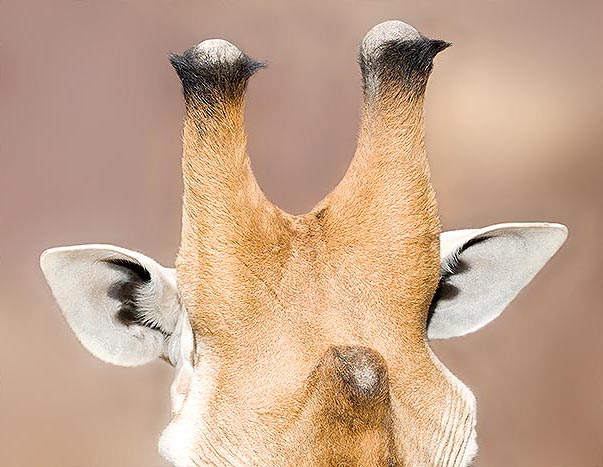
In the Giraffes the horns are very short, always covered by the skin with numerous hairs © Giuseppe Mazza
Usually the neck is well distinct and more developed in the herbivorous species, as we can see in the Cervidae, in the Bovidae and in the Equidae, or even significantly elongated like in the Giraffidae.
Instead, the neck is reduced or little evident in the aquatic ones (Cetacea) and in the delving ones (Talpidae).
Characteristic of almost all mammals is the skeletal support of the neck formed by seven cervical vertebrae regardless of its length.
In few species, such as tridactylous Sloths (Bradypus), the neck contains 8-9 cervical vertebrae, whilst the didactylous Sloths (Choloepus) have 5 to 7 of them, allowing them a rotation of the neck up to 270°-360° to defend themselves. The Manatees (Trichechus) have 6 cervical vertebrae.
TRUNK
In the mammals, the trunk is the region of the body on whose sides are placed symmetrically a pair of forelimbs and a pair of hind limbs.
From a morphological point of view, the trunk of the mammals is very varied in appearance, from long and slender, like in the Mustelidae, to stocky and stout. as in the Hippopotamidae, in the Rhinocerotidae, and others more.
In turn the trunk of mammals is divided in thorax, abdomen, pelvis, including the main body cavities where the viscera are contained. The appearance of the diaphragmatic muscle, exclusive to mammals, subdivides the inner cavity in anterior thorax cavity, and posterior abdominal cavity.
During the evolutionary path of the mammals, the skeletal and muscular structure of the trunk has undergone even substantial modifications allowing on the one hand a proper support of the inner organs and on the other one the capacity of rapid movements also to animals with a considerable body mass.
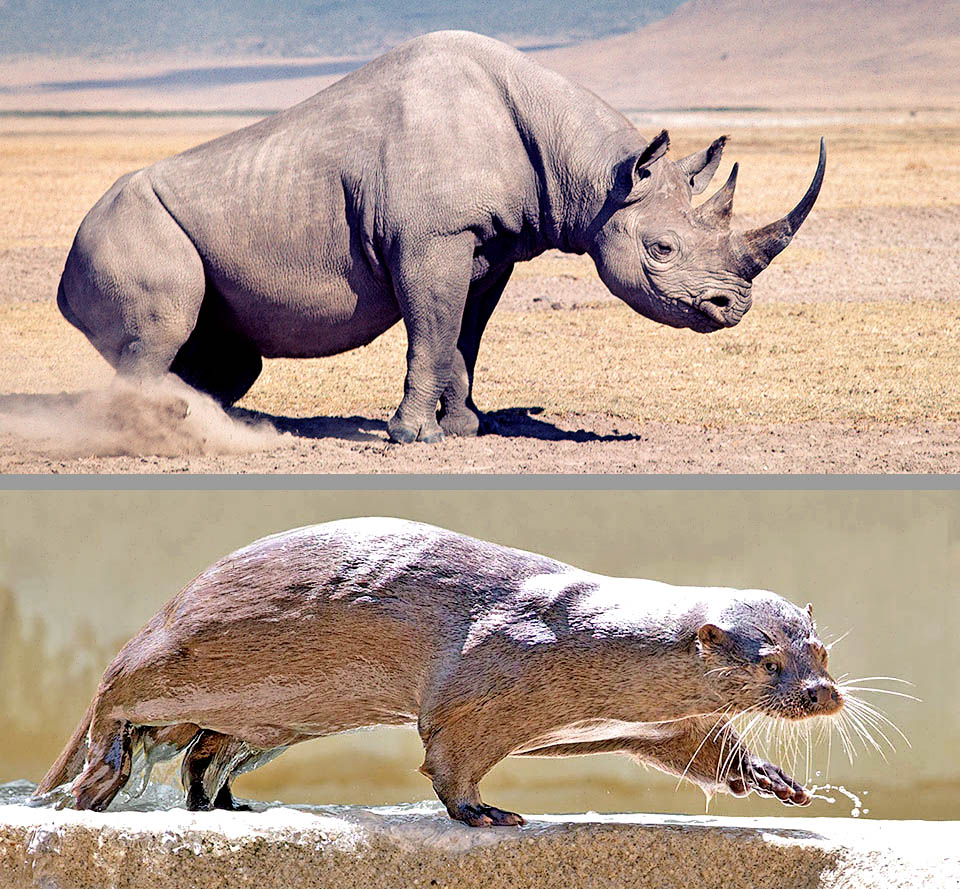
The trunk of mammals may be stocky and massive like in Diceros bicornis or slender like in Lutra lutra © Giuseppe Mazza
This has been possible with the appearance of the ribs and of the robust abdominal muscles in the terrestrial Vertebrates and the specialization of the shoulder girdle and of the pelvic girdle that allow an adequate connection and mobility of the limbs with respect to the axial skeleton.
Moreover, the passage from a quadrupedal gait, pronograde, typical to many mammals, to a bipedal gait, orthograde, typical of some Hominidae, has been possible also due to the progressive verticalization of the trunk in respect to the limbs, with adjustments to the spine, the pelvic girdle and the shoulder girdle. This has also allowed them to even abdominal adduction, abduction and rotation of the limbs movements.
TAIL
The tail appears very various as per development, shape and functions; it can be rich in hairs (Squirrels, Horses, etc.) or naked (Mice). In the Ungulates, the tail is usually long and apically provided with bristly hairs, useful for chasing away the annoying insects.
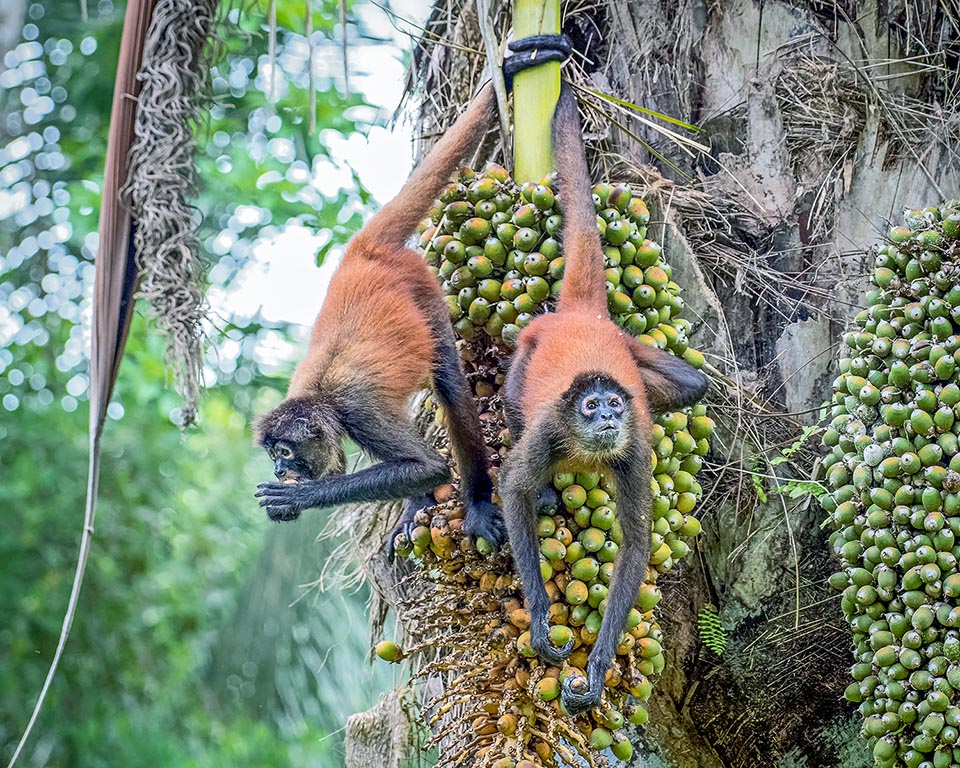
The tail, at times absent, has very varied forms: rich in hairs or naked like in mice. In beavers serves as rudder and in some monkeys is prehensile © Tony-tickspics.com
In some cases the tail is flattened and used as a rudder, like in the Beavers and in the Cetacea, or compressed laterally like in the Muskrat (Ondatra zibethicus Linnaeus 1766). The opossums, American marsupials
Didelphidae, and some Monkeys are equipped with a long and prehensile tail they use for grasping branches.
In some species, like in the Kangaroos (Macropodidae), the tail is very strong and developed, so much to be able to support the whole weight of the body.
In other mammals the tail is little developed, like in the Short-tailed opossum (Monodelphis Burnett, 1830), Short-tailed mongoose (Herpestes brachyurus Gray, 1837), Rabbits (Oryctolagus cuniculus Linnaeus, 1758) and others more.
Finally, some mammals, like Anthropoid apes (Gorilla, Chimpanzee) and Man, have a vestigial residue or lack a tail altogether (anurous).
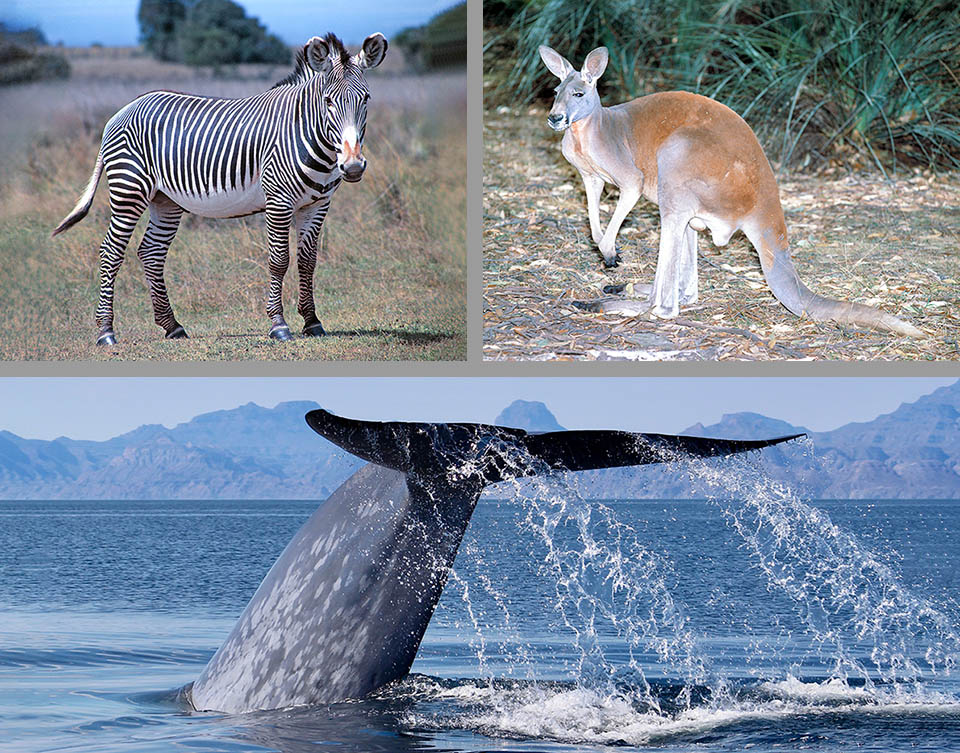
Usually mammals have four limbs, used for running like Equus grevyi, for jumping like Macropus rufus or swimming, transformed in fins, like Balaenoptera musculus © Giuseppe Mazza (above) © Roger Proudfoot (below)
LIMBS
A characteristic that unites almost all mammals is the presence of two pairs of limbs very varied in shape and development, hence the name of the superclass they belong to, the Tetrapoda.
The limbs of mammals, commonly called legs, are specialized for deambulating, running, jumping or swimming or, to a lesser extent, flying. As well as for the basic bone structure, the legs of most Mammals have the characteristic of having the extremities with five fingers, Pentadattilia, primitive characteristic shared with many vertebrates of terrestrial habits.
An exception are the members of the families Suidae and Hippopotamidae that have 4 toes, whilst Bovidae,
Cervidae, Giraffidae and Camelidae have two of them. Long and agile, like in the Deers, Antelopes, Gazelles, teh legs are huge and very stocky, like in the Elephants and in the Hippopotami.
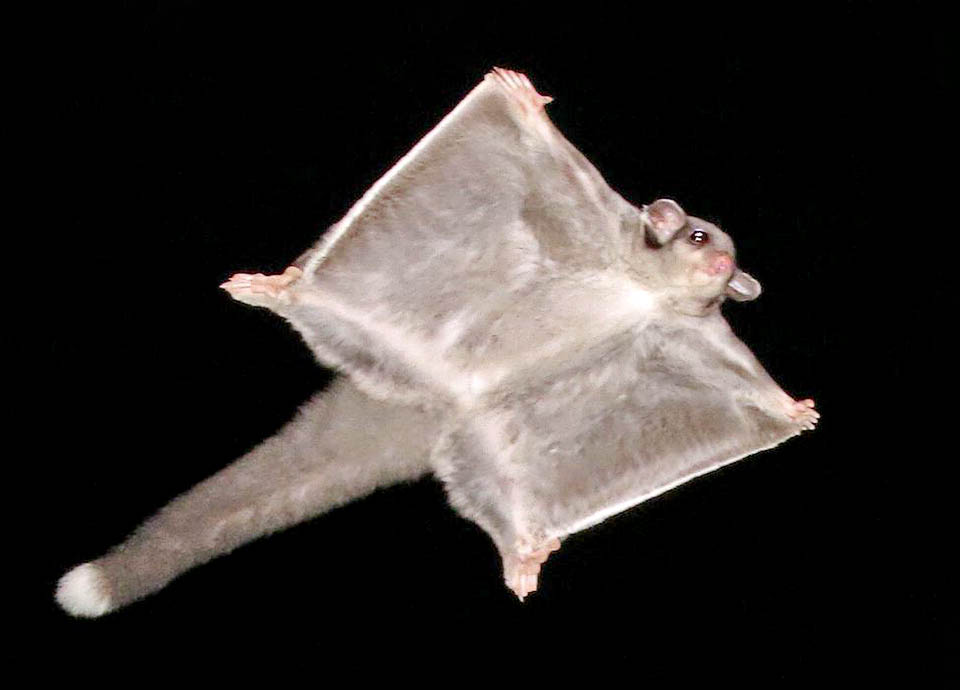
Bats fly spreading their patagium, a thin skin membrane placed between limbs. The same do, gliding, some marsupials like this Petaurus breviceps © Ian D B Moodie
Kangaroos, Kangaroo rats, Hares and other mammals have the hind legs remarkably more robust and more developed than the fore ones, suitable for hopping. In relation to their underground habitat, the Moles have legs short and with wide soles suitable for digging.
A marked evolutionary differentiation of the limbs is noted in Whales and Dolphins (Cetacea), Dugong (Dugong dugon Müller, 1776) and Manatee (Trichechus Linnaeus 1758) of the order of the Sirenia, where the forelimbs have transformed in pectoral fins whilst the back ones have reduced to small internal vestigial bones.
In the Bats (Chiroptera) the forelimbs have specialized for the active flight with the extremely elongated toes, from the second to the fifth, that subtend a thin skin membrane, the so-called patagium, that extends along the body, the hind limbs and frequently also the tail. As well as a flight organ, the patagium also works as a structure of thermoregulation, thanks to a rich net of blood vessels.
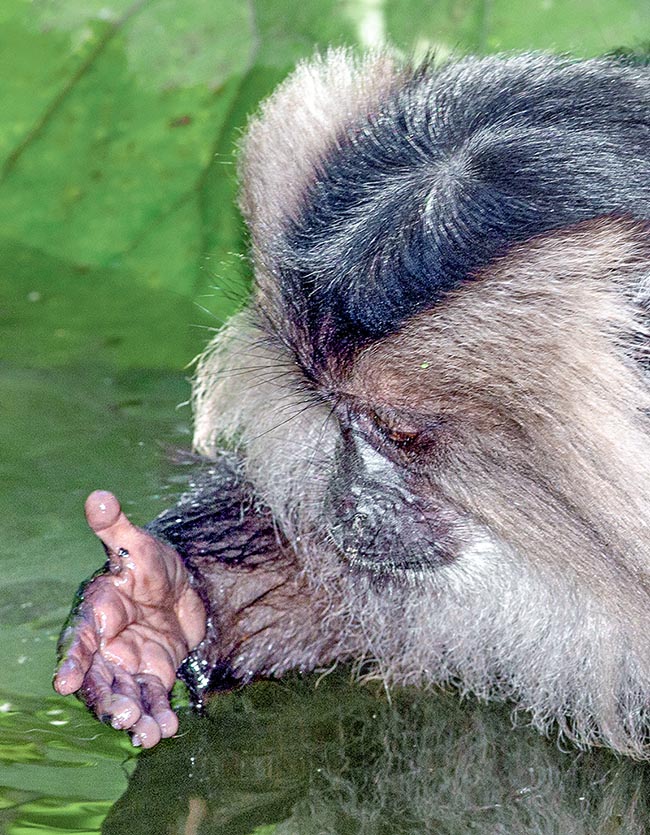
The hand, here observed from a Macaca silenus, has 5 fingers quite similar to human ones © Giuseppe Mazza
The feet, normally provided with 5 toes, at times less, have a structure varying depending on the type of locomotion, as they are suitable for running, climbing, swimming, flying, digging.
In the running mammals we see a narrowing and an elongation of the foot, as well as a reduction in the number of the toes.
The sole of the feet usually is hairless and has a thick corneum layer, in particular at the level of the fleshy pads or the fingertips.
The toes have cornified dermal formations, the nails, in their different shapes of claws or falcula, hooves or ungulae, unguiculate or laminar nails. Normally, the nails are continuously growing.
The way to move on land of the mammals is quite various and, depending on the type of locomotion distinguish: the Plantigrades who, like the Bear, walk leaning the entire plantar and palmar surface, the Digitigrades, who move leaning only two toes (like, for instance, the Canids).
Mammals who walk on their fingertips, protected by strong nails and hooves are called Unguligrades.
Depending on whether the support on the ground is done on the tip of an even number of toes or on an odd number, the Unguligrades are distinguished in Artiodattili (Camels, Antelopes, Pigs, etc.) and Perissodattili (elephants, rhinoceroses, horses, etc.).
SENSE ORGANS
Vision
The eyes, one pair in number, are usually protected by two mobile eyelids, one upper and one lower, bordered by eyelashes. In some species, such as Cats, Polar bear, Beavers, Seals, Walruses, Aardvarks, is also present one “third eyelid”, the nictitating membrane, that, unlike the other two, moves horizontally. The nictitating membrane is transparent and serves to protect the eye and at the same time to allow the vision and the positioning when the animal is submerged. In most mammals, man included, the nictitating membrane is reduced to a small vestigial residue located at the inner corner of each eye (plica semilunaris).
The size of the vision organs varies greatly, from very big in the species leading a nocturnal life, like in several Prosimians (Prosimiae), to very reduced in the digging forms, to hypogeous life, such as Moles, Shrews (Insectivora) and Marsupial moles, or Notoryctes (Notoryctes Stirling, 1891).
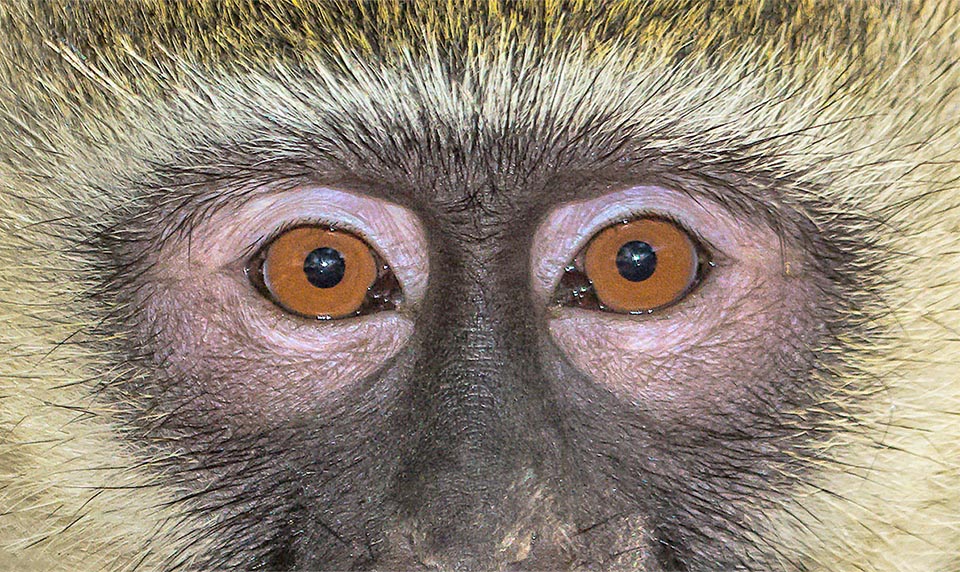
Implanted laterally in herbivores for sighting the predators, in bats, carnicores and primates the eyes are frontal for the binocular vision of the depth © Rafi Amar
Implanted laterally on the head, like in the species feeding on grasses, the eyes allow to spot from both sides possible foes and predators, whilst located in anterior position (Chiroptera, Carnivora and Primates) allow a binocular vision essential for depth perception.
The structure of the eyes is clearly similar to that of the other Vertebrates: however the sclerotic is not ossified, but is formed by dense fibrous tissue and has no comb, that is conversely present in the Reptiles and in the Birds. The pupil contracts in a vertical slit in the Felines and horizontal in the Ungulates.
The sense of vision is not the most important sense in the mammals, on the contrary, only a reduced number of them are able to see perfectly even immovable objects. The ability to perceive the colours in many members of this class is far inferior to that of many Fishes and Reptiles and of almost all Birds. The anthropoid apes and to a greater extent, the Man (Hominidae), are perfectly receptive fto colours.
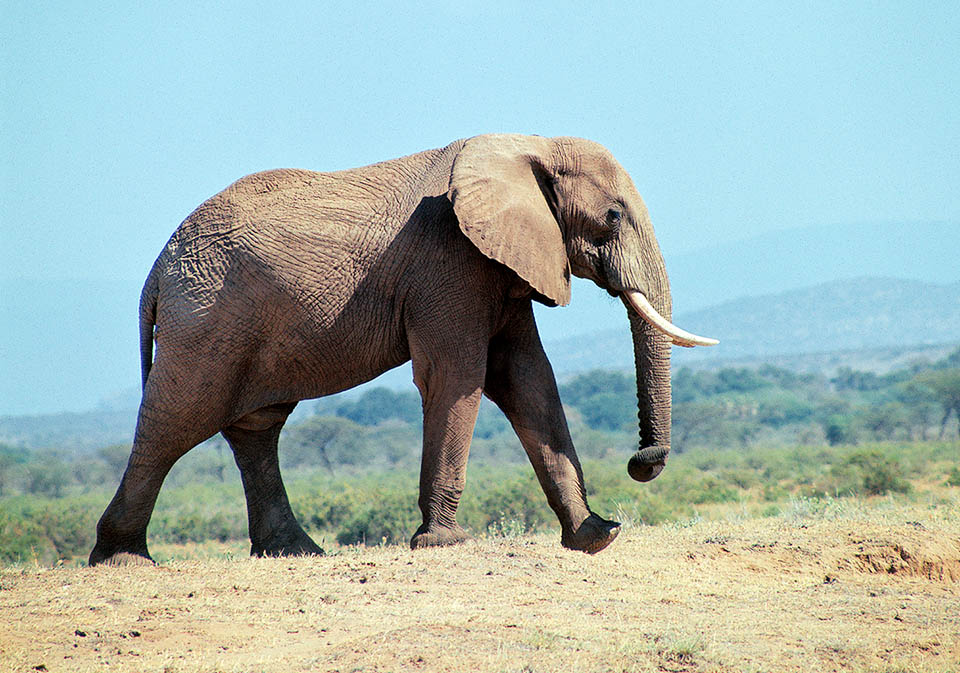
Loxodonta africana. The mammal with most developed olfaction is the elephant. In the aquatic species nostrils have transformed in a blowhole placed at the top of the head © Giuseppe Mazza
Olfaction
Usually the nostrils open at the extremity of the head, but in the aquatic forms they may be moved further back, in a dorsal position.
Several species, like Whales, Dolphins, Orcas (Cetacea), Manatees and Dugongs (Sirenia) have nostrils that have evolved in a blowhole located at the end of the head; this adaptation to aquatic life allows these mammals to be able to breathe while swimming in surface, just like Camels and Dromedaries can close their nostrils to protect them from the sand. Moreover, the presence of some sacs under the blowhole allow the Cetacea to orient themselves and hunt, emitting sounds and interpreting the returning echoes like a real biological sonar. Typically, in the Mammals the nose is supported by the nasal bones and by cartilages; at times the fleshy mass may form a long trunk like in the elephants. The sense of smell is particularly developed in some Mammals, especially in relation to their diet habits.
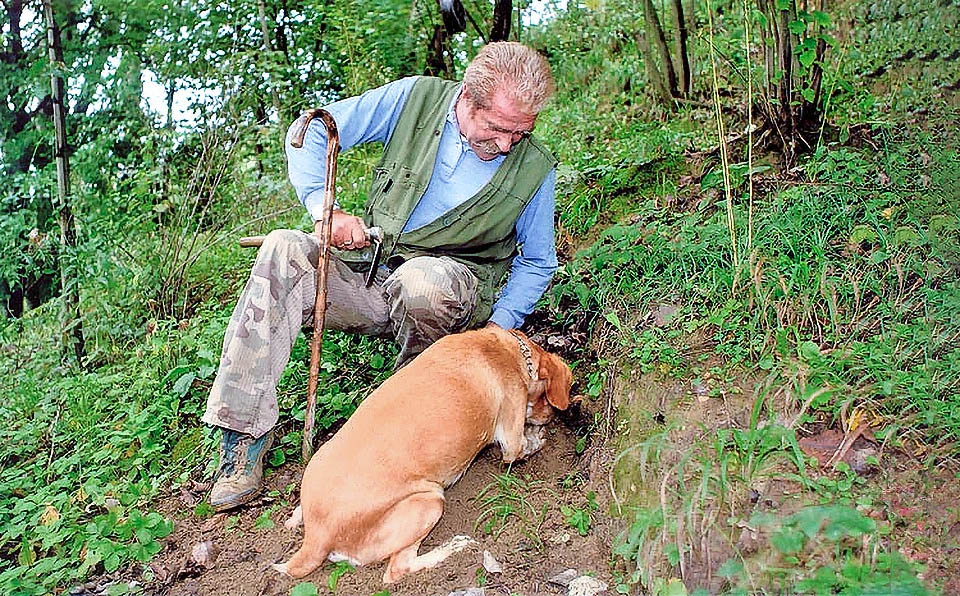
The dog, less clumsy and with 200-300 million of olfactory receptors is very used by man who can rely only on 5-6 million of receptors. Here it has found a truffle © Tartuflavio
The predatory species utilize the sense of smell for following the path of the prey, whilst those who feed on vegetables employ this sense as an effective means for promptly identifying the presence of a foe. In many members of the class of the mammals, the sense of smell plays a primary rôle in community life and in sexual relations. In these forms equipped with a very acute sense of smell (macrosmatic) the nasal cavities are rather developed and internally have a mucous membrane with many plicas and rich in fusiform cells.
In the species of mammals where the sense of smell has poorly developed (microsmatic) like, for instance, the man, the nasal cavities are reduced and the mucous membranes have no plicas; finally, animals that, like the Whales, have almost completely lost this sense are called anosmatic.
Hearing
The organ of hearing of the mammals, ear, is fundamentally responsible for perception of the sounds and the localization of the sourde producing them.
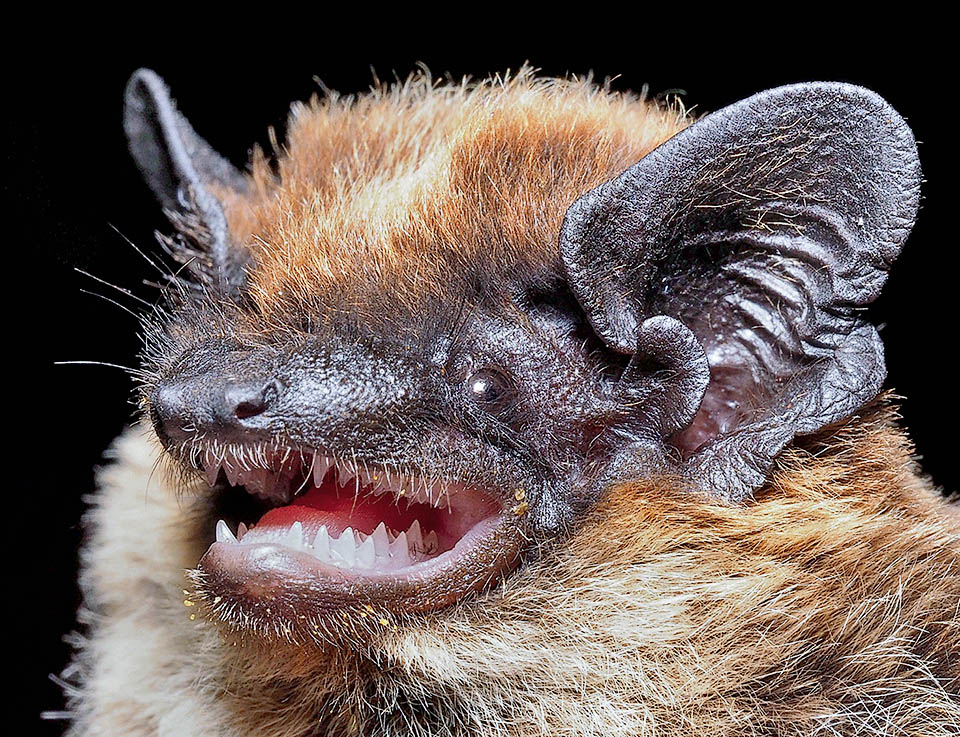
Hypsugo savii. Bats excel in hearing, detecting obstacles and small prey with the returning echoes of ultrasounds emitted at high frequency, imperceptible to man © Jakob Fahr
The ear also has the important function of collecting the information concerning the position and the movement of the body in space in order to maintain the posture and allow the coordination of the movement.
Thanks to a highly specialized ear, the mammals are endowed with exceptional hearing faculties, able to perceive sounds of very weak intensity, just a few decibels for many species among which also Dog and Cat.
Also the detectable frequency spectrum varies from the very low sounds, up to 20 Hz (infrasounds), to those very high, even beyond the 150 mil Hz (ultrasounds).
Various mammals, such as Bats, Dolphins, Orcas and others are able to perceive the environment and orientate, identify obstacles and prey, emit ultrasounds and evaluate their return echos (biosonar). The whales, particularly the gray whales and the blue whales, for communicating emit infrasounds that may travel for hundreds of kilometres.
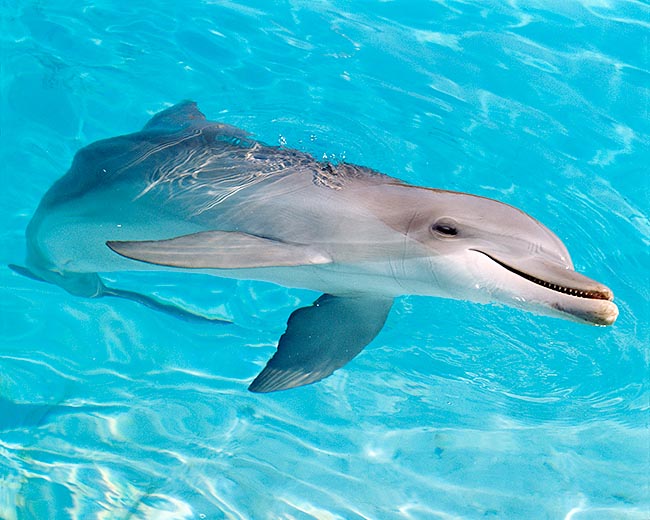
Tursiops truncatus. Also dolphins have an exceptional hearing and rely on the echolocation to orient themselves and hunt. The outer ears are reduced to tiny auricolar openings placed on the sides of the head and almost invisible © Giuseppe Mazza
Symmetrically located on the sides of the head, behind the jaw joint and anterior to the mastoid process, the hearing organ is subdivided in outer, middle and inner ear.
The outer ear is the visible part of the organ and is called pinna, mainly formed by a cartilaginous plate covered by skin and shaped like a shell.
Each pinna carries on the important function of collecting and conveying the sound waves into the ear canal towards the eardrum.
The position of the two pinnas allows to catch the sound stereoscopically and to therefore localize the origin. The pinna is particularly mobile in many species, such as Dogs and Cats, that may rotate it up to 180°. In Man, even if reduced and poorly mobile, the pinna is in any case capable of ensuring the hearing stereoscopic capacities.
The pinna reduces and becomes totally absent in the burrowing forms (Moles, Ground squirrels, and others) and in the aquatic ones, such as Whales, Seals, and Sirenians. The pinna continues with the middle ear from which is separated by the tympanic membrane (tympanum).
The middle ear characterizes for the presence of three ossicles: the malleus and the incus, exclusive to the mammals, and then the stapes. The ossicles have the function of transmitting the vibrations of the tympanic membrane caused by the sound waves through the oval window, in order to set in motion the fluid placed in the cochlea of the inner ear, thus transducing the energy of the pressure done by the sound signal.
The inner ear of the mammals is a complex structure carved into the temporal bone, formed by the bony labyrinth and by the membranous labyrinth, that contains within it a liquid (endolymph). The membranous labyrinth is characterized by the development of the cochlea, spiral-shaped, but the Monotremes. Ultimately, the inner ear performs the crucial functions in the perception of sounds through the cochlea) and of balance (through the vestibular duct with semicircular canals, utricle and saccule).
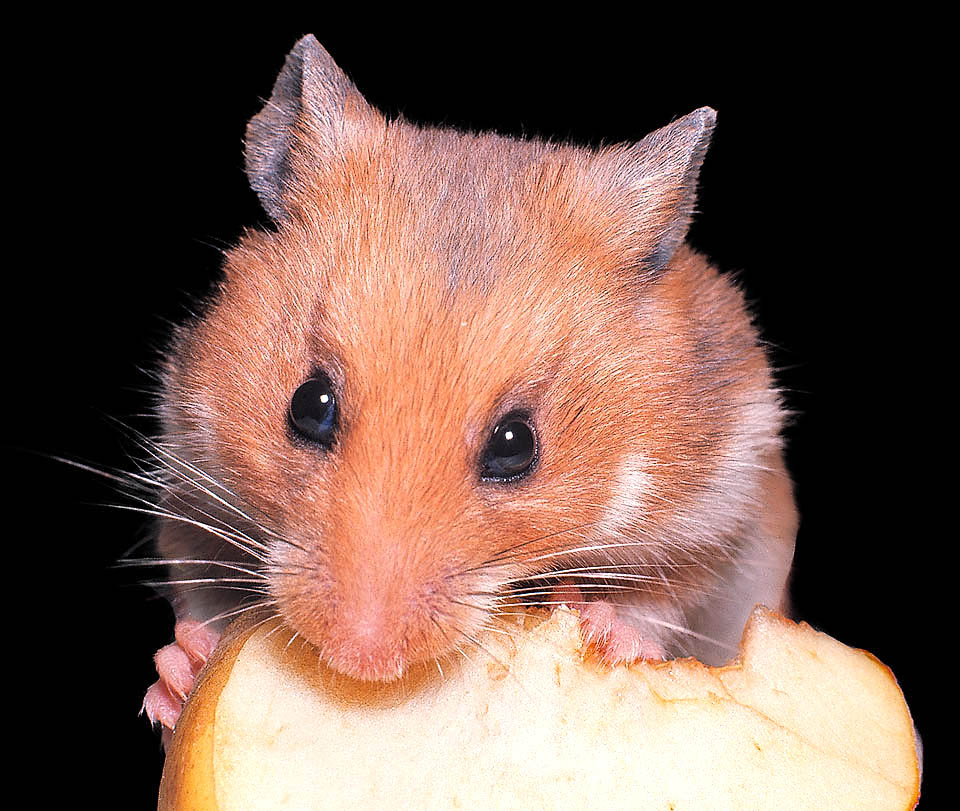
In mammals the integumentary system includes not only the hair, well visible in this Mesocricetue auratus but also nails, claws and a skin rich in glands © Giuseppe Mazza
INTEGUMENTARY SYSTEM
The integumentary system of the mammals, or tegument, is a complex organ covering the entire body and protects it and characterizes for its exclusive annexes of the class like hairs, nails, horns and glands of various kinds (sebaceous, sudoriparous, mammary). The teguments perform a fundamental rôle for the defense from the outer agents and the social communication.
Hairs
The body of most mammals is usually covered by hairs forming a thick fur coat.
As happens for the feathers of the plumage of the Birds, in the coat stand out, long and robust bristly hairs or hairs of the contour that form the so-called giarra, that cover, protecting them from the use over time, the woolly hairs, shorter and thinner, down or soft substance or undercoat.
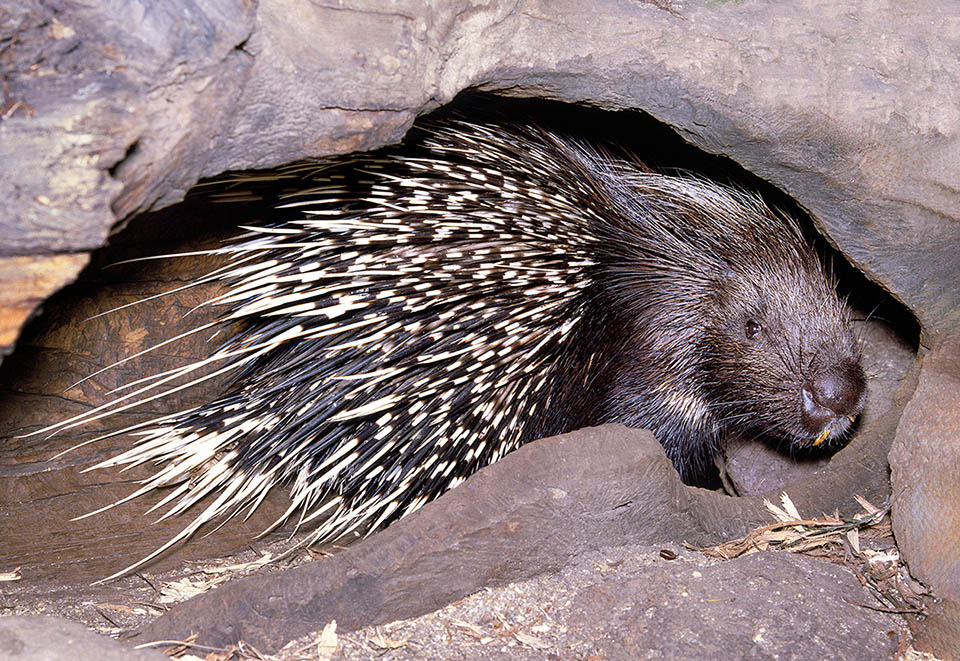
In some species, like porcupine (Hystrix galeata) the hair has transformed into robust aculei with defensive function © Giuseppe Mazza
The giarra determines as a whole the contour of the body of the animal, whilst the down performs the function of thermally insulating the body. Called also mantle or hair, teh fur of the mammals greatly varies in length, colour, hair density and texture. Long and thick in many arctic species and of cold climate, the fur is short and with thinner hairs in the fur of the Mammals living in tropical areas.
In some species however the covering of hair may be limited to some parts of the body (like in the Elephants and in Man), or can be represented by a sparse down or be wholly missing, like in the Naked mole-rat (Heterocephalus glaber Ruppel, 1842), some Cetacea, armored rhinoceroses, mainly the Indian rhinoceros (Rhinoceros unicornis Linnaeus 1758) and others more.
Must be mentioned some hairless domestic races of mammals like the Canadian Sphynx or Naked cat, and the Guinea Pig or Domestic cavy (Cavia porcellus Linnaeus, 1758), races derived from a natural genetic mutation.
In some species of mammals the hairs are modified in relation to aquatic life, like Cetacea and Pinnipeds.
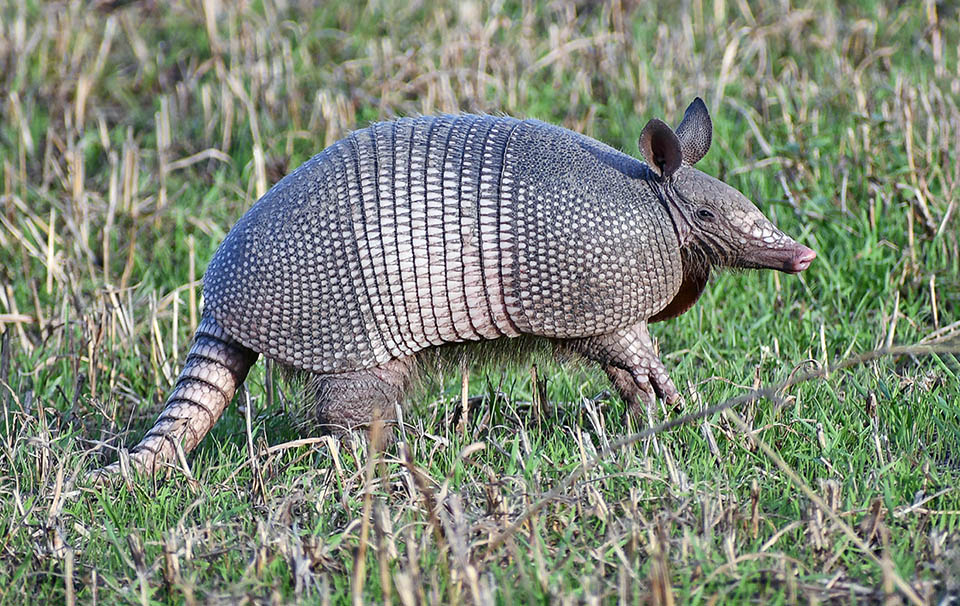
In armadillos, like Dsypus novemcinctus, the integument forms instead a cuirasse formed by bony plates covered in keratin© Roberto R. Calderón
In several mammals the hairs are transformed in rigid defensive spines, like Echidna or Spiny anteaters, Monotremes Tachyglossidae native to Australia and New Guinea, Porcupines or Old World porcupines (Hystrix Linnaeus, 1758), Rodents of the family Hystricidae, and Hedgehogs (Erinaceus Linnaeus, 1758).
Among mammals, the Pangolins (Manis Linnaeus, 1758), known also as Scaly anteaters, characterize for having the back covered a shell of epidermal horny scales, arranged in way to allow the animal to curl up into a ball if scared.
Also the Common armadillo or Lucilla (Dasypus novemcinctus Linnaeus, 1757), diffused in central-southern America, presents the body protected by an articulated shell of epidermal plaques supported by bony plaques. The Armadillo cannot curl up like a ball.
Imbricated horny scales mixed with hairs can be found in the tail of many Marsupialia and of many Rodents.
Many mammals, around the mouth, the nose and the eyes, are provided with tactile vibrissae, long and rigid hairs with the base rich in numerous sensory nerve endings, structures that allow them to orientate, communicate and hunt even in the dark.
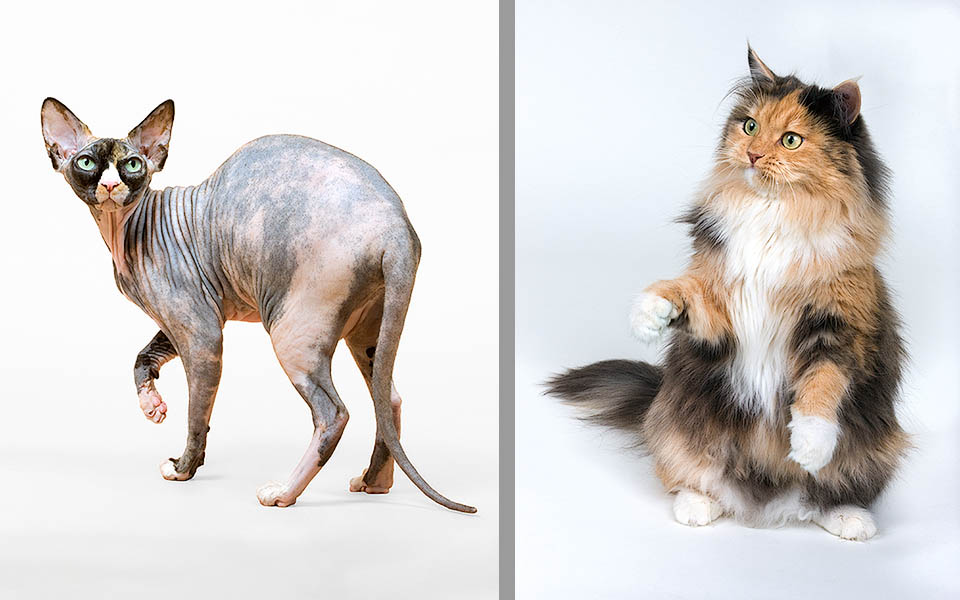
The artificial selection has accentuated in the domestic cats opposite characters, wih almost absent hairs in the Sphynx and particularly developed in the Siberian © Giuseppe Mazza
Moulting
Usually the hairs of the fur are periodically renewed with a process of moulting that usually is gradual so that the skin never remains bare.
In some species the loss of the hair begins from a more or less circumscribed point and extends like a wave all over the body, in others, instead, the moulting proceeds in a scattered and irregular manner.
Several mammals of the cold regions or of the high altitudes, in autumn change the summer coloured mantle with a winter one, white and longer. This phenomenon favours camouflaging among the ice and the snow and in the meantime reduces the dispersion of the body heat.
In the following spring, a new moulting restores the coloured summer fur.
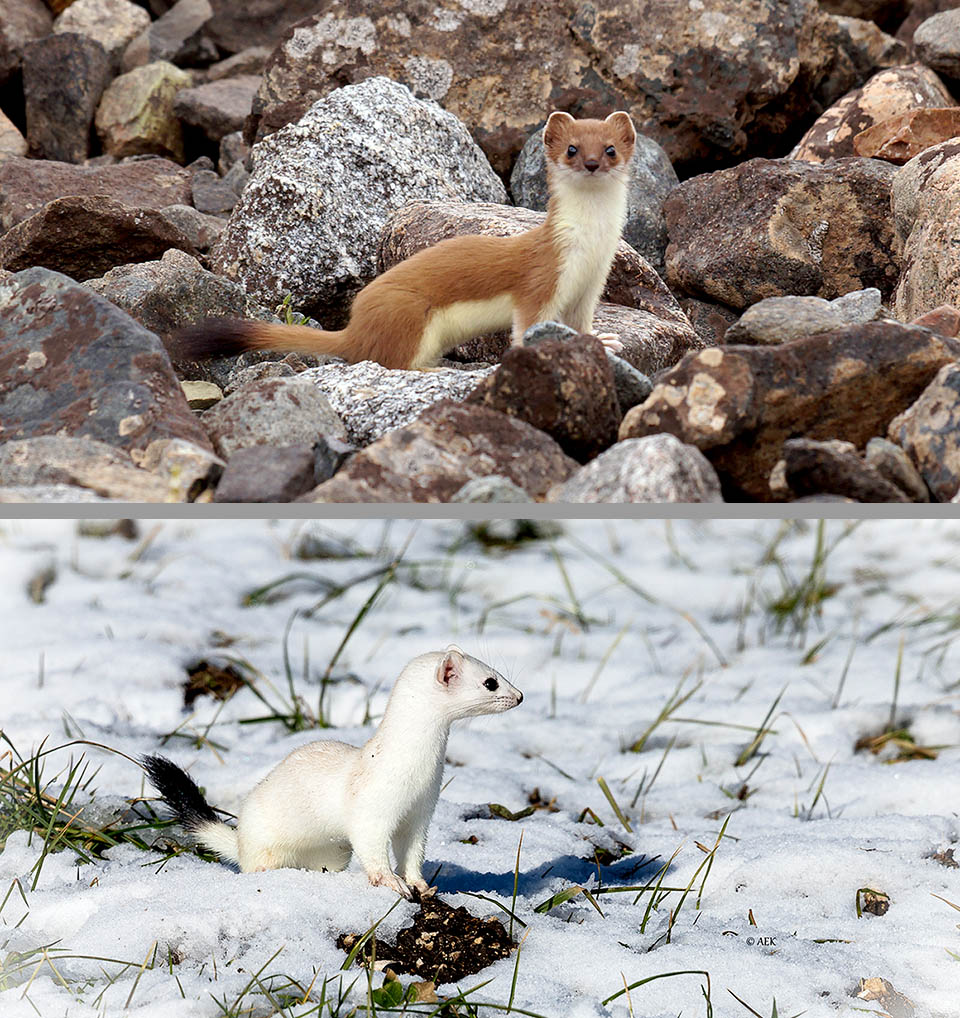
The mammals hair renews continuosly over time with the normal change of the hairs and, in many species with sesonal moults that may modify its density and colour due to camouflage needs linked to the environment. Here the stoat (Mustela erminea) reddish in summer and white like snow in winter © Mikhail Protasov (above) © AEK (below)
Each hair originates from a piliferous papilla, placed at the base of a piliferous follicle, a deep cavity covered with epidermis allocated in the thickness of the dermis. Into the follicle opens a small sebaceous gland whose oily secretion, called sebum, provides to lubricate the hair. On each follicle inserts a small erector muscle through which the hair may be straightened under the stimulation of various factors, such as fear, excitement, cold, etc.
Typically the hair is formed by 3 layers of atrophied cells, cuticle, cortex and medulla.
The cuticle (epidermal), more external, is formed by a layer of dead lamellar cells, cornified and imbricated.
The cortex, the middle layer that usually represents most part of the hair, is formed by cellular residues where stand the various pigment granules that are essentially responsible for the colour of the hair: yellow, red, brown or black. The absence of pigment granules causes the albinism.
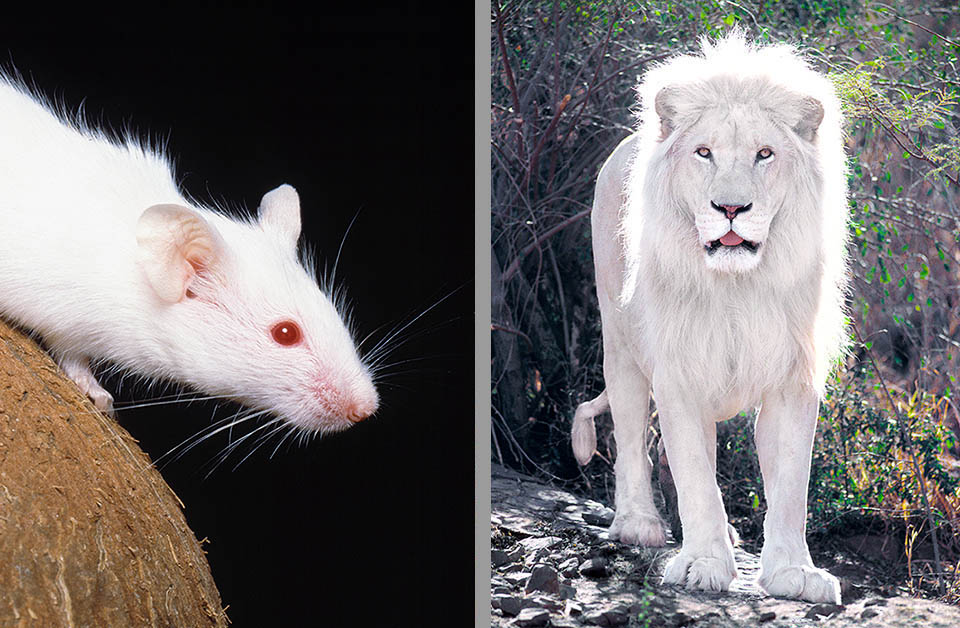
Left, albino specimen, without melanin also in the eyes. Right, a leucistic lion: the mantle is depigmented, but the eyes maintain their natural colour © Giuseppe Mazza
The medulla is the central part of the hair and is well developed and with sacs filled with air in the biggest hairs, reduced or completely absent in the smaller ones; the increase of the air-filled sacs causes the blanching of the hair.
Skin glands
In relation to its vital functions of protection, thermoregulation, secretion, excretion and sensitivity, the integument of mammals is particularly rich in multicellular glands that, from a functional point of view, are distinguished in sebaceous, sudoriparous, odoriferous, lacrimal, mammary. The sebaceous glands, acinous and holocrine, are usually associated with the piliferous follicles and produce a greasy and oily secretion (sebum) that maintains soft hairs and epidermis and represents a protection against external agents keeping them morbid.
The sudoriparous glands are essential for the thermoregulation and the disposal of waste. They may be of two main types: apocrine and holocrine.
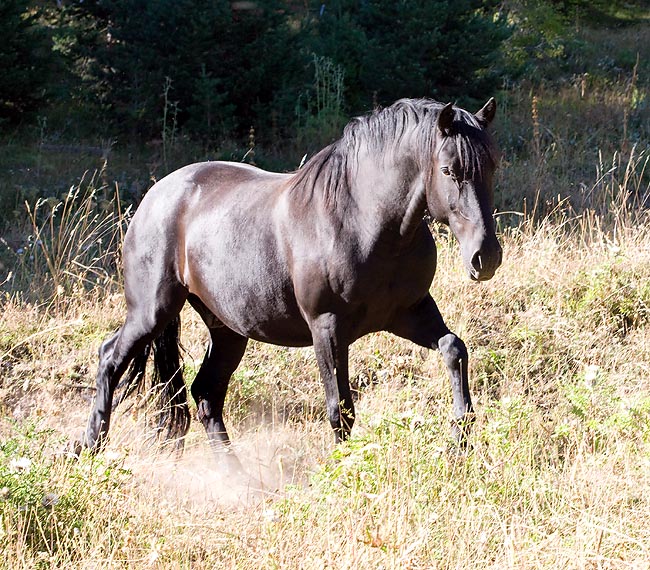
In horses the sudoriparous glands, for the thermoregulation and the disposal of waste are present all over the body © Giuseppe Mazza
The sudoriparous glands of apocrine type, present in all extant mammals and considered phylogenetically the most primitive, have the secreting part located in the deepest layers of the epidermis, or even in the subcutaneous layers, and are equipped with long excretory ducts.
In several species of mammals, man included, the apocrine sudoriparous glands develop only when the sexual maturity is reached and are limited preferably in the genital region, around the nipples and in the armpits.
These glands do not seem to be involved in the body thermoregulation processes, but their secretion formed by water, some mineral salts and organic compounds, favours the recognition of the individuals of the two sexes during the reproductive season.
Conversely, the holocrine sudiparous glands are present from birth and in most mammals having them, they are usually localized in the regions deprived or poor of hairs (nose, fleshy pads on the soles of the feet).
In some mammals, such as Horse, Monkeys, Man and others more, the holocrine sudoriparous glands are vastly distributed all over the body.
The holocrine sudoriparous glands play a fundamental rôle in the processes of regulation of the temperature of the body. Their watery secretion, particularly abundant when the environmental temperature is high, spreads on the body producing with its evaporation an effective heat dispersion from the surface. The Cetacea and the Pinnipedia do not have these glands.
The odoriferous glands, present in many mammals, vary in location; perianal in the Rabbits, in the Beavers, in the Mustelids and in others, suborbital and metatarsal in the Cervides, placed between the toes and at the base of the tail in the Canids, between the toes in the Ovines, etc. The function of the secretions of the odoriferous glands, that may be scarce and delicate, lile in the Squirrels (Sciuridae), or abundant and and intense, like in the skunks (Mustelidae), are utilized to mark individual territories, or to facilitate the matings or also as defense tool.
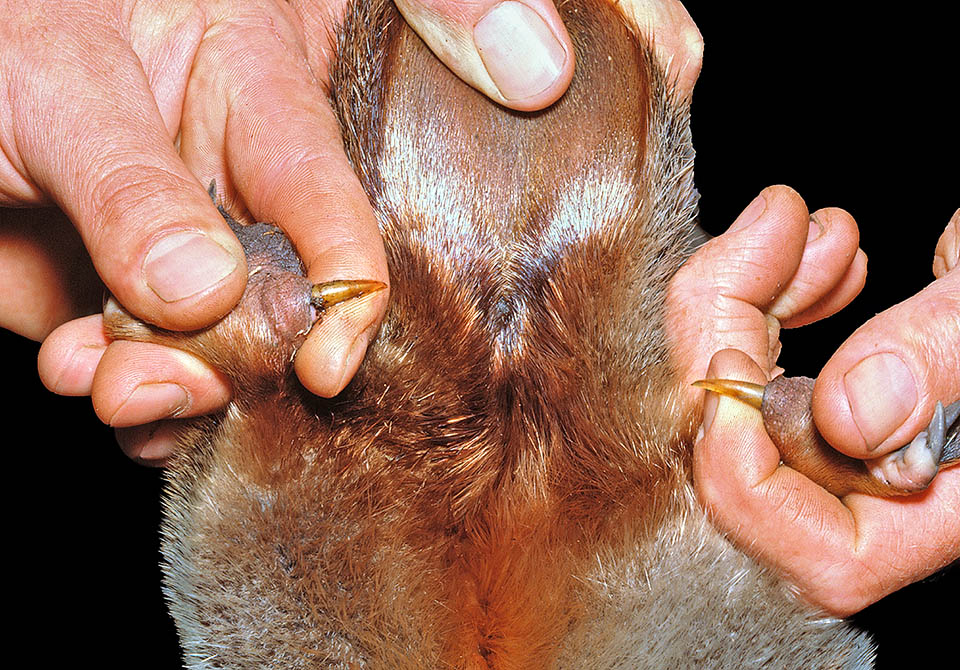
Some mammals defend themselves with poison. In the males of Ornithorhynchus anatinus the hind legs have a hollow spur connected to a poison gland © Giuseppe Mazza
Even if rare, some mammals are provided with cutaneous glands that secrete a poisonous substance or in any case toxic utilized for blocking the preys.
Among these, the most dangerous, even if not fatal for the man, is the Platypus (Ornithorhynchus anatinus Shaw, 1799), whose males are armed with a horny hooked spur placed on the heel of the hind legs. Each spur, hollow and mobile, is connected with an alveolar gland located in the upper part of the thigh, whose poisonous secretion is mainly active during the reproductive season.
Moreover, among the Primates, the Slow loris (Nycticebus) is provided on the inner part of the elbows with glands producing an oily secretion that is distributed on its own body and on those of the babies through the so-called tooth comb while cleaning the mantle. Actually, the secretion of the glands itself is not poisonous, but becomes such with the bite when it is mixed with the saliva of the Loris.
Also the Solenodons (Solenodon), Caribbean night Mammals similar to Shrews, inject poisonous saliva through the teeth.
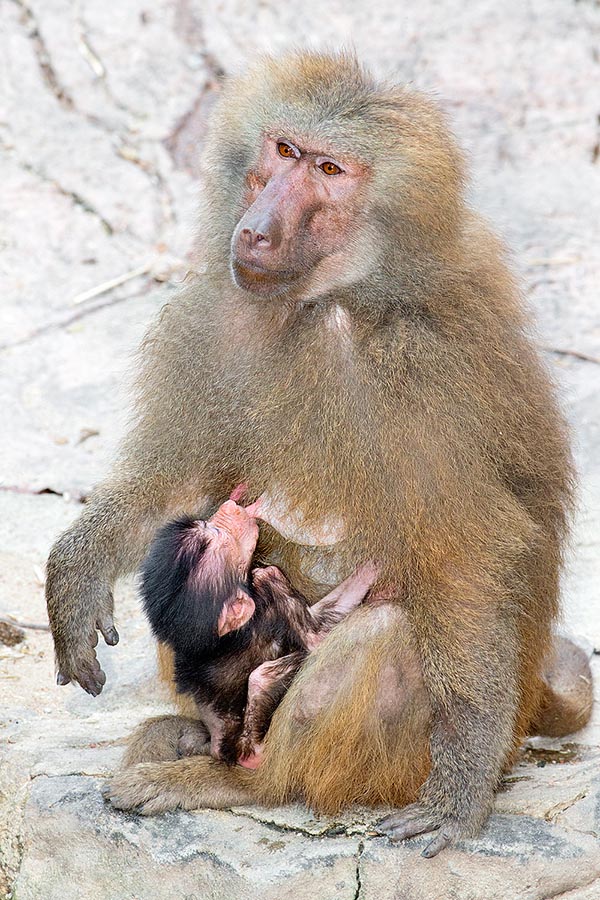
Hamadryad (Papio hamadryas) with breastfeeding baby. Mammar glands are an exclusive characteristic of the mammals and come from the sudoriparous glands modified during the evolution © Giuseppe Mazza
Finally, it should be remembered that several species of Shrews and Moles, like the Short-tailed shrew (Blarina brevicauda Say, 1823), produce toxic saliva to paralyze prey.
The lacrimal glands of the mammals are associated with the eyes and produce a secretion, the tears, that moistens, and protects the surface of the organs of sight.
The mammary glands, more commonly called udders, represent a characteristic unique to all mammals and originate from modified sudoriparous glands.
But the Monotremes, who do not have them, in the remaining mammals the udders are equipped with nipples, skin structures specialized in breastfeeding.
Associated with the reproductive system, the udders reach full development only in the females, at the time of puberty, and are ruled by the endocrine system under the stimulus of the hormonal changes associated with the youngs’ delivery.
In the males of the mammals, man included, the udders are less developed and, even though having nipples and reduced glandular tissue, are not functional for breastfeeding.
The presence of mammary glands also in the males is explained by the fact that the embryonic development is initially common in the two sexes, only at a later stage the mammary glands differ and get functional only in the females.
Depending on the species, the number of udders of mammals varies from a pair like in the Equidae and in most Primates, Man included, up to several pairs.
Cats have 4 pairs of udders, Dogs 5 pairs, Tailless tenrecs (Tenrec ecaudatus Schreber, 1778) have up to 32 of them.
Usually the udders are arranged along the so-called “mammary ridge” and can be located in the pectoral zone, like in the Primates, man included, abdominal or inguinal, as happens in Cats, Dogs, Horses, and Cows and others more.
CIRCULATORY SYSTEM
In the mammals the blood circulation is double and complete with the heart divided into two atria and in two distinct ventricles, separated by a septum. In this way, the arterial blood coming from the lungs does not mix with the venous as instead occurs in the Amphibians and in part of the Reptiles. Typically, the aorta originates from the left ventricle and bends in an arc to the left.
The red blood cells are usually oval and do not have nucleus; in the Camelidae (Camels, Dromedaries, Alpacas, Llamas and Vicunas) have an elliptic shape.
RESPIRATORY SYSTEM
The respiratory system of the mammals characterizes for the spongy and alveolar structure of the lungs which allows a greater exchange surface of oxygen (O₂) and carbon dioxide (CO₂).
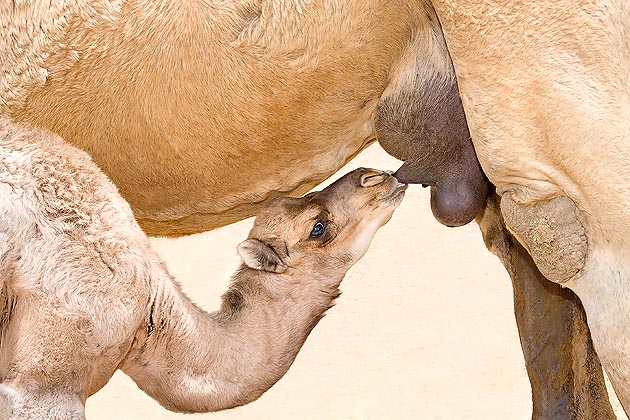
Brestfeeding of Camelus dromedarius lasts 3-4 months. The udders stand in inguinal region © Giuseppe Mazza
Another exclusive peculiarity of the mammals is the presence of a muscular diaphragm that separates the thoracic cavity containing heart and lungs, from the abdominal one where the viscera are contained.
The larynx is equipped with the vocal cords and, through the glottis and the epiglottis, communicates above with the pharynx.
DIGESTIVE SYSTEM
The digestion of food takes place on the long alimentary canal that from the mouth extends up to the anal opening, differentiating itself in various portions (pharynx, oesophagus, stomach and intestine). To the digestive system are associated important glands, like salivary glands, pancreas, liver and glands of the wall.
The stomach is simple in most mammals.
Conversely, in the ruminants displaying the double chewing of the food (ruminazione), the stomach is subdivided into 4 compartments: rumen, reticulum, omasum and abomasum.
It should be remembered that in the Ruminants, the food is initially roughly chewed and sent to the rumen.
Subsequently, from the rumen the food is regurgitated into the mouth in small masses (food boluses); here it is completely chewed and then swallowed again and sent in the remaining cavities of the stomach.
In this regard, it is to be said that the Camelidae, family of teh suborder of the Tylopoda (Camels, Dromedaries, Llamas, Alpaca, Vicunas and Guanacos), considered pseudo-ruminants even if they present the double chewing of the food, have a stomach divided in rumen, reticulum and abomasum. Characteristic of these mammals is to have in the walls of the rumen special “aquifer cells” for the accumulation of water.
The intestine follows the stomach and is short in the forms feeding on other animals.
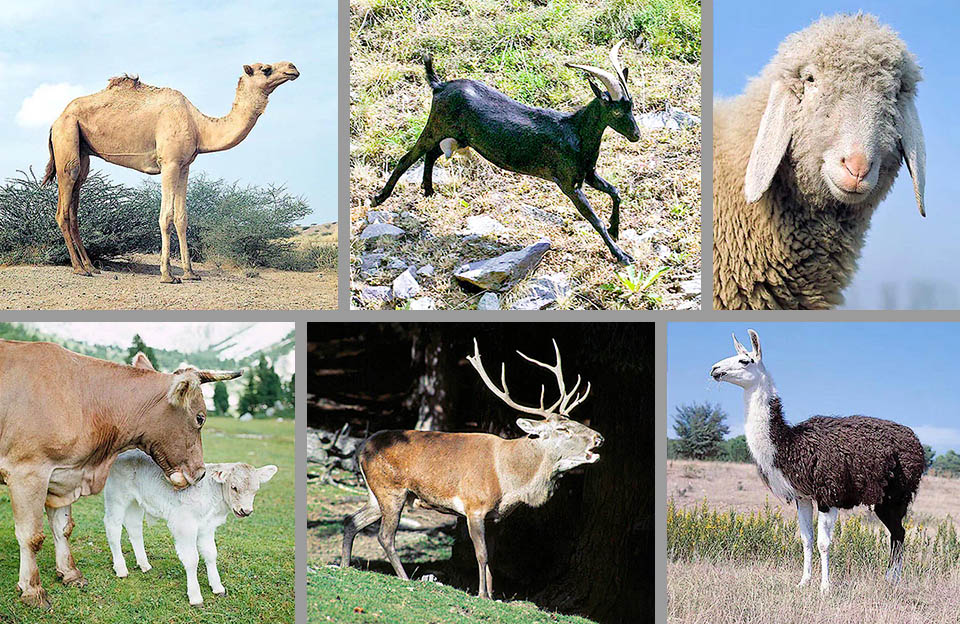
Goats, sheep, cattle and deer are ruminants with stomach divided in four sections: rumen, reticulum, omasum and abomasum. Omasum is absent in camelids © G. Mazza
Otherwise, in the species feeding on vegetal substances the intestine is considerably long, even more than 10 times the length of the body. This anatomical feature is indispensable for the fermentation, and therefore the digestion, of the cellulose, structural polysaccharide of the vegetal cells, difficult to decompose.
NERVOUS SYSTEM
In the mammals the central nervous system, encephalon, is highly evolved and significantly more developed and more complex than in the other classes of Vertebrates.
Intended for the reception, processing and response to stimuli, the encephalon characterizes for the high development of the telencephalon, with large cerebral hemispheres, and complex cerebral cortex, frequently equipped with convolutions, grooves and folds, that remarkably increase its surface.
In the placental mammals, the two telencephalic hemispheres are connected through a typical commissure or corpus callosum.
Relatively small in some forms, the telencephalon is usually well developed and covers the remaining parts of the encephalon.
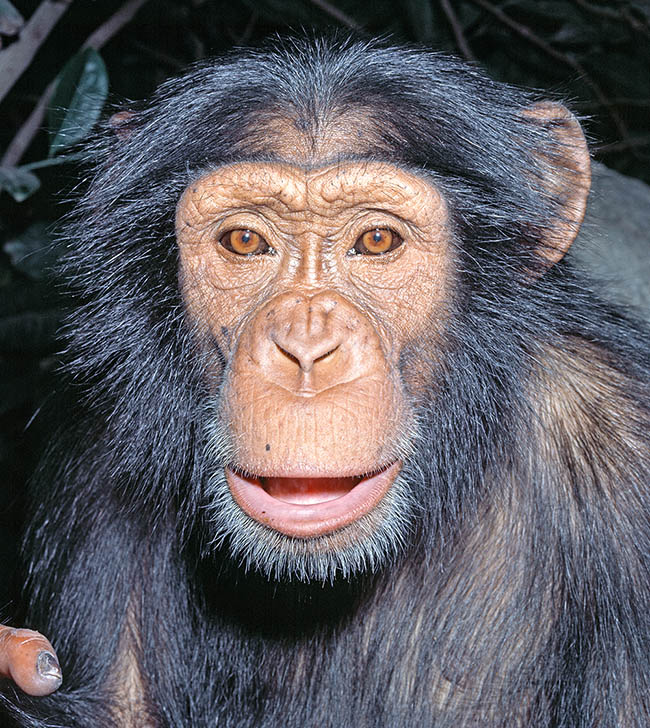
In Mammals the brain reaches the maximum development among Vertebrates. In the anthropoid apes, and above all in Man, the neocortex dominates the highest functions: memory, learning, language and sensory analysis © Giuseppe Mazza
The development of the telencephalon reaches its maximum in the Primates. Particularly developed is the neocortex, or isocortex that represents the most recent and evolved part of the brain of the mammals, a distinctive feature compared to the remaining Vertebrates. Variously extended, the cerebral neocortex reaches its maximum development in the Primates and to a greater extent in the Man where it forms about the 90% of the cortex, and is responsible for higher cognitive functions like memory, learning, language, sensory analysis.
The functionality of the nervous system is complemented by the action of a particularly active endocrine glandular system.
SKELETON
The skeleton of the mammals is mostly composed of bone tissue.
Even if limited, the cartilage tissue remains in the adults in some parts to guarantee flexibility, to reduce the lattice friction and to provide structural support, as in the articular surfaces, in the ribs, nose, larynx, trachea, bronchi.
Certain tendons include small ossifications called sesamoid bones, the largest of which is the rotula, or patella, of the knee.
The skull of the mammals characterizes for a high specialization, with an ample neurocranium to accomodate a voluminous brain.
In the spinal column are distinguished the typical regions of the Tetrapods: cervical, thoracic, lumbar, sacral lumbar.
The cervical vertebrae in almost most mammals are 7 and their number is independent of the length of the neck. This anatomical feature concerns alseo species with very long necks, such as Giraffes, or very short, like Whales.
The thoracic region is formed by 13 vertebrae on which articulate the ribs.
The lumbar vertebrae are 7, the sacral ones are 3 and are fused (sacrum) for the attachment of the pelvic girdle.
The caudal ones, up to 20 in several species of mammals, in the anthropoid Apes and in the Man, reduce to a small bone (coccyx) formed by rudimentary vertebrae.
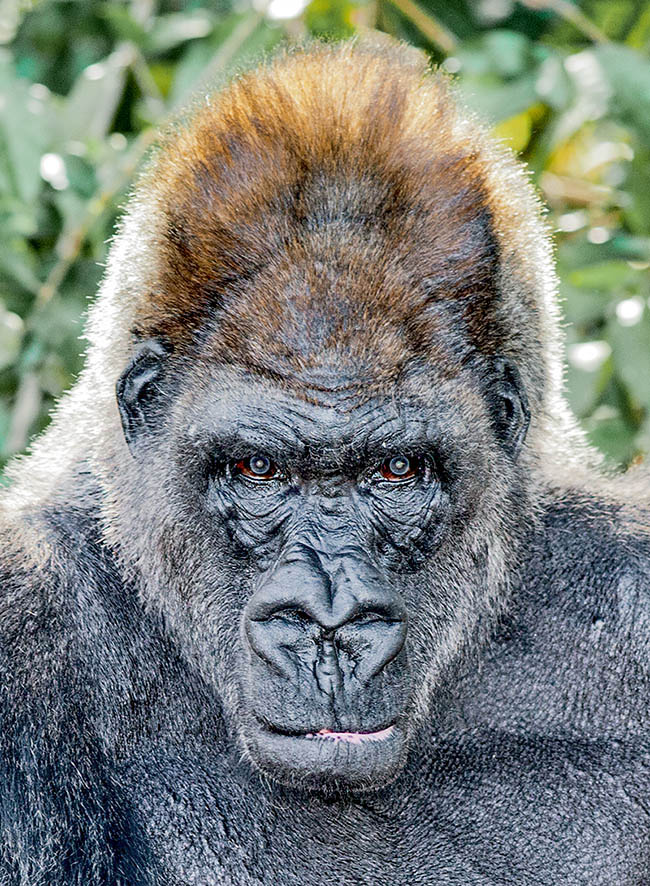
Gorilla gorilla. the great brain development reflects also in an ample and robust skull © Giuseppe Mazza
The vertebral bodies are usually aphipian or aceli, but at times more or less opistoceli (Ungulates) and separated by intervertebral discs allowing the movements of flexion of the whole column.
The sternum, thin medioventral bone typical of the class, and the 13 pairs of ribs, form the rib cage, a flexible scaffolding that, in addition to protecting the inner vital organs, performs the breathing movements.
The scapular or pectoral cingulum is characterized by the presence of a robust spine in the shoulder blade.
The pelvic cingulum, rigidly connected with the sacrum, includes on each side ilium, ischium and pubis.
Each forelimb is formed by distinct humerus, radius and ulna, 7 carpal bones, 5 metacarpal, of which the innermost is short, and the phalanges of the fingers.
The bones forming each of the hind limbs are distinct femur, tibia and fibula, 7 tarsal bones of the ankle, 4 long metatarsal bones (and a rudiment of the innermost), and the phalanges of the fingers.
REPRODUCTIVE SYSTEM and REPRODUCTION
The mammals are animals with separate sexes, with a sexual dimorphism that in several cases is noticeably accentuated.
Usually, compared to females, the males display very striking external features, such as manes and beards, bigger horns, more flashy mantle, voice with a broader and deeper tone, etc.
In many mammals, the two sexes have the same size, however in some species the males are bigger than the females, in others, instead, it’s the contrary.
Notable examples of differences in size between the two sexes are found in the Northern elephant seal (Mirounga angustirostris), where the male is more than three times heavier than the female, and in the Peninsular tube-nosed bat (Murina) where, conversely, it’s the female being 1,4 times bigger than the male.
The females of the Marsupialia differ from the males for the presence of the marsupial pouch or marsupium.
In the vast majority of species, the mammals are viviparous animals, as the females give birth to puppies whose embryonic development completes totally (Euteri) or partially (Marsupialia) inside the maternal body.
Unlike the remaining mammals, the Protoleri are oviparous and the females lay their fecundated eggs whose embryonic growth occurs instead outside the mother’s body.
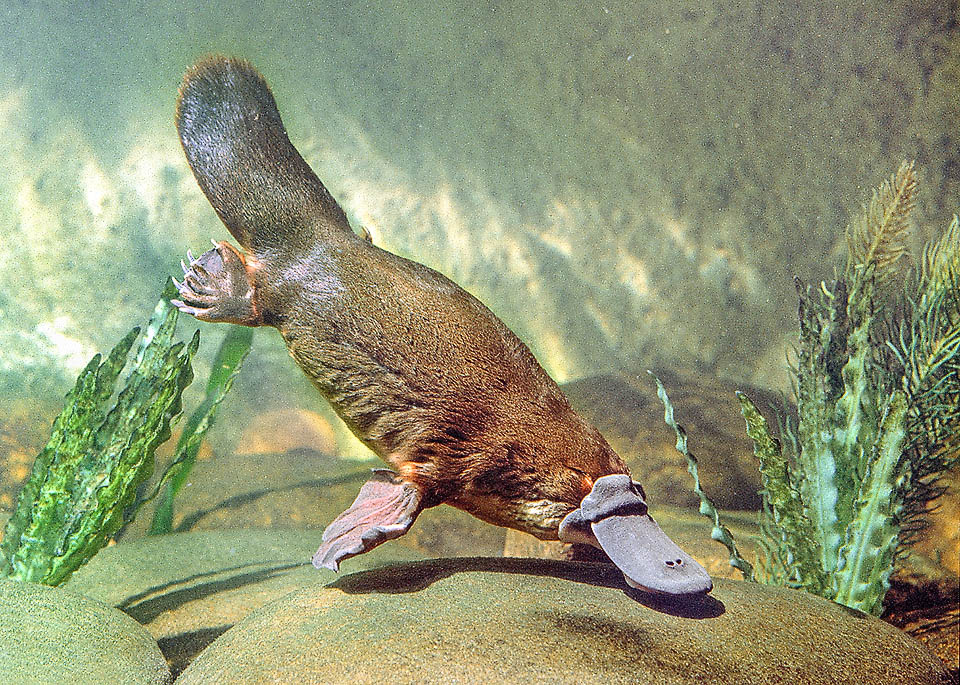
Mammals are mainly viviparous with embryonic development in mother’s body, but Platypus, though breastfeeding, lays on the soil 2 eggs at a time with calcareous shell © Giuseppe Mazza
The Prototherians, included within the mammals because having mammary glands with which they breastfeed their little ones, are represented by the unique order Monotremata to which only 5 extant species: the Duckbill or Platypus (Ornithorhynchus anatinus Shaw, 1799) and the Echidnas or Spiny anteater (Tachyglossus).
The male gonads, commonly called testicles, are paired and are responsible for the production of spermatozoa and of sex hormones, mainly testosterones.
In all mammals the original location of the testicles stands inside the abdominal cavity but in most species they become external after a migration to the interior of the scrotum (testicular descent), final location.
The scrotum is a skin sac placed at the base of the penis that guarantees its temperature lower than the body’s one, necessary for the development process of the spermatozoa (spermatogenesis).
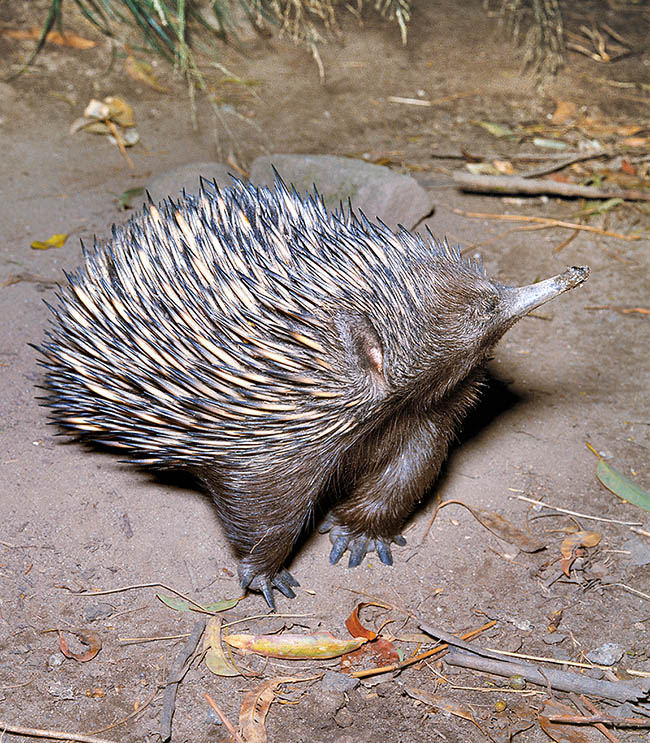
Among Prototheria Mammals the Echidna (Tachyglossus aculeatus) usually lays 1 egg, at times 2, in a ventral pouch © Giuseppe Mazza
In the mammals, the testicles move to the scrotum at different times depending on the species, usually between the advanced fetal stage and the first period of postnatal life.
Singular is the case of the Rodentia where the testicles grow and move into the scrotum only during the reproductive period; then they reduce and go back to the abdomen.
The copulatory organ, the penis, is erectile and, more or less, free in most species.
The males of several mammals have a retractable penis, that when resting is staying inside a sheath or preputial pouch.
Unlike the other mammals, the Monotremata have internal testicles and the penis is contained inside the cloaca and is everted only for the copulation.
This anatomical feature has established itself as presenting the advantage of protecting the penis from external agents.
The copulatory organ, longitudinally crossed by the ureter, in many instances is supported by a particular penile bone (baculum or os penis) whose shape varies depending on the species.
The prostate is always present among the glands attached to the male genital tract.
The female reproductive system, in addition to the ovaries, includes the genital tract, represented by a pair of oviducts, by the uterus and by the vagina, where the egg can be fecundated by the spermatozoon and develop in embryo.
In the most primitive form the female genital tract undergoes a gradual fusion into unpaired median structures; this concerns more primitively the vagina, then the uterus with different degrees of fusion (uterus bipartite, bicornuate, up to the simple uterus).
The vagina, double in the Monotremata and in the most primitive Marsupialia, presents an erectile organ (clitoris), often equipped with a small clitoral bone.
In relation to viviparity, the females of almost all members of the mammals produce very small and poor in vitellus eggs (oligolectic) This is to be related to the fact that the embryo develops inside the maternal body through the placental formations.
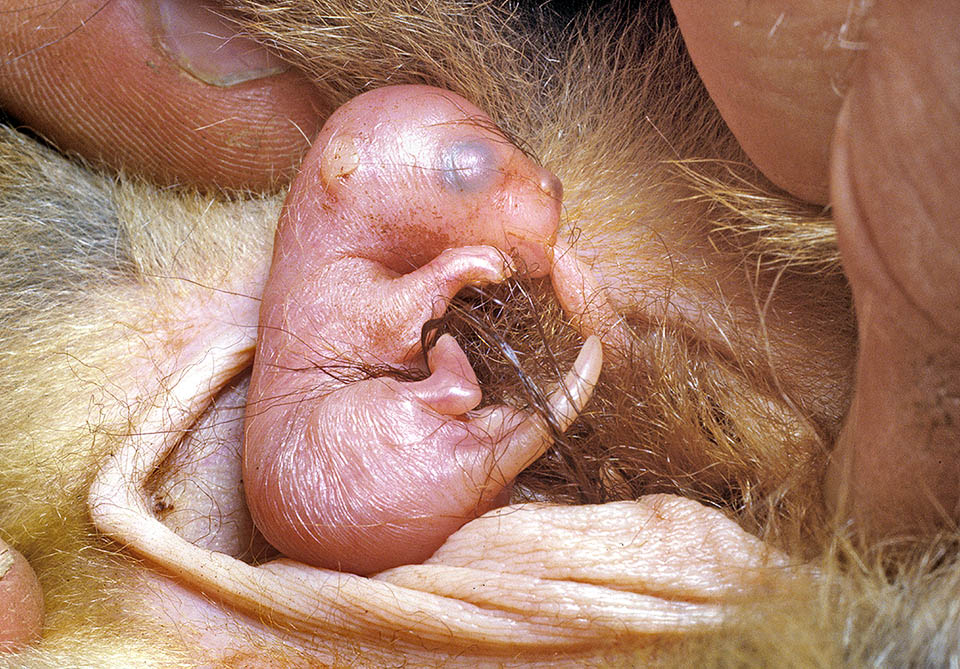
The passage from the egg developing in a ventral pouch to marsupium is really short: here, stuck to a nipple, an embryo of kangaroo © Giuseppe Mazza
Otherwise, the Monotremata, having no placental formations, produce eggs with abundant yolk (telolecithal), similar to those of the Reptiles and of diameter from 1,3 to 2,4 cm. In this case this biological characteristic finds the logical explanation in the oviparity of these primitive mammals.
The female of the Platypus (Ornithorrhynchus anatinus Shaw, 1799) lays in a cavity of the soil 2 eggs at a time provided having a calcareous shell.
In turn,the female of the Echidna (Tachyglossus aculeatus Shaw, 1792) usually holds only one egg, rarely 2, inside a ventral pouch.
Extra-embryonic annexes
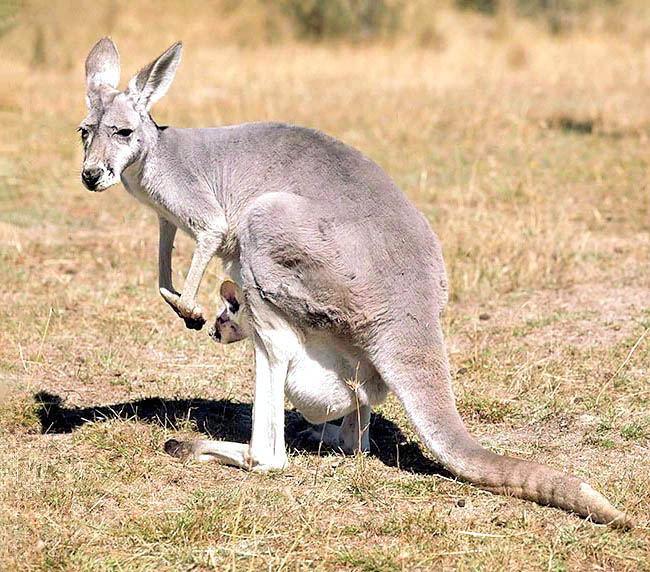
When grows, young of Red kangaroo (Macropus rufus) enters and exits the marsupium, where finds food and shelter © Giuseppe Mazza
As happens in the Reptiles (Reptilia) and in the Birds (Aves), also in the females of the mammals form extra-embryonic annexes essential for nutrition, respiration and protection of the fetus during pregnancy.
Specifically, the allantois is an extra-embryonic annex that acts as a respiratory and excretory organ and participates in the formation of the umbilical cord, of the blood vessels and of the urinary bladder.
The amnion, also called amniotic sac, is a membrane wrapping the embryo and maintaining it in a liquid amniotic environment thus playing a fundamental rôle for the integrity of pregnancy.
The outer case or chorion, is an extraembryonic annex formed by an outermost membrane that covers the embryo playing a fundamental protective and nutritive rôle.
In the Metatherians (Marsupialia) happens a significant development of the yolk sac that sticks to the chorion on which develop however few primary villi that at times connect with the uterine mucosa and originate an omphalo-placenta or placenta chorio-vitellin.This structure avers not very effective and ensures an embryo nutrition very inadequate and only working for a short time.
For this reason in the Marsupials the delivery is premature and the newborns, small and very immature, are obliged to migrate very early inside the marsupium where they complete their own development.
Differently happens in the Eutherians or Higher mammals, indicated also with the name of Placentate, where the fetus develops entirely inside the mother’s body, thanks to the formation of an allantoic placenta.
The allantoic placenta forms after the fact that the chorion gets fixed to the wall of the uterus by means of very numerous villi and fuses intimately with the allantoid, in turn richly vascularized, instead of with the yolk sac as occurs in the Marsupialia.
Efficiency of the allantoic placenta is such to allow a long stay of the embryo in the uterus and consequently its advanced development.
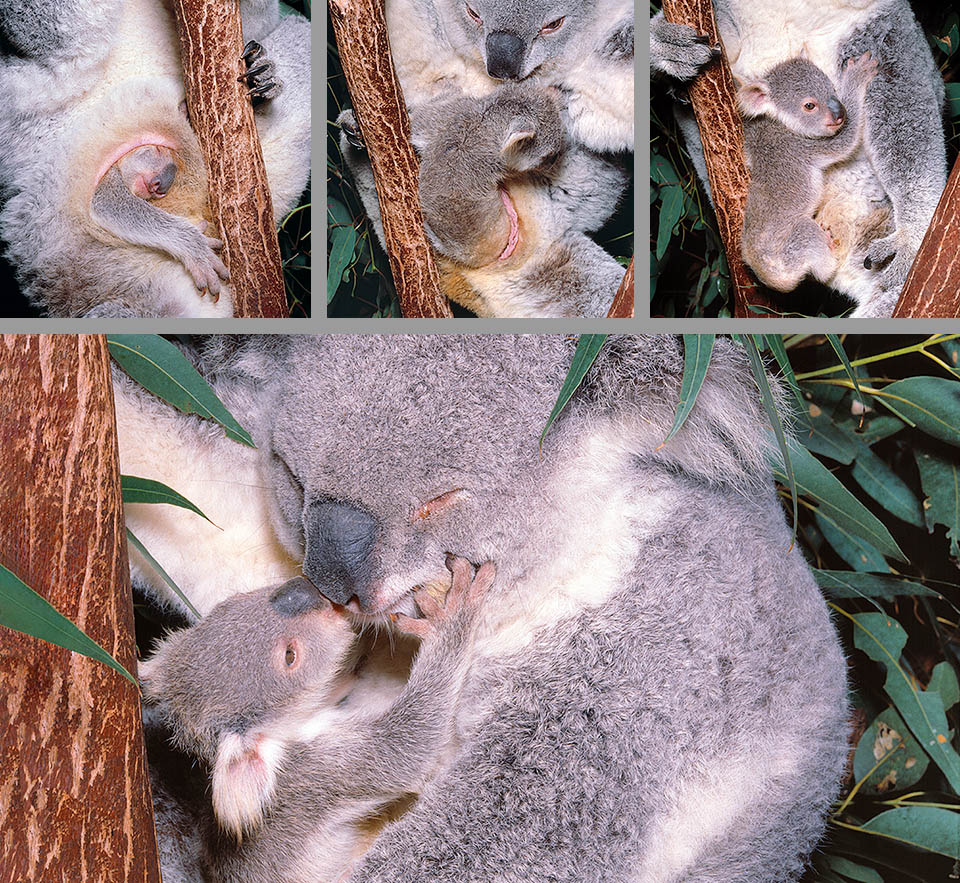
The marsupium invention has led many Australian marsupial mammals to recreate shapes and features of placentate mammals, adapting to similar environmental needs. Here a young of Koala (Phascolarctos cinereus) wakes up and exits from the marsupium looking at once for the loving and protective contact with mom © Giuseppe Mazza
In the mammals, the number of puppies born in every pregnancy is usually inversely proportional to the size of the animal. Usually, the large-sized species deliver one child a year, whilst the small-sized species are more prolific and characterize for a shorter gestation period and with several annual pregnancies.
In most classes, the reproductive activity is cyclic and is controlled by hormones. The females display phases of sexual activity (oestrus) that usually occur in spring or in winter, in relation to the maturation of the ovarian follicles, alternating with periods of inactivity (anestrus).
Several species of mammals reproduce only once per year, some more than once.
In some members of the class (Rodents, Carnivores, etc.) the new borns are weak, often have the eyelids closed and also lack fur (inept offspring).
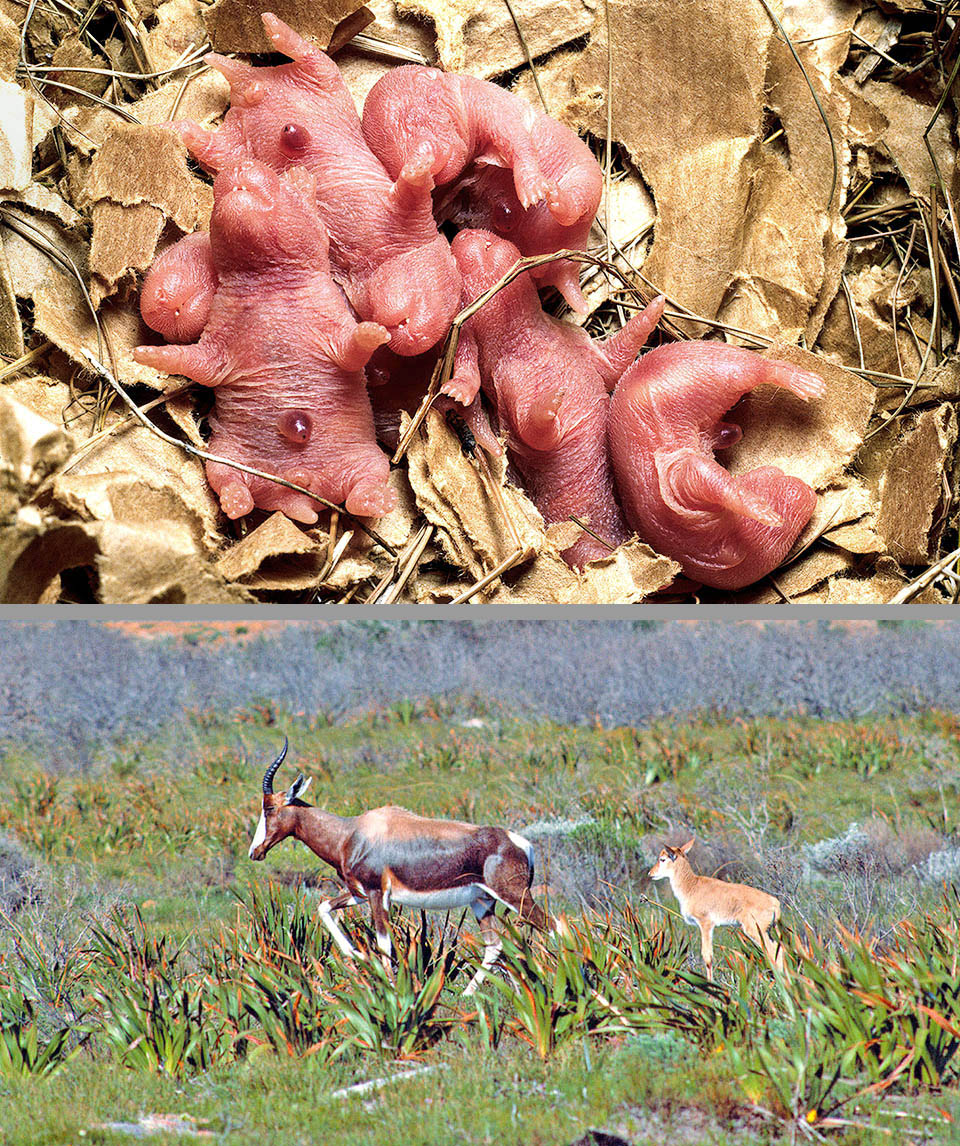
Inept and precocious babies. Some mammals are born naked and blind, like hamsters; others with hair and open eyes, already able to follow parents like Damaliscus dorcas © Giuseppe Mazza
In other mammals (Artiodactyls, Perissodactyls, etc.) instead, the puppies are born with the body already covered by hairs, have open eyes and are able to walk not long after birth (precocious or suitable offspring).
After their birth, the children of the mammals are the object of special care for a very varied period of time (parental care).
The care of the offspring is entrusted only to the mother or to both parents with whom may associate also members of the same species. Usually parental care is simple in the less evolved and more prolific forms, whilst they are very specialized in those with long gestation and with a reduced number of children.
The first and most important moment of parental care is by sure that of the suckling. In this period, and even after, the puppies, in addition to being fed, receive from the mother information of primary importance for their survival.
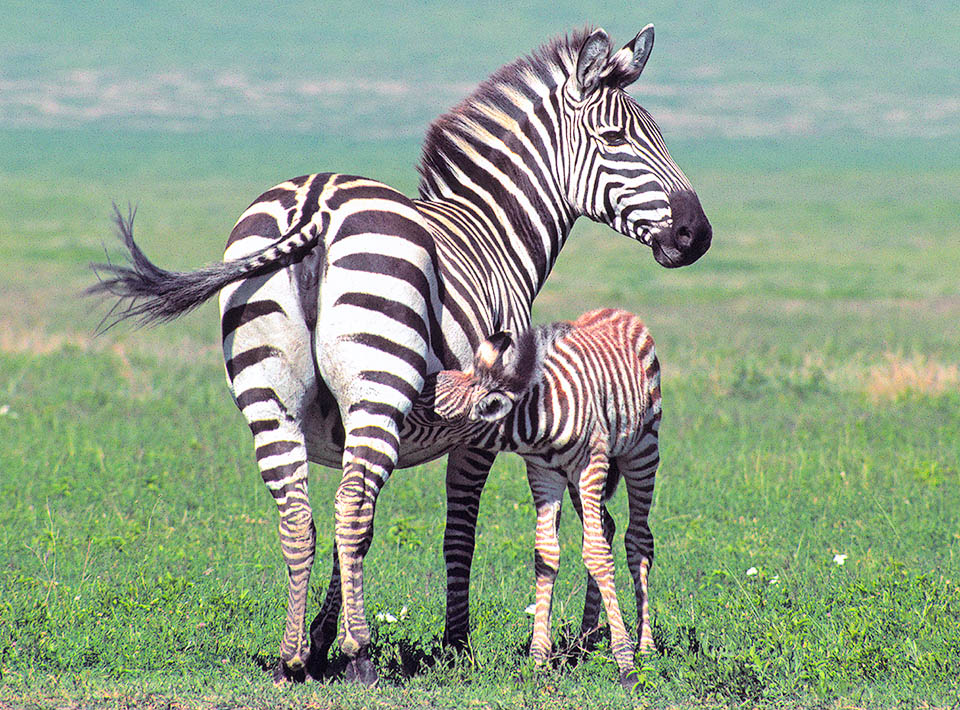
The care of babies is first of all entrusted to the breastfeeding mom. They are protected by the father and the conspecifics, who give them useful info good for surviving © Giuseppe Mazza
The duration of breastfeeding is quite various depending on the group and usually lasts until when the puppies develop an efficient set of teeth, thus becoming able to feed autonomously.
In many mammals have been observed protective cares concerning the defense against predators, choice of shelters, etc., and educational cares, suitable for transmitting the sons experiences useful for their survival.
DISTRIBUTION AND BEHAVIOUR
The present mammals are found practically in almost all available habitats at all latitudes of our planet. Most species of Mammals do live in the merged lands, but there are quite several who have adapted to the aquatic life (Cetacea, Pinnipedia, Sirenia, etc.). Some forms of mammals are able to perform a real active flight like the Bats (Chiroptera).
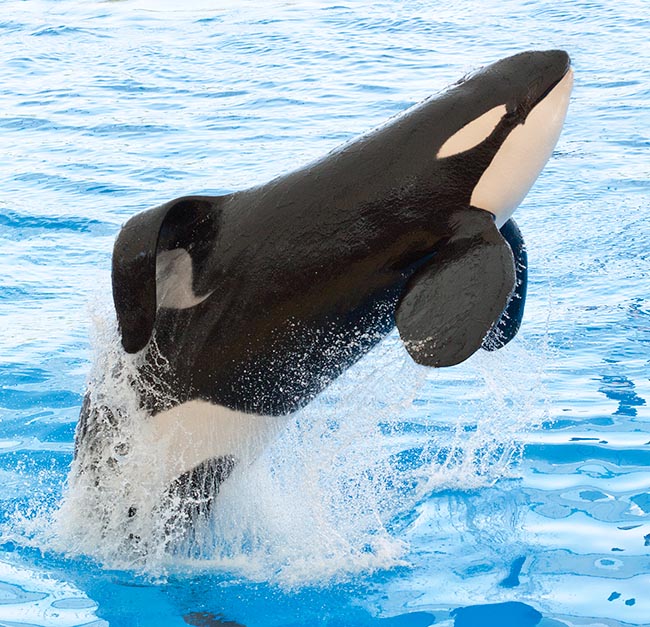
Mammals have colonized all the planet. Most of them live on the emerged lands, but some, like this Orcinus orca, have adapted to aquatic life becoming great marine predators all over the world © Giuseppe Mazza
Several mammals are able to perform a gliding flight, like the Southern greater glider (Petauroides volans Kerr, 1792) among the Marsupialia, the Flying squirrels (Pteromyini Brandt, 1855) among the Rodentia and the Flying lemurs or Colugos among the Dermoptera.
Many mammals live on the ground, many are arboreal, several are hypogeous.
DIET
The diet of the mammals is extremely varied.
Many forms, like the Ungulates and most Rodentia feed exclusively or mainly on plant substances, such as herbs, leaves, little twigs, bark, seeds, pollen, nectar, fruits.
Several species of mammals are predators of other animals.
The Felidae and the Mustelidae are carnivorous, the Pinnipedia and the Cetacea Odontoceti eat essentially fish; the Talpidae, Soricidae and several small Bats are mainly or exclusively insectivorous.
Some mammals have a mixed diet and feed on animals as well as on vegetable substances.
The species with a specialized diet are very rare. Some mammals feed on plankton (Cetacea Misticeti), others on blood, like the Vampire bats (Desmodus Wied-Neuwied, 1826) among the Chiroptera. Very few species are monophagous like the Koala (Phascolarctos cinereus Goldfuss, 1817) marsupial nourishing only of eucalyptus leaves.
Usually the species of mammals with a broad food spectrum (eurytrophic) can live stably in the same territory being able to feed on various food during the different seasons.
Otherwise, the forms with a more strictly defined diet (stenophagous) are obliged to suffer from seasonal shortage of their usual food making migrations, or entering in summering or in hibernation, minimizing the vital functions.
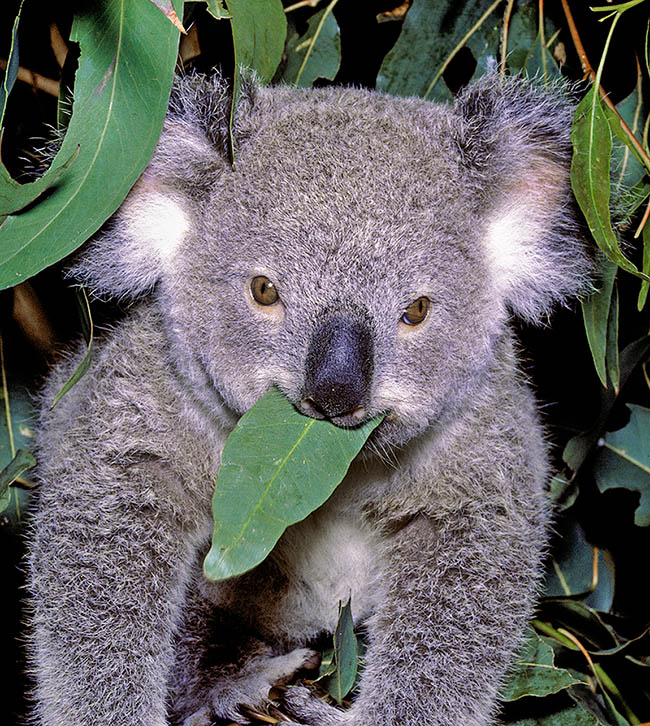
Very few mammals are monophagous, like the Koala (Phascolarctos cinereus), who eats only eucalyptus leaves © Giuseppe Mazza
Various species of seals (Pinnipedia), whales (Cetacea Mysticeti), Reindeers (Rangifer tarandus Linnaeus, 1758) and of bats (Chirotera), carry on latitudinal migrations, at times of great magnitude.
Differently it happens in some temperate regions where Cervidae, Bovidae and other mammals effect altitudinal migrations, settling in high mountains in the summer months and moving to the nearby valley during the winter.
Local relatively reduced migrations are observed in many Rodentia and Lagomorphs and in some Chiroptera.
Conversely, other mammals, during the seasons where food is scarce and the environmental conditions are not good, are able to pass to an inactive life, becoming temporarily heterothermic, and survive utilizing reserve substances, previously stored in the tissues. If this period of inactivity occurs during the summer months, the phenomenon is called aestivation.
The summer forms, most of whom feed on vegetables, usually retreat in underground dens where they sleep. In this way during the aestivation the metabolic processes slow down with consequent saving of the stored energy.
The phenomenon of aestivation is limited to a few species that live in environments with very warm and dry climate, such as Rodentia, Insectivores, and Marsupialia.
Inlike hibernation, the aestivation allows to overcome long periods of environmental hostility.
Otherwise, the hibernation, or torpor, occurs during the cold months.
The hibernating animals get even more markedly heterothermic, slowing down significantly the frequency of the rate of breathing, the rhythm of the heartbeat, etc.
Many Carnivores, like the Bears, keep sleeping for almost the entire winter period but their metabolic rate, and consequently their body temperature do not drop dramatically, so their sleep is to be considered as a winter sleep, rather than a real hibernation.
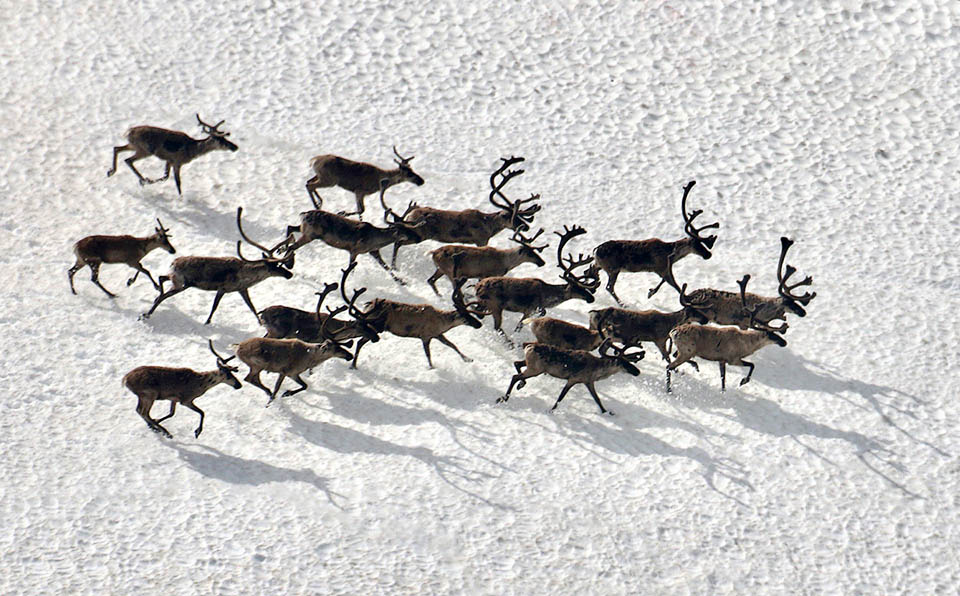
For feeding the reindeers (Rangifer tarandus) perform long winter migrations looking for food in the woods or under the snow © Jeffrey H. Skevington
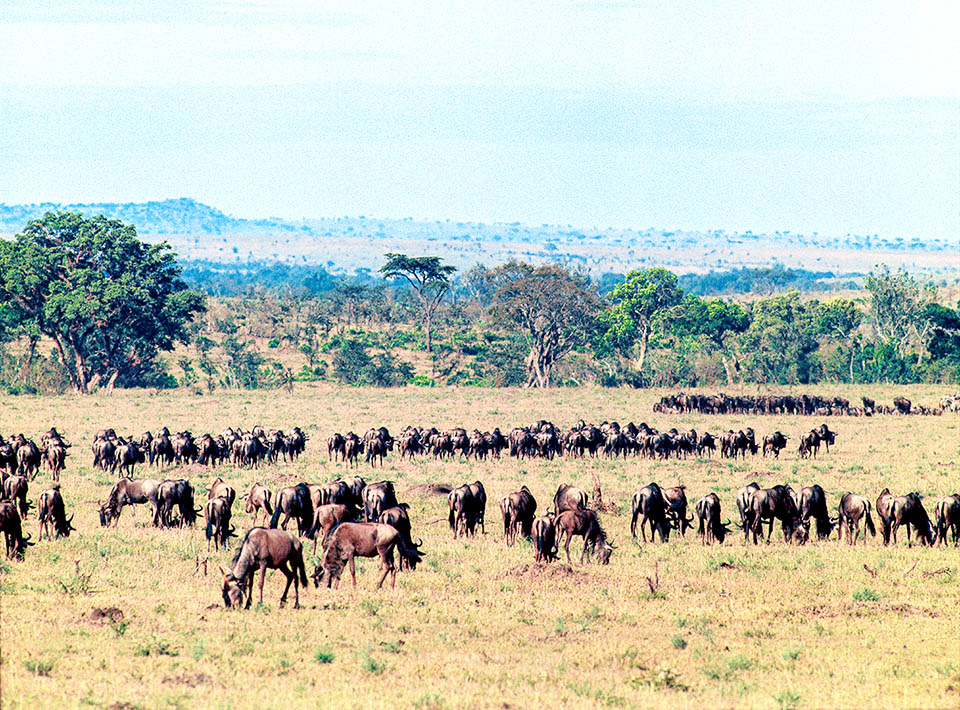
Similarly the Blue wildebeest (Connochaetes taurinus) cover about 800 km per year from Tanzania and Kenya to escape aridity © Giuseppe Mazza
COMMUNICATION
The mammals communicate with each other via various signals, olfactory, vocal, visual, acoustic, tactile etc. The activity of communication is more developed in those species living in social groups.
Various activities, particularly those related to the reproduction and to the cohesion of the group, are often associated with chemical signals carried out by pheromones formed by the secretion of the aforementioned odoriferous glands.
It is through the pheromones that many species recognize their own offspring or of the members of their group.
Many mammals utilize facial and body language, like the position of the body, of the ears and of the tail, the exposition of coloured parts, as visual messages to express fear, excitement, irritation, etc.
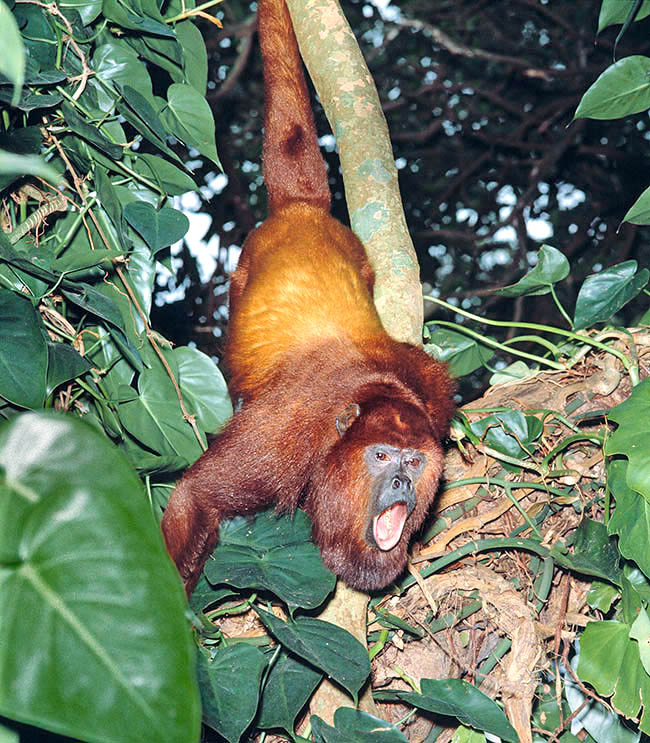
A Red howler (Alouatta seniculus). The mammals communicate expecially with vocal, olfactory and visual signals © Giuseppe Mazza
Several species utilize their own voice for transmitting information with different meanings: maintain the cohesion within a pack, favour the meeting of males and females for mating, localize the parents or the offspring, and also to report a danger, to intimidate potential foes.
The Bats (Chiroptera) emit short ultrasound trains (50 kHz) that, reflected by nearby objects, guide them also when flying and in locating the prey; the same happens in some Shrews (Soricidae).
Some big Cetacea, Elephants, Rhinoceros, Hippopotami, Giraffes, Alligators and others produce infrasounds, with low frequency around 20 Hz, that can be detected even at kilometers far away.
The language, usually formed by stereotypical signals, is more varied in the Primates where it gets articulated in the Man.
Other rather used methods of communication are the noises produced in various ways, like the flapping of the tail against the surface of the water of the Beaver (Castor Linnaeus, 1758).
Several mammals, like the Prairie dogs (Cynomys Rafinesque, 1817), utilize tactile signals of the kissing model to recognize the members of their own pack.
Few species of mammals lead a nomadic life; usually each individual occupies a well defined space, family area, inside which it moves carrying out there all its own activities (eating, resting, reproductive, leisure, etc.).
The size of the family area space occupied by the mammals varies depending on the species and is influenced by various factors, such as the size of the animal, its mobility, its eating habits, the sex, the age, the season, the population density. The family area is a few square meters in some small Rodents and Insectivores. Otherwise, in the big Carnivores and in the Cetacea the family area extends for several square meters.
Many mammals have developed a sense of territoriality (territorialism) and actively defend from the intrusion of other individuals their own shelter and the surrounding territory.
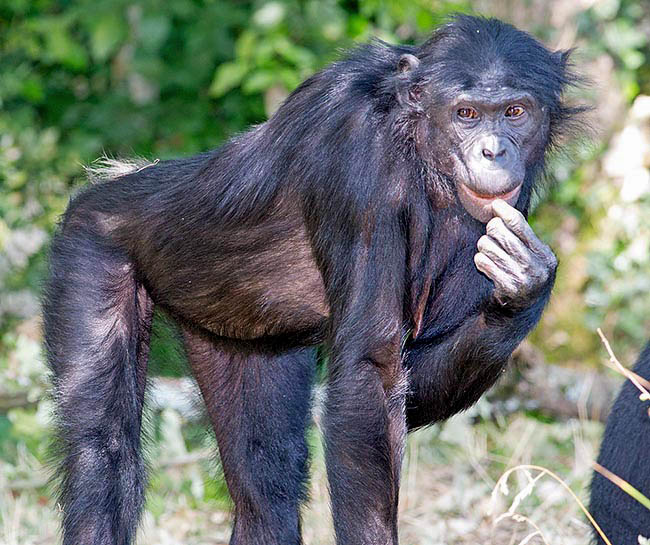
Interested look to a male of a female of Bonobo (Pan paniscus) © Giuseppe Mazza
In some species the defense behaviour manifests only during the reproductive period and of the caring of own offspring, in othess, instead, is permanent.
Many mammals utilize shelters for resting, caring osn offspring and repairing from the hostile weather conditions.
Some species exploit the natural cracks between the rocks (Carnivores, Bats, etc.), others the cavities of the trees (Opossum, Hamsters, Marmots, Ground squirrels, etc.).
Various Wood mice (Apodemus sylvaticus Linnaeus,1758), Squirrels (Sciuridae) and Hamsters (Cricetidaei) build nests among the foliage of the trees.
Some mammals, like Moles, Ground squirrels, Badgers, Skunks and more, dig tunnels in the ground.
The Beavers (Castor Linnaeus, 1758), considered in the imagination as the engineers of Nature, build up dams and shelters in the water.
The individuals of the same species do not live in isolation but often they gather to form more or less stable social groups. The simplest form of aggregation is the family group formed by a couple and its own children. In some mammals, the children leave their parents immediately after the weaning, in others, instead, they remain with the mother until reaching sexual maturity. In some like the Elks (Alces), Otaries (Otariidae) and others, the individuals merge in packs that migrate united during the Mating season.
During this time, usually ech male joins a group of females and of children, forming its own harem it defends against other males.
Some mammals join to form the so called gangs, more complex and numerous social organizations, for the search of food, the reproduction and the protection.
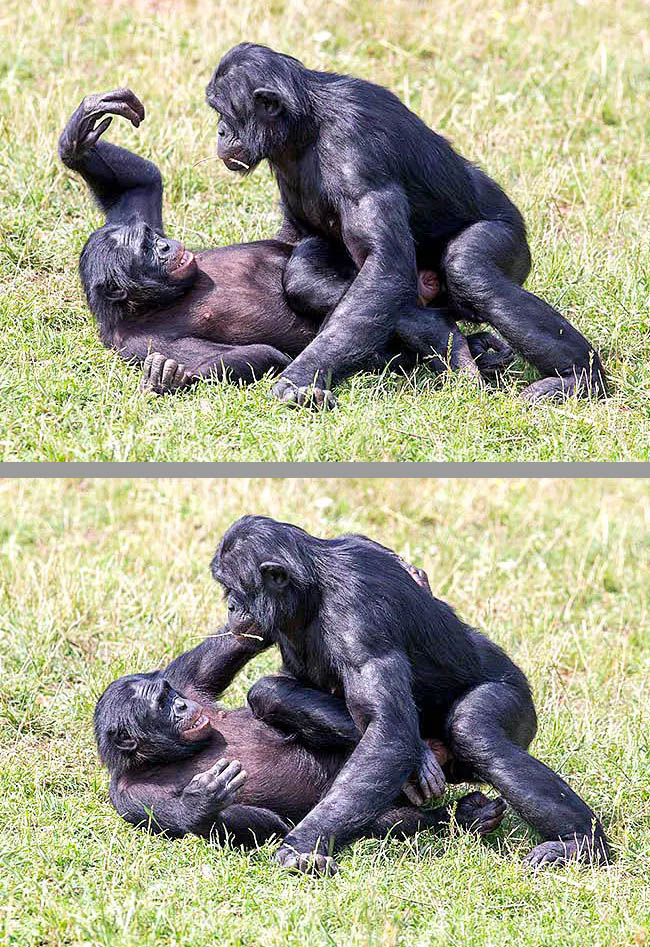
To the glances communication here adds the tactile one, no less important in the mammals © G. Mazza
Within the gangs, among the single members forms a precise hierarchy dominated by a leader, who controls its activities.
Each gang has a well delimited territory that the members defend all together. The association in gangs is well developed within various species of Monkeys, in particular the Macaques.
THE MAN AND THE MAMMALS
Since prehistoric times, the relationships linking Man to the other mammals are multiple and linked to his subsistence: for the food, the clothes, the transportation, the work in the fields and other necessities.
With a process that began several centuries ago, several species of mammals have been tamed and raised in captivity by Man for satisfying his own necessities.
The Sheep, the Goats, the Oxen provide milk and meat. The Horses, the Oxen, the Camels, the Llamas and others more, are employed as saddle, packsaddle and draught animals.
The hair of the mantle of Sheep, Goats, Camels, and of other mammals is transformed into yarns for the preparation of fabrics. The skins of many mammals are tanned and transformed into leathers and furs.
Otherwise, several species cause damage to crops and to livestock.
Moreover, some species of mammals may transmit serious diseases to the man (zoonosis), such as plague, typhus, rabies, toxoplasmosis, salmonellosis, brucellosis, leishmaniasis, hydatid disease, and several others.
On the other hand, many species are very useful in the field of medical and pharmacological research, for the preparation of serums and vaccines and for the testing of new drugs.
Several mammals like Dogs, Cats, Horses, Donkeys, Rabbits and others, play an important rôle also in the supportive therapies to improve physical and psychological health of the persons (pet therapy).
On its part human activity has led to extinction of several species of mammals, especially those of medium or large size and with diurnal habits.
Despite the protectionist measures enacted in several countries, the numerical consistency of many species of mammals continues to decrease significantly.
Continuing the reckless destruction of forests in all continents, it seems very likely that in a not too distant future most of the big sized species will be able to survive only inside parks and reserves.
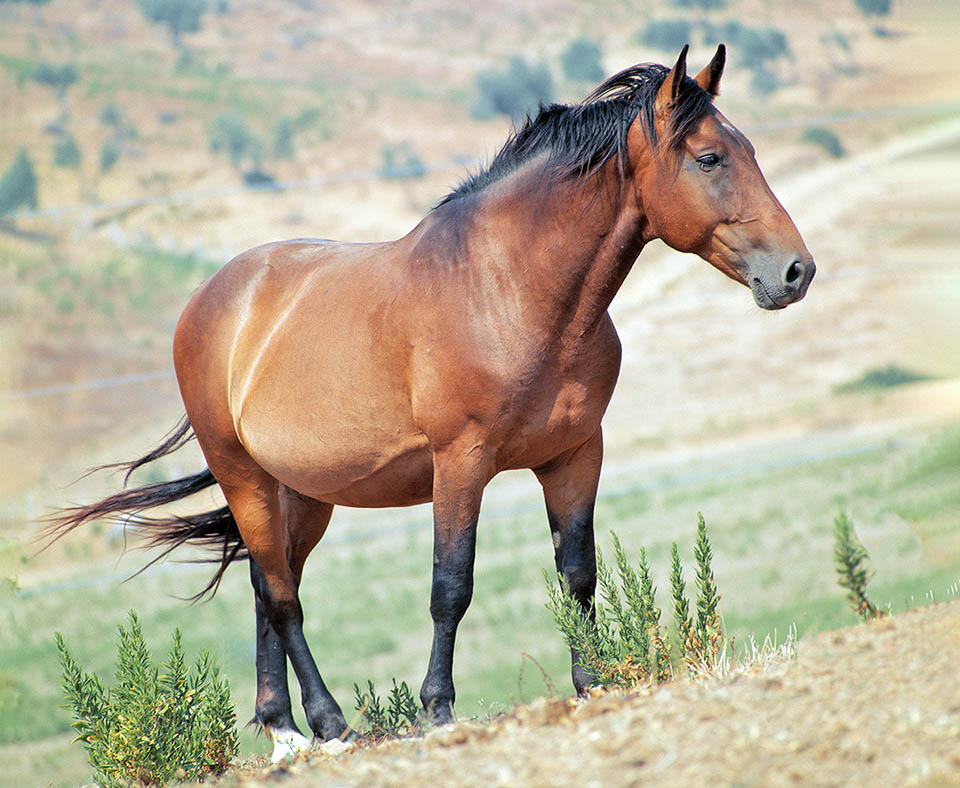
Since prehistoric times, the tamed mammals have furnished to man food, clothes and means of transport. With sheep and cattle, the horse has been one of the most important © Giuseppe Mazza
Presently, various species of mammals with a wide Euro-Mediterranean distribution, are in a worrying state of threat.
The Eurasian lynx (Lynx lynx Linnaeus, 1758), whose range until some time ago extended from the Pyrenees, and Alps up to the Siberia forests, has disappeared from the Alpine arc already at the beginning of the 20th century due to the human persecution.
The Common wolf (Canis lupus lupus Linnaeus, 1758) is nowadays relegated to the Eastern Alps.
The Eurasian wolf (Canis lupus italicus Altobello, 1921), subspecies diffused in central-western Europe in Italy on the Western Alps and on the Apennines is suffering.
The Sicilian wolf (Canis lupus cristaldii Angelici & Rossi, 2018), a subspecies endemic to the woody mountain areas of Sicily, has already become extinct in the XX century.
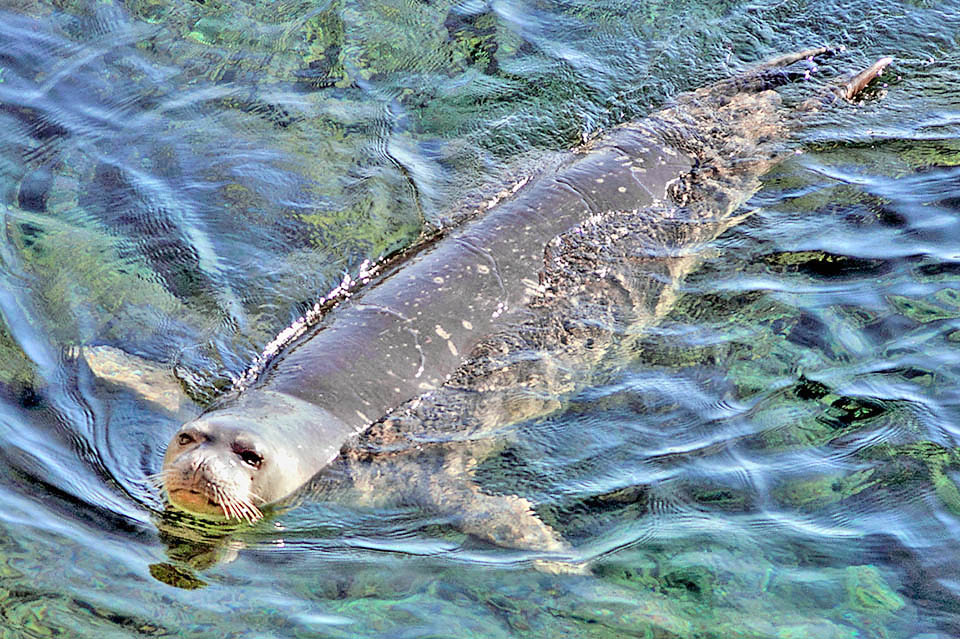
With less than 700 specimens, the Monk seal (Monachus monachus), occasionally seen along the Mediterranean coasts, is a species at high risk of extinction © Александр Гончаров
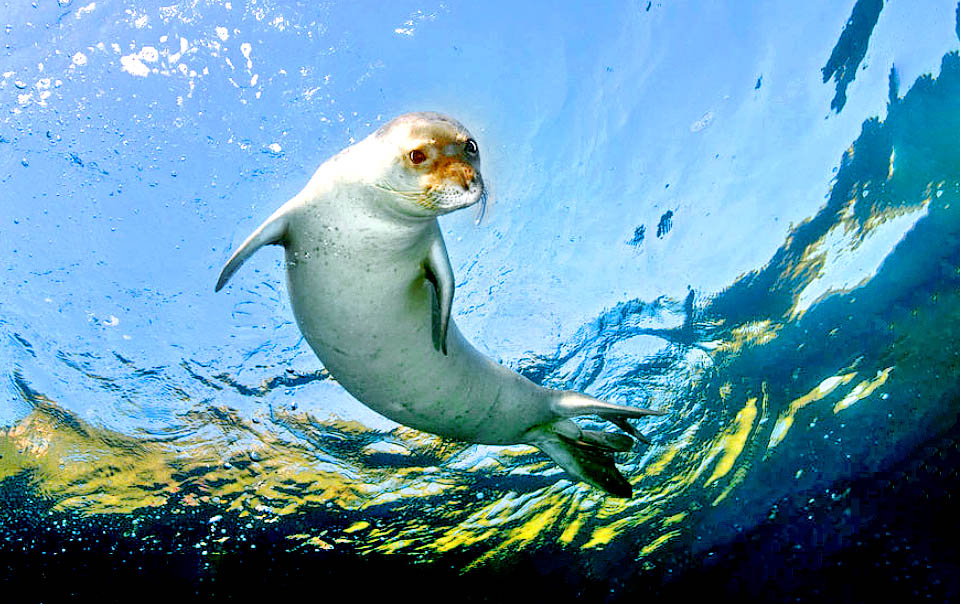
A juvenile. It can live for 20–30 years, but once persecuted by fishermen, it is now threatened by pollution and marine plastic debris © Monk Seal Alliance
The Eurasian Brown bear (Ursus arctos arctos Linnaeus, 1758) whose range includes all northern Eurasia, in Italy is confined to the Alps of western Trentino and to the boundary between Friuli, Austria and Slovenia.
Another subspecies is the Marsican brown bear (Ursus arctos marsicanus Altobello, 1921) endemic to central-southern Italy where it survives in the Abruzzo National Park.
The Mediterranean monk seal (Monachus monachus Hermann, 1779), of which are occasionally sighted individuals, along the coasts of almost all Mediterranean countries, is a species at high risk of extinction of which survive in nature less than 700.
Other big mammals, presently drastically reduced in number with a consistent risk of extinction, are the Red deer (Cervus elaphus Linnaeus, 1758), the Alpine ibex (Capra ibex Linnaeus, 1758) and the Roe deer (Capreolus capreolus Linnaeus, 1758).
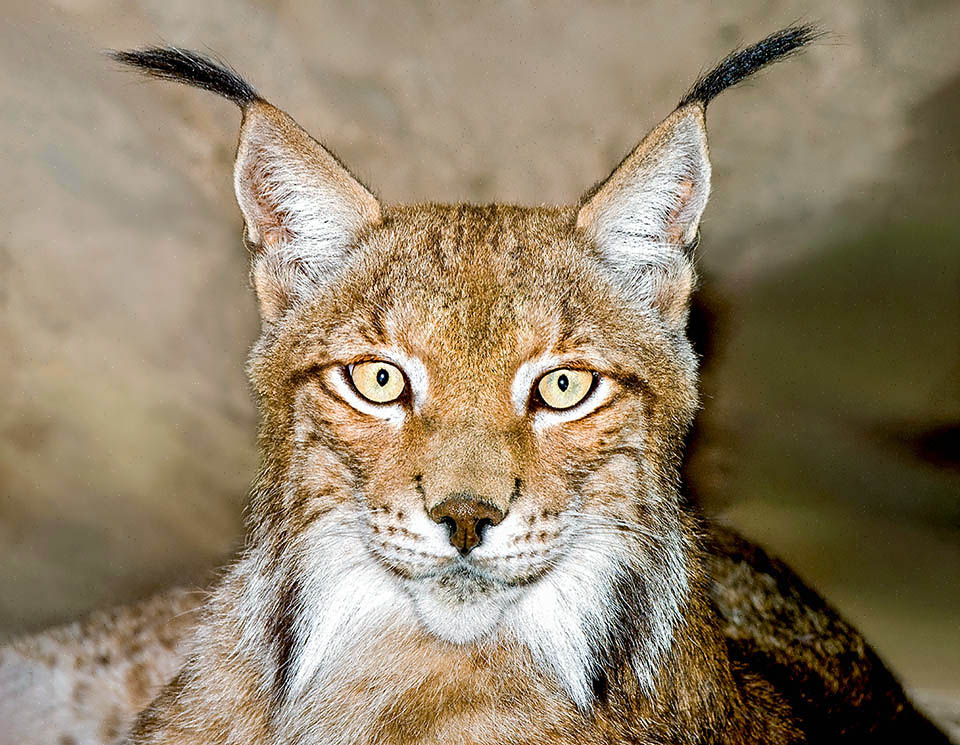
Lynx lynx, once diffused from Pirenees to Siberia, has disappeared from alpine arc due to human persecution © Giuseppe Mazza
The Mouflon (Ovis gmelini musimon) is present in all Europe and is everywhere threatened as object of heavy hunting.
And also the Chamois (Rupicapra rupicapra, Linnaeus, 1758), now present in the mountain systems of central and southern Europe, the Pyrenian chamois (Rupicapra pyrenaica pyrenaica Bonaparte 1845), confined to the Pyrenees, and the Abruzzo chamois (Rupicapra pyrenaica ornata Neumann, 1899) endemic to central Apennines, all in need of continuous protection and assistance for guaranteeing their survival.
Only some micromammals, despite the hunting activity, have not undergone any nymerical decrease, rather they were favoured thanks to the rarefaction or disappearance of many of their predators.
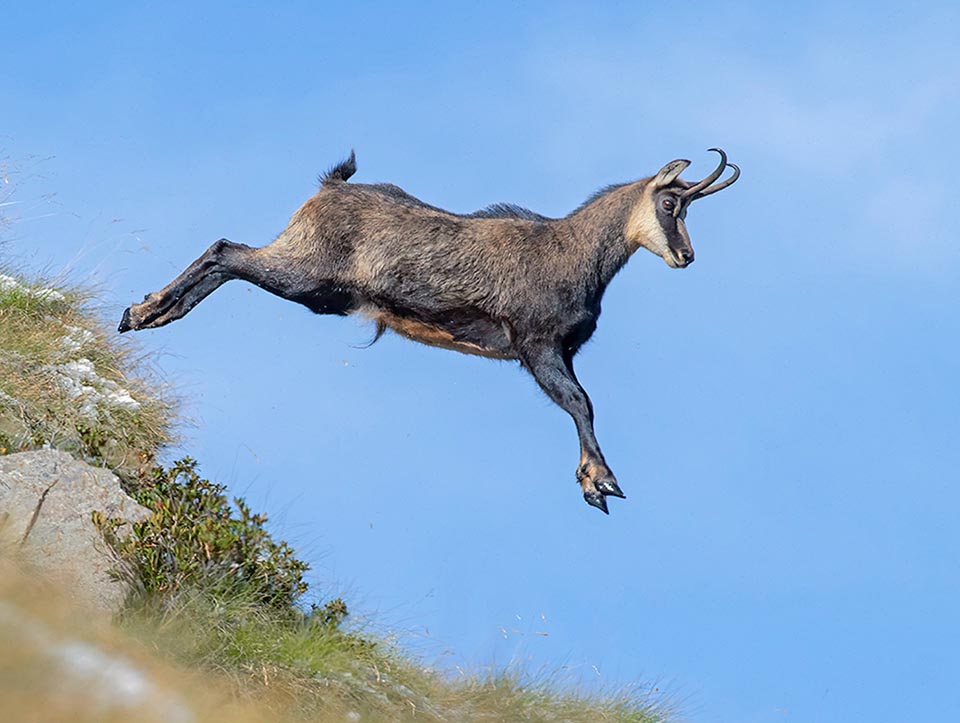
Due to hunting and geographical isolation, some subspecies of the Chamois (Rupicapra rupicapra) are presently object of protecction © Emilio Ricci
ORIGIN AND EVOLUTIONARY PATH OF MAMMALS
The beginning of the evolutionary history of the Mammals is traced back up to more than 300 million years ago, starting from a. branch of the Synapsida, a vast group of terrestrial Tetrapod Vertebrates resembling a large lizard, very widespread in that time and where are also included the present Mammals. It is necessary to specify that, despite their outer appearance, the prehistoric Synapsida were not real Reptilians (Reptilia), but a distinct and parallel revolutionary line.
Without going into speculative details of learned phylogenetic dissertation, this is not the place, and even though aware that the origin of the Mammalia is a very complex paleontological question and in some ways still not consolidated, we share the opinion of the scholars largely in agreement in believing that the modern Mammals are a monophyletic group that originated rightly in late Triassic, about 225 million years ago, rightly from a grouping of Synapsida, precisely that of the Cynodontia.
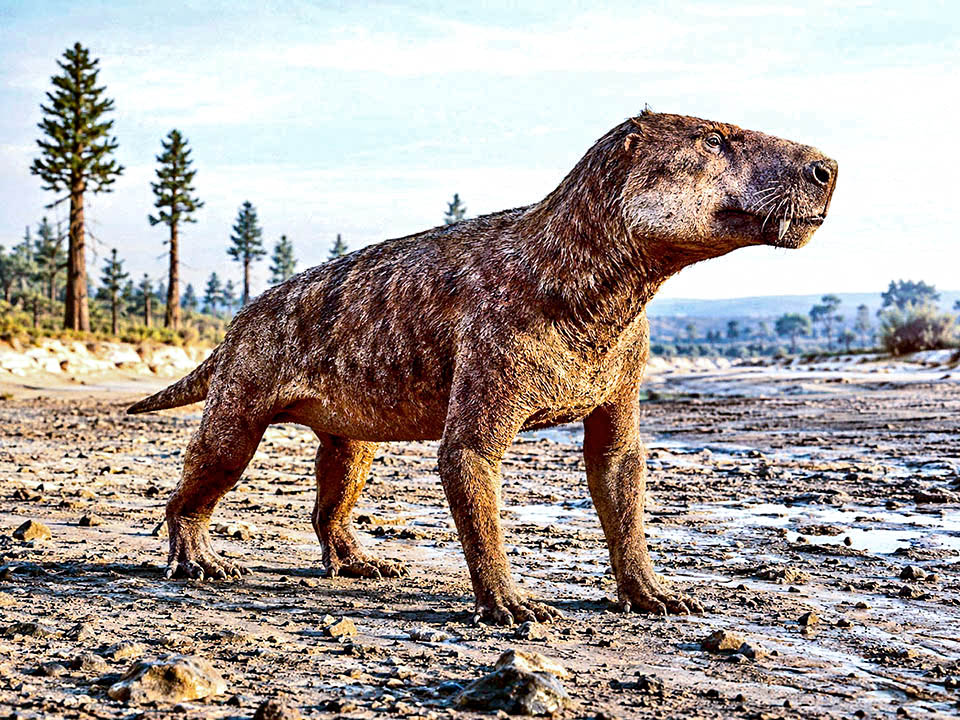
Cynognatus – Immagine generata con intelligenza artificiale da Giuseppe Messina
So called for the most evident characteristic of having “dogs teeth”, the Cynodontia laid the eggs like the Reptilians and it is considered probable that they were warm-blooded animals having the body covered with hair. It was precisely in the Triassic that Cynodontia, divided in two evolutionary lines that for ease of display we shall call Non-mammaliaform Cynodontia and Mammaliafor Cynodontia.
Non-mammaliaform Cynodontia
In their evolutionary path, they occupied various ecological niches like carnivores and herbivores. Surviving the major mass extinction of the Permian-Triassic occurred about 252 million years ago, they disappeared gradually during the Lower Cretaceous, about 140 million years ago. The decline and final disappearance of this branch are blamed on the competition with the Dinosaurs and especially with that of the true Mammals, born in the meantime rightly for evolution of the mammaliaform Cynodontia.
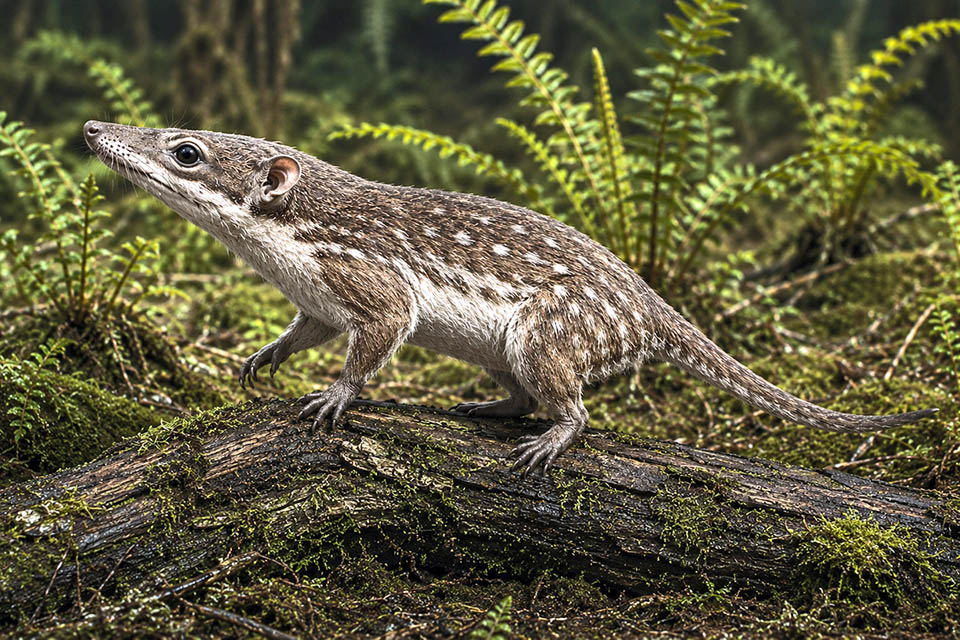
Mammaliaform Cynodontia
While the evolutionary history of the npn mammaliaform branch of the Cynodontia ended with its extinction, that of the mammaliaform Cynodontia instead continued and got more and more important diversifying more and more in the true Mammals.
Within the forms of transition between mammaliaform Cynodonts and the first Mammals stands out the Adelobasileus (Adelobasileus cromptoni, small and agile animal who lived in the region presently corresponding to North America in the Upper Triassic, 225-220 million years ago.
First ancestors and Archaic Mammals
At the dawn of their appearance on the living scene, the ancestors of present Mammals were small, 10-20 cm per few grams, similar to shrews or mice, with night habits and thick fur to protect against cold. The reduced size and the help of darkness favoured them to escape carnivorous Dinosaurs.
Within the most archaic mammals we recall the species mentioned below.
The Morganucodon (Morganucodon), an animal the size of the common Mouse appeared more than 200 million years ago and became extinct 170-180 million years ago. The Kayentatherium, cynodont of the Lower Jurassic, had a size similar to that of a big cat.
Due to various characteristics, such as partial coat, specialized teeth, incisors, canines, molars and semi-erect posture, this species is considered as standing among the possible Mammals ancestors. Widespread in North America, this species has disappeared about 180 million year ago, much earlier than the big extinction of the non avian dinosaurs. Life for these primitive Mammals by sure was not easy, especially due the presence of several and terrible predators.
Dinosaurs predating the small Mammals
Particularly feared were Microraptor, Sinornithosaurus and Deinonychus, carnivorous dinosaurs of small and medium size, ferocious predators even of small mammals.
Specifically, the Microraptor was very small in size, about like that of a crow. It had the body covered by feathers, four wings and characteristic feathers on the legs.
It was widespread in the north-eastern Asia subtropical and temperate forests where it carried on a semi-arboreal life. It lived in the Lower Cretaceous, about 125-113 million years ago.
Larger in size, comparable to those of a large turkey, was the Sinornithosaurus, carnivorous dinosaur, it too feathered, as evoked by the scientific name meaning “Chinese bird-lizard”. Typically equipped with long canines with a possibly poisonous bite, was common in north-eastern China, where populated the humid and temperate woody environments also got extinct in the Lower Cretaceous.
Another particularly fearsome predator for the small and primitive Mammals was Deinonychus, a feathered carnivorous dinosaur that reached dimensions comparable to those of a wolf. Equipped with big sickle claws, hence the scientific name meaning “terrible claw”, this dinosaur was spread in North America and lived preferably in wooded areas, where hunted in packs. It died out around 100 million years ago.
Ends this short review of predators of Mammals in prehistoric times, the Velociraptor, carnivorous dinosaur that populated the desert dune environments of central Asia.
As big as a large turkey, it had the body covered by feathers and on the claws it carried feathers similar to those of the present birds.
The mouth was equipped with about 30 sharp and serrated teeth and the second tooth of each foot had a big hooked claw, retractile, with which it seized and immobilized the prey.
It lived in the Upper Cretaceous, dying out around 71 million years ago.
Apart from the merciless hunt suffered, the primordial mammals were however obliged to live in the shade of the strong competition of the dinosaurs, which practically dominated the terrestrial, marine and aerial environments until their final disappearance occurred 66 million years ago.
Cretaceous-Paleogene mass extinction
About 66 million years ago a catastrophic event did take place that radically modified the vegetal and animal biodiversity on our Planet and the fate of our ancestors.
That is the mass extinction of the Cretaceous-Paleogene (event K-Pg), caused by the impact of a giant, 10-15 km, asteroid as proven by the crater of Chicxulub in the Yucatán peninsula.
The impact triggers tsunamis, fires and an initial heat wave, followed by an immense cloud of dust that did darken the sun for a long “nuclear winter”.
Deprived of light and consequently unable to carry out the process of photosynthesis, the plants died causing the ecosystems to collapse in a few months or years.
This led to the disappearance of the big herbivores and of their carnivorous predators.
Some recent geological research done in North America highlighted how the extreme immediate thermal shock has amplified the overall mortality. Regardless how the details have occurred, a tragedy took place which cancelled about 75% of the living species, including all non avian dinosaurs.
The mammals after the dinosaurs
Fatal for the dinosaurs, the huge mass extinction of the Cretaceous-Paleocene instead saved various ancestral forms of mammals. These small animals did survive thanks to their insectivorous and omnivorous diet, to their warm-blood metabolism and to their mainly nocturnal lifestyle.
With the disappearance of the big predators and the liberation of countless ecological niches, for the mammals began an extraordinary adaptive radiation. Free from competition, they were able to explore new territories, to exploit abundant food resources and, gradually, to conquer even the daytime spaces.
From that moment on, the Earth went through an intense and complex evolutionary path, marked by tectonic upheavals and impressive orogenic thrusts that have redesigned the geography of the planet; climatic fluctuations with the cyclical alternation of phases of deep cooling and major global warmings; large scale migratory flows, accompanied by the continuous appearance and vanishing of countless animal species.
Considering the informative purposes of this treatise and the immense complexity of the matter, we shall avoid the superfluous details for tracing a brief chronological excursus.
We shall concentrate on the essential geo-climatic events and on the ecological and biogeographical variations of the Afro-Eurasian area (the “Old World”), starting out treatise from the end of the Paleocene.
Continental drift and paleogeographic evolution
During the Paleocene, about 60 million years ago, Eurasia presented a geographical configuration rather different from the present one.
At the time the Eurasian plate, resulting from the ancient supercontinent of Laurasia, was divided in two by the Turgai Strait, a long stretch, shallow, of the Tethys Ocean which separated the European block to the West from the Asian one for various thousands of kilometres.
In that period, the geographical area of the European block was formed by an archipelago of islands surrounded by shallow seas.
In its turn, the southern part of the old Tethys Ocean, that separated the Laurasia from the Gondwana, kept closing due to the approaching of the African plate and the Eurasian one.
It was then that the first interactions between the microplates and the southern edge of Europe started the future formation of the Alps.
In those times, the Earth enjoyed a warm and humid climate with large areas covered by dense forests.
Paleocene-Eocene Thermal Maximum (PETM)
About 56 million years ago, the Thermal Maximum of the Paleocene-Eocene (PETM) carried a high global warming that lasted about 150-200 thousand years.
The Planet transformed into a greenhouse, with lush forests stretching to the poles. This warm climate created a high-latitude corridor that favoured the rapid diffusion of animals in Eurasia and in North America.
In the same period, the movements of the tectonic plates merged lands previously separated and attracted important events of formation in the mountains. Together with the warm climate, this continental union accelerated the evolution of the first small mammals, originating the big modern groups: Prototheria, Metatheria and Eutheria.
During the initial phase of the warming, in Europe did also arrive the ancestors of the true Primates (Euprimates). These animals were already adapted to life on the trees: had a bigger brain, frontal eyes for the stereoscopic vision, prehensile fingers and nails instead of claws.
Primates and Archaic Mammals of the Paleocene-Eocene
About 56 million years ago, during the maximum thermal of the Paleocene-Eocene, the climate of North America and Europe was warm, humid and of tropical type.
In this scenario the following spread: Adapis, distant relative of lemurs; Eosimia, very small primate discovered in China; Teilhardina: small primate similar to a South American marmoset; the Phenacodus (Phenacodus), lived in the Eocene and amply diffused al over North America and Europe, was an animal whose size usually did not exceed the length of one metre.
Slim in shape and with paws having 5 toes, the Phanacodus lived mainly in habitats having dense and humid vegetation of the tropical and subtropical forests of the time.
Of predominantly terrestrial habits, it had a mainly herbivorous diet tha in part was integrated with small invertebrates.
The Phenacode is considered the progenitor of the Perissodactyla (horses, rhinoceroses, tapirs) and of the Artiodactyla (pigs, sheep, cows, deer, hippos). From it probably derived the Hyracotherium, the first ancestor of the horses.
Another archaic mammal of that time is the Purgatorius, genus diffused in North America from more than 60 million to about 50 million years ago (Middle Eocene).
Similar in appearance to squirrels or shrews, the Purgatorius were small animals that usually attained the length of about 10-15 cm, in addition to the long tail used for balancing, and a total weight of just 0-100 grams. The paws had 5 toes.
Skilled tree climbers, considered as the precursors of the primates, ate fruit and invertebrates.
In that period, some species of mammals, in relation to the great availability of plant food, underwent a rapid and noticeable increase in size.
Among these stand out the Titanoides, a genus gathering together species that most likely exceeded even the length of 2,5 m and a weight that could attain about 2 quintals.
The Titanoides had robust paws with toes armed with strong and long claws utilized for tearing up roots and vegetation of the subtropical swamps which they fed on.
Lived about 61-55 million years ago, the Titanoides lived in a geographical area limited exclusively to North America and became extinct without leaving direct descendants about 55 million years ago, by the end of the Eocene.
We conclude this brief review dedicated to Paleocene-Eocene ancestors of the present Mammals with the Pakicetus, genus of ancestral Mammals lived about 50 million years ago.
Animals carnivorous and of terrestrial habits, the Pakicetus distinguished for having long snout, thick and long tail and paws with clogs, like the ancient ungulates. The look of these Mammals reminded that of a dog or of a wolf and the size attained about 1,5 m of length.
Lived in the area corresponding to present Pakistan, these animals occupied preferably habitats of shallow waters or close to water streams where they fed on by hunting fishes.
The particular importance of this animal comes from the fact that, on the basis of the study of its skeletal configuration and in particular of the tympanic bone of the inner ear, it is presently considered as the most primitive ancestor of the modern Cetacea.
Temperature drop and Grande Coupure
Time passes and about 34-36 million years ago, at the end of the Eocene and and at the beginning of the Oligocene, occurred an abrupt drop in the temperature of the Planet with the formation of the first permanent ice in Antarctica.
This phenomenon has also greatly reduced the area of the forests in favour of grasslands and savannahs and has been the cause of the disappearance of more than 60% of the species of native mammals at that time living in Europe and in North America.
During that event, known as Grande Coupure and still for about 500 thousand years ago, in Europe ancestral and endemic forms of marsupials, primates and rodents have died out.
In turn, the disappearance of the native fauna has favoured the immigration from Asia of new species ready to occupy the ecological niches left free.
The migration wave has carried in Europe classic ruminants, such as the Tragulidae, old relatives of the Hippopotamuses (Anthracotheriidae), and small herbivores similar to primitive deers (Celocidae) known as Mouse deer, as big as rabbits and considered as close to the Suids (Suidae).
Concluding, the Grande Coupure has represented a decisive turning point for the evolution of the present Mammals.
The first great mountain chains of Eurasia rise
The years passed and arrived in the lower Oligocene, about 30-35 million years ago, Eurasia was interested in an intense tectonic activity. In particular, the push of the southern plates, Africa and India, against the Eurasian margin caused the upheaval of the first big Alpine-Himalayan chains.
The Tethys Ocean was reduced and split into minor basins.
The Turgai Strait disappeared and took form a solid and continuous territorial connection inside the Eurasian bloc.
In the meantime also formed temporary land bridges between the continents caused by variations of the sea level and tectonic thrusts.
Just over 23 million years ago, at the end of the Oligocene, such an environmental situation would also favoured the appearance in Eurasia of terrestrial herbivorous forms large in size of which Rhinocerotoids (Paraceratherium) are the most singular representatives.
Of impressive dimensions, even 8 metres long per an estimated weight of 15-20 t, they had long and columnar legs similar to those of an elephant. The even exceeding 5 metres height at the withers and the elongated neck, allowed these enormous animals to feed on the tree foliage like a present Giraffe.
Lived in Eurasia 34 to 23 million years ago, the Rhinoceroteroids should become extinct at the beginning of the Miocene, coinciding with important climate and environmental changes.
At the beginning of the Miocene, about 20 million years ago, took place the final closure of the Tethys Ocean and began the final joining between the eastern margin of the Eurasian plate and the Afro-Arabian block, thus interrupting the great water exchange between the oceans.
At that time, the Mediterranean area was formed by a sea characterized by typical ample island arches and moving microplates.
Proboscidean Datum Event and Miocene Climatic Optimum
Some time later, approximately 20 million years ago, the Earth entered a phase of progressive warming, warming that about 3-5 million years later should have reached the Miocene Climatic Optimum.
Then the climate of Europe began to become warm and humid favouring the growth of large extensions of dense temperate and subtropical forests that continued towards Asia.
Furthermore, the ice of Antarctica became much smaller than the present ones and consequently the level of the sea was higher.
At that time, taking advantage of the closure of the Tethys Ocean and of the so-called “bridges”, territorial connections caused by the collision of the African and Eurasian plates, big African Mammals of the order of the Proboscidea, like Mastodons and Gomphotheres, relatives of the Mammoths and of the present Elephants, have given rise to a massive migration started from Africa and that amply developed in the Eurasian continent.
To this event, known as Proboscidean Datum Event, did participate the Gomphotherium, a great proboscidean od look similar to the present Elephants but equipped with four fangs, of which the lowest two were elongated and flat, utilized as shovels for digging and collecting the food.
Widespread throughout much of Eurasia, Italian peninsula and Sicily included, this genus would disappear from Europe about 10 million years ago.
Then there was also the gigantic Zygolophodon, among the greatest terrestrial mammals, that spread throughout Eurasia, northern Italy included, where it was frequent in woody humid environments.
Considering the taxon from which has later on originated the Mastodon or Borson’s Mastodon (Mastodon borsoni), the Zygolophodon should have disappeared from the Mediterranean territories 2,5-3 million years ago.
To the Proboscidean Event participated also the Arvernia Mastodon (Anancus arvernensis), who starting from about 8,5 million years ago populated the dense humid and subtropical forests of Eurasia, central-northern Italy included, where its fossil remains are amply documented.
The Arvernia Mastodon was a prehistoric proboscidean equipped with typical straight and very long tusks, up to 4 m, and of massive size, comparable to that of a present African Elephant.
This species will disappear by the beginning of the Pleistocene, about 2 and 1,5 million years ago.
Monterey Event – Middle Miocene Climatic Transition (MMCT)
The great heat of the Miocene Climatic Optimum ended about 14 million years ago.
On that date concludes the phase of maximum heat and begins the climate transition of the Middle Miocene with a progressive and marked global cooling.
The marked drop in temperature caused the contraction of forests in favour of the open prairies.
In the new prairies arrived and developed Horses, Donkeys and Zebras (Equidae), perissodactyls with tridactyl legs.
That period, known with the names of Monterey Event and Middle Miocene Climatic Transition (MMCT), was characterized by climate fluctuation, by a remarkable underwater and subaerial volcanic activity and by a high oceanic eutrophication caused by a cycle of a significant deposition of organic carbon on the seabeds.
It was then that the panorama of the animal and vegetable biodiversity began decidedly to assume a look quite similar to the present one.
Closure of Gibraltar Strait and Salinity Crisis of the Mediterranean
About 6 million years ago, at about the conclusion of the Miocene era, the collision of the tectonic plates, Eurasian and African, caused the formation of a sort of natural dam that closed the Strait of Gibraltar, connecting the Iberian Peninsula with North Africa and transformed the Mediterranean into a closed sea.
The lack of water flow coming from the Atlantic Ocean and the intense evaporation led to the drying up almost totally of the Mediterranean basin that in a short time took on the appearance of a vast desert depression with isolated hypersaline brines.
This event, known as the Messinian salinity crisis, had as consequences the massive disappearance of Mediterranean marine fauna with the loss of almost 90% of its autochthonous species.
The previous environments of coral reefs disappeared completely.
On the other hand, the birth of new land bridges due to the almost total drying up of the Mediterranean has allowed several terrestrial species, especially of Mammals to freely move between Africa and Europe, Italy included.
It was then that African Rodents like the Myocricetodon, as well as primitive hippopotami and elephants, utilizing the land bridges, reached Europe and colonized the nearby islands.
Zanclean Flood
But the geographical panorama changed again after about 700 thousand years.
In fact, about 5,3 million years ago, between the Miocene and the Pliocene, the Mediterranean came back to be again an open basin after the collapse of the barrier that had kept the Strait of Gibraltar closed.
The reopening of the Strait unleashed a huge waterfall which from the Atlantic Ocean poured into the almost completely dried up Mediterranean (Zanclean Flood).
In addition to filling with water the Mediterranean depression, the Atlantic Ocean also brought back new species and, with them, life which had disappeared almost completely.
It took a long time to restore the primitive conditions of life in the Mediterranean.
The new biodiversity of the Mediterranean, almost totally dependent on the Atlantic one, has practically employed more than one million year to settle on levels comparable with those existing before the Salinity Crisis of the Mediterranean.
Mid-Pliocene Warm Period
At the end of the Pliocene, about 3-3,5 million years ago, the Earth went through a long period of global heat known as the Mid-Pliocene Warm Period. In that period, thanks also to an increased rainfall, vast area of southern Europe and of the Italian peninsula were covered by dense and humid forests, whilst in regions like Calabria and Sicily, dominated shrubs and sclerophylla of the primordial Mediterranean scrub.
Among the big Mammals that characterize the European wildlife panorama that time there was the Etruscan Rhinoceros (Stephanorhinus etruscus), diffused in Eurasia in open forest and flooded meadow environments.
Close to the end of the Pliocene, just under 3 million years ago, the Etruscn Rhinocero pushed itself steadily towards south Europe, Italy included.
In the same period in Europe appeared the Elasmotherium (Elasmotherium), the so-called Siberian unicorn, a great Asian rhinoceros with an immense frontal horn adapted to the cold steppes.
These big animals became extinct about 40.000 years ago, during the Upper Pleistocene , due to the climate changes that reduced the open steppes of which they nourished.
The warm period of the Middle Pliocene had already previously closed: about 2,6 million years ago, in fact, the Neogene ended (and with it the Tertiary) and the Earth entered the Quaternary, the geological era we live on
Climatic Fluctuations and migratory Flows
The Quaternary characterizes mainly for the alternation of very cold periods (glaciations) and temperate periods
(interglacial) that have. caused respectively the expansion and the retreat of the glaciers with significant consequences for the fauna as well as vegetational populations.
During the repeated glacial phases of the Pleistocene, the large quantities of water trapped by the ice lowered by several metres the level of the Mediterranean Sea.
In those periods the central-northern part of the Adriatic Sea became a wide arid extension that united the Italian peninsula to the Balkan one allowing the passage of migratory flows.
The advance of the ice towards the temperate regions has pushed also several species of Mammals of the Arctic regions and of the mountains to migrate southwards or to live at lower altitudes to escape the cold.
At that time, The Mammals became the rulers of the faunal panorama and in the meantime the peninsulas of South Europe (Iberian, Italian, Balkan and Greek) played the important rôle of refuge areas, real and true cradles of biodiversity.
During the Pleistocene glaciations, several big and well adapted to cold Mammals, following various migratory routes moved to central and southern Europe where they colonized new free habitats and developed characteristics useful for surviving the rigidities of the Ice Age.
It was then that to the first ancestors of the Proboscideans, like Elephants, Mammoths and Mastodons who had previously arrived in Eurasia, well before the Miocene Climatic Optimum, added other new forms.
Among the many species that immigrated in that era, we recall the Southern Mammoth (Mammuthus meridionalis), that from the beginning of the Lower Pleistocene, about 2,6 million years ago, from Asia Minor and eastern Europe widely spread in the European continent, including the Italian peninsula.
It is assumed that in later times, a little less than million years ago, from some populations of the Southern Mammoth differentiated the Steppe Mammoth (Mammuthus trogontherii), who from its places of origin diffused also in Siberiawhere in the eastern part should have differentiated about 800 million years ago the Woolly Mammoth (Mammuthus primigenius).
It also seems that, under the pressure of the remarkable expansions of the glaciers and of the adaptation of the extreme cold, the Steppe Mammoth has later one evolved into the known Woolly Mammoth. Due to the remarkable expansion of the glaciers and always favoured by the adaptation to the extreme cold, the Woolly Mammoth diffused up to western Europe, including the northern areas of the Italian peninsula.
With the time passing, the number of the fauna species immigrated in Eurasia continued to increase with new arrivals.
Always at the beginning. of the Pleistocene but during the interglacial period, just little less than 2 million years ago, from the African continent arrived the ancestors of the ancient European Hippopotamus (Hippopotamus antiquus) that also spread to southern Europe reaching also the Italian and Balkan peninsulas.
The European hippopotamus disappeared progressively during the Pleistocene and there are no sufficient elements that prove its arrival in Sicily.
Time passes and arrived at about 1,5 million years ago, due to the reduction of the forests in favour to the prairies, caused by the worsening of the cold and arid climate, the migratory phenomenon registered the arrival of the archaic
Chinese Bison (Bison palaeosinensis), a ruminant of the family of the Bovidae that from Asia spread in western and southern Europe, up to the Italian peninsula.
In the new territories, from these primitive Bisons over time would have originated the European species most known of the genus, like the Bison of the thickets (Bison schoetensacki) and the Bison degiulii.
Later on, appeared the big Steppe bison (Bison priscus). Large in size, about 3 m long, with more than 2 m tall at the withers and a weight that could even attain 1,5 t., the Steppe bison characterized for the structurally primitive skull and the horns were shorter and slender compared to the present Bisons.
Big herbivore, this species occupied a very vast range extending all over Europe and North America where it preferred the cold and open steppe habitats.
Due to the isolation, in Sicily has differentiated the subspecies Bison priscus siciliae.
About 700 thousand years ago, a long time later after the aforementioned Proboscidean Datum Event, wit the first glacial Pleistocene phases has occurred a first wave of migration of the Straight-tusked Elephant (Palaeoloxodon antiquus), big animal even more than 4 m tall at the withers per a weight of about 13 tons, that diffused in much of central-western Europe.
Across land bridges surfaced as a consequence of the sea level drop during the glacial phases, populations of the Straight tusked Elephant have also reached Sicily.
Later, following the long isolation of these populations, due to the process of insular dwarfism should have differentiated the Sicilian dwarf elephant (Palaeoloxodon falconeri), a proboscidean who did not reach one metre in height.
This species should have become extinct around 400 thousand years ago.
Within the arrivals of that time stood also the Merck’s Rhinoceros or Forest Rhinoceros (Stephanorhinus kirchbergensis). This was a large sized species that came from central Asia, about 700-600 thousand years ago, in Europe and in Italy, populating woods and savannahs where it found shelter and abundant food consisting in foliage and shrubs. This species is the only rhinoceros whose presence in Sicily and it is witnessed in specific Pleistocene deposits of the island.
During the most rigid glacial phases, about 450 thousand years ago, from Asia came the Woolly Rhinoceros (Coelodonta antiquitatis). This species has spread widely in Europe also with successive waves of migration populating habitats of tundra and steppe grasslands.
Big animal, it was more than 3 m long per a weight that attained 2 t, the Woolly Rhinoceros distinguished for the thick fur, the fatty hump on the back and for the length of the first of the two horns that exceeded even the metre.
Unluckily rare in the Italian peninsula, this species has disappeared from Europe about 14-10 thousand years ago due to the rapid climate warming and the contraction of its natural habitat.
In a previous time, about 700.000-600.000 years ago, the ancestor of the Straight-tusked Elephant (Palaeoloxodon antiquus) had already arrived in Sicily and in Malta, originating the very first dwarf elephant (Palaeoloxodon falconeri).
Later on, about 2OO thousand years ago, a new migration wave of the same king has carried in Sicily a bigger Elephant that, always due to insular dwarfism, has originated a second species of dwarf elephant (Palaeoloxodon mnaidriensis). This bigger form reached almost two metres in height.
About 20 thousand years ago, almost at the end of the Pleistocene, due to important climate changes and habitat modifications that occurred at the beginning of the last glaciation, also this species should have disappeared.
During the last Pleistocene glacial phases, about 150-250 thousand years ago, taking advantage, like other species, of the remarkable sea level drop, populations of the common Hippopotamus (Hippopotamus amphibius) have reached Sicily and other Mediterranean island leaving from Africa.
Due to the long isolation of the island, and similarly to what happened for the dwarf Elephants, also the Hippopotami have undergone a process of insular dwarfism, originating the dwarf Hippopotamus (Hippopotamus pentlandi), species endemic to Sicily.
This species has later disappeared by the end of the Upper Pleistocene, about 20 thousand years ago, as a consequence of the big climate changes and of the hunting pressure done by the prehistoric man.
Finally, more or less 100 and 15 thousand years ago, with the advancing of cold climates during the glacial phases of the Pleistocene, the Reindeer (Rangifer tarandus) has migrated from the Arctic regions southwards, going up to the mountains and the Italian Alpine and pre-Alpine valleys.
Glacial Shelters
About 20-25 thousand years ago, during the coldest phases of the last glacial phase years, the advance of the ice, with the consequent contraction of the forests replaced by open steppes and by the northern tundra, pushed several herbivorous Mammals of the Arctic regions to look for shelter and food in more hospitable areas of southern Europe.
Some of these species have arrived also in the Italian peninsula, like the Muskox (Ovibos moschatus) and the Giant deer (Megaloceros giganteus), but upon the arrival of the global warming of the early Holocene interglacial their range has contracted again towards north.
The populations of other species that since time lived also in southern Europe, like the Cave bear (Ursus spelaeus), with the advancing cold of the last glaciation, have taken shelter in the southern zones with milder climate.
At that time, the areas of South Europe, including Italy, had the function of natural climatic shelter for many species.
Great Pleistocenic Predators
During the glacial periods, in Europe lived also uncommon carnivorous forms of great predators who dominated the terrestrial ecosystems and contained the impact of the great herbivores (trophic cascade) controlling their number and the movements.
Please find here below the most representative predatory species.
The scimitar-toothed cat (Homotherium) with its characteristic big and protruding incisors, measured about 1 m in height at the withers and weight that might exceed 200 kg. The front legs longer than the rear ones, with semi-retractable claws, made it a formidable hunter even of big prey like Giant deers and young mammoths.
Spread with various species in a very vast range where it loved prairies, steppes and open areas, in Eurasia the genus was represented by the Homotherium latidens, species that lived also in the Italian peninsula. The genus disappeared at the end of the glaciation, about 12 thousand years ago.
The environments of forests and woody open areas were populated by a form of Saber-toothed predator (Megantereon cultridens), that occupied a vast range extending in Europe, Asia, Africa and North America.
Similar in appearance to the modern jaguar, this animal had a sturdy body measuring about 70 cm at the withers per a variable weight which could attain 150 kg. The species did distinguish for the elongated and flat superior canines and the fore legs.
This Saber-toothed predator has lived also in Italy, as proven by the fossil remains found mostly in the centre of the peninsula. About 1 million years ago, the deep climate changes of the lower Pleistocene have caused the disappearance of this species frm Italy and from Europe.
The Giant short-faced hyena (Pachycrocuta brevirostris) was the giant of the genus, with about 1 m height at the withers per a weight even exceeding 100 kg. Native to Africa, the Giant short-faced hyena has migrated from north)eaten Asia to Europe, venturing up to central Italy. It extinguished about 500 thousand years ago mainly due to the unforeseen climatic and environmental conditions.
During the glacial phases of the late Pleistocene, when the level of the lower sea facilitated the passage, from continental Europe specimens of Spotted hyena (Crocuta crocuta) have migrated in Sicily where they should have lived up to about 16.000 years ago. It is not sure that in the island this species has developed characteristics of insular gigantism.
In those days, contemporary and in partial with the Giant hyena, there was also the Grey wolf (Canis lupus), descendant from Eurasian ancestors and progressively spread across a large part of the Northern Hemisphere.
In the Italian peninsula, from the long isolation of populations of Grey wolf has originated the Amennine or Italian (Canis lupus italicus), subspecies endemic to the mountains of the Apennine range.
Also in Sicily the Grey wolf has originated the Sicilian wolf (Canis lupus cristaldii), exclusive to the island. Between the years twenty and forty of the last century, the Sicilian wolf was extinguished due to the hunt it was subjected to.
At that time, also ancestors of the Lion migrated in Eurasia where they did evolve in the Cave lion (Panthera spelaea) that more than 600 thousand years ago populated various parts of Italy up to Sicily.
Extremely spread in the Middle Pleistocene at the beginning of the Holocene, this species, known also with the name of Steppe lion is famous as as been represented in many cave paintings of the Paleolithic, like those of the Chauvet Cave and of Lascaux in France and those of the Grotta Romanelli in Apulia (Italy).
With the end of the glacial period the Cave lion extinguished in Europe and Italy.
Other predators of that time native to the Arctic and boreal regions that following the expansion of the tundras and the cold steppes have moved towards southern Europe. In that time, various species typical to the cold northern environments have moved to Italy where they could find vast tundra and steppe areas. Have lived in Italy also the Arctic fox (Vulpes lagopus) and the Wolverine (Gulo gulo).
The Arctic fox with the increase of the temperature by the end of the last glacial has left the southern lands to repopulate the original nordic environments.
A different fate has befallen to the Wolverine that, considered undeservedly a ruthless and damaging predator, was relentlessly hunted that in the XIX century has led to its disappearance from the Italian peninsula.
Dwarfism and insular gigantism
The reduction of body mass, the dwarfism, is a phenomenon we find very frequently in the animal populations of the islands especially in those small in extent.
Caused mainly by the limited availability of food and by the genetic isolation, as well as for the absence of big predators, the phenomenon of the dwarfism is particularly detectable in species whose individuals are normally large in size, like in the mammals.
In Sicily, due to the long isolation and the particular environmental conditions, the Straight-tusked elephant has split into two endemic species of prehistoric dwarf elephants, classic examples of the process called insular dwarfism.
The Palaeoloxodon falconeri, a small elephant not reaching one metre in height, disappeared 200 thousand years ago.
The Palaeoloxodon mnaidriensis, diffused in Sicily and Malta, reached 2 m at the withers and has extinguished quite some time later, also following the arrival of humans.
Another species of Dwarf elephant, always derived from the giant Straight-tusked elephant, is Palaeoloxodon tiliensis, less than 1,5 m tall and endemic to theGreek island of Tilos.
Also the Sicily dwarf hippopotamus (Hippopotamus pentlandi) and the Malta dwarf hippopotamus (Hippopotamus melitensis) are clear manifestations of insular dwarfism.
Other instances of dwarf forms are those derived from ancestors of big Eurasian Cervids that in the Pleistocene reached islands of Mediterranean.
Like the Premegaceros cacioti, endemism shared by Sardinia and Corsica, and the Cervus elaphus siciliae, subspecies endemic to Sicily. These two dwarf species would subsequently go extinct after the profound climate and environment changes of the end of the last glaciation.
Instead, insular gigantism is an evolutionary process for which somesmall species remained for a long time isolated in small islands that present significantly larger dimensions than those living in the continent. This phenomenon can be charged to the absence of great predators and a reduced selective pressure.
Here below stand examples of insular gigantism.
The Giant Dormouse (Leithia melitensis), endemic rodent of Sicily and Malta whose size measured about double than that of the present European Dormouse, disappeared by the end of the Pleistocene about 10-12 thousand years ago.
The Sicilian Cave Hyena (Crocuta crocuta spelaea), subspecies more massive and bigger than the African spotted hyena, from which has originated. One of the major predators of that time, it became extinct by the end of the last glacial period.
Out of Africa
Virtually contemporaneous with the mentioned above events is the arrival in Europe of the first Hominids of the genus Homo. After the main paleoanthropological theory, Out of Africa, they have originated in Africa and then spread across the European continent with various waves of migration passing through the Middle East and Caucasus.
It should be noted that at that time, the Middle East and Caucasus represented a must-visit stop for all migration flows bound from Africa to Europe.
Along this course, just under two million years ago arrived archaic forms, like Homo ergaster and in later times also Homo erectus.
Quite some time later, about 600-800 thousand years ago, a further migratory wave, always coming from Africa, carried in Europe Homo heidelbergensis.
This species has replaced the previous forms and, in a period included between about 400 and 500 thousand years ago, has originated in Eurasia the ancestor of Homo neanderthalensis.
Glacial Relicts
In these times, while the Man of Neandertal continued in Eurasia the evolutionary adventure begun by his ancestors in Africa, the Earth entered a phase of strong intensification of climate extremes, passing from the bitter cold of an extreme glaciation to one of the warmest periods of his recent history.
After the strong expansion of the glaciers occurred during the glacial phase, the Earth entered the Interglacial (Riss-Würm) and started warming up again.
With the high temperatures, the continental glaciers have melted and the water has come back into the oceans.
This has caused the sea-level rise of a full 5-7 m and perhaps even more that has submerged the land bridges that emerged during the previous glaciation.
Moreover, the significantly warmer and more humid climate has caused a deep transformation of the European and Mediterranean landscape. The tundra and cold steppe areas have reduced, allowing the massive expansion across much of Europe of mixed broad-leaved forests. Also the conifers, such as pines and firs, dominant during cold periods, were confined to the highest mountain ranges.
The arisen environmental conditions allowed the diffusion towards more northerly latitudes of animal species typical of warm or temperate climate.
For their part, the animals of cold environments that during the previous glacial phase had come down seeking refuge in southernmost temperate regions, with the return of the warm migrated again towards the arctic regions of North Europe or have moved on the highest mountain bands.
Here, they would have remained trapped and isolated assuming the ecological and biogeographical of glacial relicts.
Nowadays, many of those species that remained at that time trapped became extinct, several others survive but are highly in danger because of the warming of the Planet that further restricts their high-mountains habits.
Among the Mammals, classic examples of glacial relicts presently relegated to the Alpine arc are the Variable hare or White hare (Lepus timidus), the Alpine marmot (Marmota marmota) and the (Mustela erminea).
Homo sapiens asserts
Time passes and about 45 thousand years ago, through the Middle East arrived a massive wave of migration that together with other species carries in Eurasia a new special guest.
It’s Homo sapiens, a species native to the African continent where it had undergone a long evolutionary process lasting about 200-300 thousand years during which he had acquired a substantial and valuable wealth of intellectual and practical skills.
Spread rapidly, on the Eurasian territory, Homo sapiens came into contact with a very close relative.
He was the Homo neanderthalensis, a species with Eurasian distribution originated by far-away relatives migrated long before, about 600-800 thousand years ago.
When they met, apart from a few subtle nuances, between the two species there were no significant morphological differences and not even in cognitive and operational capabilities such as to establish a clear superiority of one over the other.
Both of them had large brains and already knew how to work the stone and the bone in a way to get various objects from them, such as blades and harpoons for hunting and for fishing; they were even capable of building tools for cutting the wood and also sewing needles.
Both species knew how to harness fire, to build shelters for protecting and utilize the skins for fashioning rudimentary garments to protect oneself from the cold of the glacial steppes.
Moreover, the members of each species lived in organized groups, more or less numerous, and were able to communicate by means of a language based on the use of the words.
They knew how to create jewels, to use pigments like ochre and depict cave paintings, demonstrating capabilities to use signs, words or images to represent abstract ideas and objects.
Also, they hunted in groups large animals and took care of weak or injured members of the group.
In Europe, Homo sapiens and Homo neanderthalensis coexisted for quite some time, about 5-8 thousand years, they have also crossed between them and probably have also had descendants.
Then, about 40 thousand years ago, Homo neanderthalensis has disappeared progressively, especially due to climate changes and the demographic and genetic isolation caused by its social organization.
From that moment on and till now, Homo sapiens has remained the only species of the genus on the Earth.
But it was a species whose the already extraordinary capacities, unique among living beings, to increase and transmit from one generation to the other the body of cognitive and technical achievements (cultural evolution), were further strengthened by the genetic heritage at immunological level obtained through the crossing with Homo neanderthalensis.
The cultural evolution with the biological one has allowed the Homo sapiens to spread across the entire plant and to survive even in hostile environments and lands, constituting the keystone for the birth of the modern man.
With the invention of writing, which occurred about 5 thousand years ago in Mesopotamia and then in Egypt, Prehistory ends. But that’s another story.