
Family : Gobiidae

Text © Dr. Giuseppe Mazza

English translation by Mario Beltramini
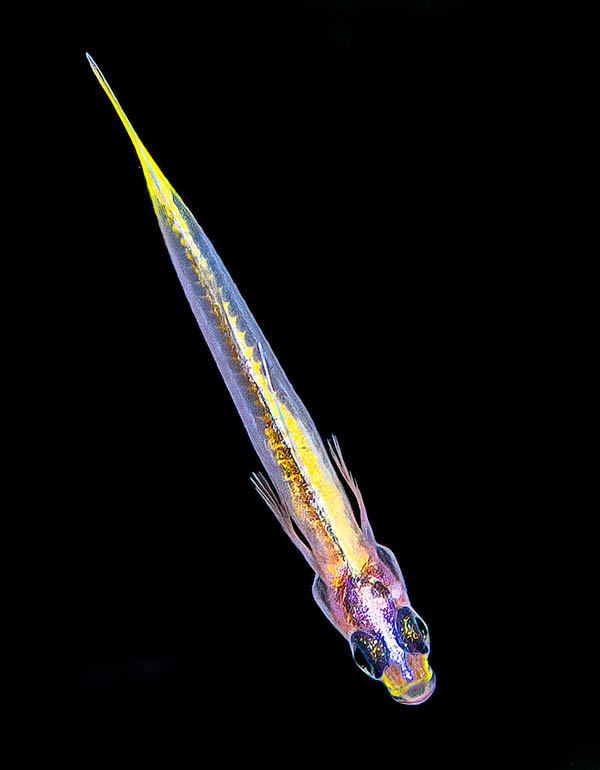
Only 3 cm long, Vomerogobius flavus lives only on few far from each other sites of tropical Atlantic © www.carlosestape.photoshelter
The Lemon goby (Vomerogobius flavus Gilbert, 1971) is a small fish that stimulates curiosity, belonging to the order of the Gobiiformes and to the family of the Gobiidae.
The genus, created by Gilbert in 1971, originates from “vomer”, vomer, in ichthyology the bone forming the front part of the palate, and “gobius”, the name created by Linnaeus and applied preently to various gobies. The reference to the vomer is anything but coincidental. Vomerogobius in fact is characterized by the presence of vomerine teeth, a character at that time quite uncommon among gobies.
Gilbert completes the binomen with “flavus”, yellow in Latin, as this is the dominant colour of the fish.
Vomerogobius flavus moreover is the only species presently recognized by the genus Vomerogobius, a genus therefore monotypic.
So, a yellow goby, but why talk about a little fish that does not exceed 3 cm and that does not even interest the aquarists?
Perhaps it is intriguing thatVomerogobius flavus is known by few locations of western Atlantic, especially concentrated in the Bahamas and in the north-western part of the Caribbean. Its area of occupancy (AOO) in fact is approximately estimated at about 112 km2, whilst the extension of presence (EOO) reaches about 607.771 km2. The surface actually occupied is consequently very limited whilst the total geographical area is decidedly much more ample.
Numbers that would normally lead to question oneself about the possible risk for the species, but the available information are still too poor to establish with reliability its state of conservation and therefore, from 2011, the Lemon goby appears in the category “DD, Data Deficient“, that is “insufficient data”, of the IUCN Red List. This is an important distinction that does not mean neither “safe species” nor, automatically, “threatened species”: it simply means that for the moment we still do not have sufficient information for establishing with reliability its state of conservation.
It could also be a not rare species. And if we add that in 1971 on the base of only 11 specimens collected at the Bahamas and that presents an odd sexual dimorphism, this small thin goby stops being a ‘mino fish’ and becomes a species to be observed with attention.
Zoogeography
Vomerogobius flavus is known from a few locations of the Bahamas and of the north-western part of the Caribbean.
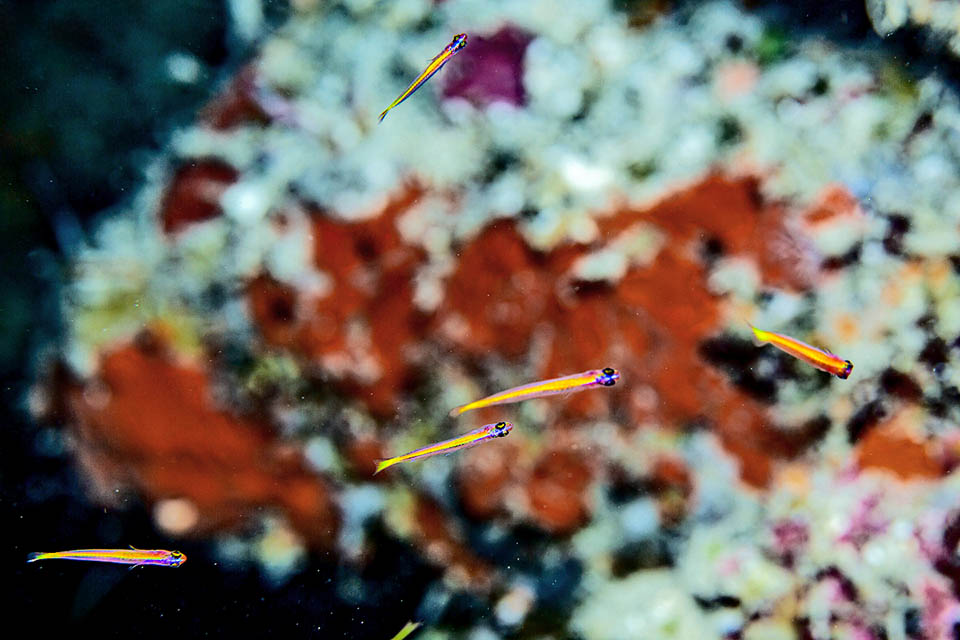
Known as Lemon goby due to its main colour, it is found in small schools suspended on the outer side of reef, feeding on plankton carried by currents © www.carlosestape.photoshelter
In the Bahamas it has been reported in the southern part of Grand Bahama, on Eleuthera island, in the Exuma Sound, in the Samana Cays, in the Plana Cays and on Acklins island. It is also known off Belize, close to the coral reef of Glover, and off Honduras, close to the island of Roatán. The apparently fragmented distribution helps to explain the great difference between EOO and AOO and, together with the scarcity of observations, makes it difficult to explain how extensive and numerous are its populations.
Ecology-Habitat
It is a tropical benthopelagic marine species, reff-associated, living between 14 and 42 m of depth. It goes swimming just off the seabed and can form small schools or small groups along the steep external slopes of the reefs, where it feeds on plankton carried by the currents. The behaviour in the water column, typical of small planktivorous gobies , makes this fish rather different from the most common image of the goby strictly linked to a den or staying on the substratum.
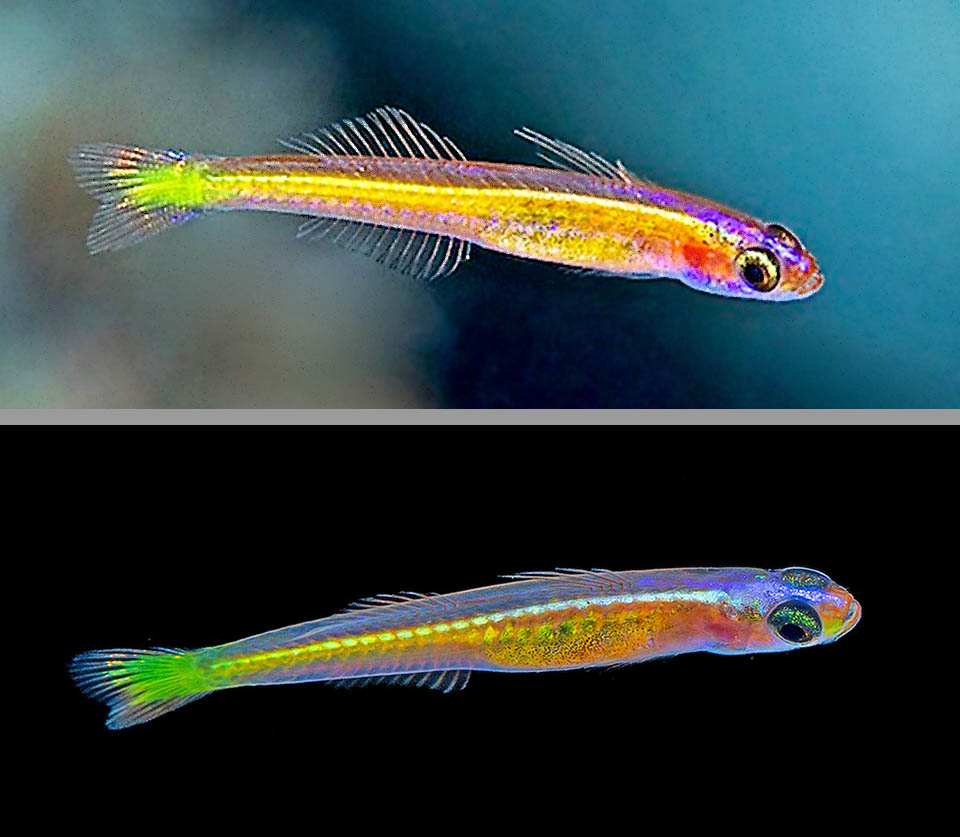
There’s a great dimorphism: the top male differs by sight from the female due to its bright livery and the much longer third and fourth spine of the first dorsal fin © www.carlosestape.photoshelter
Morphophysiology
The scaleless body of Vomerogobius flavus appears elongated, with roundish head and big eyes. The lateral line is missing. The mouth, large and moderately oblique, reaches the centre of the eye. The tongue, heart-shaped and curved sides bent upwards, has in the centre a semicircle of separate and pointed teeth, to which adds a pair of canines.
On the vomer are present three highly curved and pointed teeth, character from which comes the name of the genus.
The species presents an unusual sexual dimorphism. The males distinguish due to the third and fourth spine of the first dorsal fin, much longer compared to the females, and for a livery not having the more evident dark markings present in the females. These last, in fact, display an increased pigmentation on the dorsal, anal and pelvic fins and in the central part of the snout.
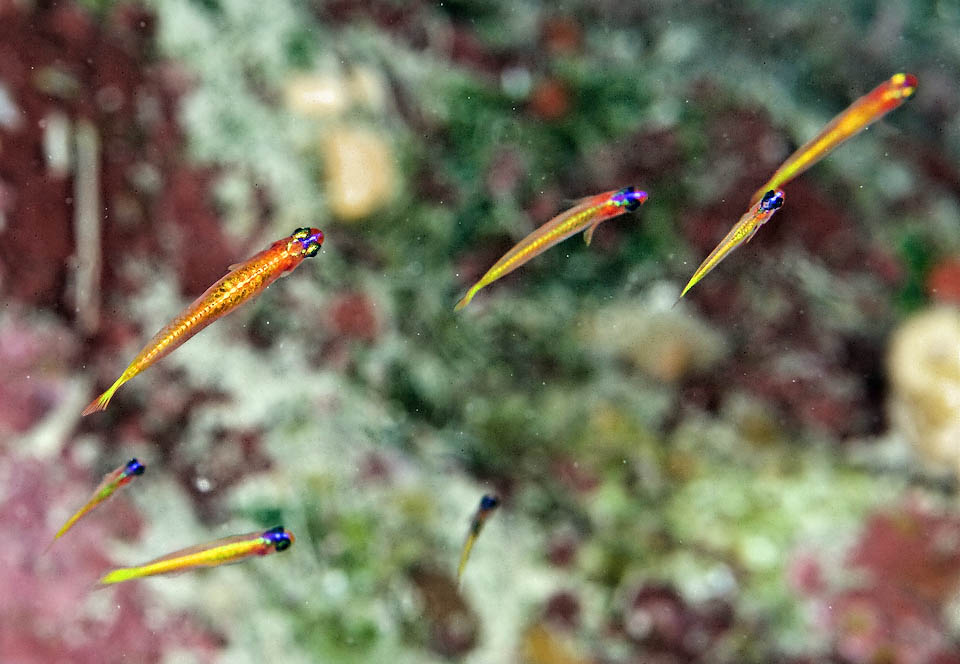
Small school. The species often lives united in the water column, but about its reproductive biology the available information still stand surprisingly poor © www.carlosestape.photoshelter
The second dorsal fin, amply separated from the first, has in both sexes a hard ray and 11-12 soft. The anal, symmetrical to this one, has one dark ray and 12 soft; the pelvic ones have one hard ray and five soft; the pectoral ones 15-16 rays. The caudal is concave, with rounded extremities.
Ethology-Reproductive Biology
Information on reproductive biology of Vomerogobius flavus is still limited, consistent with the general scarcity of data on the species. The minimum estimated time for the doubling of the population is less than 15 months, value suggesting a relatively fast potential capacity of recovery.
And perhaps this is really the charm of the Lemon goby: a few centimetres goby, described by only 11 specimens and known by a surprisingly reduced number of locations. Small in size, but far from free of questions.
→ For general information about FISH please click here.
→ For general information about BONY FISH please click here
→ For general information about CARTILAGINOUS FISH please click here.
→ To appreciate the BIODIVERSITY of BONY FISH please click here.
→ To appreciate the BIODIVERSITY of CARTILAGINOUS FISH please click here.