
Family : Carangidae

Text © Dr. Giuseppe Mazza

English translation by Mario Beltramini
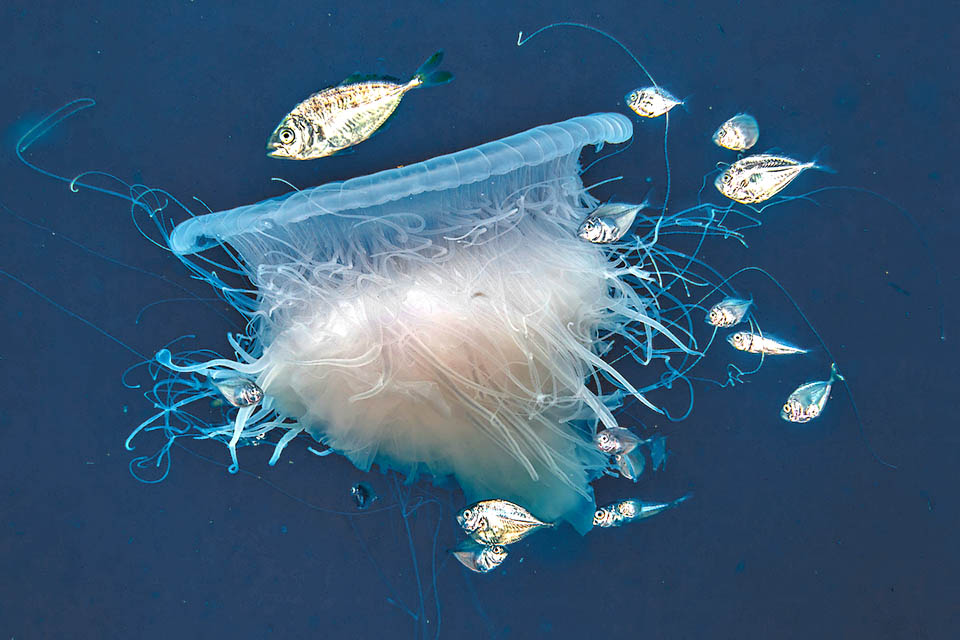
Chloroscombrus chrysurus stands on both Atlantic sides. During part of its youth, gets shelter among the stinging jellyfish tentacles © www.carlosestape.photoshelter.com
Imagine a small silvery fish swimming close to a jellyfish, following its movements and staying in close contact with its translucent umbrella. It is not an unusual scene for the juveniles of Chloroscombrus chrysurus (Linnaeus, 1766), Atlantic fish whose juvenile stage is linked to an interesting association with the jellyfish. In an environment populated by predators, even the presence of an apparently inhospitable organism may in fact transform in an opportunity: a mobile shelter, a point of reference and a way for increasing the possibilities of survival.
The genus Chloroscombrus, created by Girard in 1858, originates in Greek, with an unexplained allusion, from “chloros”, green, perhaps observing the reflections on the back and “skombros”, name used in the old times for various fishes like in the Mediterranean Scomber scombrus, whilst the specific term chrysurus originates composed by “chrysos”, gold and “ouros”, tail, with reference to the golden yellow of the caudal fin.
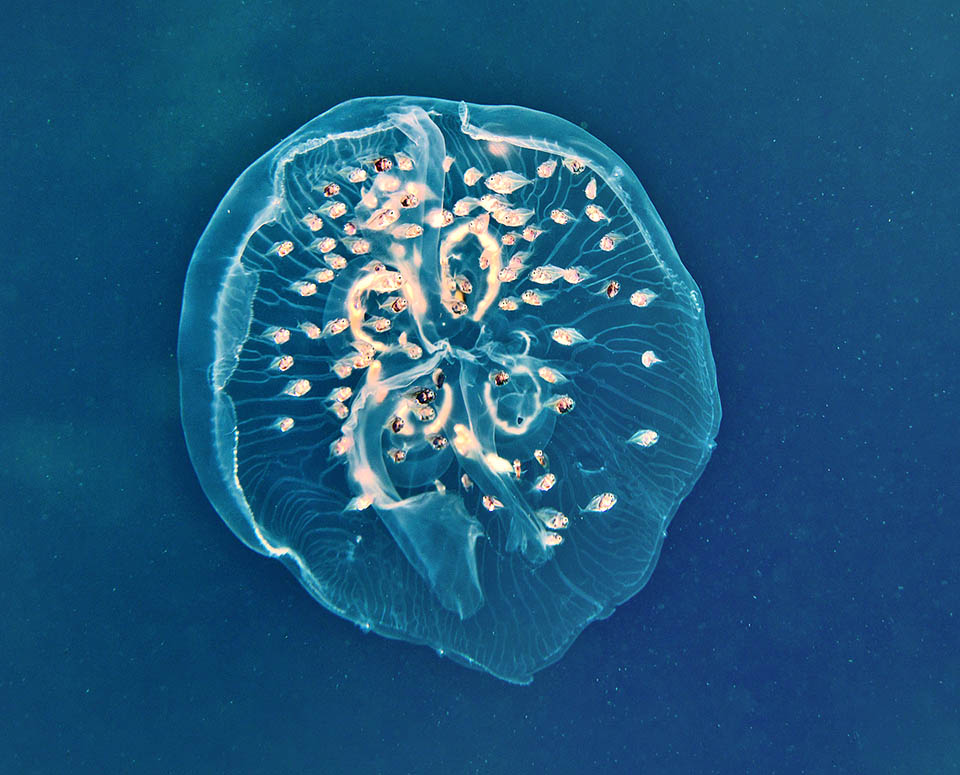
After the larval phase, when they drift carried by currents, this is the house of the young © www.carlosestape.photoshelter.com
Chloroscombrus chrysurus belongs to the order of the Carangiformes and to the family of the Carangidae, that counts about forty genera and almost 150 species, often tropical, that may attain considerable dimensions like Coryphaena hippurus or Seriola dumerili.
Zoogeography
It is a fish present on both sides of the Atlantic Ocean.
It is found from North America and Bermuda up to Uruguay, including the Caribbean regions and the Gulf of Mexico, whilst in the Old World follows the coasts of Cape Verde and of Mauritania up to Angola.
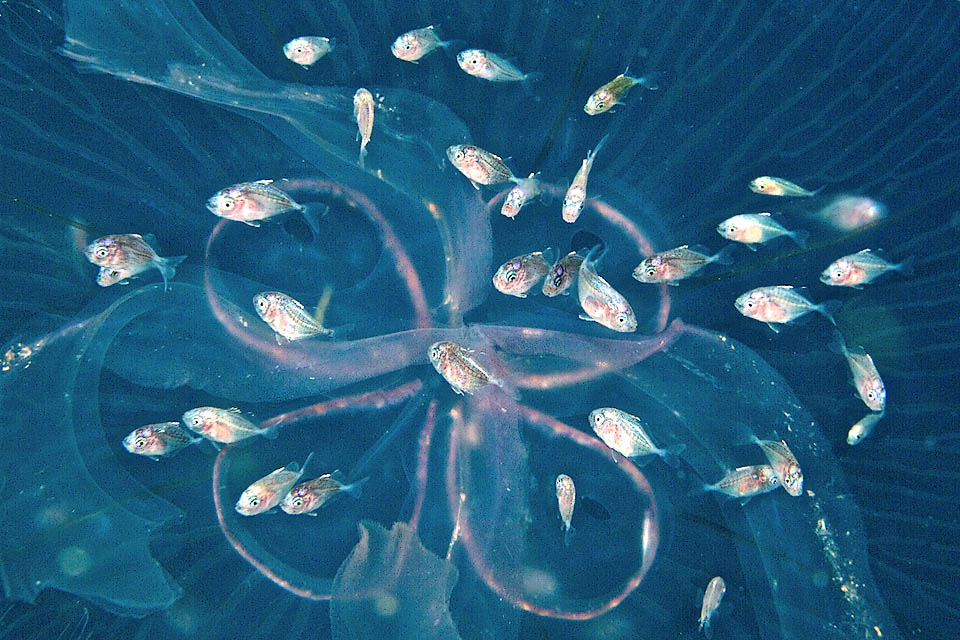
It’s a meeting and growth point where the zooplankton based diet progressively enriches with bigger prey © www.carlosestape.photoshelter.com
Occasionally, it has been reported in the Mediterranean: in December 1997 a specimen was seized off Almuñécar, in the southern coast of Spain. It is a species of Atlantic origin, considered as allochthonous in the Mediterranean, where no evidence has emerged of a permanent settlement of the population.
Ecology-Habitat
The distribution of Chloroscombrus chrysurus includes coastal and neritic environments up to about 110 m of depth. Its presence in the brackish waters demonstrates a good capability of adapting also in the transitional spaces.
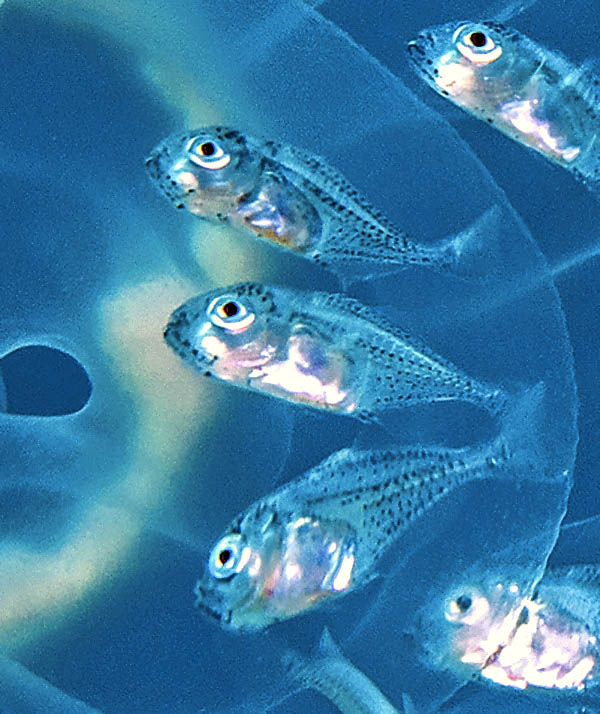
Small fishes enlargement in the jellyfish heart © www.carlosestape.photoshelter.com
It frequents coasts, lagoons, estuaries and vast areas of the continental shelf, where the adults often form school on the surface.
The juvenile phases are particularly associated with shallow coasts, the brackish waters of the estuaries and of the mangrove swamps offering food resources and conditions favourable to the growth.
One of the most interesting aspects, as aforementioned, is the association of the juveniles with the jellyfish. These small fishes can swim close to the umbrella and the tentacles of the gelatinous organism, potentially exploiting their presence as protection from the predators. Thus the jellyfish becomes a sort of living and mobile shelter, able to accompany the fish during its movements.
This relationship must not be interpreted necessarily as an obligate symbiosis: it is an ecological association where the main advantage might be represented by the reduction of the predation risk. For a small fish, to live close to a stinging organism can form a particularly effective strategy, even if the actual benefits vary depending on the type of jellyfish and the environmental conditions.
From a nutritional standpoint, the species presents a varied diet that includes zooplankton, small fishes and cephalopods, in addition to organic material of various kinds. The larvae mainly feed on small planktonic organisms, among which cladocerans and copepods, with prey of increasing size as they develop.
Morphophysiology
The body of Chloroscombrus chrysurus, protected by tiny cycloid scales, is compressed on the sides, relatively tall and characterized by a ventral profile more compressed than the dorsal one.
The colouring is typically silvery on the sides, with greenish or bluish shades on the back, livery that contributes in rendering it little eye-catching in the pelagic environment.
The head is short, with a blunt snout, whilst the presence of two dorsal fins and of one forked caudal fin is consistent with the life of an active swimmer. Like other carangids, the shape of the body and of the tail favours the movements inside the water column and when looking for prey.
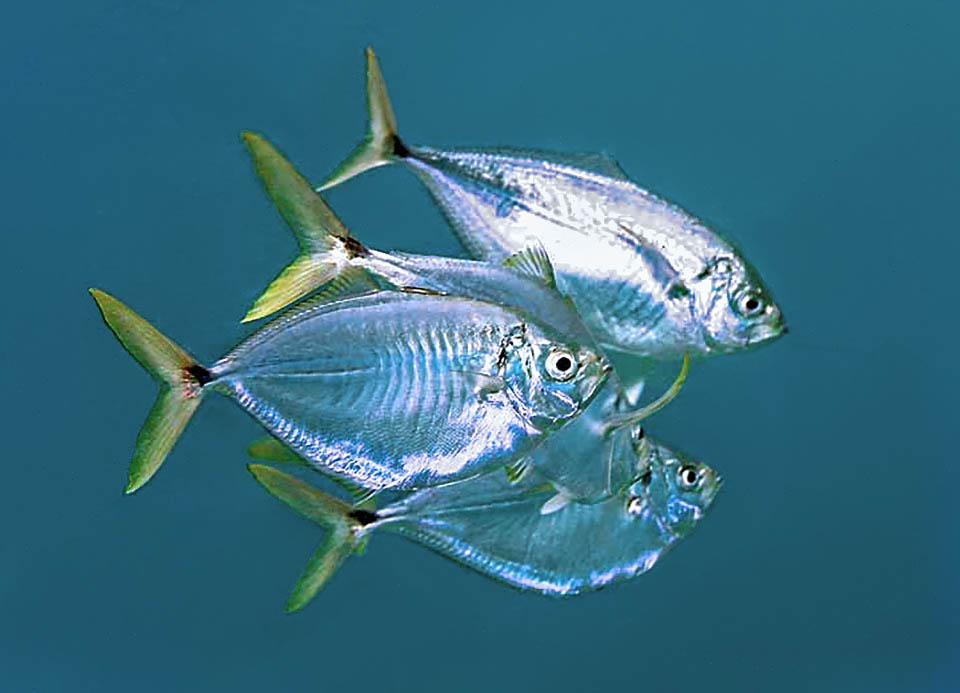
In the now adult specimens we note the typical dark spot on the caudal peduncle, contrasting with the fins yellow, hence comes the species name © Kevin Bryant
There are two dorsal fins, the first with 8 spines, the second with 1 spine and 25-28 soft rays. The anal fin has 2 detached spines followed by 1 spine and 25-28 unarmed rays. The upper lobe of the caudal fin is longer than the lower one.
A character useful for the recognition is the dark spot, similar to a saddle, placed on the caudal peduncle. There is also a dark spot at the level of the upper part of the operculum. These elements, together with the outline of the body and the metallic livery, allow to distinguish the species from other small silvery pelagic fishes.
Albeit the dimensions commonly reported stand on about 25 cm in total length, the sources also report specimens of bigger size, up to a record of 65 cmm per a weight of 121 g.
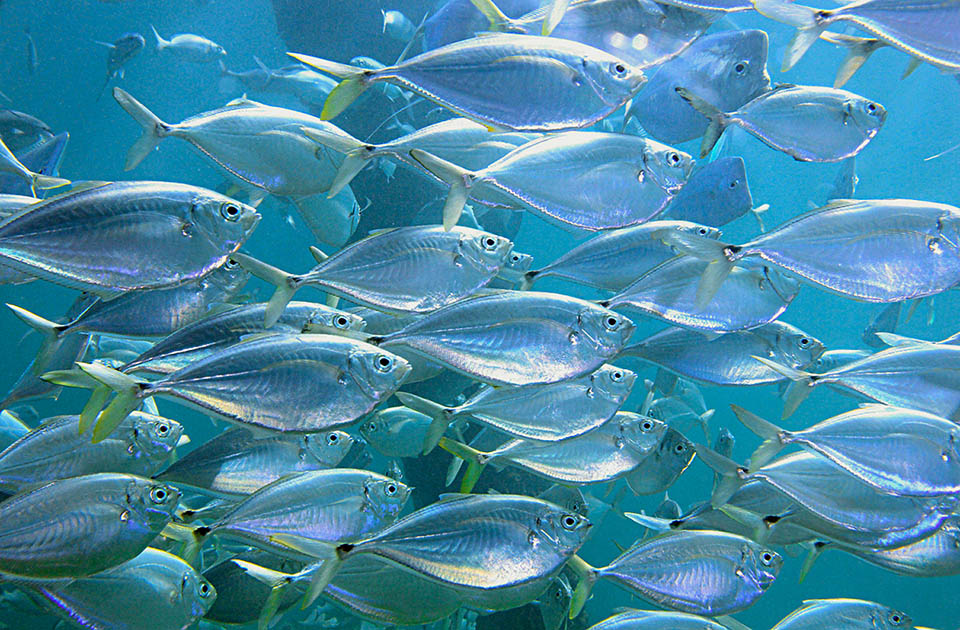
Adults are consumed fresh, smoked or dried or preserved in salt. The species is also utilized industrially for producing meal and oil fish © Kevin Bryant
Ethology-Reproductive Biology
Like other carangids, Chloroscombrus chrysurus is an oviparous species with external fertilization. Short-lived, rarely exceeding the 3;5 years, it usually reaches sexual maturity during the first year, with a length of about 12-13 cm. Mating occurs in the water column with floating eggs entrusted to the current. The growth of the larvae depends initially on the planktonic resources, and with the growth the diet gets ample, including prey of bigger size.
Resilience is average, with a medium time for doubling the populations of 1,4-4,4 years, and the fishing vulnerability, moderate, marks 29 on a scale of 100.
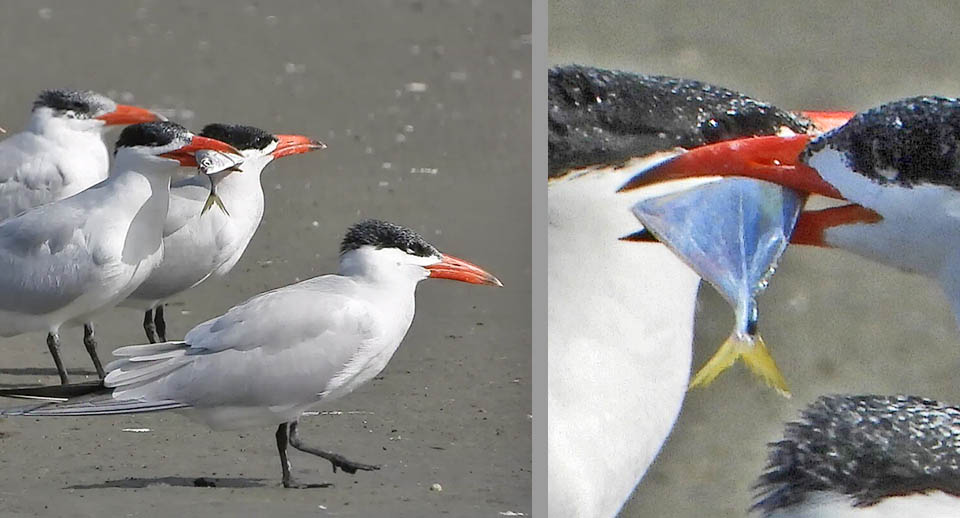
When schools swim at surface, they are easy prey for marine birds. Here a group of Caspian terns (Hydroprogne caspia) vying for a fish on the image right © Maksymilian Wojtkiewicz
It is casually seized, with drag-nets and circling nets, or for pleasure, with the fishing line, and is consumed fresh, smoked, dried or salted, and industrially for the production of fish meal or fish oil. The schools swimming at the surface are often preyed upon by birds, but seeing the vast diffusion Chloroscombrus chrysurus is not an endangered species and from 2012 in fact appears as ”LC Least Concern” in the IUCN Red List.
Synonims
Scomber chrysurus Linnaeus, 1766; Micropterus chrysurus (Linnaeus, 1766); Micropteryx chrysurus (Linnaeus, 1766); Scomber chloris Bloch, 1793; Seriola cosmopolita Cuvier, 1829; Micropteryx cosmopolita (Cuvier, 1829); Chloroscombrus caribbaeus Girard, 1858; Chloroscombrus ectenurus Jordan & Osgood, 1897; Chloroscombrus hesperius Fowler, 1906.
→ For general information about FISH please click here.
→ For general information about BONY FISH please click here
→ For general information about CARTILAGINOUS FISH please click here.
→ To appreciate the BIODIVERSITY of BONY FISH please click here.
→ To appreciate the BIODIVERSITY of CARTILAGINOUS FISH please click here.