
Family : Physaliidae

Text © Dr. Giuseppe Mazza

English translation by Mario Beltramini
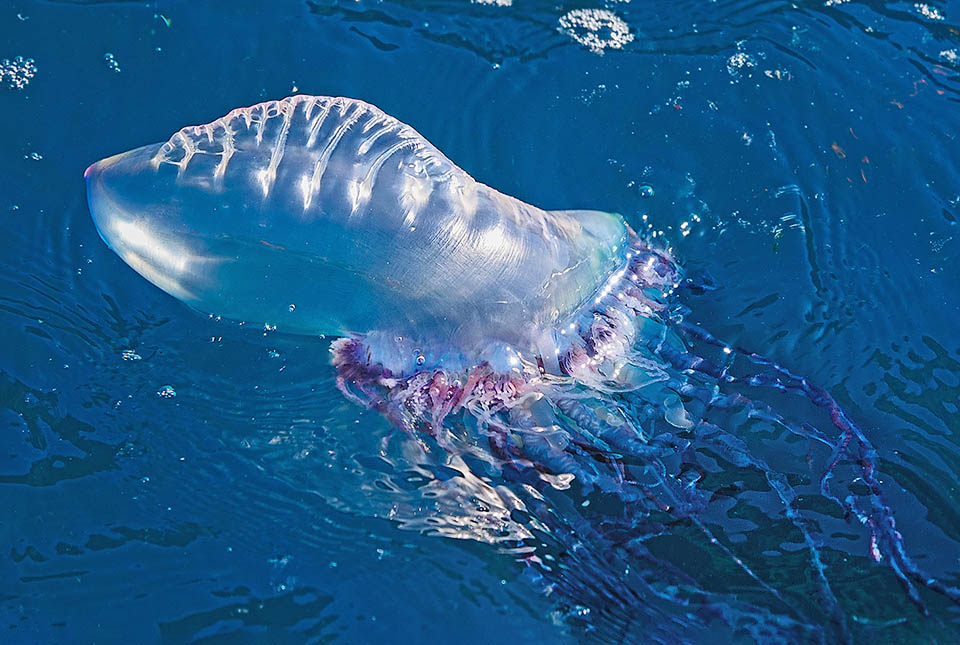
Mostly found in tropical and subtropical waters, the Portuguese man o’ war (Physalia physalis) is not a jellyfish but a group of autonomous organisms with specific duties © Tim Melling
At first glance Physalia physalis (Linnaeus, 1758) might seem like a jellyfish, but it is rather a tiny, living sailing ship, driven by the wind, on the surface of the ocean. Its translucent blue and purplish float, recalls a sail inflated by the breeze and has inspired the common name of Caravela Portuguesa, evoker of the ancient sailing ships, or Portuguese man-of-war.
Also the name of the genus Physalia and the specific one physalis remind this structure and are connected to the Greek “physallis”, blister or vesicle.
But the real surprise is something else: what appears as one single animal is actually a colony of specialized organisms, closely integrated with one another. Some seize the prey, others digest them, and more others participate in the reproduction. The colony behaves like one only biological entity, although it is composed of elements with different forms and functions.
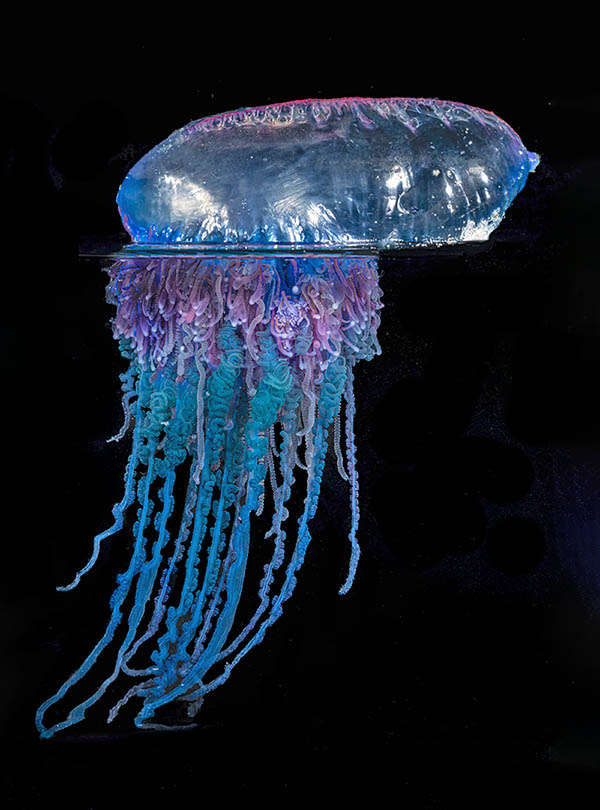
Under a floating organ called pneumatophore, we see several zooids with pinkish-purplish shades and the long blue tentacles, equipped with stinging nematocysts, specialized in seizing prey © Gonzalo Giribet
The traditional classification places it into the phylum Cnidaria, that of the corals and og the jellyfish, in the class, Hydrozoa, order Siphonophorae and family Physaliidae.
In 2025, a study based on the genomic sequencing and on the analysis of the morphological characteristics has found various evolutionary lines in the genus Physalia, proposing to recognize at least four species. The research has also re-evaluated some historical denominations previously considered as synonyms. In this page we keep Physalia physalis as the main term, pointing out that the traditional classification has been subject to a significant revision.
Zoogeography
The Caravela portuguesa arais mainly present in the tropical and subtropical waters of the Atlantic, Pacific and Indian oceans. It can also reach temperate regions, where winds and currents carry the colonies far away from the areas where they are more frequent. In the eastern Atlantic it is reported along the European coasts, Iberian ones included and, occasionally, the northernmost ones. Its distribution does not depend only on the temperature of the water. Being a floating organism on the surface, it is carried by the marine currents and especially by the wind, that acts on the crest of the float. In this way it may cover considerable distances without doing swimming movements like those of other fish and other marine animals.
The apparition of numerous specimens along a coast does not necessarily indicate a stable increase of the local population. It may depend on particular meteorological and oceanographic conditions, able to carry towards the ground colonies coming from the open sea. The sea storms and the persistent winds can cause mass beachings, at times extended to long stretches of coastline. The recent taxonomic revision also suggests that the populations in the past attributed to one only species include distinct forms, with partly different geographic distributions. The identification of the single species however requires caution: colour, size and shape of the float may provide clues, but not always they are sufficient for a sure identification.
Ecology-Habitat
Physalia physalis is a pleustonic organism that lives at the interface between water and air, in the open sea. Its float, called pneumatophore, supports the colony and carries a crest working as a sail, allowing the wind to be harnessed for moving. However, it does not have a system of propulsion capable to allow it to actively swim against the wind or to freely choose its own destination.
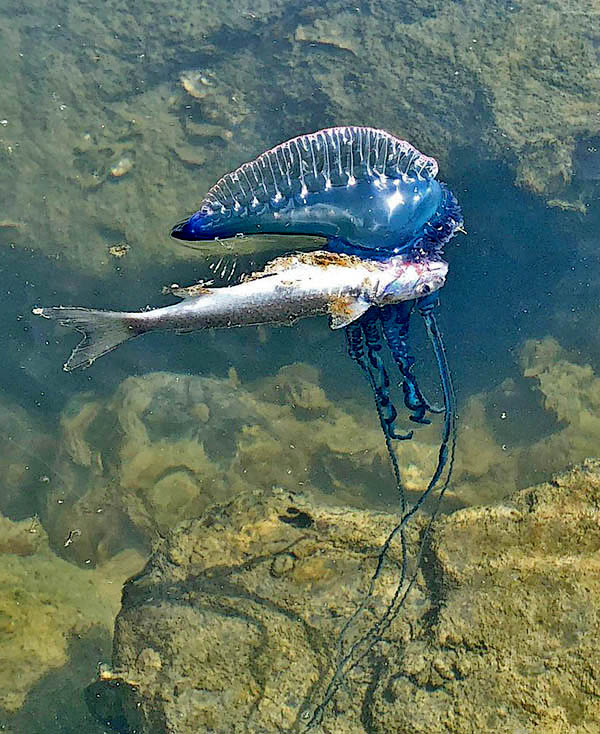
Usually they measure about ten meters, but some sources report exceptional lengths of 20-30 and even 50 m. Here their strong venom has just immobilized a fish of considerable size in a matter of mere seconds © kraft_a_006
Under the surface the tentacles stretch out, as they may extend for many metres and are carried by the water during the drift. Like those of the Lion’s mane jellyfish, Cyanea capillata, belonging to a different group of pelagic cnidarians, also the tentacles of the Caravela portuguesa intercept small fish, larvae and other planktonic organisms entering in touch with them. Their length increases the area explored by the colony, but also renders the animal potentially dangerous for those swimming nearby.
The Caravela is inserted into a complex ecologic net. Some marine organisms can prey on it, whilst others frequent its tentacles or the float, taking advantage from the resources offered by the colony. Among the most interesting cases stands that of the fish Nomeus gronovii, associated with the Caravela and able to frequent zones where many other fish would be seriously damaged by the nematocysts. This relationship does not mean that the fish is completely immune to stings.
When the winds push the colonies towards the land, the specimens may accumulate on the beaches in even numerous groups. The float can collapse or lose part of its form during the beaching, whilst the tentacles scatter across the sand and may get difficult to detect. The beached specimens must not be touched with bare hands. The nematocysts may keep the capacity to discharge even after the death of the colony and the drying out of the tentacles. For this reason caution is necessary also when the animal now appears inert or dehydrated.
Morphophysiology
The most evident is the pneumatophore, a floating structure filled with gas, translucent and often blue, purplish or pinkish. Its shape varies with the dimensions and the state of the specimen and can be modified by the exposition, by the collapse or by the damage of the colony. The float supports the other components and keeps the organism on the marine surface. The upper crest operates like a sail: intercepts the wind and contributes in determining the direction of the drift. The asymmetrical shape of the float is particularly interesting. The single individuals may present two orientations of the sail, conventionally defined as right-handed and left-handed in relation to its position in relation to the part of the colony that has the tentacles.
This difference influences the way how the specimens move in relation to the wind. Experiments conducted with tri-dimensional models have shown that, with weak winds, the two forms may follow divergent trajectories, whilst with the increase of the speed of the wind the drift tends to align itself more closely to its direction. The opposite forms may therefore contribute in distributing the individuals on different paths and, in determinate conditions, to reduce the possibility that all of them are pushed to the same coast.
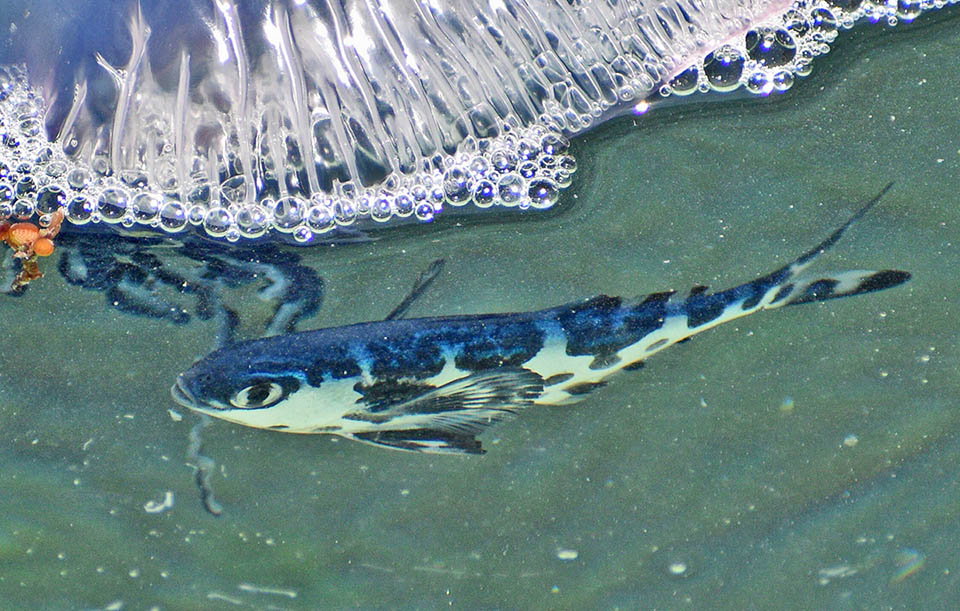
But there is a fish, Nomeus gronovii, that finds shelter among the tentacles although not totally safe from the effects of the stings © Miguel A Mejias, PhD.
However, it does not provide an absolute protection against the beachings, that depend also on the currents, the direction of the wind and on the conformation of the coastline.
Under the pneumatophore stands the colonial part, formed by different types of zooids, specialized structures that cover complementary functions. The dactylozooids are associated to the seizing of the prey and to the tentacles; the gastrozooids care for digestion; the reproductive zooids are organized in structures called gonodrendons. Each component contributes to the functioning of the whole colony, but is not able to live independently like a complete animal. The tentacles are equipped with cnidocytes, cells characteristic of the cnidarians that contain capsules called nematocysts. When stimulated, these capsules discharge rapidly a filament, often equipped with penetrating structures, that allows it to inject stinging substances into the prey. The mechanism acts in very short times and can immobilize small animals: in the man it causes intense pain and may cause more extensive reactions.
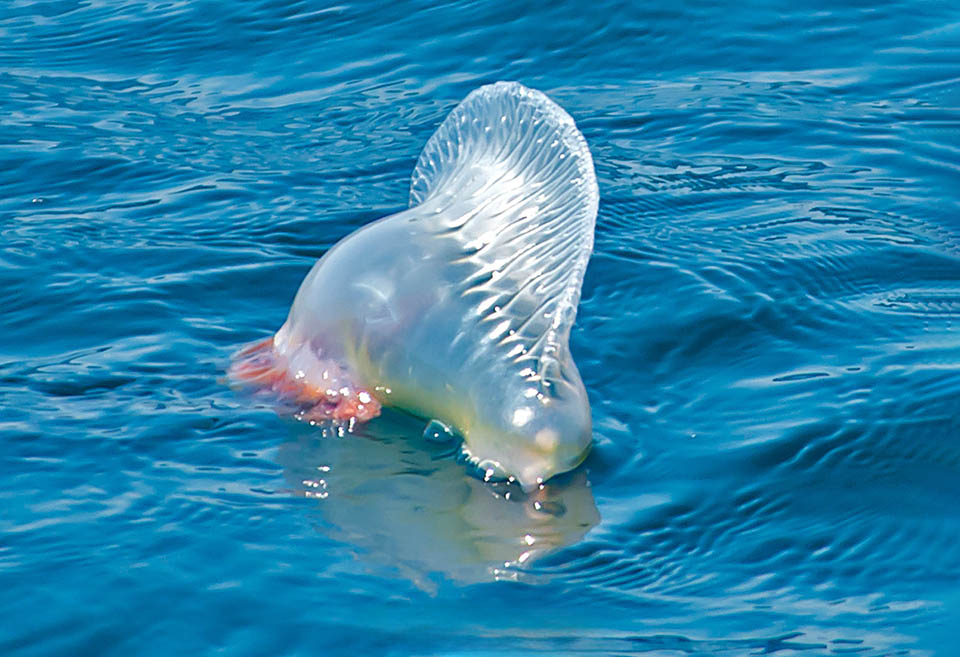
Physalia physalis cannot contrast the wind force, but exist specular sails, right and left-handed, that reduce the risk of beaching with different trajectories © Steve King
Moreover, the colony can partly modify its own shape. The crest can vary its configuration and the tentacles can stretch or contract, influencing to a limited extent the behaviour while drifting. These movements however are not equivalent to an active control of the navigation: the Caravela remains highly dependent on environmental conditions.
Ethology-Reproductive Biology
The Caravela portuguesa does not actively chase the prey: it lets itself be carried by the wind while the tentacles intercept the organisms coming into contact with them. The nematocysts can immobilize or harm the prey, which is then transferred to the zooids responsible for the digestion. The diet includes especially small fish and larce of fish, besides other planktonic organisms. The seizing depends to a large extent on the casual meeting between tentacles and prey, but their extension allows them to explore a considerable volume of water. The system is effective even without pursuits: it’s the colony to be carried across the environment where it feeds on.
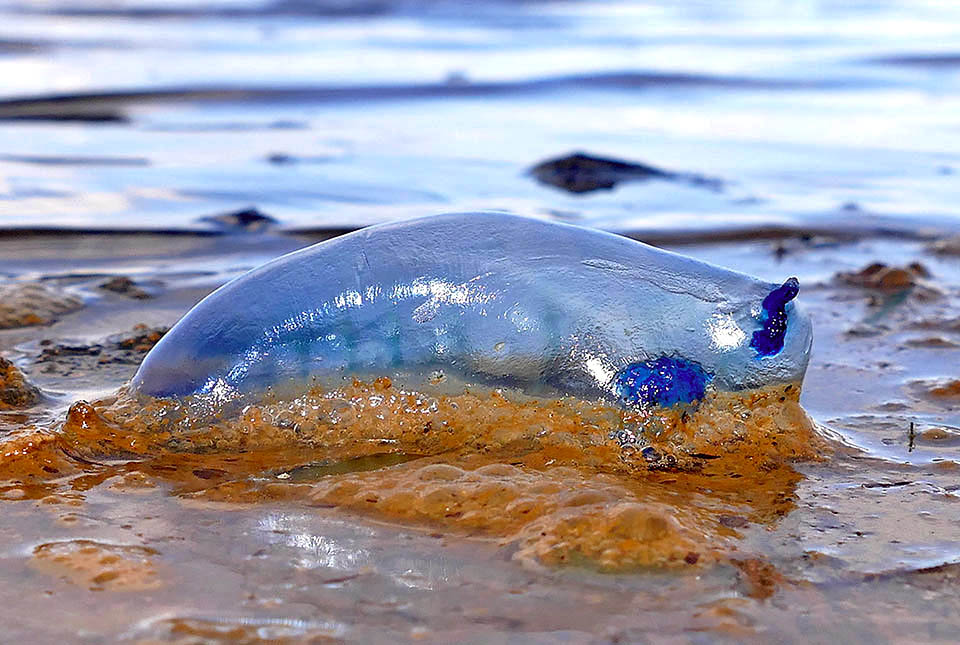
The specimens beached usually die of dehydration but their poisonous tentacles keep active long time and it is dangerous to touch them © Benoît Henry
The relationship with other organisms can be surprising. The fish Nomeus gronovii, for instance, is known for frequenting Caravela and moving among its tentacles, though not being completely protected from the effects of stings. Also some pelagic mollusks, like the nudibranch Glaucus atlanticus, can prey upon floating cnidarians and incorporate their nematocysts in defensive structures. These relations show how the Caravela is not just a predator, but also a resource and an important element of the oceanic food webs.
Reproduction occurs via gonodendrona, structures that have specialized reproductive zooids. The colonies are usually male or female and free the gametes in the water, where the fecundation can take place. The development leads to the formation of a new colony that progressively differentiates the various specialized structures and the float. The details of the reproductive cycle in the open sea are less known compared to other aspects of its biology.
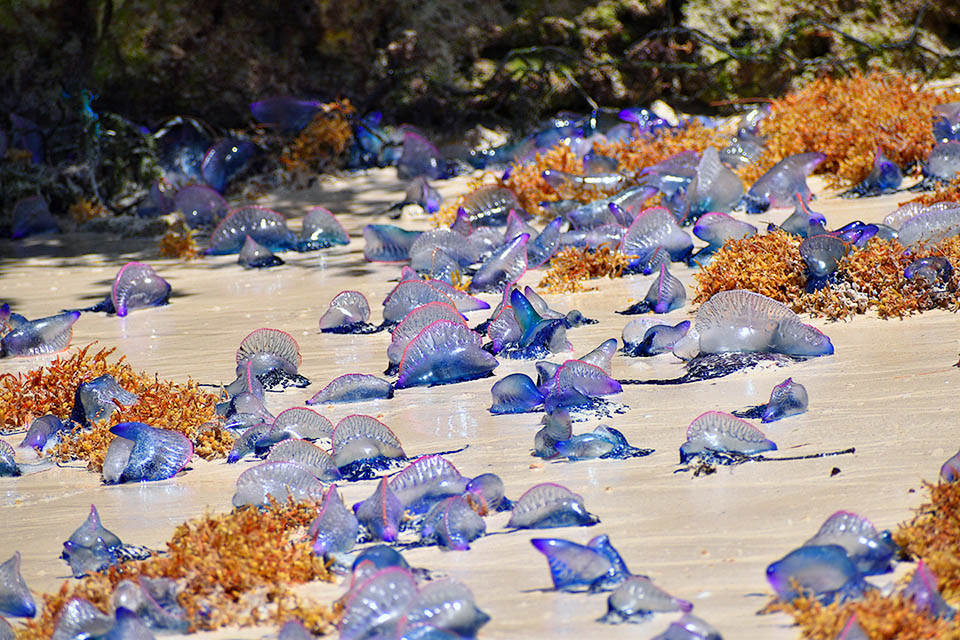
Wind and currents may push to the coast several colonies, causing massive beachings along ample stretches of coastline © Miguel A Mejias, PhD
The colonies that are close or that end beached together are not necessarily engaged in reproduction. Their concentration may be explained by the transport effected by wind and currents. In the same way, the presence of individuals of different size on the same beach does not prove on its own that it is matter of different development stages; the shape of the float and of the tentacles can be influenced also by damages, contractions and conditions following the beaching.
Synonyms
In the taxonomic literature preceding the 2025 revision, Physalia physalis has been associated with various denominations considered as synonyms, among which Physalia australis Péron, 1807, Physalia gigantea Bory de Saint-Vincent, 1804 and Physalia pelagica Lamarck, 1801. These names reflect the traditional classification of the genus. In the light of the recent taxonomic revision, the historical attributions must be, however, interpreted with caution and not considered automatically valid for the species discussed here.
→ To appreciate the biodiversity of the CNIDARIANS please click here.