
Family : Cyaneidae

Text © Dr. Giuseppe Mazza

English translation by Mario Beltramini
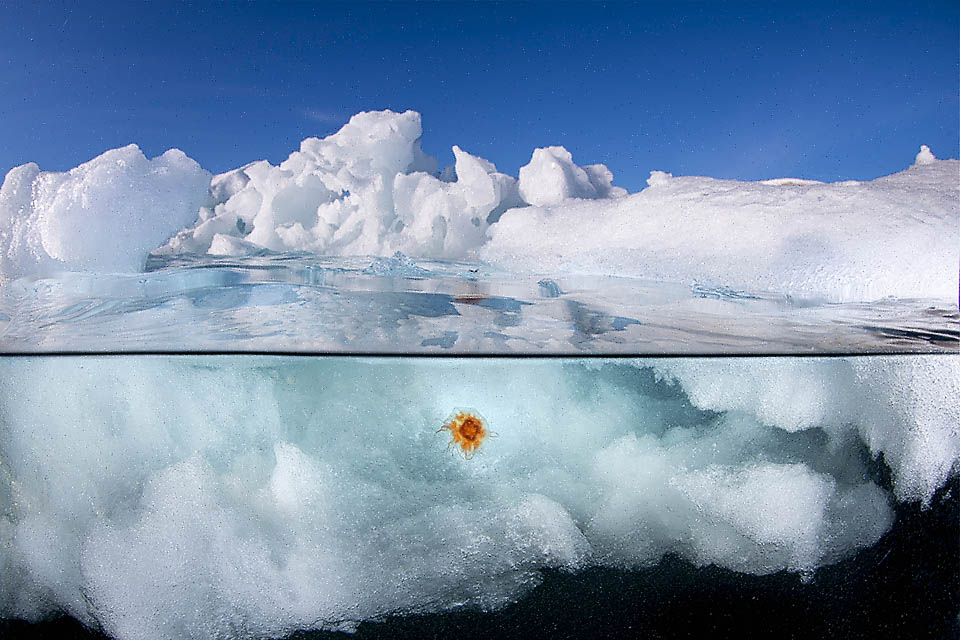
Cyanea capillata is widespread mainly in cool and temperate waters of northern hemisphere of the Atlantic and Pacific oceans © Pat Webster @underwaterpat
A jellyfish goes swimming in the dark waters beneath an expanse of ice. The landscape, the temperature and the environmental conditions seem to make any form of life difficult. And yet, even here, the sea hosts an extraordinary variety of organisms.
Within these, stands the Cyanea capillata (Linnaeus, 158), one of the most spectacular jellyfish in the northern hemisphere.
Its common name, Lion’s mane jellyfish, comes from the mass of tentacles originating from the umbrella floating in the water like the mane of a large feline.
Also the scientific name evokes the appearance of the animal: Cyanea refers to the dark blue, whilst capillata, from the Latin “capillus” means endowed with hair.
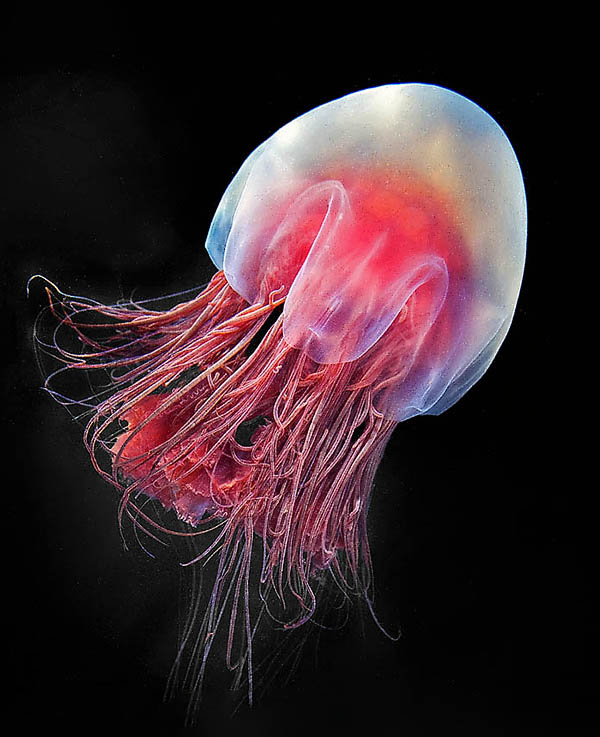
Drifts carried by currents, but the umbrella contractions allow small movements © Alexander Semenov
It belongs to the phylum Cnidaria, that also includes corals and sea anemones, to the class Scyphozoa, the group of the jellyfish in sensu stricto, and to the family of the Cyaneidae.
Its body is largely made up of water and gelatinous tissues, but behind this apparent simplicity hides an efficient organism, able to swim, seize prey and complete a complex cyclelife.
However, its beauty must not deceive: its tentacles are equipped with stinging cells capable of causing painful stings, and may preserve this capability even after the death of the jellyfish. Therefore, it is a creature to observe with admiration, always maintaining a safe distance.
Zoogeography
Cyanea capillata is widespread mainly in the cold and temperate waters of the boreal hemisphere. Its range includes the Arctic and subarctic regions, northern Atlantic and northern Pacific, with numerous presences along the coasts of Canada, northern USA and North Europe.
The species may appear even at more southerly latitudes, carried by the currents that connect the different marine areas.
The distribution of the specimens observed along the coasts in fact depends, in fact, not only on the environment conditions, but also on the circulation of water and on the meteorological conditions.
Ecology-Habitat
Cyanea capillata leads a pelagic life, spending most of its time suspended in the water column. It may be found close to the surface or at greater depths, depending on the local conditions and on the movements of water masses.
Its body is adapted to live in an environment where the movement of the currents is of fundamental importance. The pulsations of the umbrella allow it to swim, but do not allow it to completely control the direction of the movements: winds, currents and tides may carry it for long distances.
It is a carnivorous predator feeding on small crustaceans, planktonic organisms, fish and other jellyfish. Within its prey is often present the Moon jellyfish, Aurelia aurita (Linnaeus, 1758), another species common in many temperate and northern waters.
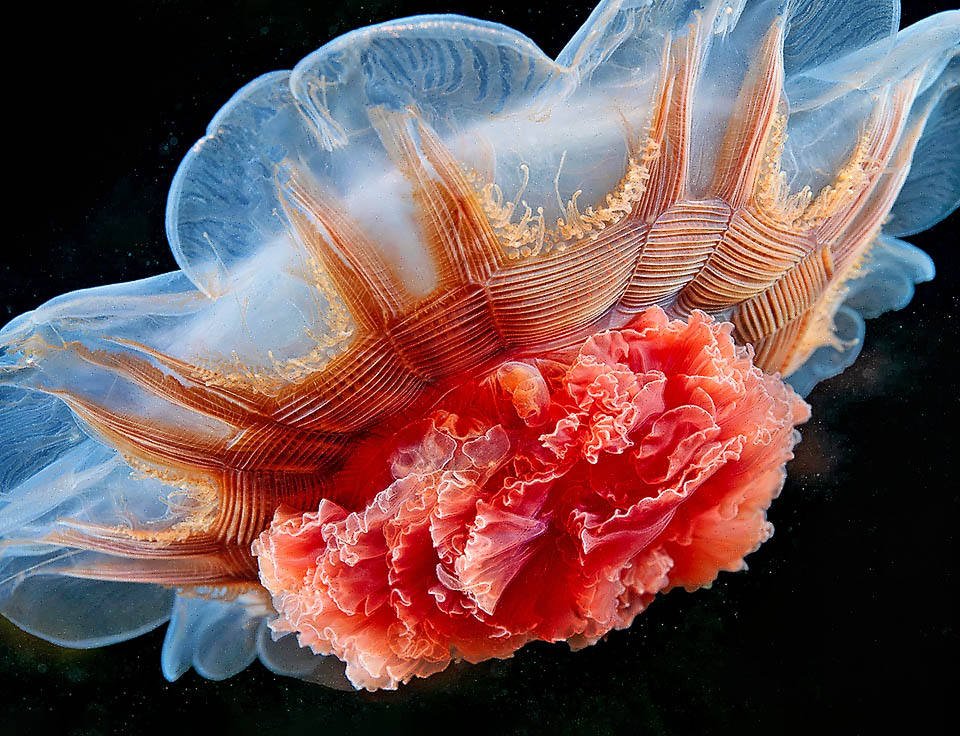
Here on the lower surface, the muscle bundles pushing rhythmically water backward, allowing the jellyfish to advance © Alexander Semenov
The catch may be spectacular. The long tentacles intercept the prey and the stinging cells help to immobilize it. Then the oral tentacles are involved in the transfer of the food to the mouth. When a preyed-upon jellyfish is already enveloped by the animal’s structures, the scene may show an advanced phase of the seizing and of the ingestion.
But the presence of the jellyfish may create an opportunity also for other animals. Some small fishes swim among the tentacles, finding there a relative shelter from the predators. It is a fascinating ecological association: structures dangerous for many organisms can become, for some small fishes, a useful protection.
For example, Atherina boyeri, Risso, 1810, keeps in the upper part of the jellyfish, in order to leverage the deterrent effect of the tentacles.
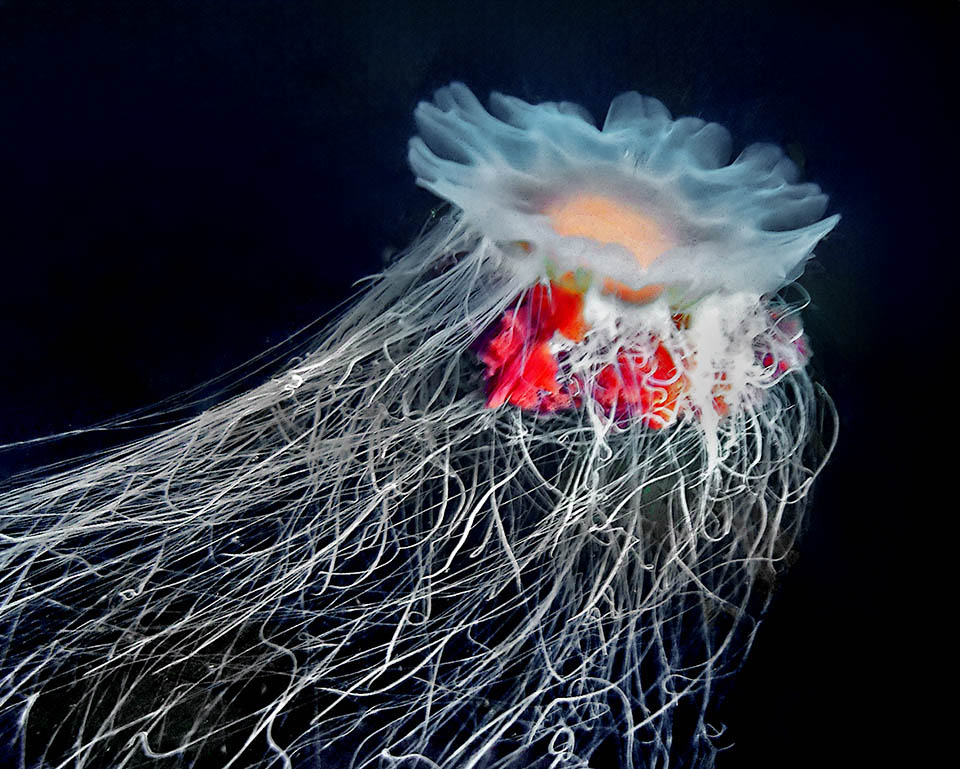
Cyanea capillata is commonly known as Lion’s mane jellyfish, due to the thick stinging tentacles that may attain 20-30 m in length © sam_aeostomeae
It is not necessary to imagine a permanent or mandatory relationship: it is sufficient to observe how the presence of a big invertebrate may modify the possibilities of survival of other inhabitants of the sea.
However, also the Lion’s mane jellyfish may become a prey of other animals.
One of its best documented predators is the Lute turtle (Dermochelys coriacea Blainville, 1816), a big marine turtle that feeds mainly on gelatinous organisms. A study carried on in New Scotland waters, in the Canadian Atlantic, has utilized tele cameras carried by the turtles for documenting directly the capturings of the preys: the images have shown that Cyanea capillata was a dominant component of the organisms consumed by the observed specimens. Therefore it is a matter of a dietary relationship verified in the field, not a just simple assumption.
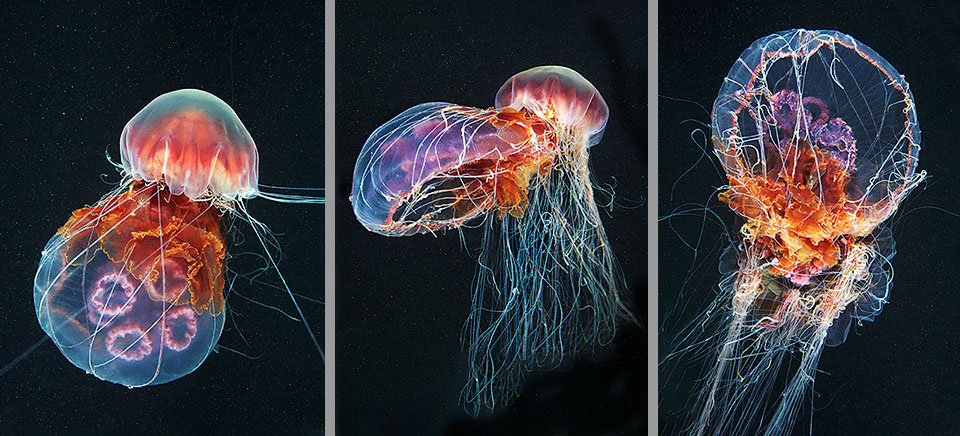
Here has seized Aurelia aurita, another jellyfish that carried by the oral branches ends on the right side of stomach © Alexander Semenov
An even more unusual episode is documented by a photo done by the marine and photographer biologist Alexander Semenov, where the sea anemone Metridium senile (Linnaeus, 1761) is feeding on a Lion’s mane jellyfish.
The anemone is a benthic cnidarian, usually stuck to the substratum, whilst Cyanea capillata lives free in the water column. The contact may allow the anemone to seize food-grade material by means of its own tentacles and transfer it to the mouth. The photo witnesses an instance of predation particularly interesting, but does not allow on its own to establish the frequency of this behaviour in nature.
The vulnerability of the species does not concern the adult specimens only. Also the first phases of the vital cycle may be exposed to predation.
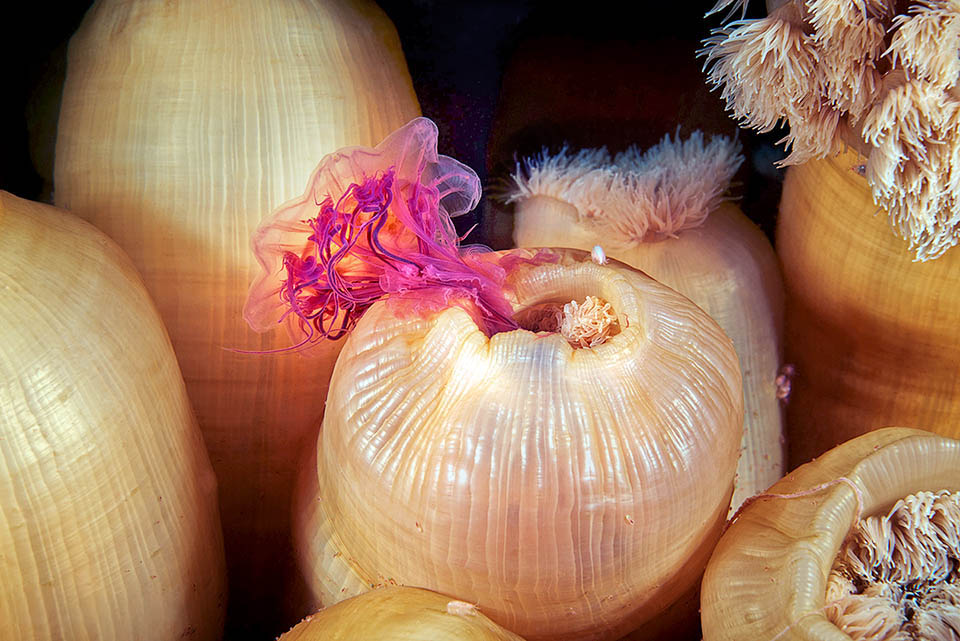
In turn, youth aside, Cyanea capillata is often preyed upon by large turtles like Dermochelys coriacea and sea anemones like this Metridium senile © Alexander Semenov
An experimental study published in 2015 has proved that the planula larvae of Cyanea capillata may be consumed by the mussel Mytilus edulis (Linnaeus, 1758) and by the ascidian Ciona intestinalis (Linnaeus, 1767). In the experiments, also the ctenophore Mnemiopsis leidyi (A. Agassia, 1865) has ingested planulae when these were offered as the only prey. The authors have suggested that the consumption of the larvae by suspensivorous organisms can contribute to influence the abundance of the populations of jellyfish. It is important to clarify that these results concern planuale and do not demonstrate that the same animals predate also the big adult jellyfish.
These examples show how Cyanea capillata participates in a complex food net: it is able to seize other jellyfish, may form a food resource for the large marine vertebrates and, during the first phases of the development, can be consumed also by much smaller organisms. Its ecological function therefore does not limit to the rôle of predator, but includes several relations that change during the vital cycle.
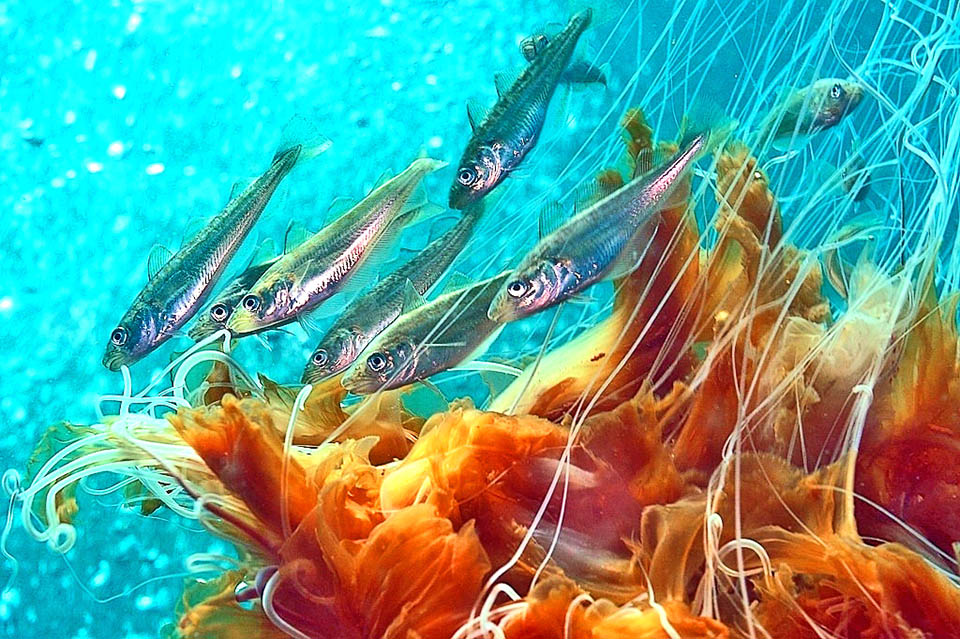
Paradoxically some small fish like Atherina boyeri profit from the stinging deterrent of the jellyfish © Tony Gilbert
Under certain conditions, currents, winds and tides numerous specimens may concentrate along the coast. Some are pushed towards shallow waters or directly on the water’s edge, where they can die. The mass beachings can thus cover large stretches of sand.
These events are natural phenomena, the extent of which depends on the local circumstances and on the marine and weather conditions. A beach covered by jellyfish does not necessarily indicate an ecological disaster, but shows the effect that the dynamics of the sea can exert an influence on the distribution of the organisms.
Even if they are dead, these jellyfish may maintain their stinging capacity. It is therefore wise to observe them without touching them.
Morphophysiology
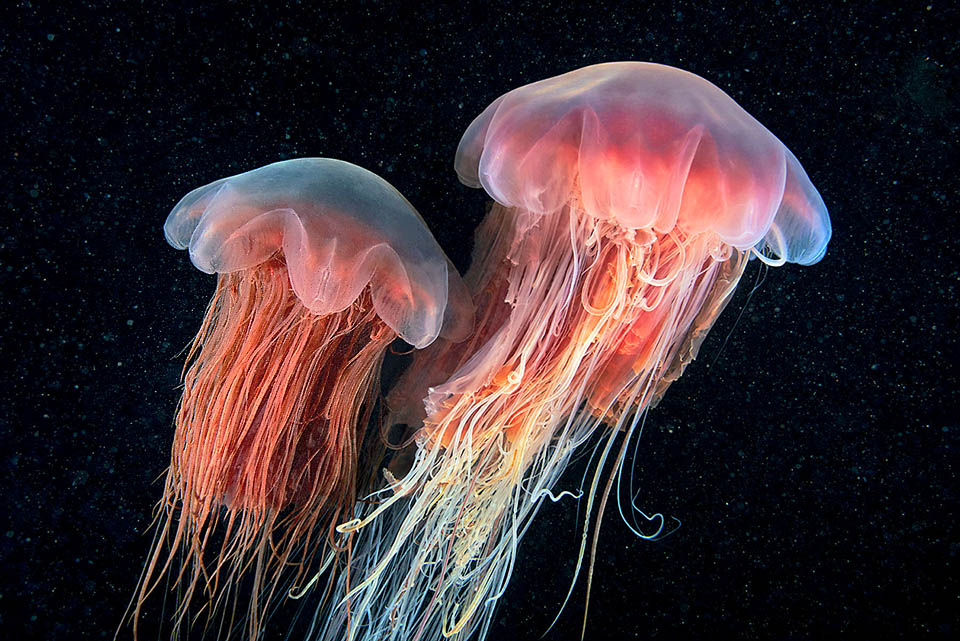
Cyanea capillata life includes a swimming adult phase and a juvenile one stuck to the substratum. The reproductive cycle alternates sexual and asexual reproduction © Alexander Semenov
The body of Cyanea capillata is dominated by an ample umbrella shaped like a disc or an overturned plate, with a central region, thicker, and a thin margin. The colouration varies a great deal from one specimen to another and may range from yellow-orange to red-brown, from pink to purplish.
The dimensions can be considerable. Common are umbrellas with a diameter of tens of centimetres, but the exceptional specimens can attain about two metres. The margin of the umbrella presents a regular subdivision in lobes, from which start numerous thin and extendable tentacles.
These tentacles are organized in eight groups and, in the large specimens, can reach exceptional lengths exceeding twenty metres and thirty in some cases. Their disposition creates a vast tridimensional net, able to intercept the organisms that come into contact with them.
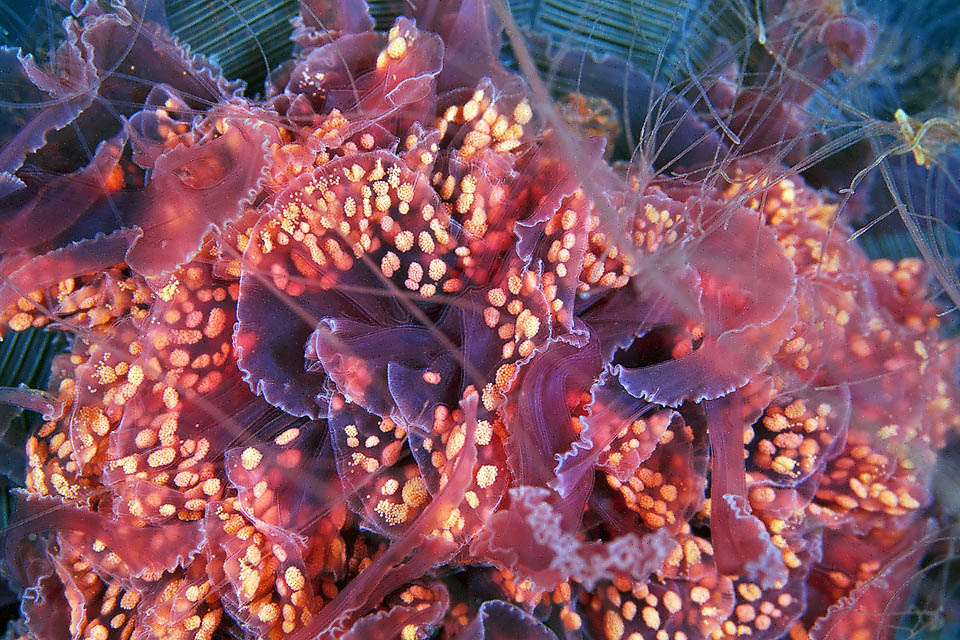
Gonads details. Males free the spermatozoa in the water, whilst fecundation occurs in the female’s genital tract © Alexander Semenov
The movement of the jellyfish is entrusted to the rhythmic contractions of the umbrella. On the lower surface are present muscle bundles that, contracting and relaxing, modify the shape of the body and push the water backward. This movement generates the propulsion that allows the jellyfish to move forward.
The jellyfish seen from below allows us to observe the inner structure of the umbrella and the appendages that hang down from its lower surface. Conversely, in the side view the profile of the margin renders more evident the subdivision in lobes. These are not true independent fins: it’s the musculature of the bell producing the pulsating movement characteristic of the jellyfish.
Tentacles are one of the most impressive elements of the species. They are thin, flexible and mobile, and their extension increases enormously the surface suitable for intercepting the prey.
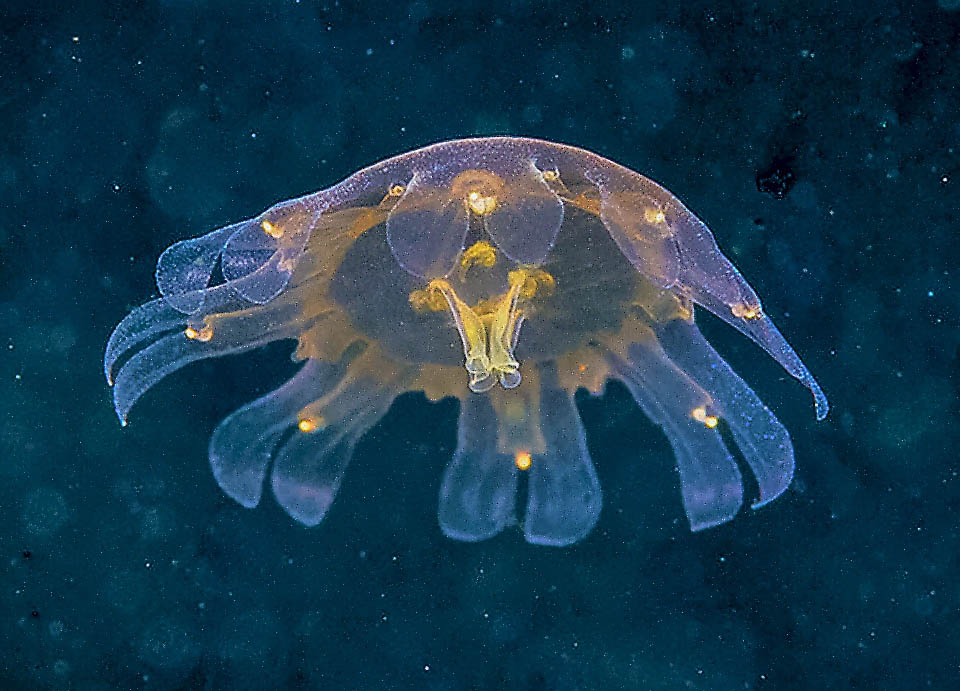
Fecundated eggs develop in the female up to the planula larva stage. Then, after a short swimming life, they fix on the substratum transforming in small polyps that may reproduce asexually by strobilation. They divide into small discs that, upon detaching from the polyp, develop into tiny free-swimming jellyfish like these, called ephyrae © Alexander Semenov
Under the umbrella we find also four distinct rows, wider and folded over, that participate in the collection of the food and to its transfer toward the mouth.
The capture system is entrusted to the cnidocytes, specialized cells containing stinging structures called nematocysts. At the contact, these may download quickly a filament capable of adhering to the prey and introduce toxic substances. The mechanism allows the jellyfish to immobilize small organisms and to facilitate their transfer to the mouth.
For the human being, the contact with the tentacles may cause strong pain, skin irritation and lesions; in some instances more important symptoms may appear. Also the fragments of the animal deserve caution.
Ethology-Reproductive Biology
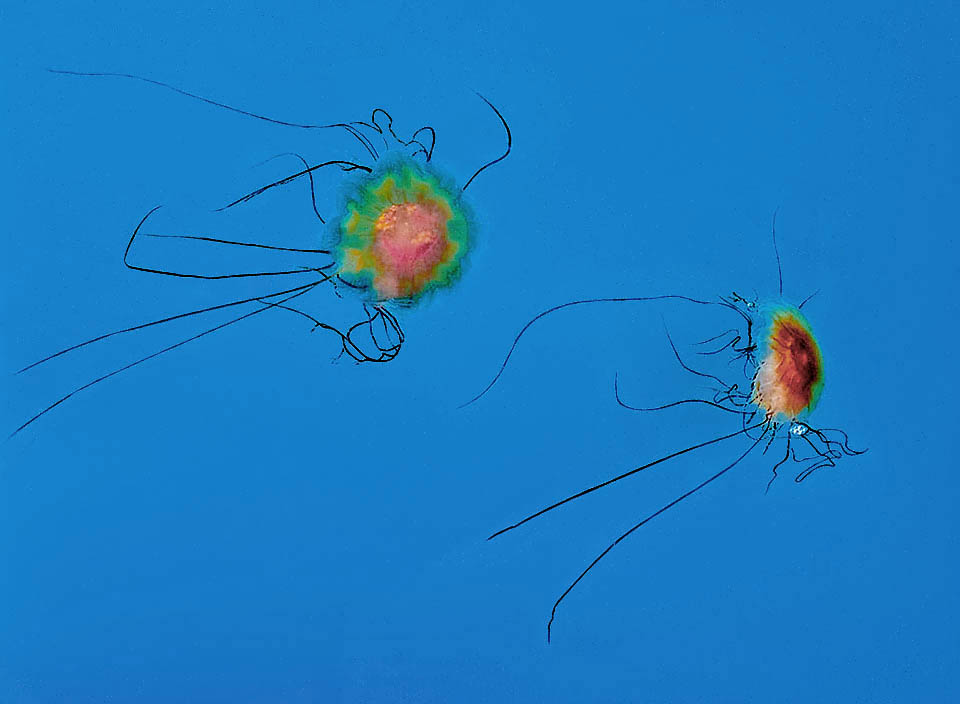
Here two young growing jellyfish, characterized by a still small umbrella and by relatively long, compared to the body, tentacles © Charlotte Kirchne
The life of Cyanea capillata includes a swimming adult stage and a juvenile one stuck to the substratum, connected by a reproductive cycle that alternates between. sexual and asexual reproduction. The individuals are of separate sexes. During the reproductive phase, the males release the sperm into the water, whilst the fecundation occurs in the female genital tract.
The fecundated eggs are held temporarily and develop up to the stage of planula larvae, that is housed within the folds of the oral branches before being released. The gonads are four reproductive structures located in the region under the umbrella, close to the oral branches. Through the translucent tissues, they may appear like curved or lobed formations, of pinkish or reddish colour.
After the release, the planulae carry on a short free life in the water, and, when they meet a suitable substratum, they stick to it transforming in small polyps.
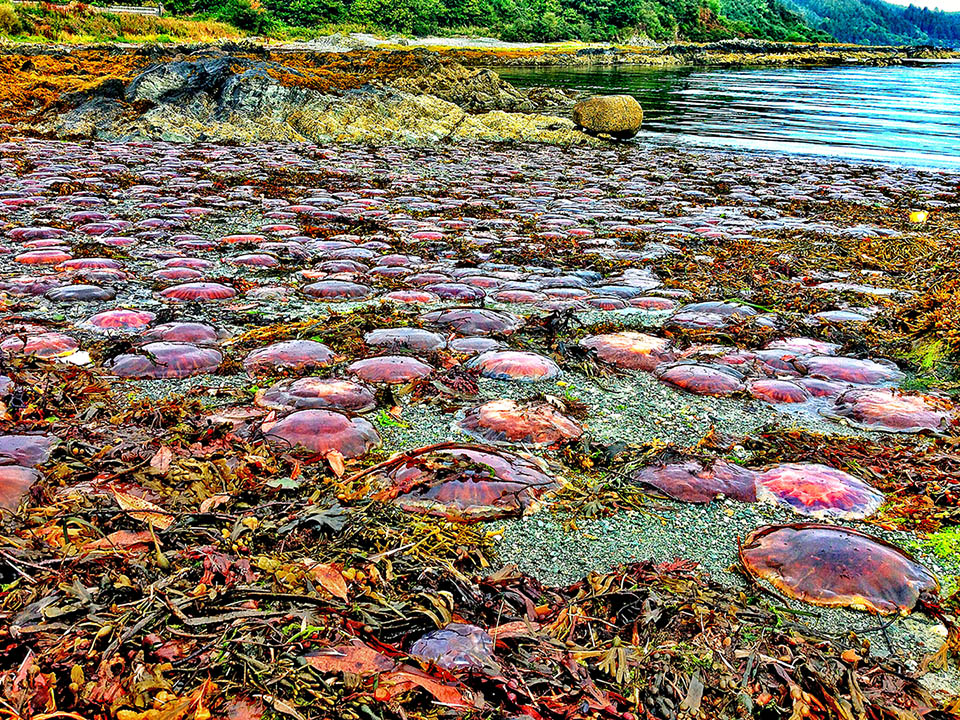
Currents, winds and tides may cause mass beachings. Even if dead, these jellyfish keep their stinging capacity and therefore are not to be touched © Elinor Scott-lester
These organisms, called scyphistomes, represent a phase completely different from the large floating jellyfish.
The polyp can sexually reproduce through a process called strobilation.
The body divides transversely into a succession of discs who then detach originating the ephyrae, young characteristically shaped jellyfish. The ephyrae grow in water, gradually developing the umbrella and the tentacles, until they reach the adult’s morphology. The vital cycle therefore includes quite different phases: from the microscopic planula to the fixed polyp, from the young jellyfish to the large swimming form.
Synonyms
Medusa capillata Linnaeus, 1758; Cyanea arctica Péron & Lesueur, 1810; Cyanea versicolor L. Agassiz, 1862.
→ To appreciate the biodiversity of the CNIDARIANS please click here.