
Family : Centropomidae

Text © Dr. Giuseppe Mazza

English translation by Mario Beltramini
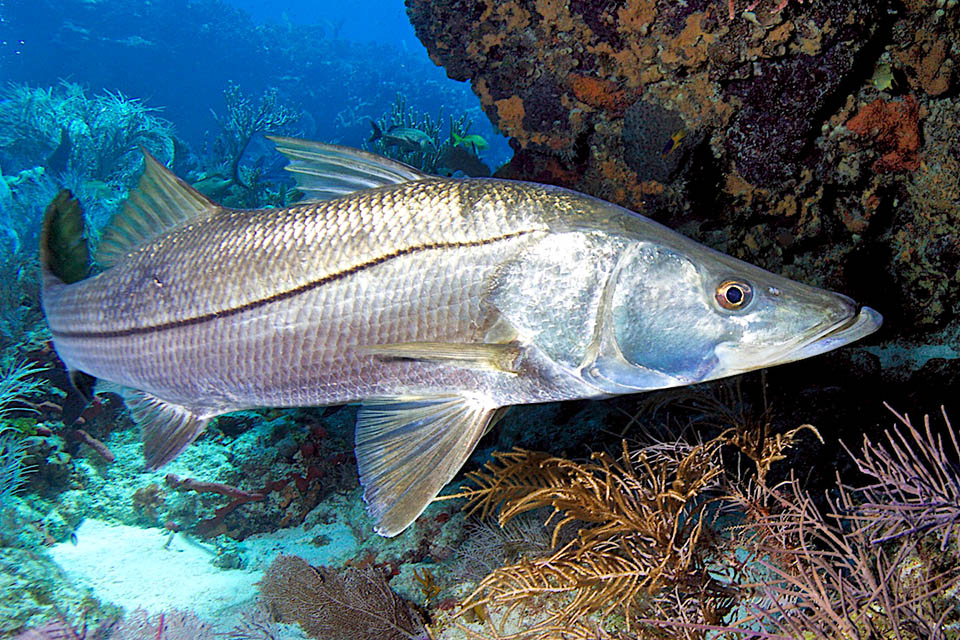
Centropomus undecimalis is a usually half metre long fish present from South Carolina to Rio de Janeiro © www.carlosestape.photoshelter.com
Known as Common snook or Robalo, Centropomus undecimalis (Bloch, 1792), is inserted in the class of the Actinopterygii, the ray-finned fish, in the order of the Perciformes and in the family of the
Centropomidae, that counts only one genus, Centropomus, and about one dozen of species.
The genus Centropomus, created by Lacépède in 1802 for Centropomus lupus, the Seabass called nowadays
Dicentrarchus labrax, originates composed from the Greek “kentron”, spine, and “pomus”, cover, with reference to the spines on the corner of the preoperculum, whilst the specific term undecimalis, assigned by Bloch, evokes the 11 rays of the dorsal fin.
Zoogeography
Centropomus undecimalis is present from South Carolina and Florida to the Gulf of Mexico, the Caribbean, central America and then the Brazilian coasts up to Rio de Janeiro.
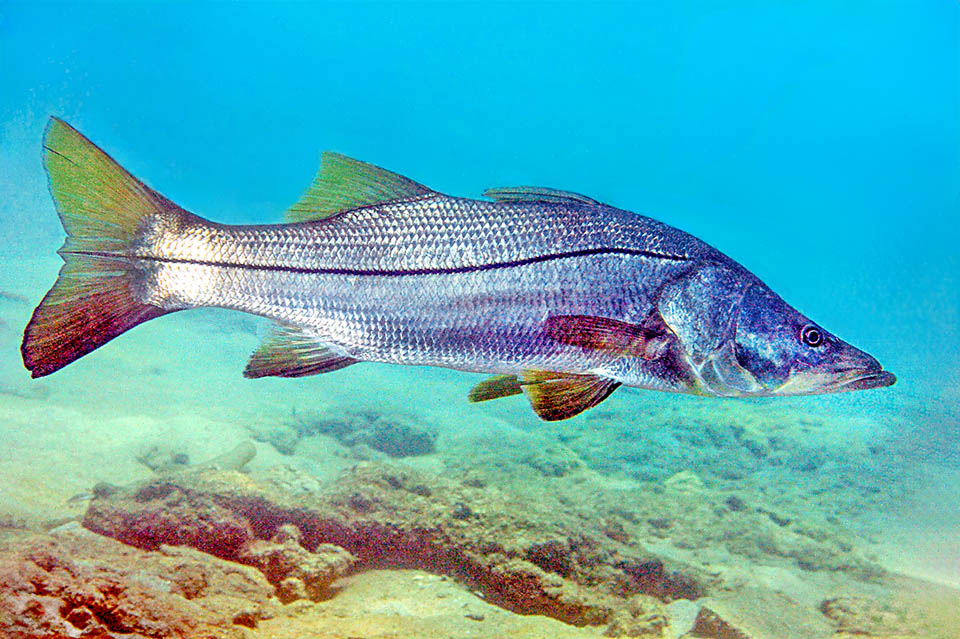
The head profile is slightly concave with protruding lower jaw. The showy black lateral line is present also on the caudal fin, the powerful motor of the fish © Kevin Bryant
Ecology-Habitat
Sensitive to cold, the Common snook may die after sudden drops in temperature. It is mostly found in shallow waters, up to 20 m deep, with temperatures standing from 23,5 to 28,1 °C.
It frequents lagoons, mangrove swamps and mouths of rivers, as it tolerates different salinities.
Morphophysiology
Although the average size is about half a metre, Centropomus undecimalis can reach 140 cm and 24,3 kg. The body is oblong and slender, silvery on the sides, covered with rough scales. The head has a slightly concave profile, the mouth is large and protractile with a standing out lower jaw. The teeth, small, are arranged in bands, and the margin of the preoperculum is serrated.
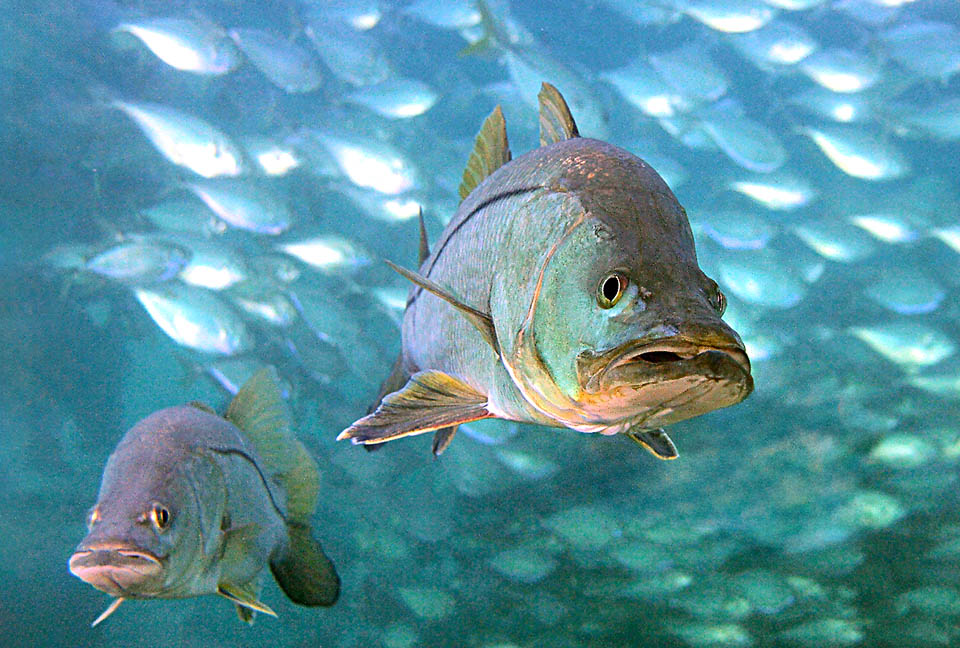
Centropomus undecimalis eats mainly fishes and small sized crustaceans like the shrimps © Kevin Bryant
The first dorsal fin is triangular; the second is longer than the anal. The pectoral fins count 14-16 rays, the pelvic 1 hard ray and 5 soft. The caudal, biforked, allows strong accelerations: the upper lobe is mainly yellowish, the lower one is dark. The black lateral line crosses the peduncle and the whole caudal fin.
Centropomus undecimalis is a protrandic hermaphroditic fish: that is, born male, becomes female as it grows up. This increases the reproductive success, as the males, though small, can however fecundate the eggs, whilst the big females are more prolific. So, starting from a certain size, but also for environmental and social factors, within a few weeks or months, the male gonads transform into ovaries. Conversely, the fishes called protogynous hermaphroditic, like Epinephelus itajara, Cetoscarus ocellatus or Lachnolaimus maximus, have females that, growing, become males as they have to defend a territory or a harem.
Ethology-Reproductive Biology
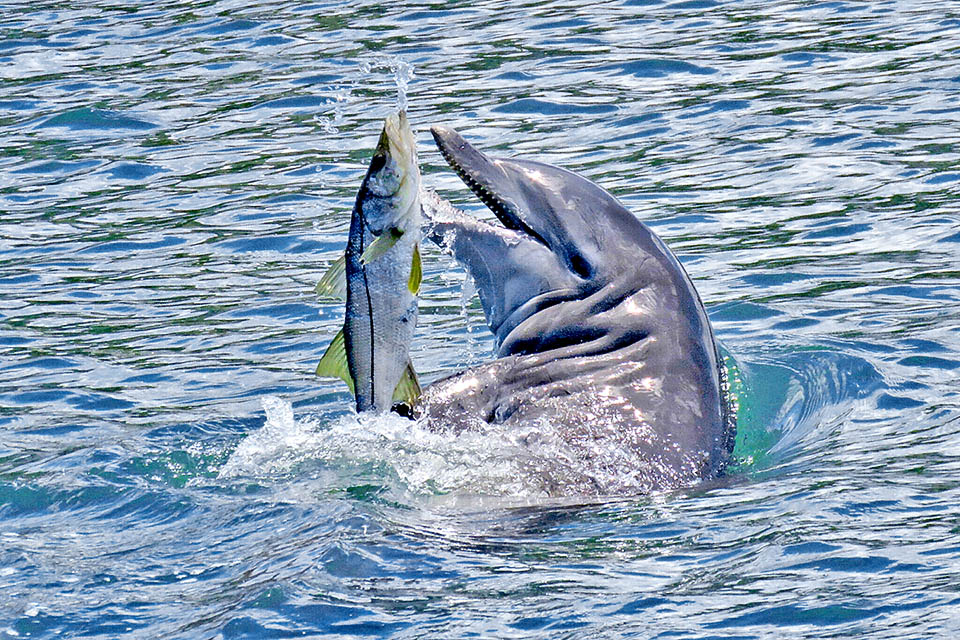
Is in turn preyed by the dolphins and big fishes like sharks and barracudas. The young must also watch out for the birds © Squidpastry
Sometimes cannibal, Centropomus undecimalis feeds mainly on small fishes and shrimps, hunting by ambush especially at dawn and at dusk.
For the reproduction the males show off twice a year in courtship arenas with sudden accelerations, jumps and lateral movements showing their vigour. The females do not remain indifferent and release close to the chosen thousands of floating eggs, quickly fecundated in the water column while they rise to the surface to be dispersed by the currents.
The juveniles grow in the mangrove swamps that offer shelter and food, then going up the rivers before returning to the sea for reproduction.
The resistance of the Common snook is average with a minimum time for doubling the populations of 1,4-4,4 years and the fishing vulnerability, moderately high, marks 46 watch out on a scale of 100.
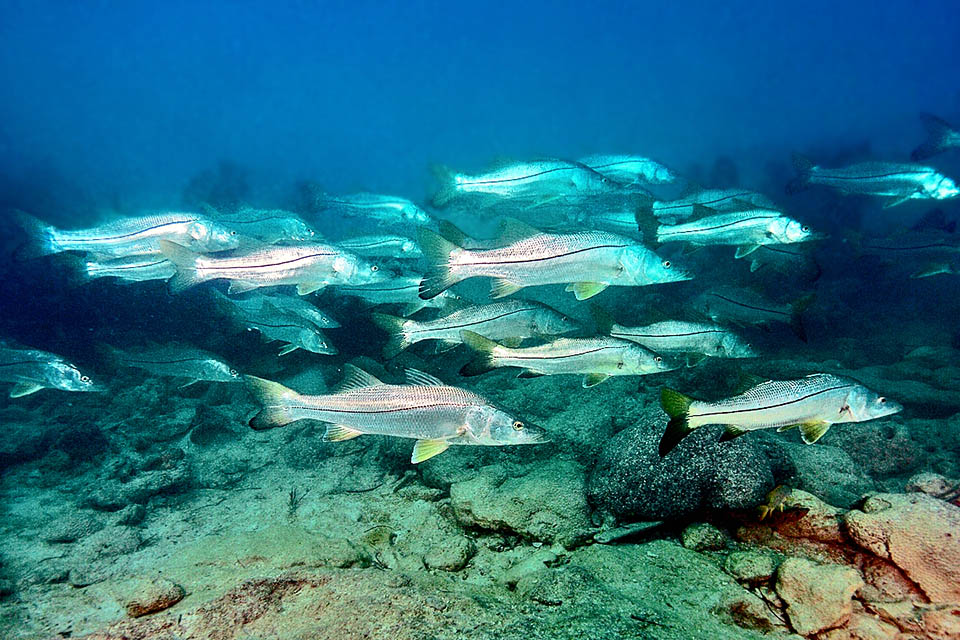
In the gatherings the males exhibit in courtship arenas with sudden accelerations that show their vigour. The females, bigger, lay close to the cosen thousands of floating eggs dispersed by currents. The jouveniles grow up in mangrove swamps that offer shelter and food, then going up the rivers before returning to sea for reproduction © www.carlosestape.photoshelter.com
It is highly appreciated by the sport fishermen due to its combativeness, and the flesh is high quality, but the skin is to be removed because, while cooking, produces a soapy flavour.
In nature the main predators of the adults are the dolphins and big fishes like sharks and barracuda, whilst the young also have to watch out for birds.
The trend of the populations is little known, and even if at the Florida Keys a decrease has been observed, there are no significant decreases Thanks to its vast distribution and to the protective measures, from 2019 Centropomus unidecimalis is classified as “LC, Least Concern” in the IUCN Red List of the endangered species.
Synonyms
Sciaena undecimalis Bloch, 1792; Centropomus argenteus Regan, 1904.
→ For general information about FISH please click here.
→ For general information about BONY FISH please click here
→ For general information about CARTILAGINOUS FISH please click here.
→ To appreciate the BIODIVERSITY of BONY FISH please click here.
→ To appreciate the BIODIVERSITY of CARTILAGINOUS FISH please click here.