
Family : Conidae

Text © Dr. Luca Tringali

English translation by Mario Beltramini
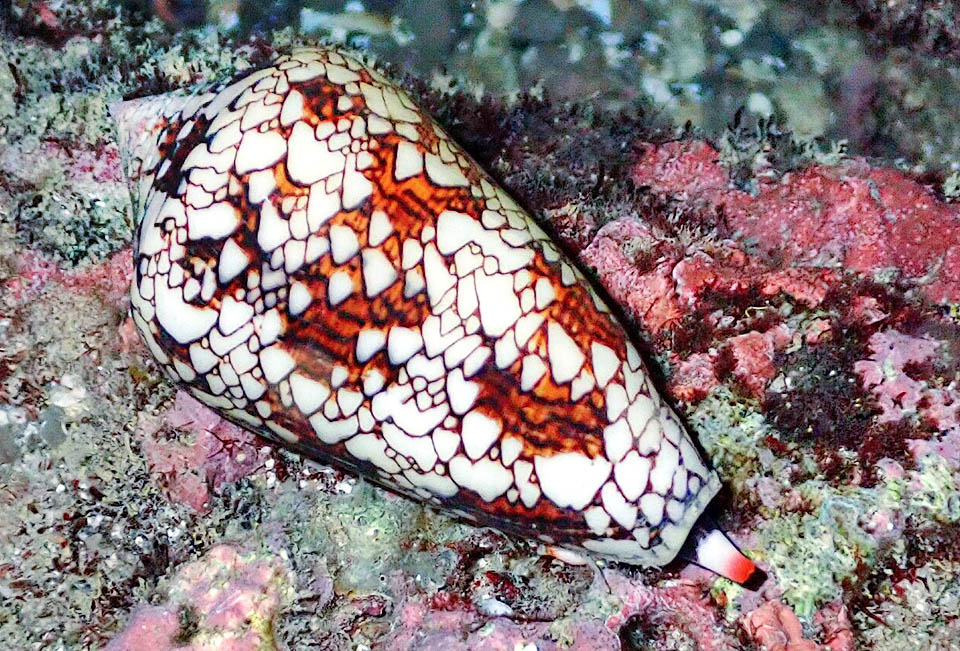
Frequent in Indian-Pacific coral formations, Conus textile is found from African coasts and Red Sea to the Fiji Islands, French Polynesia and Hawaii © Nicola Crockford
Conus textile Linnaeus, 1758, vulgarly known as Textile cone or Cloth of gold cone, is a mollusk gastropod whose etymology recalls the external look of the shell: the generic epithet, coming from the Latin “conus” cone, indicates its shape, whilst the specific name, always from Latin “textilis”, textile refers to the eye-catching triangle design.
It belongs to the family Conidae J. Fleming, 1822, a group of marine gastropods greatly diversified due to the presence of highly poisonous venoms and of the elegance of their shells.
In addition to the mitochondrial genetic analysis, at least two different types of identification keys have been proposed. The first is based on the morphology of the radular teeth, that have now been described in several species and that seem to be amply adapted to the strategy of the conids for poisoning their prey; the second is based on the presence or absence of some characteristics specific to the shell.
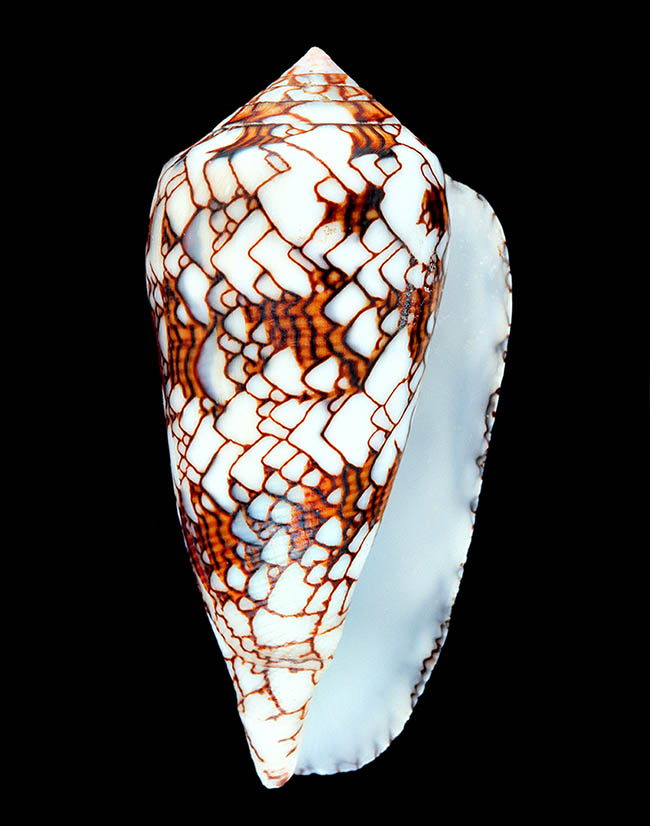
Due to the nice triangular drawing, the shell is sought after by collectors and a source of income for local fishermen © Giuseppe Mazza
This family counts more than 1000 species divided in 8 genera: Californicus J.K. Tucker & M. Tenorio, 2009 with the only species Californicus californicus (Reeve, 1844); Conasprella Thiele, 1929 with 180 species living in the bathyal zone between 200 and 2000 m of depth; Conus Linnaeus, 1758, the largest group, with 844 described species, including the emblematic Conus gloriamaris (Chemnitz, 1777 and the at times fatal Conus geographus Linnaeus, 1758; Kenyonia Brazier, 1896 but that, after some Authors, would be simply matter of an abnormal specimen belonging to the genus Conus; Lilliconus G. Raybaudi Massilia, 1994 with 8 species distributed along the southern coast of the Southern Arabian Peninsula and the coasts of eastern Africa and those of Madagascar; Profundiconus Kuroda, 1956 with 31 species of waters deep around 1000 m, diffused especially in the Indo-Pacific region and of rather large size, extremely thin and elongated shell, and big operculum with serrated outer edge; Pseudolilliconus J.K. Tucker & M. Tenorio, 2009 with 4 species of the coast of Southern Arabian Peninsula; Pygmaeconus Puillandre & M. Tenorio, 2017 with 7 small sized species of the sandy coasts of Philippines, Indonesia and eastern Australia.
Zoogeography
The first conids of the genus Conorbis, extinct today, appeared at the beginning of the Eocene, about 55 million years ago (Mya), when the ocean was uniformly warm with temperatures of the surface waters of about 22 °C in the low latitudes.
Subsequent diversifications occured at the end of the Late Eocene (35 Mya, with at least 40 known fossil species), and between the Upper Oligocene (29,3-35,4 Mya) and the Upper Miocene (5,2-10,4 Mya) with about 150 known fossil species, period to which also would date back Conus textile.
The Lower Pliocene (5,4-3,2 Mya) was characterized by a major extinction that reduced the number of species by 73%. Later on occurred a second radiation that gave origin to various hundreds of species dating back to before the Pleistocene, for which there is no fossil documentation. Presently the genus Conus is vastly distributed in all tropical and subtropical oceans of the Indo-Pacific province and in the central-southern Atlantic, but is more diversified in the western Indo-Pacific region.
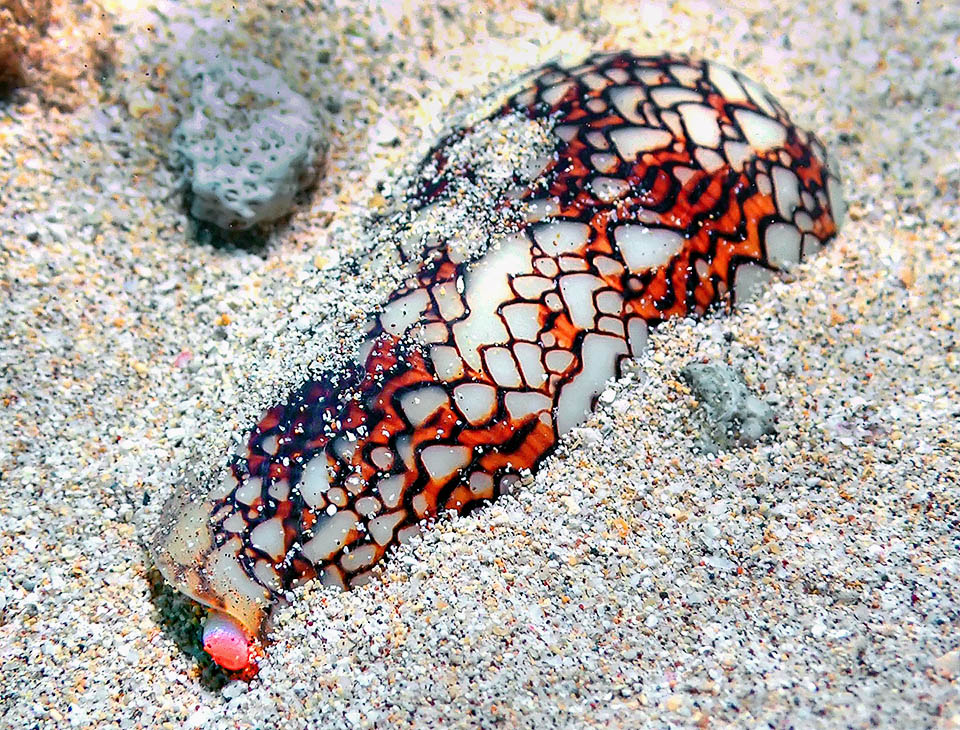
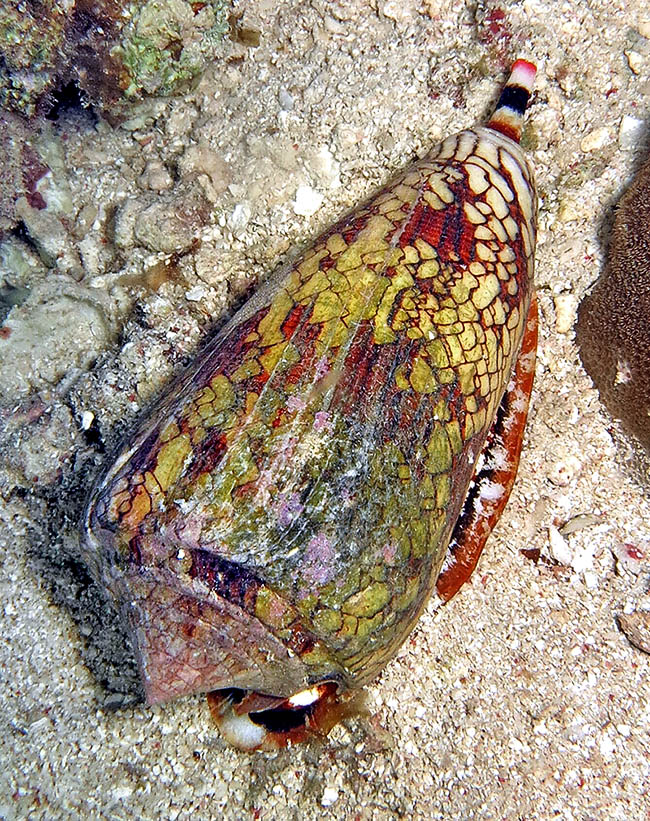
Of mainly night habits, Conus textile is often found during the day sunken into the sand sheltered from light © Sara Thiebaud
The few species present beyond the 40th North or South parallel are located in South Africa, southern Australia, southern Japan and Mediterranean Sea.
These gastropods are found mainly in the coral reef areas, usually in shallow waters, under corals and sunken in the sand or under piles of rocks and debris. Most Conid species have a high reproduction rate but have evolved to adapt to live in a very specific environment in relation to ecological factors and have a relatively short latent life even if some species have planktonic periods lasting about one month.
As a consequence no Conidae is cosmopolitan or circumtropical. Conus textile displays a very vast distribution, in both North-South and West-East directrices all over the Indo-Pacific region, from the Gulf of Aqaba to South Africa westwards, and from Japan up to New Zealand eastwards, through the central Indian Ocean, India, Indonesia, Philippines and Australia.
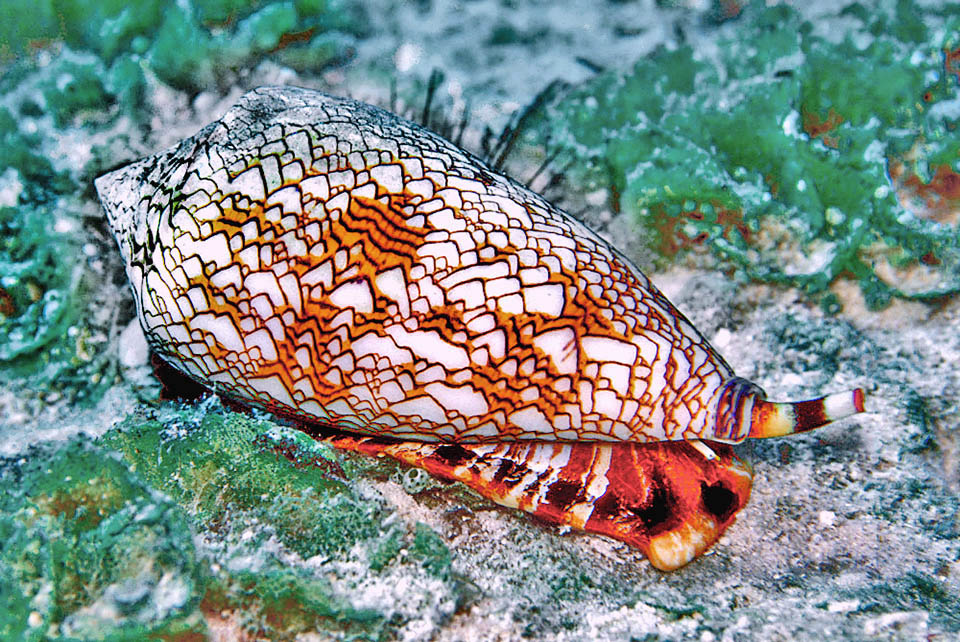
Present in shallow depths, it’s a benthic mollusk crawling on the substratum with a muscular foot mostly hidden by the shell © uwkwaj
Moreover, it is present in the Hawaii islands, in the Fijis and in French Polynesia.
Three subspecies of the Textile Cone have been described: Conus textile textile Linnaeus, 1758, the nominal subspecies with the amplest distribution; Conus textile neovicarius by Motta, 1982, typical of the Gulf of Aqaba and found on both African and Arabian coasts of the Red Sea; Conus textile vaulberti Lorenz, 2012, once known as Conus scriptus Sowerby II, 1858, of Saint Brandon Archipelago about 50 km north of Mauritius Island.
Ecology-Habitat
Conus textile frequents the rocky and coral reefs, where it is found under rocks and plates of coral or sunken into the sand, at depths varying from the tide level up to 50 m.
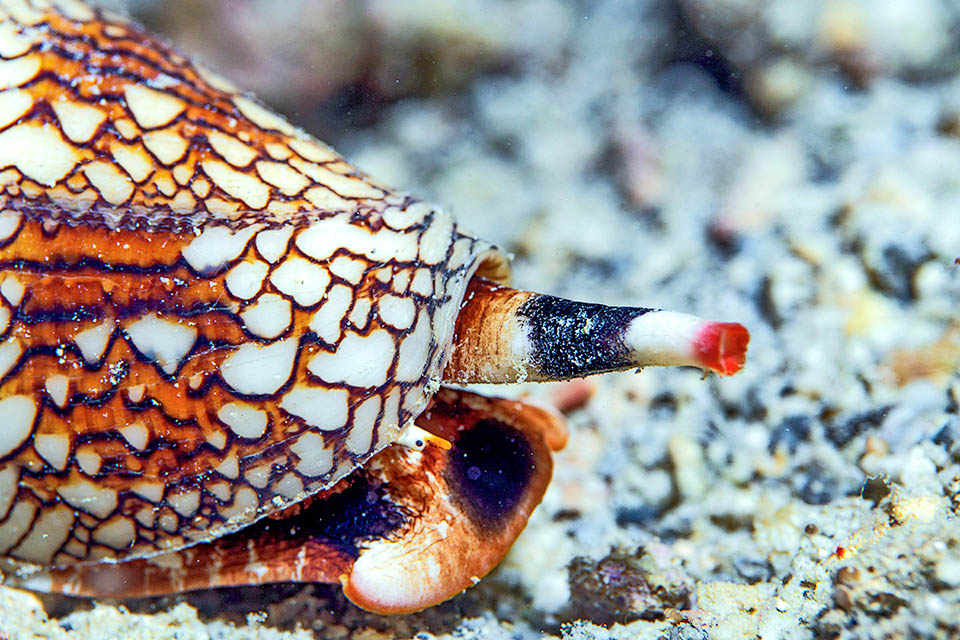
When moving from the fore part get out ocular peduncles and inhalant siphon that carries the water for breathing to a cavity of the mantle under shell © Damien Brouste
Usually solitary, during the night it leaves its shelter and goes around looking for prey. Like all conids this species is a highly specialized predator. Also if other gastropods, like for instance, Cumia reticulata (Blainville, 1829), utilize complex chemicals for hunting the prey, the poison utilized by the Textile Cone stands by far among the most studied. Even if most Conus are vermivorous (they essentially feed on Polychaete Annelids) or piscivorous, the prey of Conus textile are formed essentially by other mollusks (Strombidae, Nassaridae, Bursidae, but also bivalves and other Conidae).
Once identified the prey by means of a chemosensor organ, the osphradium, the Textile Cone crawls towards it, extends its proboscis and, upon contact with any soft part of the body, throws a sort of a hollow harpoon, repeatedly injecting a very powerful poison. Poisoning progresses very rapidly, usually followed by paralysis.
In the presence of a threat Conus textile exhibits a different behaviour.
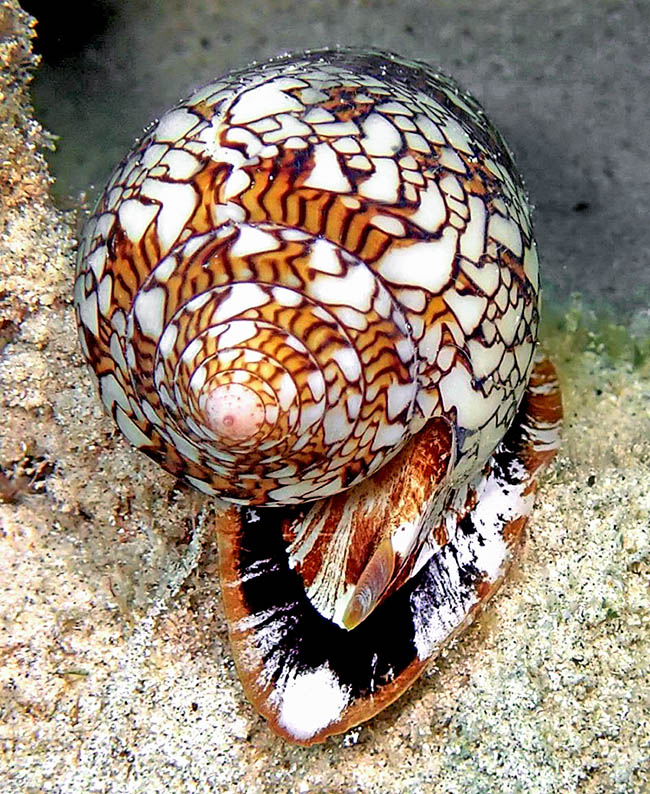
On the rear we note a small horny operculum nail-shaped, folded inward for the anchorage to the substratum © Shallow Reef
Firstly, the mollusk withdraws into its shell, which is a safe shelter from many predators. If the threat persists or intensifies, the cone, still safe in its niche, spreads the proboscis and moves it trying to sting the predator.
Stings of Conus textile to humans are the consequence of this defensive behaviour; most accidents occur when Conus textile is collected by a diver and pressed against the wetsuit, or when a collector tries to clean the shell of a still alive animal.
Morphophysiology
The shell of Conus textile may attain a maximum length of 15 cm, with average size of 8-9 cm, has a moderately high spire, base colour brown-orange with two darker central bands, all covered by wavy brown axial lines and white triangular dots; the inside of the opening is white. The periostracum, the external layer of the shell formed by conchilin (a cornificate protein), is fairly thin and transparent, and the chromatic motifs of the underlying drawing may be seen through it.
In its natural environment the only visible part of the body is usually its inhalant siphon, even if at times is also visible the sheath of the proboscis, placed immediately under the siphon and protruding from the front end of the animal. Conus textile crawls on the substratum utilizing the muscular foot that is mostly hidden by the shell. On the rear extremity of the animal stands a small horny operculum folded inwards shaped like a nail, utilized for anchoring to the substratum, as well as during the locomotion and also for stabilizing the animal when it is sunken into the sand.
Conus textile utilizes the poison as means of predation and as defense. This gastropod paralyzes the prey with specialized mouthparts able to inject the venom through highly modified radular teeth similar to hooked and serrated harpoons. These teeth are housed in a radular sac in the rear part of the pharynx.
Simplifying, the poisonous apparatus of Conus textile is formed by four organs: 1) the poison gland from which the poison is secreted; 2) the poison duct, a very thin 4-6 cm long yellowish tube; 3) the radular sac, where stand about 75 upto 10 mm long teeth and able to store the poison; 4) the pharynx-proboscis complex, whose extremity is first invaginated to collect a tooth and then rapidly expanded to inject it into the prey.
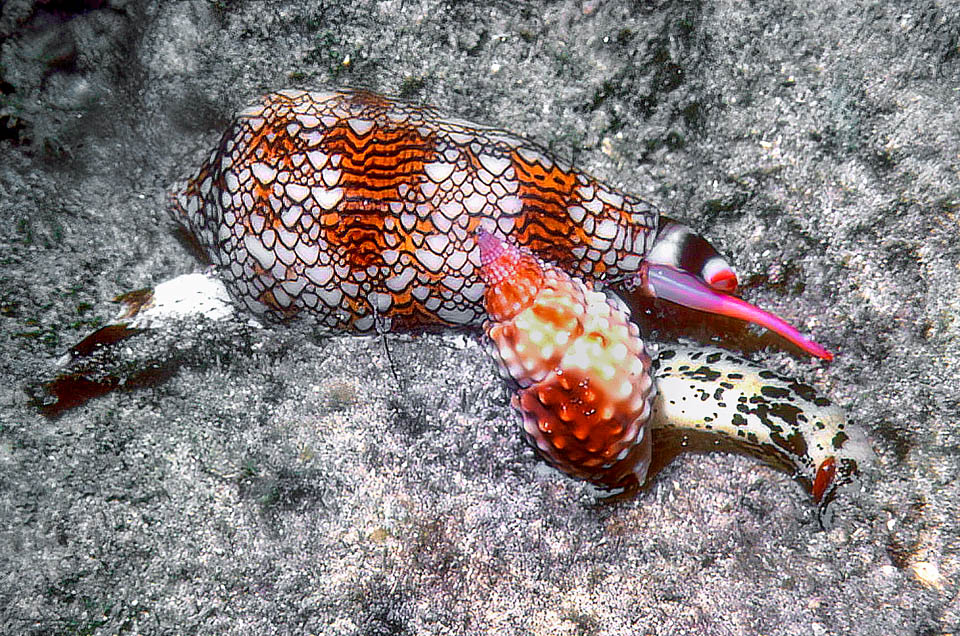
During predation, in this case on gastropod Nassarius papillosus, the proboscis is extroflexed, placed under the siphon, to inject a paralyzing poison © uwkwa
The predatory strategy of the Textile Cone stands in actively chasing the prey and striking it several times.
The single attack lasts averagely only a few milliseconds and the prey usually stands paralyzed in one second, but the cone may keep motionless on the prey even for many minutes, during which what’s going on is not clear.
The sting is followed by the injection of a copious amount of poison that at times produces a whitish cloud that gets out from the tip of the proboscis. The first injection slows down the prey, and are therefore necessary two, three or more injections with different peptides for paralyzing the prey completely.
The poison produced by Conus textile is formed by a complex mixture of more than 1000 neurotoxic peptides called conotoxins that are released into the soft tissues of the victim and act on its neuromuscular system.
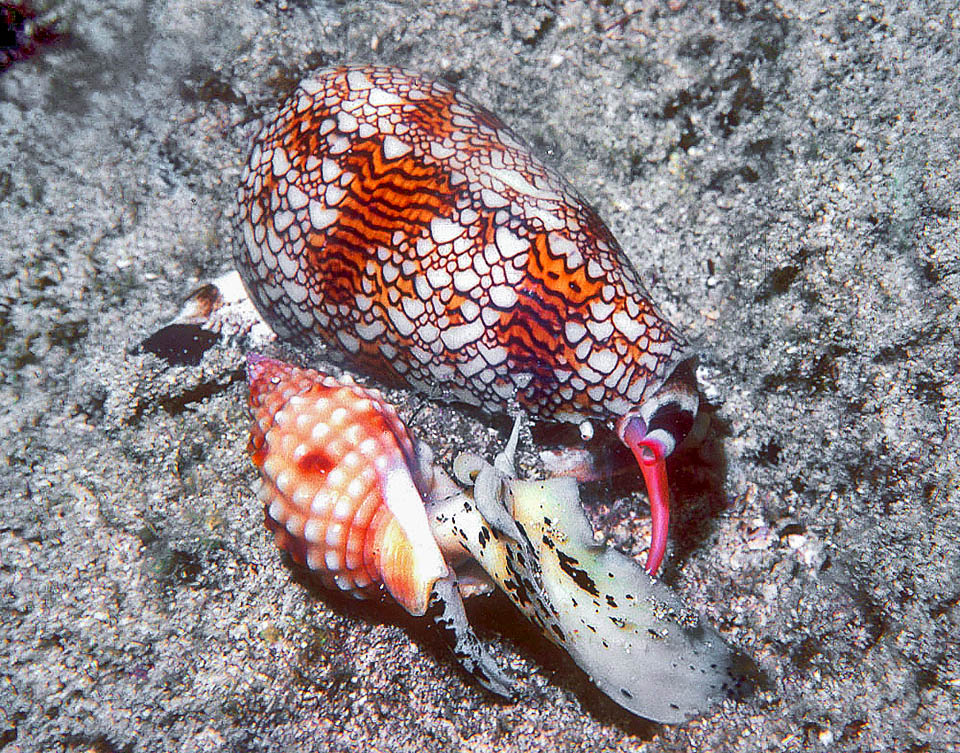
Here prey is now immobile and overturned with extroflexed foot while the Conus expands the mouthparts assimilating the soft parts © uwkwa
The toxicity of the poison is related to its strong ability to bind to DNA and to the high hemolytic activity on the erythrocytes. The conotoxins of the Textile Cone appear to have, moreover, a great potential as drugs. In fact, they have proven promising in treating chronic pain, epilepsy, the neurodegenerative disorders, in the treatment of cardiovascular diseases and in the therapy against cancer, thanks to their capacity of destroying the cell membranes of the tumor cells.
The toxicity of Conus textile is known already since the XVIII century, when the biologist and botanist Georg Eberhard Rumphius reported the death of a woman from the Moluccas Islands stung by this mollusk that, although not always lethal, can inflict very painful stings.
It is known that some fishes, crustaceans and mollusks of the genus Octopus are natural predators of Conus textile, but these are only anecdotal information. Finally, it is utilized as a source of food by the Polynesian populations as cooking inhibits the poison’s toxic potential.
In this Conus textile neovicarius is visible the opaque periostracum through which the triangle design shows up © Sylvain Le Bris
Ethology-Reproductive Biology
The reproductive biology of Conus textile has not been too studied, but it shares many of the characteristics common to the family.
It has separate sexes with internal fertilization, and the female, who owns a seminal receptacle, can be inseminated by various males.
Lays eggs once a year, stuck to the substratum in ovarian capsules, each containing a variable number of eggs.
Usually, the egg masses are composed of a maximum of 25 capsules and every capsule may contain up to 1.000 eggs; therefore, each mass may contain about 25.000 of them.
The capsules have the shape of a flat sac and are laid by the female under layers of coral or rock to protect them.
The first stage of the larval development occurs inside these capsules, and later develops, fort of all, the stage of veliger, the pelagic phase with larvae swimming freely, and then the stage of veliconcha, the benthic phase with the small young mollusks moving on the substratum.
These initial phases of development are critical and a huge number of individuals do not survive after the first days following the hatch.
The pelagic phase occurs between 1 and 50 days. The vital cycle does not include the trochophore stage. During the veliger stage, the larvae of Conus textile must feed on specific forms of phytoplankton before settling and metamorphosing in the benthic environment.
After metamorphosis, the small cones follow a diet that may be quite different from that of the adults or of the larvae.
In summary, the conditions considered essential for the reproductive success of Conus textile include running water, presence of a biological film for the metamorphosis and an adequate source of food.
In French Polynesia populations the lifespan of this gastropod is estimated to be around ten to twenty years.
Conus textile is classified “LC, Least Concern”, IUCN Red List of the endangered species of extinction due to its vast geographical distribution in the Indo-Pacific area and for the absence of significant threats for its survival.
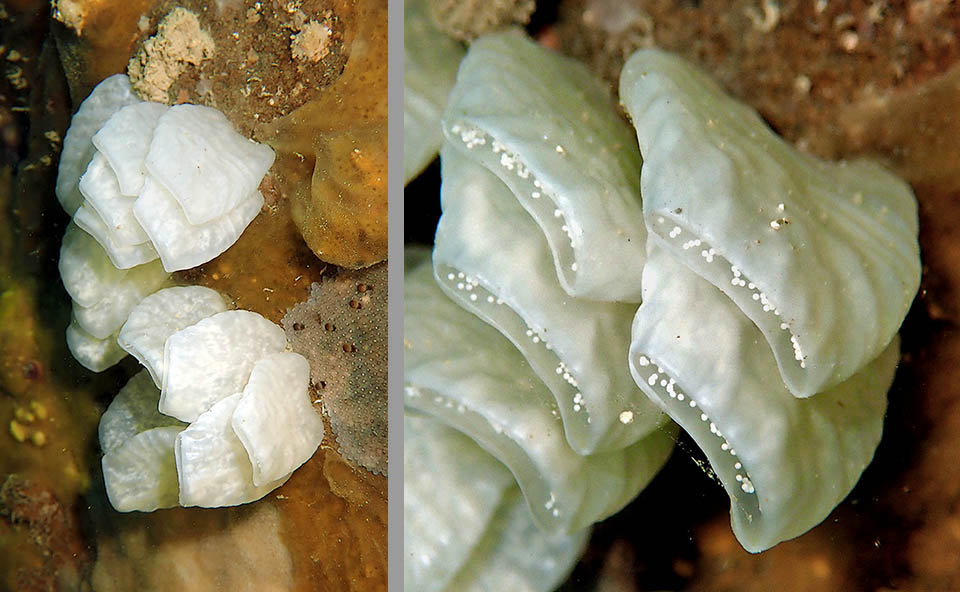
The ovarian capsules containing up to one thousand eggs each are stuck by the female once a year. Inside them occurs the first larval stage. Follows the veliger stage, the pelagic phase with swimming larvae, and finally the veliconcha stage, the benthic phase with the pups moving on the substratum, where they continue their development © Jean Roger
It is however necessary to note that, although marine mollusks constitute about 23% of all extant marine taxa, research on their conservation status has so far failed to fully reflect their importance, with consequent minimal inclusion in the IUCN Red List.
Loss of habitat is considered by many malacologists the main risk factor for the tropical marine species of mollusks,and there exist many concret proofs sustaining this opinion.
Where coral cover has been seriously damaged or degraded due to the increase of the surface temperature of the oceans, of pollution, the sedimentation, the coastal anthropic development and the destructive fishing, as can be seen in much of the tropics, the ecological. niches of the mollusks associated to the corals like the Conus textile are occupied by the bivalves living in the cracks.
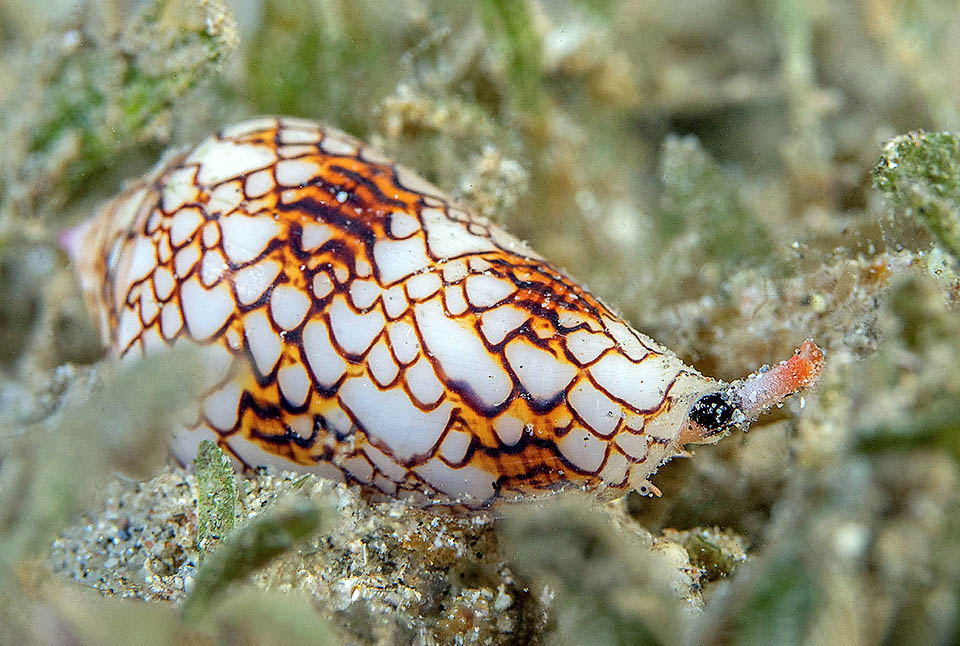
A juvenile. After metamorphosis, the young follow a diet that may be quite different from that of the adults or of the larvae © Rafi Amar
Even if this species, economically important for the pharmaceutics and for the populations of the fishermen trading in it, seems to be able to survive moving to neighbouring geographical regions, in the face of another decrease of climatically suitable areas the species would be no longer able to move its distribution, increasing the risk of local extinctions.
As of 2026, given its vast range, Conus textile is listed as “LC, Least Concern”, on the IUCN Red List of Threatened Species.
Synonyms
Cylinder textile (Linnaeus, 1758); Conus undulatus [Lightfoot], 1786; Conus textile archiepiscopus Hwass, 1792; Cucullus auratus Röding, 1798; Cucullus auriger Röding, 1798; Conus reteaureum Perry, 1811; Conus verriculum Reeve, 1843; Conus concatenatus Kiener, 1850; Conus dilectus A. A. Gould, 1850; Conus corbula G. B. Sowerby II, 1858; Conus tigrinus G. B. Sowerby II, 1858; Conus cholmondeleyi Melvill, 1900; Darioconus osullivani Iredale, 1931; Darioconus textilis osullivani Iredale, 1931; Cylinder loman (Dautzenberg, 1937); Conus vezzarochristophei T. Cossignani, 2018; Conus estellae T. Cossignani, 2020.
→ To appreciate the biodiversity within the MOLLUSCS please click here.