
Family : Syngnathidae

Text © Dr. Giuseppe Mazza

English translation by Mario Beltramini
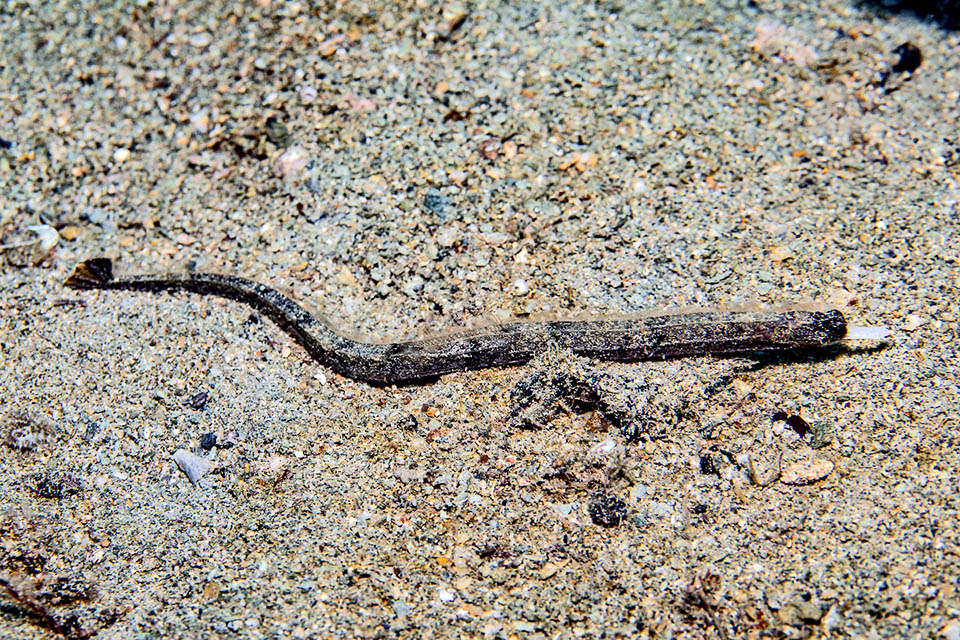
At first sight Cosmocampus albirostris seems a small marine snake or a snake eel © www.carlosestape.photoshelter.com
At first sight Cosmocampus albirostris (Kaup, 1856) might seem like a small sea serpent or a snake eel like Ophichthus ophis. The elongated and supple, the narrow head, the forward-leaning snout and the particular way it moves in the water produce this impression. But just looking closer is sufficient to discover that that shape, apparently far from the usual image of a fish, instead belongs to one of the most specialized and fascinating families of the marine ichthyofauna.
In fact it is a pipefish inserted in the order of Syngnathiformes and in the family of Syngnathidae, the same of the seahorses. Therefore its shape is not that of a snake, but the outcome of a long evolutionary history
where body, head, snout and behaviour have adapted to an existence strictly linked with the coastal seabeds like the analogous Micrognathus crinitus.
The genus Cosmocampus originates from the Greek “kosmos”, ornament, decoration, with reference to the crests and the dermal flaps that adorn the head, and “kampos”, the mythological sea monster we find as suffix also in the genus Hippocampus. Conversely, the specific epithet albirostris, more immediate, comes from the Latin “albus”, white, and “rostrum”, snout, which, at times, is not pigmented.
Zoogeography
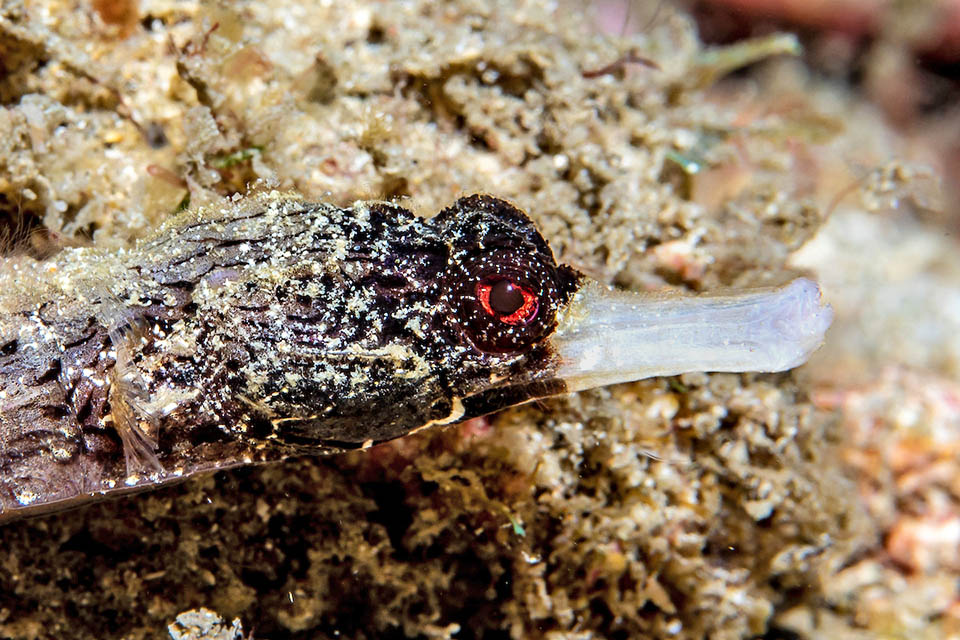
But observing the head, doubts arise at once due to that odd tubular snout © www.carlosestape.photoshelter.com
Cosmocampus albirostris is a marine species associated with the western Atlantic tropical and subtropical waters. Its range includes a vast portion of the American coasts of AAtlantic, with documented presence in the Gulf of Mexico, in the Caribbean and along the tropical and subtropical coasts of central and southern America, up to the coastal areas of Brazil.
Ecology-Habitat
The shape of Cosmocampus albirostris gets understandable especially when we observe the environment where it lives. It is a coastal fish, associated to relatively shallow environments, between 0,5 and 50 m, prairies of marine phanerogams, weeds, reef and other complex substrata that offer a shelter, the possibility of camouflaging and the presence of small prey. In fact it is not a pelagic fish who travels great distances in open sea; the presence of the species in a certain zone doesn’t depend only from the water temperature or from the latitude, but also from the availability of its habitat.
Cosmocampus albirostris is not a swimmer built for the fast chase. Its ecological strategy is different: to stay close to the substratum, to explore the structure of the habitat and to go unnoticed. This strategy also influences the way it gets the food.The long tubular snout is particularly suitable for catching small organisms. Getting close to the prey, the fish can utilize its own specialized mouthparts for sucking it quickly.
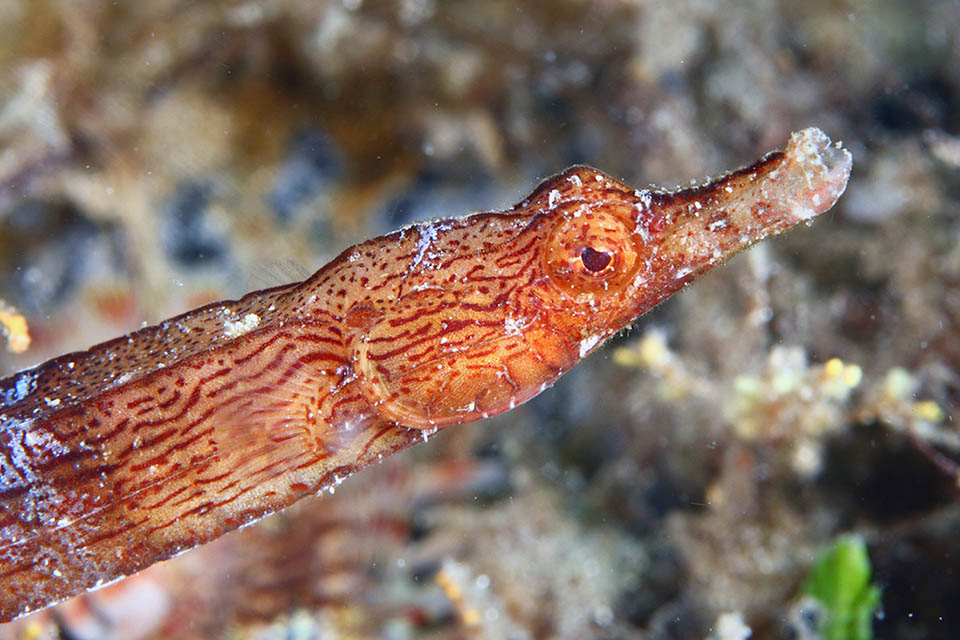
Though, contrasting the scientific name, it is not always white, evokes that of the seahorses and of the pipefishes © Kevin Bryant
In this way, the morphology of the head, that initially may appear only funny, gets a precise ecological meaning.
Morphophysiology
The morphology of Cosmocampus albirostris is the most evident outcome of its evolutionary specialization. The body is strongly elongated and thin, with a structure that distinguishes it immediately from most bony fishes. The overall shape recalls superficially that of a snake, but the anatomy is unmistakably that of a fish. The body is organized in segments and presents a rigid and specialized structure, characteristic of the Syngnathidae. It is above all the head that captures the attention. The snout is elongated and tubular, whilst the terminal mouth is adapted to a particular mechanism of feeding by suction.
This conformation modifies completely the relationship between animal and prey. Not having the need to grasp large organisms with an ample mouth, Cosmocampus albirostris can concentrate on catching small prey, especially small crustaceans and other planktonic or benthic organisms of reduced size. The comparison with other Syngnathidae allows us to understand better what makes it particular. In the pipefishes the snout is usually elongated and tubular, but the shape, the length and the proportions may vary considerably between genera and species. In the seahorses, instead, thehead assumes a quite different conformation with a characteristic curvature of the head and of the body.
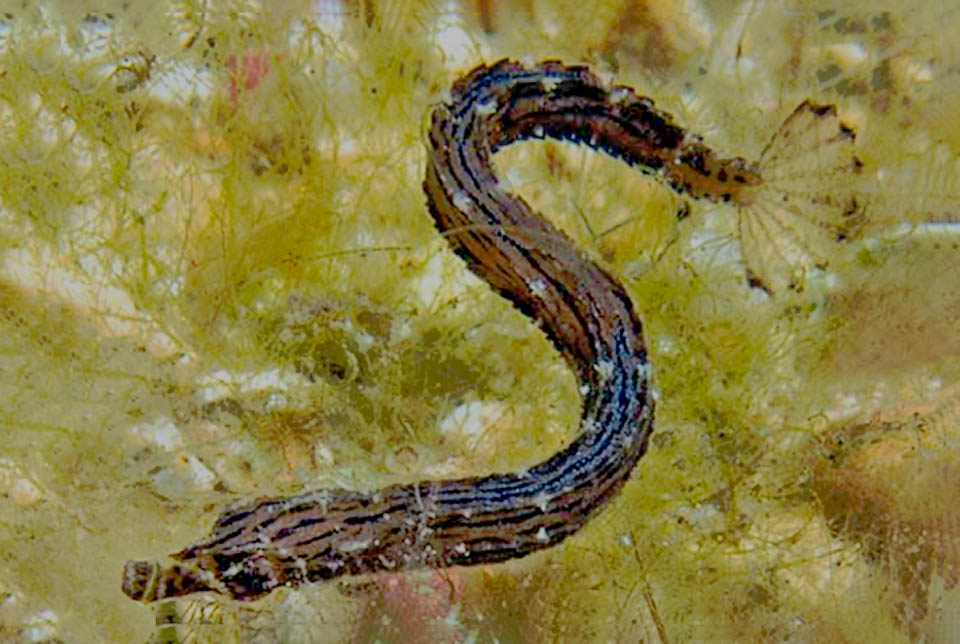
The extended caudal fin dispels all doubts: it isn’t a little snake resembling a fish, but a fish who, for hunting camouflaged on seabeds, has taken this form © Michy Charteris
In Cosmocampus albirostris we find some anatomical principles common to the family, but organized following their own morphology. It is precisely the comparison that allows us to avoid a frequent mistake: to consider the external appearance as a simple oddity. That shape is functional.
The long rostrum, the position of the eyes, the mouthparts and the structure of the body are all elements connected to the way the animal perceives the environment, feeds and camouflages. The tubular snout is not only an aesthetic feature. In the Syngnathidae the diet is largely based on the aspiration of the prey. The movement of the mouth and of the associated structures produces a rapid flow of water that allows it to catch small organisms. It is particularly effective when the animal lives among vegetation and structures of the seabed. Therefore the head becomes a sort of precision instrument more suitable for catching small prey than for the strength or the speed. The lengthening of the body and the presence of rigid structures contribute to the particular posture and the way of moving of the animal. The locomotion is not that of a pelagic fast fish: Cosmocampus albirostris is linked to an environment where the capacity of manoeuvering among structures and of maintaining a controlled position can be more important than the maximum speed.
The serpentine shape that had struck us at first finds its explanation. It is not a snake who has assumed the look of a fish. It’s a fish that, through its own evolution, has taken an extremely elongated and specialized shape.
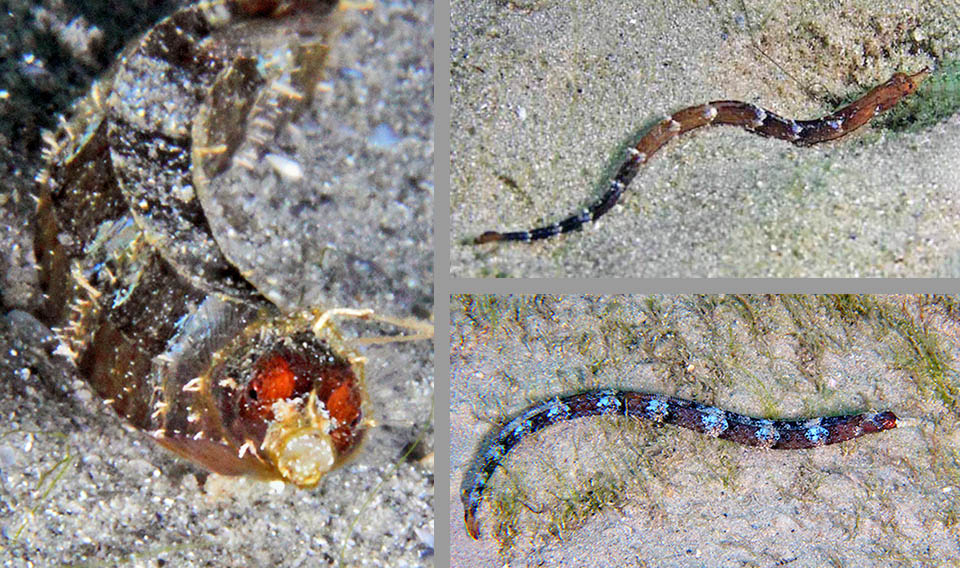
Also changing livery has adapted to the environment © Kevin Bryant and © www.carlosestape.photoshelter.com (top right)
Ethology-Reproductive Biology
The biology of Syngnathidae contains one of the most extraordinary features of the whole family: the reproductive rôle of the male. Like in the other Syngnathids, also in Cosmocampus albirostris the reproduction is characterized by the transfer of the eggs to the male who takes care of their incubation. This represents one of the most unique aspects of the biology of the family. Depending on the group and the species, this structure can take different forms and may have various degrees of complexity.
During the incubation the male protects the eggs and contributes to the conditions necessary to their development. Some species like Hippocampus kuda keep the eggs in a pouch then give birth to the little ones, others like Solegnathus spinosissimus or Phyllopteryx taeniolatus carry the eggs with them stuck under the tail.
The males of Cosmocampus albirostris protect the eggs in an incubating pouch and the resilience of the species is high with a possible doubling of the populations in less than 15 months. The fishing vulnerability, occasional with the trawl nets, is low, marking 18 on a scale of 100. From 2015 the species appears as “LC, Least Concern” in the IUCN Red List of the endangered species. However, this does not mean that Cosmocampus albirostris is not in danger: in fact it lives in coastal environments subject to several pressures linked to human activities. Based on present criteria, it is LC, but the sea continues to change.
→ For general information about FISH please click here.
→ For general information about BONY FISH please click here
→ For general information about CARTILAGINOUS FISH please click here.
→ To appreciate the BIODIVERSITY of BONY FISH please click here.
→ To appreciate the BIODIVERSITY of CARTILAGINOUS FISH please click here.