
Family : Orchidaceae

Text © Prof. Pietro Pavone

English translation by Mario Beltramini
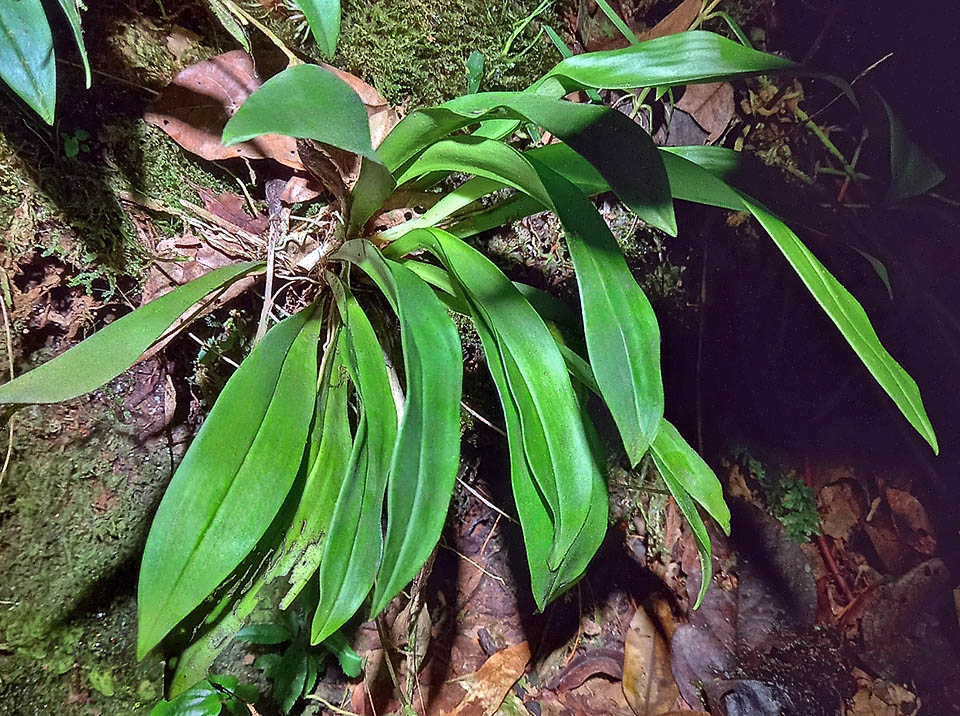
Dracula ezekiana is a little epiphyte, native to Napo and Zamora Chinchipe forests in Ecuador, where it grows in the forests at altitudes from 800 to 1700 m © Luis Salagaje
Dracula rezekiana Luer & R.Hawley is a species of the subtribe Pleurothallidinae, tribe Epidendreae, subfamily Epidendroideae, family Orchidaceae.
Created in 1978 by Crlyle August Luer (1922-2019), the genus Dracula is found in America, in the Andes Central and Western Cordillera and counts about 146 species. Some species of this genus were discovered in 1870 and included in Masdevallia, a genus. created in 1794 by two Spanish botanists, Hipólito Ruiz López (1754-1816) and José Antonio Pavon (1754-1840). While studying several specimens of Masdevallia Carlyle A. Luer realized that they presented characters substantially different from the others included in the genus and so separated them creating a new genus he named Dracula.
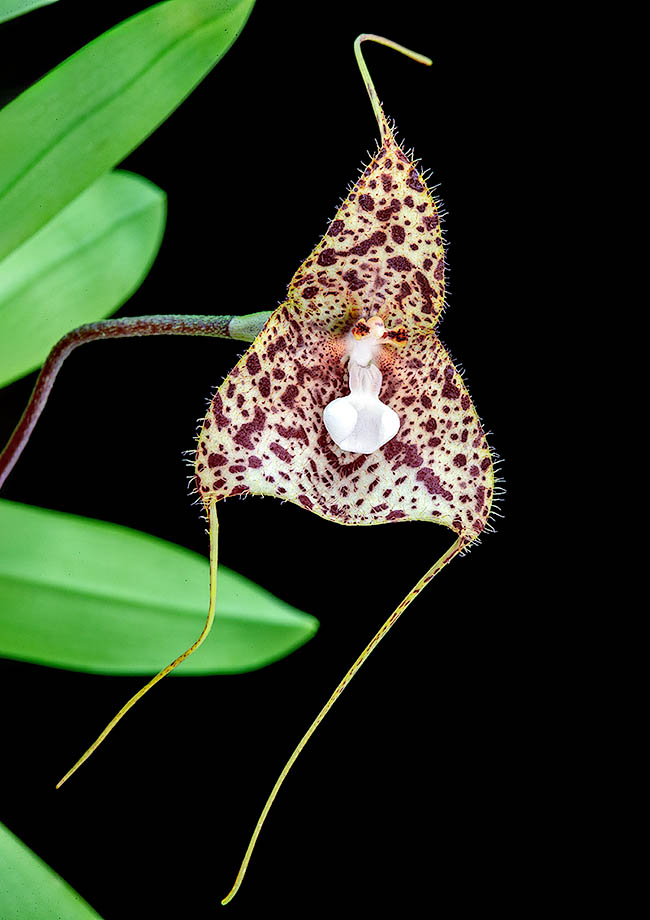
Dracula rezekiana is a very variable species. Even if the colour typical of the flower was described as ivory white or cream, can be often found also specimens with brown or purple spots more or less marked © Dr. Giuseppe Mazza
In fact, the species of the genus Dracula differ because of the shape of the flowers, that reminds the snout of a monkey or the head of a dragon, and of the leaves, coriaceous, dorsally keeled and progressively narrowing at the base.
The etymology of the name Dracula means “little dragon” due to the resemblance with the head of a dragon, due to the long pointed sepals present in almost all species of this genus.
The specific epithet rezekiana is honoured to Mrs. Marie Friedrich de Rezel of Quito (Ecuador), passionate connoisseur of the local flora.
Luer saw a specimen of this species in 1975 cultivated by Joe Brenner, owner of the Hotel Turingia (Puyo, Ecuador), passionate orchid enthusiast who hosted and even helped the botanists in their collection and identification of the plants present in Ecuador.
As this specimen had the flower already withered, Luer turned to Richard Hawley, resident in California, collector and grower of orchids, to be able to validly describe it.
In fact, it was described and published in 1979 in the magazine Phytologia 44:165.
Dracula rezekiana is present in Ecuador, in the Provinces of Napo and Zamora Chinchipe, where is met in the forests at altitudes between 800 and 1700 metres, as little epiphyte with erect and robust ramicauls, wrapped at the base by 2 to 3 loose sheaths, and bearing one single apical leaf, erect, rather coriaceous, keeled, strictly elliptical, sharp, 10-15 cm long, that gradually gets narrower below in an indistinct petiole, 1,8-2,7 cm broad.
The inflorescence is a raceme with few flowers on a thin peduncle, suberect or horizontal, scarcely bracreated, 11-15 cm long that originates from the low part of the ramicaul. The floral bract is tubular, 5-7 mm long.
The sepals are white, glabrous outside, pubescent inside with some red-purple dots close to the base. The dorsal sepal is obovate, connate at the lateral sepals for 8 mm forming a conical cup with obtuse apex that contracts into an erect tail, thin, red, about 25 mm long.
The lateral sepals are broadly ovate, oblique, 15 mm long, 15 mm broad, connate in way to form a rectangular synsepal with the apices subacute narrowed in tails similar to that of the dorsal sepal.
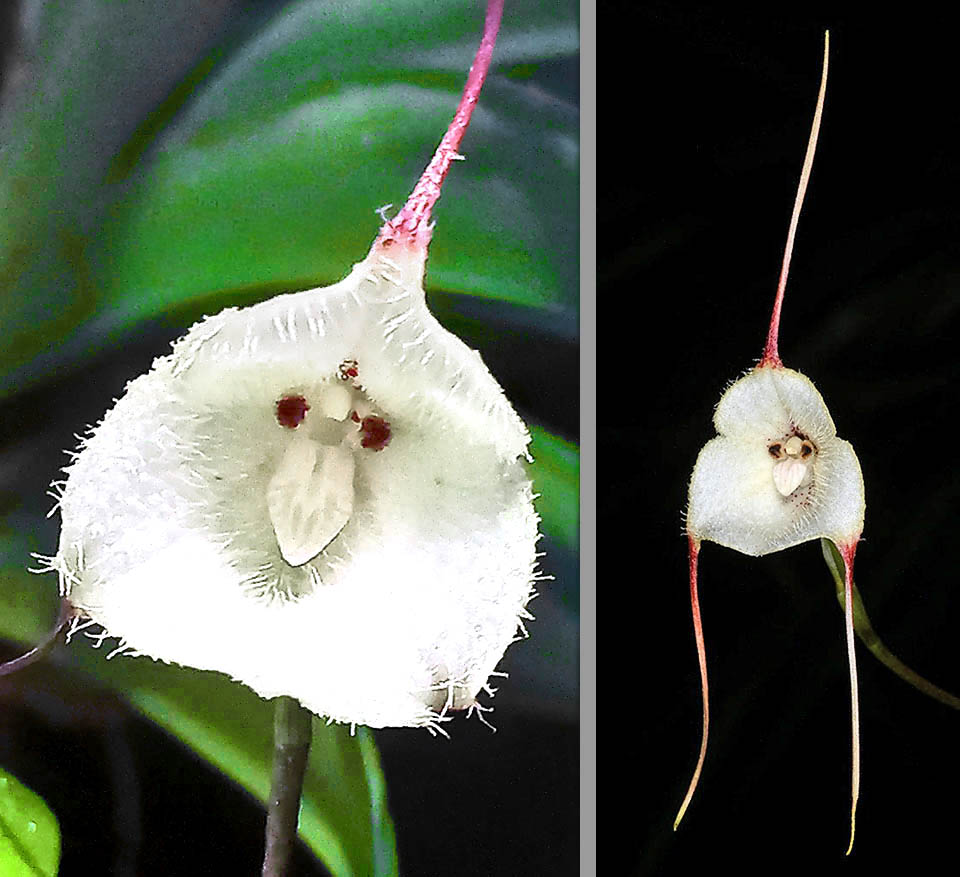
For some, the flower recalls a monkey’s snout, but for others the long pointed sepals evoke, like the scientific name, the head of a dragon © Luis Salagaje (left) and © Ron Parsons (right)
The petals are ivory coloured, brown spotted, cartilaginous, oblong-spatulate, 3,5 mm long, 2 mm broad with bivalve apex, densely papillose.
The labellum is white, obovate, 5,5 mm long, 3,5 mm broad, without demarcation between the apical portion (epichile) and basal (hypochile). The epichile is ovate, obtuse, 3 mm long, 3,6 mm broad, slightly concave, with few elevated and ramified ribs and obovate hypochile, about 2,5 mm long, 2,5 mm broad, with erect marginal angles, centrally divided and concave base hinged to the foot of the column.
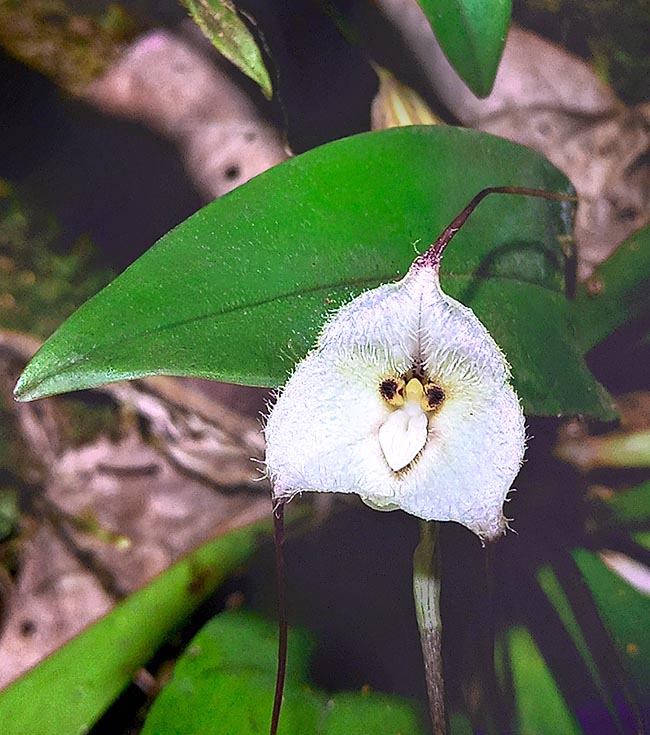
It grown in partial shade at moderate temperatures. The baskets substratum mus be humid but without stagnations © Luis Salagaje
The column (gynostemium) is of white-greenish colour, robust, 3,5 mm long, with a robust foot of equal length.
The pollen is organized in two compact masses (pollinia) that come off easily and, using the adhesive disc (viscidium), adhere to the pollinators.
This mechanism is essential for the transportation of the pollen from one flower to another. The blooming takes place in spring and in summer.
The ovary is purple, 5 mm long, sub verrucose, and round. The seeds are very small, similar to dust and notoriously difficult to germinate.
Dracula rezekiana, like many other species of orchids, is at risk of extinction because many hectares of tropical rainforest in South America are lost every year due to deforestation. As a matter of fact, this species has been recently inserted in IUCN Red List of the endangered species and is reported at risk of extinction (EN, Endangered).
When cultivated, Dracula rezekiana requires partial shade and can grow in cold or cool climate conditions.
It is a good practice to place it on the windowsill (north or east window) or in a verandah. In winter it requires a temperature of 15-20 °C, in summer, outside up to 30 °C, but exclusively in the shade.
As the peduncles of the inflorescences grow downwards, it is good to cultivate it on a basket with loam (fine bark and perlite and sphagnum) that must be kept humid. Stagnations are to be always avoided as root rot may develop.
The fertilizers, in whose composition is preferable a higher content in nitrogen (N) to phosphorus (F) and to potassium (K), are always to be dissolved in the irrigation water and administered with an always humid substratum, but we should not overdo with fertilizers. In case of presence of chochineal and aphids on the leaves these insects may be eliminated, in the home cultivations, with a cotton ball soaked in alcohol to be passed over the leaves.