
Family : Orchidaceae

Text © Prof. Pietro Pavone

English translation by Mario Beltramini
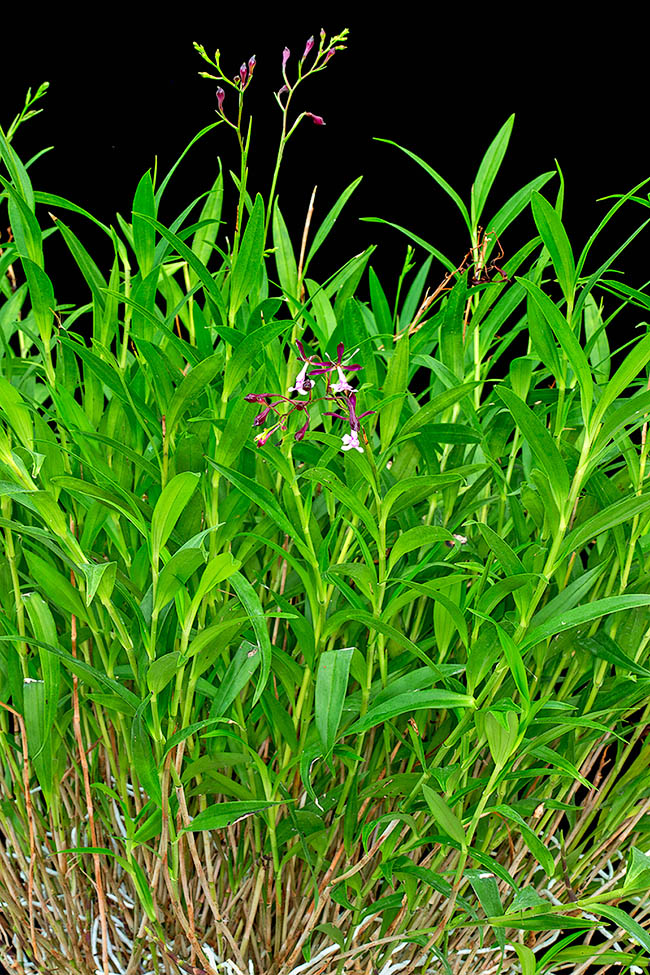
Big epiphyte or terricolous species, with cylindrical and thin stems similar to reeds, Epidendrum englerianum grows in Ecuador forests on the Andes amazonian side at altitudes between 1500 and 2600 m © Dr. Giuseppe Mazza
Epidendrum englerianum F.Lehm. & Kraenzl. is a species of the subtribe Laeliinae, of the tribe Epidendreae and of the subfamily Epidendroideae, family Orchidaceae.
The genus Epidendrum L. was described by Carolus Linnaeus (Carl Nilsson Linnaeus 1707-1778) in his opus “Species plantarum” (Sp. Pl. ed. 2.: 1347 (1763).
The genus counts more than 1.880 species and is one of the vastest and richest genera of the family Orchidaceae.
Due to this richness of species it is called “megadiverse” (or mega genus). Infact, its species are characterized by plants from more than 2 m tall up to a few centimetres.
Native to Americas (neotropical) the genus includes epiphyte, lithophyte and terrestrial species This ability to occupy different niches has favoured a really high speciation process.
The flowers display a wide range of colours (yellow, violet, pink, red, white) and may open simultaneously or in succession. In some species like Epidendrum secundumscondarily Jacq. secondarily the resupination has been lost.
Recent taxonomic and phylogenetic studies suggest, but they are to be confirmed, that the species of this genus have had a rapid adaptive radiation and the ancestral ones are confined to Mexico and to Central America. Therefore, these regions could be the sites where the early diversification of Epidendrum has occurred.
Most species of Epidendrum are mainly located on the slopes of the tropical forests of the Anden mountain ranges of Guyana and of the Central America mountains.
Most species are epiphyte, present in the dry forests, where they grow on species of Cactaceae and of Velloziaceae, or in the humid rainforests on the mountain slopes where light and humidity are better available. Epidendrum is pollinated by a vast range of pollinators and does not have strong barriers of pre-coupling.
In the genus we note polyploid species and this status is to be considered an adaptive advantage because it represents the most common way of sympatric speciation in the plants. The chromosome number is known only for a small fraction of species of Epidendrum (<3%) and the counts available today state that the most common number in the whole genus is 2n = 40. In some species of the section Tuberculata of the subgenus Amphiglottium the numbers vary frm 2n = 24 and 2n = 240, with intermediate numbers (2n=28, 2n=48, 2n=52, 2n-60 and 2n=80).
It has been identified between the species that present a different chromosome number that does not seem to act as reproductive barrier in Epidendrum unlike what happens in other groups of plants.
The deception pollination, like that by food or sexual, has repeatedly evolved in various lines of orchids. It is in fact estimated that one third of the species of orchids deceives its own pollinators. In Epidendrum are present the rewarding species as well as deceptive.
Usually, the bright yellow and orange flowers are present in the species pollinated by butterflies, whilst the white and light green flowers and very fragrant attract the moths. In the genus are also present ornithophilous and myophily species, the latter ones attract the diptera.
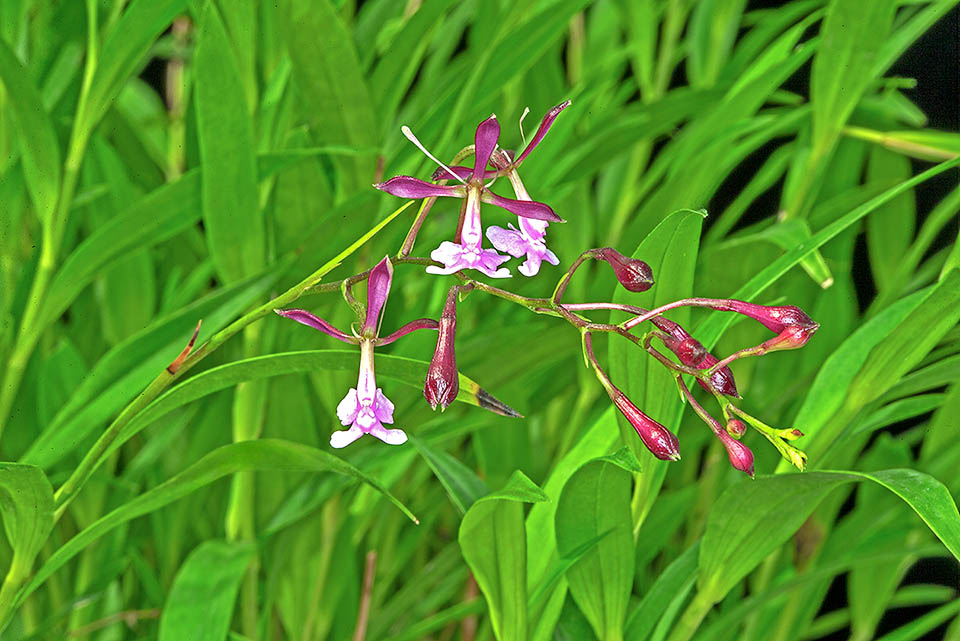
The coriaceous, strictly lanceolate leaves have entire edge. The thin terminal panicle inflorescences, sometimes slightly arcuate, normally have few flowers © G. Mazza
Epidendrum englerianum is a species described in 1899 by Friedrich Carl Lehmann (1850-1903) and by Friedrich Wilhelm Ludwig Kränzlin (1847-1934) in Botanische Jahrbücher für Pflanzengeschichte und Pflanzengeographie (Bot. Jahrb. Syst. 26: 466, 1899).
The name of the genus comes from the Greek “επί”, epi (over) and “δένδρον”, dendron (on the trees) with reference to the posture as epiphyte, whilst the specific epithet is honoured to Heinrich Gustalv Adolf Engler (1844-1930), German botanist, curator of the Botanischer Jahrbücher from 1880 and 1930, magazine where was published for the first time the name of this species. The common name is Epidendrum of Engler or Engler Epidendrum.
Epidendrum englerianum is found in Ecuador on the Amazonian side of the Andes in the provinces of Napo and Tungurahua, at altitudes between 1500 and 2600 m. It is a large epiphyte or terrestrial plant. The stems are simple, cylindrical, thin, erect similar to reeds, wrapped in the basal half by membranous sheaths bearing in the upper half 8 to 11 distichous leaves, coriaceous, strictly lanceolate, sharp and with entire margin.
Blooming occurs all year round and the flowers form on a panicle-like terminal inflorescence, at times slightly arcuate, thin, normally with few flowers (pauciflorus). The flowers, resupinate and odourless, are dark violet with pink labellum.
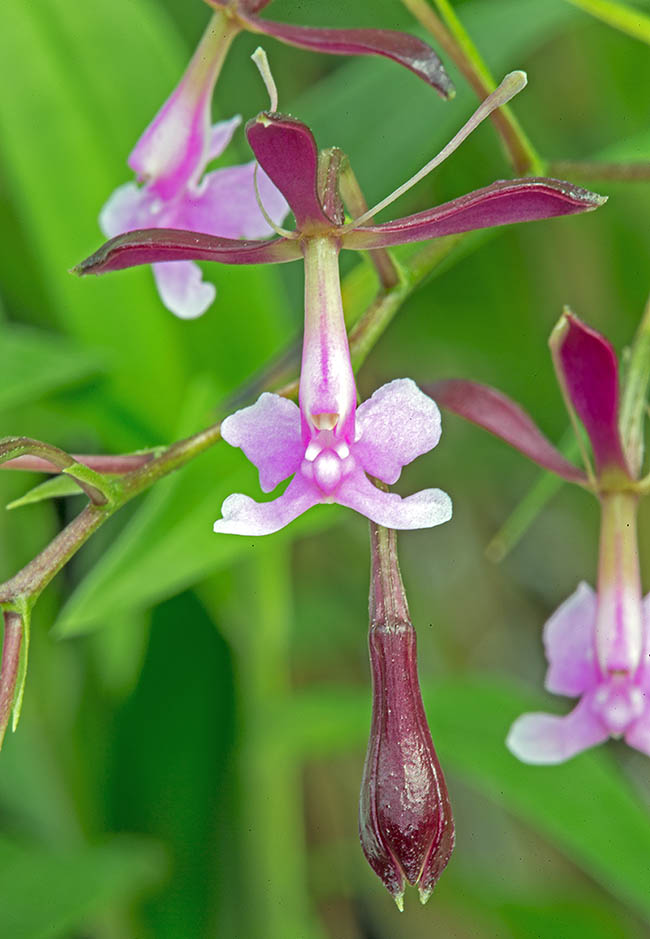
The flowers with column fused to the labellum forming a narrow tube, suit to butterflies proboscis © Dr. Giuseppe Mazza
The sepals are free, fleshy, strictly oblanceolate, obtuse, with 5-veins evident on the dorsal surface and entire margin, 10-15 x 2-3 mm. The lateral sepals are slightly oblique. and pointed (apiculate).
The petals are reflexed, free, filiform and spatulate, with rounded apex, with only one vein and with an entire margin (9-12 x 0,3-0,5 mm).
The labellum is merged t with the column, 3-lobate, cordate at the base, 8-12 x 10-12 mm; with two flesh protuberances. These are thin, prominent, elongated beyond the base of the median lobe and almost parallel to the lateral keels of the disc. On the labellum are present three prominent longitudinal crests; the central is wide and very fleshy. The column (or gynostemium) is straight, slender, with the apex having a couple of small, 7-8 mm long teeth and a 4-locular anther.
The pollinarium contains 4 pollinia shaped like the wing of a bird, strongly compressed laterally, unequal, the inner pair a little shorter. The rostellum is subapical and overhangs the anther and on which is fixed the retinaculum (or viscidium), sticky pad serving to stick on the body of the pollinators. The stigma has prominent lateral lobes, half as long as the stigmatic cavity. The ovary is not swollen and has no ornaments.
The structure of the flower with the column fused to the labellum forming a narrow tube, is typically suitable for the feeding tube (proboscis) of the lepidopters.
After the fecundation takes form an ellipsoidal (20-22 x 9-11 mm) capsule with three longitudinal ribs, on a 11-15 mm long peduncle.
The capsule contains thousands of very small powdery seeds, that in nature for germinating require the presence of mycorrhizal fungi.
In the areas of origin Epidendrum englerianum is employed for lowering fever, for soothing skin diseases, through compresses, and also for relieving digestive problems.
It’s a species very sought after by the collectors being ornamental. It can be grown both indoors and outdoors with intense and indirect light. It prefers warm and humid conditions. The best humidity levels stand between 60% and 80%; to maintain them must be utilized humidifiers or regularly spraying. It is good to keep the plant with diurnal temperatures between 18 °C and 24 °C and slightly cooler during the night (15-20°C).
Watering must be abundant when the substrate begins to dry up, but water stagnations are to be avoided. A good air circulation is useful for preventing fungal infections. The loam must be of the draining type, with bark of orchid, to prevent root rot. It is good practice to fertilize every two weeks during the growth season and to reduce the frequency during the dormancy period. A balanced orchid fertilizer must be used, like the 20-20-20. When the plant iss no longer suitable for its container, repotting must be done preferably in spring.
The propagation of Epidendrum englerianum can be done by division of the tuft, in any case making sure that each section has healthy roots and buds. Usually the pruning is not necessary, even if it’s possible to remove dead and yellowed leaves to maintain the appearance and the health of the plant. If parasites, like aphids and mites, are present, it is good to eliminate them promptly.