
Family : Orchidaceae

Text © Prof. Pietro Pavone

English translation by Mario Beltramini
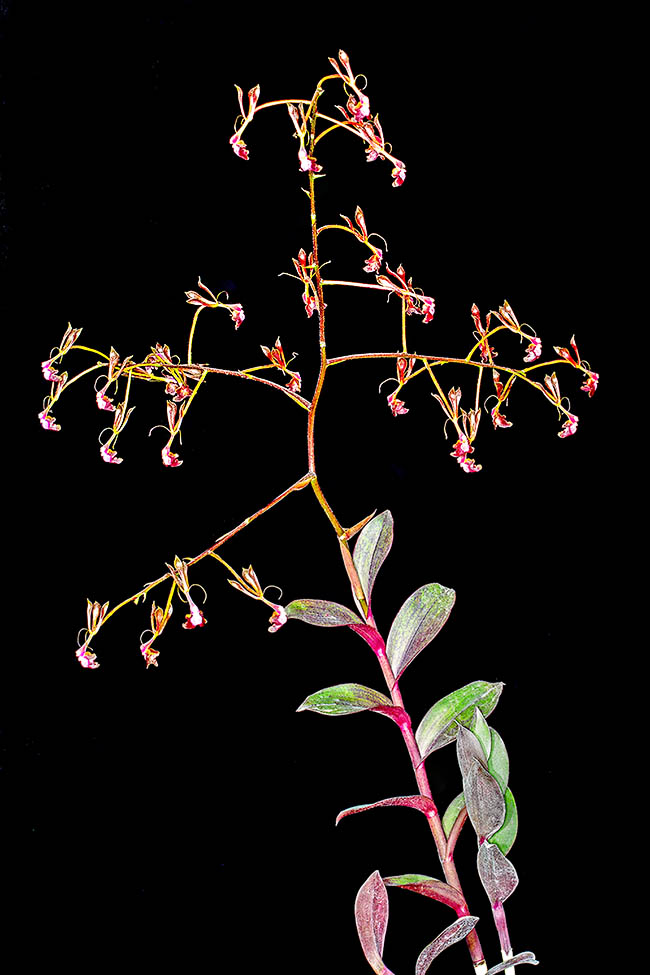
Epidendrum melanoporphyreum is an epiphytic and terricolous orchid of north Peru mountain humid forests © Dr. Giuseppe Mazza
Epidendrum melanoporphyreum Hágsater, is a species inserted in the subtribe of the Laeliinae, in the tribe Epidendreae, in the family of the Epidendroideae and in the family of the Orchidaceae.
This species, native to Peru, has been described in 1993 in the magazine Icones Orchidacearum, Mexico City, (Icon. Orchid. 2: t. 156) by Eric Hágsater (1945-) distinguished Mexican botanist and ornithologist, an authority in the field of orchids, particularly specialized in the study of the genus Epidendrum.
Epidendrum melanoporphyreum belongs to the interesting group Pseudepidendrum and to the subgroup Paniculatum characterized by cane-shaped stems with sharp or pointed leaves that usually form an apical inflorescence whose flowers have filiform petals and a trilobed labellum.
The name of the genus comes from the Greek επί, epi (above) and δένδρον, dendron (tree) “on the trees” referring to the epiphytic posture. The specific epithet comes from the Greek μελανος, black, and πορφυρος, violet, due to the very dark colour of the flowers, almost black-purple.
Common name: Black-violet epidendrum.
Epidendrum melanoporphyreum is an orchid native to north and central Peru and lives in the humid mountain forests at about 1300-1700 of altitude. It is a terrestrial and epiphytic species, maybe also lithophyte, characterized by herbaceous, deciduous, terricolous, bushy, 30-70 cm tall, plants. It has fleshy roots, about 2,5 mm thick and stems, not ramified, cane-shaped, straight, 30-60 cm long, with a diameter of 4-9 mm.
The leaves, 7 to 14 on the stem, have tubular sheath, smooth, up to 5 cm long. The lamina, 6-12 x 2-4 cm, is elliptic, sharp with an entire margin, of olive green colour in the upper pagina, purple in the lower one.
The inflorescence is terminal, compound, in the form of a panicle, sub-erect, 15-25 cm long, on a peduncle having two basal bracts, acute, conduplicate, up to 5 cm long. The floral bract is triangular and acuminate.
The flowers, about 25 per inflorescence, open almost simultaneously. They are resupinate and odourless and have waxy consistency. The sepals, the petals and part of the labellum are of dark purple colour, almost black, whilst the basal part of the column is green, and the apical part and the disk are of bright purple colour.
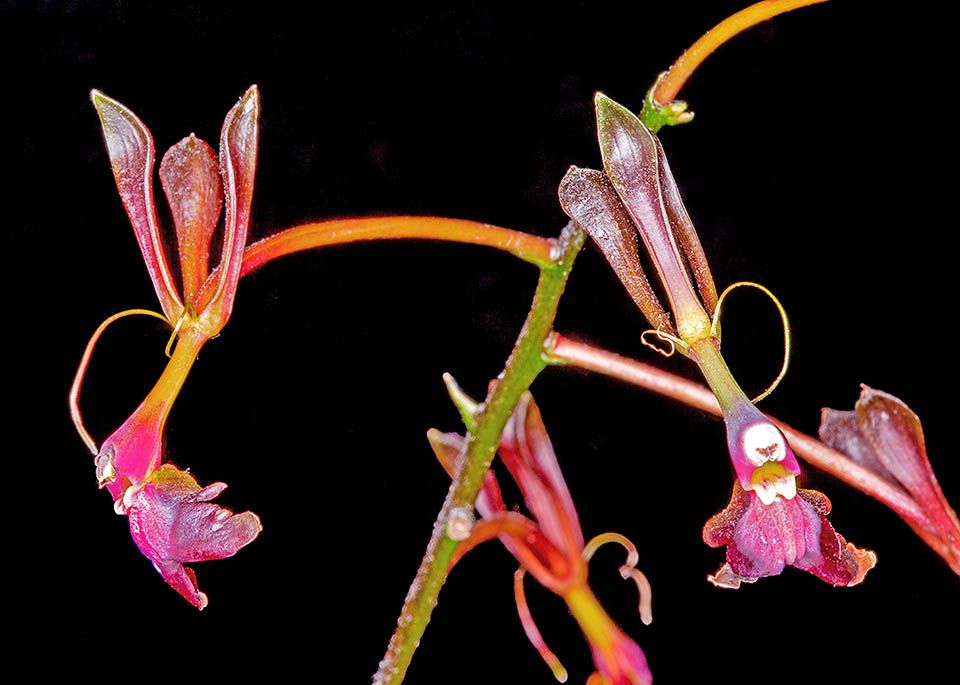
The inflorescence bears about 25 flowers opening almost the same time. They are resupinate and odourless with waxy texture © Dr. Giuseppe Mazza
The ovary is not swollen, with a circular section (terete), smooth, 24-40 mm long.
The sepals are somewhat bent backwards (reflexed), free, without dorsal keel, smooth, fleshy, spatulate-oblanceolate, pointed (20-21,5 x 4-5 mm).
The petals are spread apart, filiform, obtuse (20 x 0,5 mm).
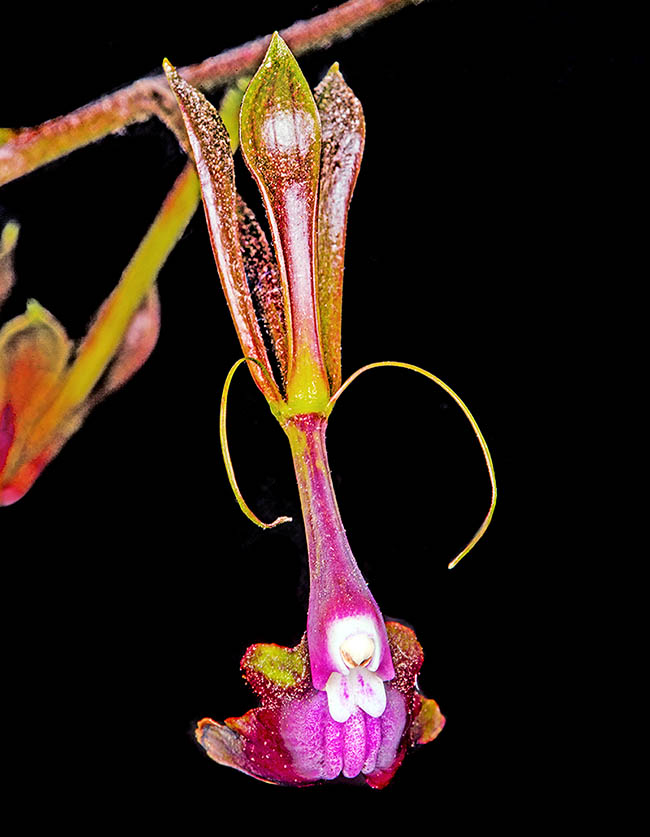
Purple, bright in the apical part, dominates in dark flowers. Odd curved growths of the labellum called calli © Dr. Giuseppe Mazza
The labellum adheres to the column, convex, rigid, quadrilobate , with flesh protuberances (calli) on the junction between the base of the labellum and the column.
The labellum has three central prominent and blunt keels and apical lobeds spread apart, wider from each other than the basal ones.
The column is straight, slender, 16 mm long.
The anthers are subglobose and quadrilocular. The pollinia are 4, like a “bird’s wing”, strongly compressed on the sides, transparent, the inner ones are a little smaller.
The viscidium is semiliquid, translucent. The rostellum is subapical and fissured. The nectarium is shallow and smooth inside.
Blooming takes place from August to November.
Epidendrum melanoporphyreum is an orchid easy to cultivate but it is good to keep in mind that it lives in environments where the daily rainfalls vary from intense in May to poor in December. The humidity varies from 76% to 81%, the maximum in July and the minimum in February. The temperature varies from 11 °C to 24 °C; the maximum is in February.
The plant grows very well in baskets or in pots with well draining loam or on cork sheets.
Watering must be regular, especially during the warm season.
Moss can be used for retaining the water and thus avoiding that the roots dry up too fast.
It is good practice during the growth to fertilize with balanced liquid fertilizer for orchids increasing the phosphates before blooming. This orchid also tolerates slow-release fertilizers applied at a rate of 1-2 granules per pot (250 ml) of substratum.
Repotting must be done every 2-3 years and at the end of winter, when the new growths begin to appear. To avoid the repotting during the warm season.
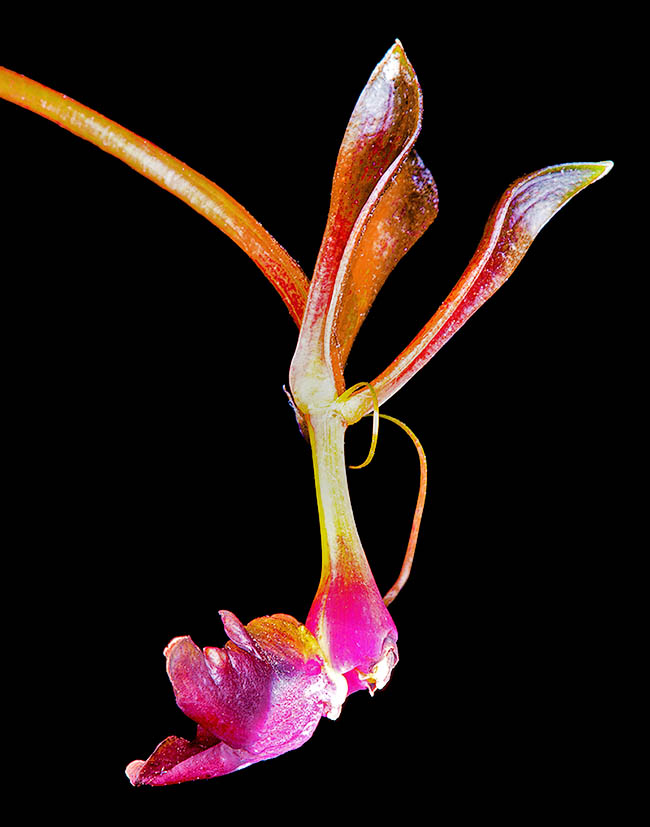
The sepals are backwards folded. Easy cultivation but requiring adequate humidity © Dr. Giuseppe Mazza
Epidendrum melanoporphyreum primary and secondary hybrids of do exist that have been registered at the RHS (Royal Horticultural Society), the International Authority for the Registration of the Hybrids of Orchids.
Epidendrum ‘Cotacachi’ has been obtained by Ecuagenera through the cross between Epidendrum medusae × Epidendrum melanoporphyreum and registered on 30/10/2023 at RHS.
The flowers have colours of dark and intense shades, brown-blackish, the labellum is big and off-white fringed in the centre, brown and tinged with green on the edges.
Epidendrum ‘Fuzzy Grapes’ obtained by W. Goldner by cross between Epidendrum melanoporphyreum × Epidendrum ilense and registered by Woodstream on 11/03/2004 at RHS.
The name “Fuzzy Grapes” (hairy grapes) recalls the dark colour similar to that of the ripe grapes as well as the consistency. This hybrid is particularly appreciated by the collectors thanks to the contrast between the dark colours of the petals and the elaborate structure of the fringed labellum (derived from Epidendrum ilense) that grants the flower a delicate and particular look.
Epidendrum ‘Wolf Creek’ has been obtained by W.Goldner from cross between Epidendrum conopseum × Epidendrum melanoporphyreum and registered on January 4th, 2021 by Woodstream at RHS. It presents flowers with dark shades usually from dark brown to almost black purple with labellum having greener or more yellowish tones.
Epidendrum ‘Minimel’ has been obtained by J-C. Hannachi with cross between Epidendrum melanoporphyreum × Epidendrum antonense, registered at RHS on 30/12/2025.
This is a small hybrid suitable for the cultivation in small spaces, with coriaceous leaves arranged along thin stems and flowers of variable colour having the sepals and the petals which may be of greenish yellow colour and labellum partially brown-purple.