
Family : Scombridae

Text © Dr. Giuseppe Mazza

English translation by Mario Beltramini
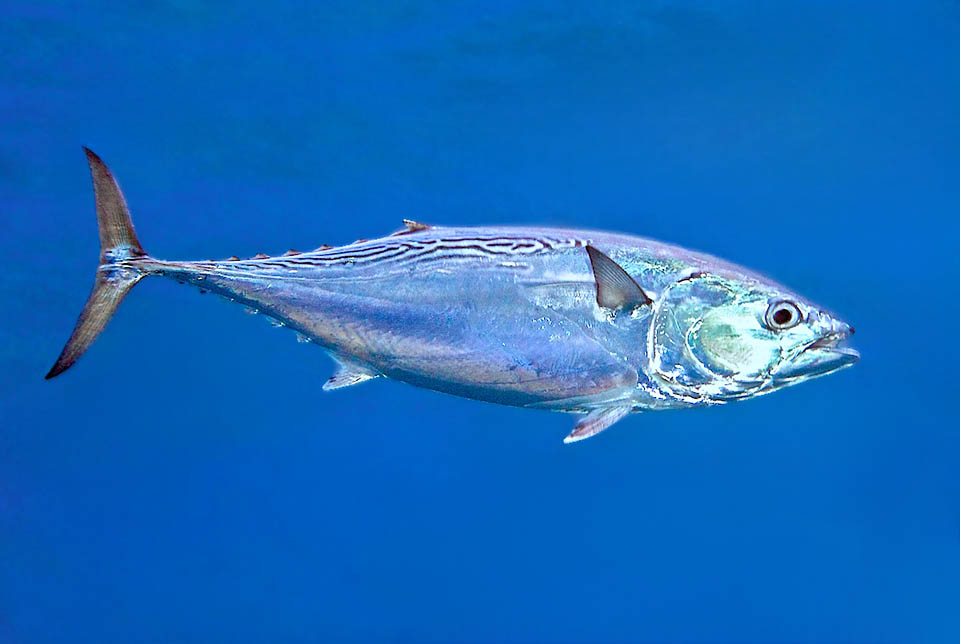
Little tunny (Euthynnus alletteratus) is at once recognized due to the scribbled drawing on the back, over the lateral line © www.carlosestape.photoshelter.com
Like a cannon shot, the quick dash upwards of the Little tunny, Euthynnus alletteratus (Rafinesque, 1810), catalyzes the mixed school for a sardine hunt.
Are present three species that the evolution has lined up for a team game in the strategic points of the water column: the young Little tunnies and the Bullet tunas Auxis rochei (Risso, 1810), higher on the sides with their fast and nervous swim; an the Atlantic bonito, Sarda sarda (Bloch, 1793), already ready on the surface.
Leaping violently out of the water, the Little tunny has dispersed the sardines, and the associates, awakened by the crash, make a clean sweep. Everyone wins in the mixed school, because the confusion of the terrorized prey is total and therefore the predation is quite easier. And this is not the only advantage, because many eyes scan the surroundings, and possible approaching attackers, like sharks or dolphins, are promptly reported.
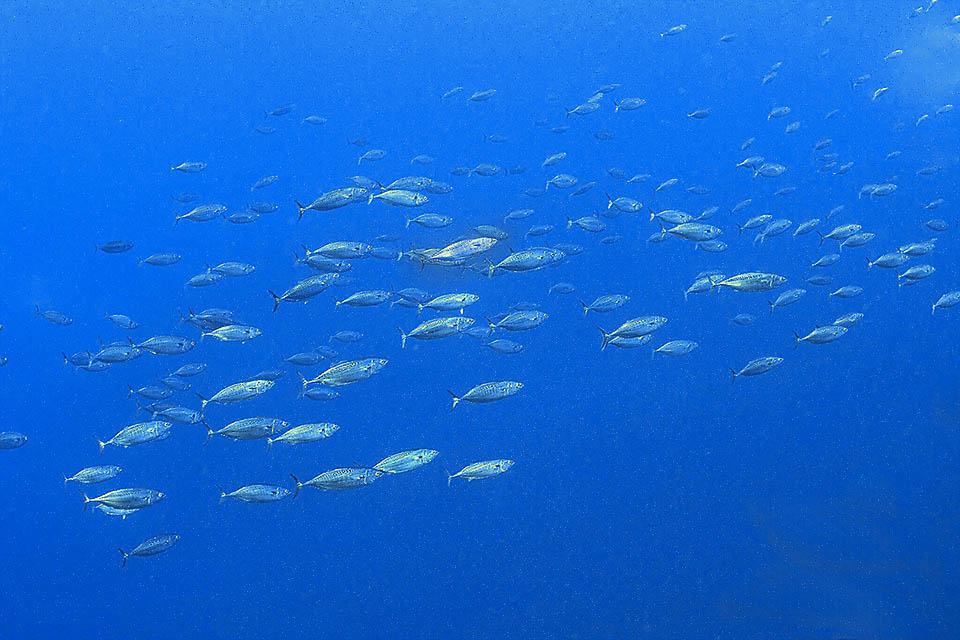
Lives on both coasts of Atlantic forming moving schools, often mixed, that may exceed 3 km in length with more than 5.000 individuals © Luis Pérez Berrocal
Together with the Atlantic bonito and the Bullet tuna, the Little tunny is inserted in the class of the Actinopterygii, the ray-finned fishes, in the order of the Perciformes and in the family of the Scombridae, that, getting its name from the Atlantic mackerel (Scomber scombrus), counts 15 genera and more than 50 species.
The genus Euthynnus, created by Lütken in 1883, originates composed by the Greek “eo”, good, and “thynnos”, tuna, reminds us that despite the modest size these fishes have all the characteristics of a tuna, whilst the specific term alletteratus, given by Rafinesque, is an allusion to the characteristics vermiculated drawings on its back, doodles that evoke, starting from several vulgar Italian names, the letters of the alphabet.
Zoogeography
Euthynnus alletteratus has a vast distribution on both Atlantic coasts.
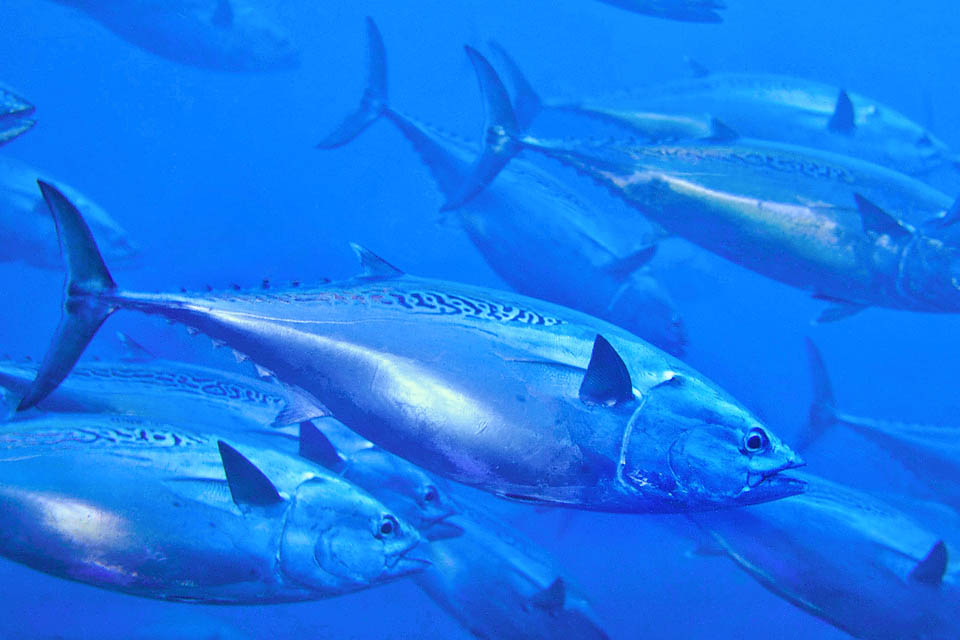
Even if current size is of about 80 cm, it has the characteristics of the large tunas but the flesh is not among the best © Athila Bertoncini Andrade
In America it is present from Massachusetts to the Caribbean and the Gulf of Mexico, and in the Old World, beyond the Mediterranean and the Black Sea, from the coasts of Denmark up to South Africa.
Ecology-Habitat
Rather chilly, as the seasonal movements do suggest, the Little tunny swims between 1 and 150 m in depth, in waters with temperatures between 24 and 30 °C. It is found in the open sea, but unlike other tuna it prefers the coasts, especially where the currents are fast. It forms endless schools of moving fishes, based more on size than on the species, that may exceed 3 km in length with more than 5,000 individuals.
Morphophysiology
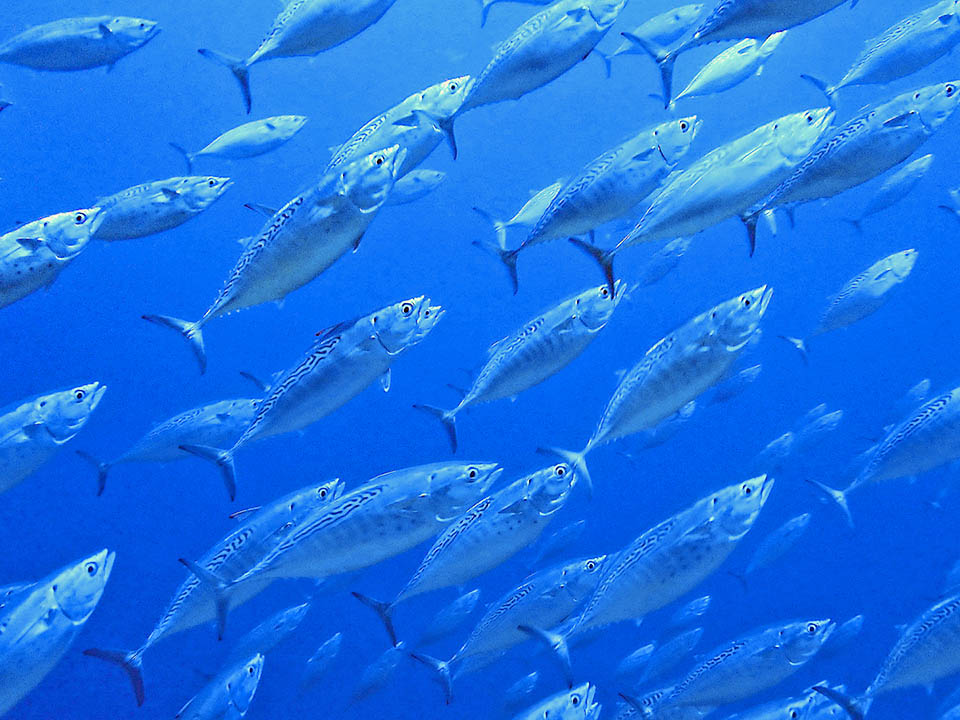
Here we well note in the specimen close to the left edge of the photo, the typical black spots on sides, under the pectoral, that by sure distinguish it from other Scombridae © Sylvain Le Bris
Even if the current size is around 80 cm, Euthynnus alletteratus can reach the length of 122 cm with a maximum weight of 16.5 kg.
The body is stocky and muscular with the head relatively short if compared to other Scombridae.
The scales, thickened in the front part of the body, forms like in the tunas a sort of girdle. Otherwise, the body has no scales, apart from the lateral line, essential, because with its sensors synchronizes the movements in the school.
The relatively short head has the lower jaw slightly protruding. Both have one row of small sharp teeth, at times present, but with poor solidity, also on the palate.
There are two dorsal fins separated by a short space. The first, pointed, has 12–16 decreasing spiny rays that form a concave edge, and the second, smaller, is similar to the anal. Then follow towards the tail, 8–9 pinnulae above and 7–8 below.
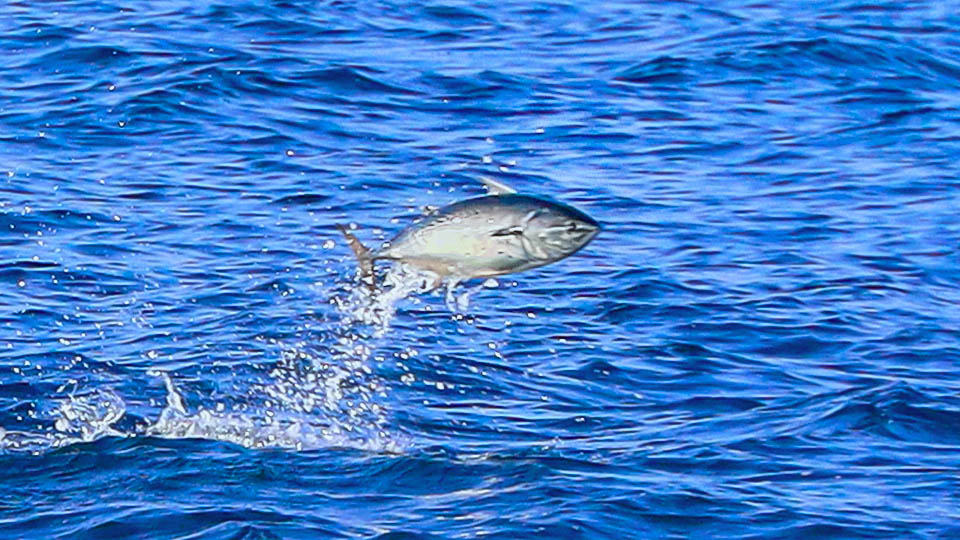
The Little tunny does showy leaps out of water at 40 mm/h to break the dense schools of bluefish, like sardines or anchovies © Falk Viczian Solarboot-Projekte gGmbH
The pectoral fins are short and robust. The pelvic ones have two points and the caudal, falcate with very open lobes, has at the base two small keels, separated by a larger one, that improve the hydrodynamics of the fish allowing a cruising speed of 5–10 km/h and sprints at 40 km/h for disorienting the preys or for escaping.
There is no swim bladder consequently the Little tunny must swim continuously so as not to sink.
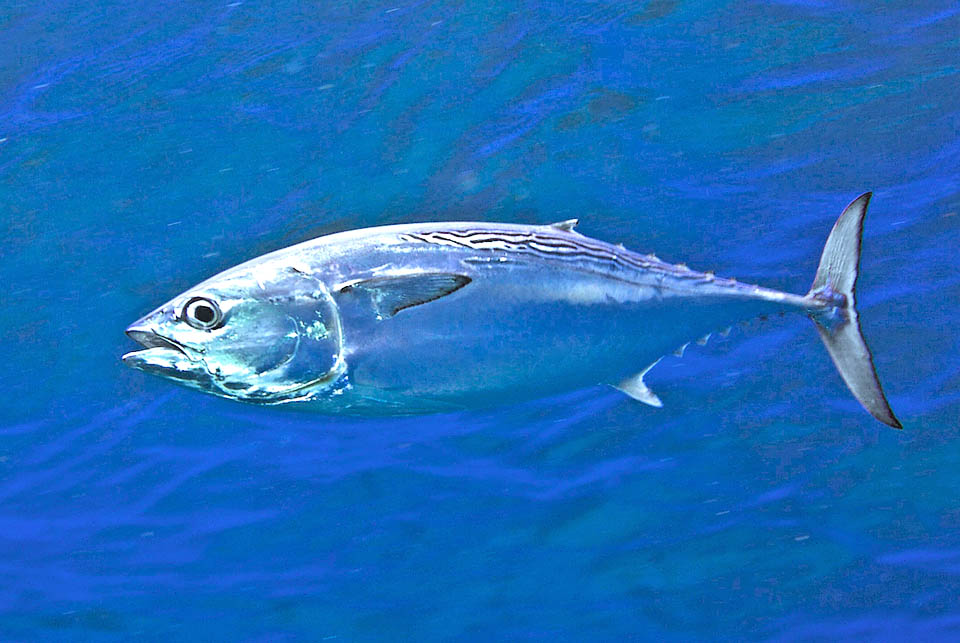
The livery, steel blue on the back with blackish scribbled drawings over the lateral line, distinguishes it at first sight from the Atlantic bonito that has straight stripes and from the juveniles of the Atlantic bluefin tuna (Thunnus thynnus) that do not have them at all.
For the rest the livery is silvery with characteristic black spots, more or less evident, under the pectorals that differentiate it from the Bullet tuna, among other things, smaller and tapered.
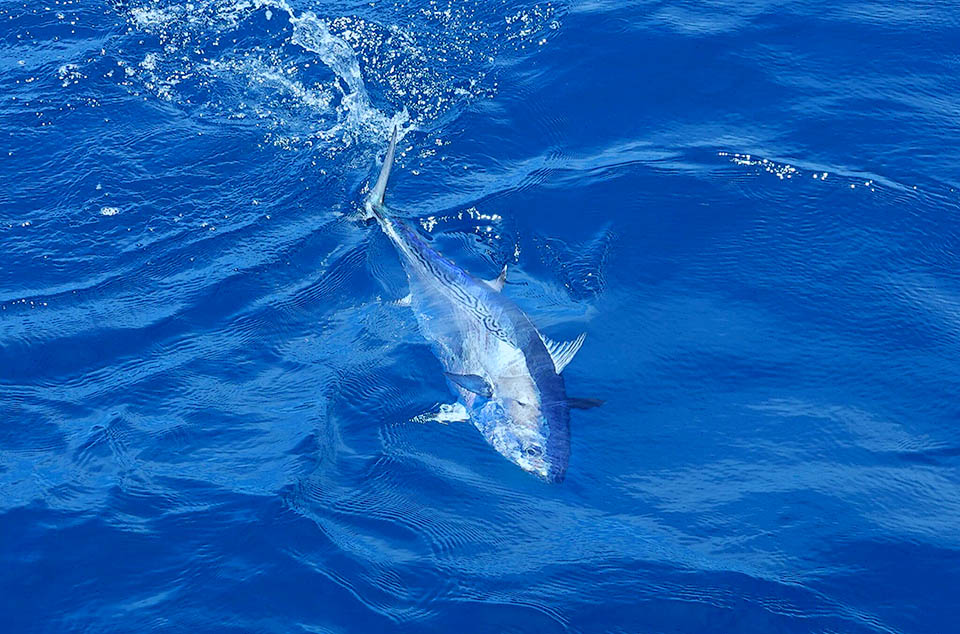
The attack team members are catalyzed by the thud, and everyone benefits because the confusion of the terrified preys facilitates the massacre © Donald Fraser
Ethology-Reproductive Biology
Euthynnus alletteratus mainly feeds on fishes like sardines and anchovies moving in school like it, but also on squids and crustaceans.
It reaches sexual maturity. when circa 38 cm with about 3 years of age and reproduces offshore, at 30–40 m of depth.
In the reproductive season a female may release, on several occasions, in the clouds of sperm, 1.75 million eggs.
These measure 0.8–1.1 mm and contain one drop of oil that improves their buoyancy for a fast ascension to the surface where they are carried by the currents and the about 3 mm larvae that are born immediately, after 24 hours from the fecundation, are also planktonic.
Euthynnus alletteratus mates offshore at 30-40 m of depth. In the reproductive season, every female can release, on several occasions, 1,75 million of floating eggs © www.carlosestape.photoshelter.com
The Little tunny regularly falls, unintentionally into the purse seine and gillnets, and due to its combativeness is hunted by sport fishermen, but its flesh, dark and red due to the high contents in myoglobin, protein present in the muscles that allows the storing of oxygen increasing the performances and the fatigue resistance, is not very sought-after because of the strong odour of fish and the possible risk of ciguatera, serious food poisoning linked to the toxin produced by the dinoflagellate Gambierdiscus toxicus, at times carried by the preys.
The resilience of Euthynnus alletteratus, that reaches the age of 5–7 years, is mediocre, with a possible doubling of the populations in 1.4–4.4 years, and the fishing vulnerability, moderate, marks 41 on a scale of 100.
The populations appear to be stable, and from 2022 the Little tunny appears therefore as “LC, Least Concern”, in the IUCN Red List of the endangered species.
→ For general information about FISH please click here.
→ For general information about BONY FISH please click here
→ For general information about CARTILAGINOUS FISH please click here.
→ To appreciate the BIODIVERSITY of BONY FISH please click here.
→ To appreciate the BIODIVERSITY of CARTILAGINOUS FISH please click here.