
Family : Orchidaceae

Text © Prof. Pietro Pavone

English translation by Mario Beltramini
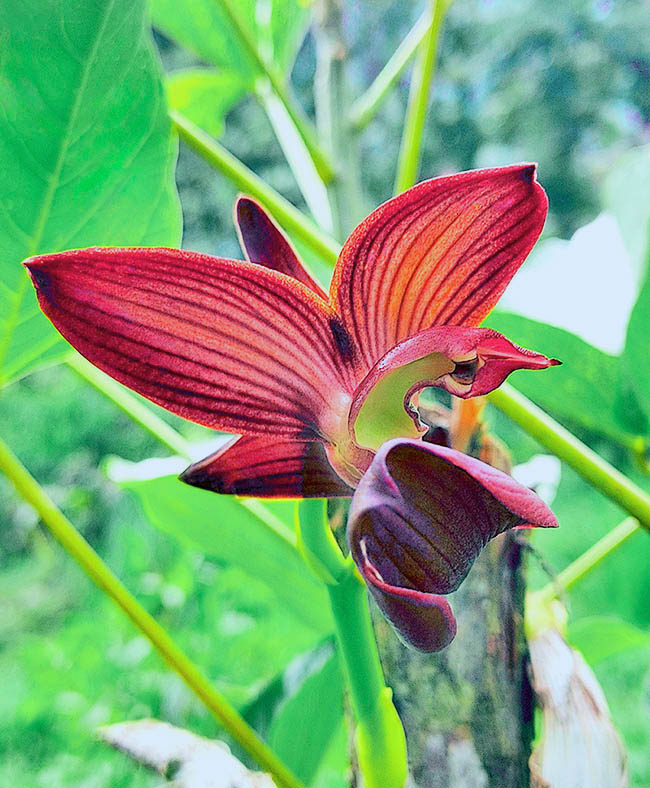
Due to the flower, Mormodes rolfeana shows well the origin of genus Mormodes, evoking a goblin in Greek © Paola Ordóñez M.
Mormodes rolfeana L.Linden is a species belonging to the family of the Orchidaceae, to the subfamily of the Vandoideae, to the tribe. Cymbidieae and subtribe Catasetinae.
It was described in 1891 by the Belgian botanist, horticulturist and explorer Lucien Linden (1851-1940) and published in the magazine Lindenia (7:5, 1891).
Initially the name of the species was Mormodes rolfeanum, later on amended in Mormodes rolfeana because in botany the name of the genus is treated as feminine.
Son of the famous botanist and explorer Jean Jules Linden (817-1898), he inherited his passion for tropical flora from the father, succeeding him in the management of the famous family business “Horticulture Internationale, Société Anonyme”, based in Brussels, specialized in import and marketing of exortic hoiuseplants and in particular orchids.
He published several works among which the impressive volume of more than 1000 pages “Les Orchidées
Exotiques et leur culture en Europe” published in 1894 in collaboration with Célestin Alfred Cogniaux (1841-1816) and Georges Grignan (1853-1928).
Lucien Linden has been the director of some of the most remarkable illustrated botanical publications of the XIX. We mention: Lindenia. Iconographie des Orchidées rich in hundreds of chromolithographic plates of the species described; Le Journal des Orchidées, magazine dedicated to cultivation and study of the orchids and the
L’Illustration Horticole, magazine with extraordinary chromolithographs of exotic plants, orchids and varieties selected by the floriculturists.
The name of the genus Mormodes comes from the Greek words mormō (μóρμω), that means “goblin”, “ghost” or “scaring monster” and -oeidēs (-οειδής) that means “similar” or “similar in shape”, alluding to the look of the flowers having an unusual and asymmetric shape. The specific epithet is honoured to Robert Allen Rolfe (1855-1921) british botanist specialized in the study of orchids, author of several species new for the Science. He has been the first curator of the orchidological herbarium of the Royal Botanic Gardens in Kew, and has founded the magazine The Orchid Review, considered as the oldest and most influential magazine in the world, presently edited by the Royal Horticultural Society (RHD).
Robert Allen Rolfe, though being self-taught of orchids, with his publications began to correct the descriptions done by Heinrich Gustav Reichenbach (1823-1889), at that time considered as the “king of the orchids” being the only one entitled to describe the new species that arrived in Europe.
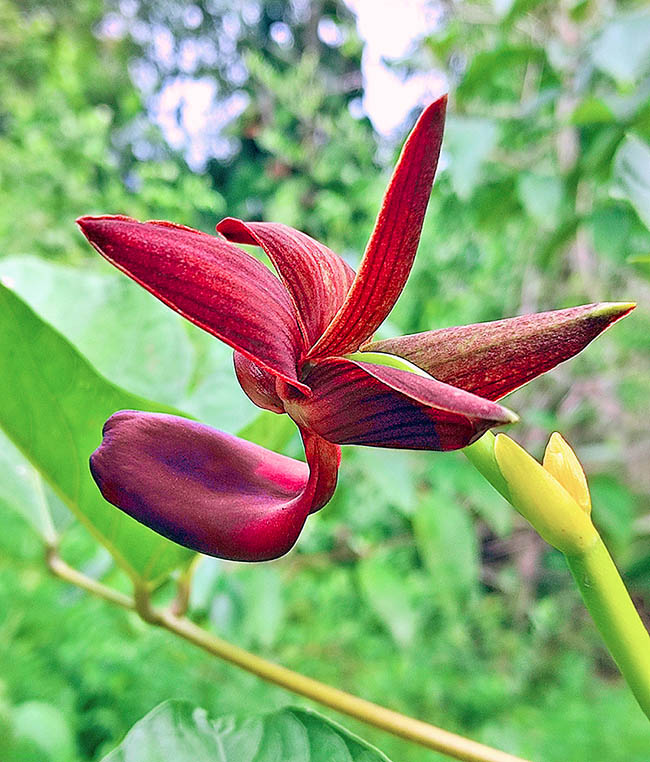
Flowers assigned to the species of this genus also emit a strong scent attracting the bees of the tribe Euglossini © Paola Ordóñez M.
The acme of the rivalry took place upon the death of Reichenvach when they discovered that instead of leaving his herbarium with thousands of samples and unique drawings to the Royal Botanic Gardens of Kew, in his will he left this this immense patrimony to the Vienna Natural History Museum, putting a clause as a mandatory condition: “The collection had to remain sealed and inaccessible to anyone for 25 years”.
The purpose was clear, to prevent Rolfe and the British researchers from consulting the “phyla” on which he had done the botanic descriptions. He feared that, after his death, the English would have “plundered” his work to take the credit of discoveries he had not been able to publish.
Rolfe, because of this, had many problems because it was impossible for him to determine if the orchids that reached Kew from America had been already described or not.
This created a great deal of confusion in the botanic nomenclature of the time and only in 1914, upon expiration of the imposed deadline, when Reichenbach herbarium was opened, they noticed that many species were already described, under different names and therefore a long work, lasted decades, was necessary for the nomenclatural corrections.
Mormodes rolfeana, commonly called Rolfe’s Mormodes, is a rare orchid present in Bolivia, Colombia, Ecuador and Peru. In Ecuador, it is found in the province of Morona-Santiago, in the belt of the Cordillera del Condor, at an altitude of 1100 m.
In Peru, it grows in the department of Pasco, at about 15 km north-east to Owapampa at an altitude of 1750 m. Usually is found in the rainforests at altitudes between 900 and 1900 m.
It is an epiphytic and caespitose species that may reach a height of 60-70 cm. It has fusiform pseudobulbs at timed ovoidal-fusiform, up to 27 cm long and with a diameter of about 3,6 cm, covered by 6-9 pairs of foliar distichous imbricate sheaths.
The leaves are lanceolate or elliptic-lanceolate, sub coriaceous, of bright green colour, up to 25-40 cm long, deciduous.
The inflorescence originates from the base of a mature pseudobulb with leaves. It is a racemose, up to 28 cm long, and bears 6-10 flowers. These are about 10 cm large on 5 cm pedicels and emit a penetrating scent, sweet, at times slightly spiced, like that of anise or even of chocolate.
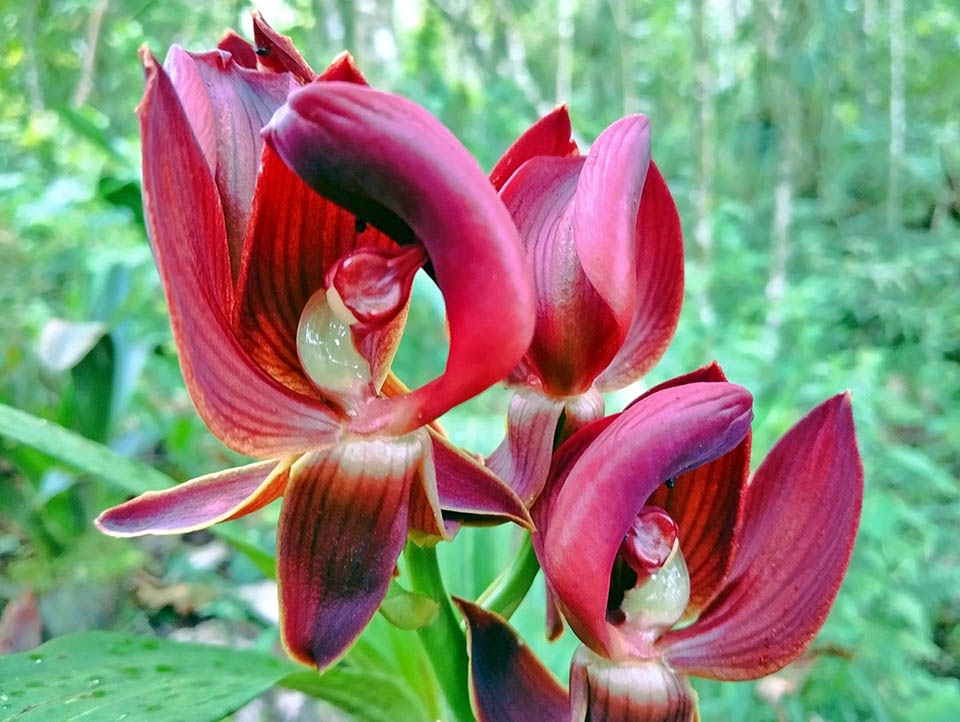
To stick their pollinarium, avoiding self pollination, the column and the labellum finally do a 90-180° torsion in respect to the axis of the flower © Paola Ordóñez M.
Moreover, inside the same inflorescence there is the phenomenon called “enantiostyly”. The flowers are asymmetric for a lateral torsion to the right or to the left. This asymmetry serves to prevent teh self-pollination and, in the meantime, to promote the crossed fecundation. In fact, thanks to the asymmetry of the flower, the pollen sticks to one side of the pollinator. The insect, with the pollen stuck on a side, will deposit it on the stigma of another flower with opposite asymmetry and not on the same where it has received it.
The asymmetric and rich in scent flowers are a distinctive characteristic of the genus Mormodes. The petals and sepals of Mormodes rolfeana usually display a green yellowish to brown reddish colouration, often with darker longitudinal veins. The sepals are patent, usually ovate-lanceolate or elliptic-lanceolate, sharp, 4-4,5 cm long, with reflections when completely open. The petals are acute, elliptical and oblong wider than the sepals. The golden yellow or yellow-orange labellum contrasts with the sepals and the petals. It is fleshy, trilobed with a central lobe often reflexed. The base is apiculate, widely unguiculate and 2,5 cm wide. The column is arcuate, rigid, 2,5 cm long, of pink-purple colour in the upper part, with green stigma and cover that covers the anther red-purple.
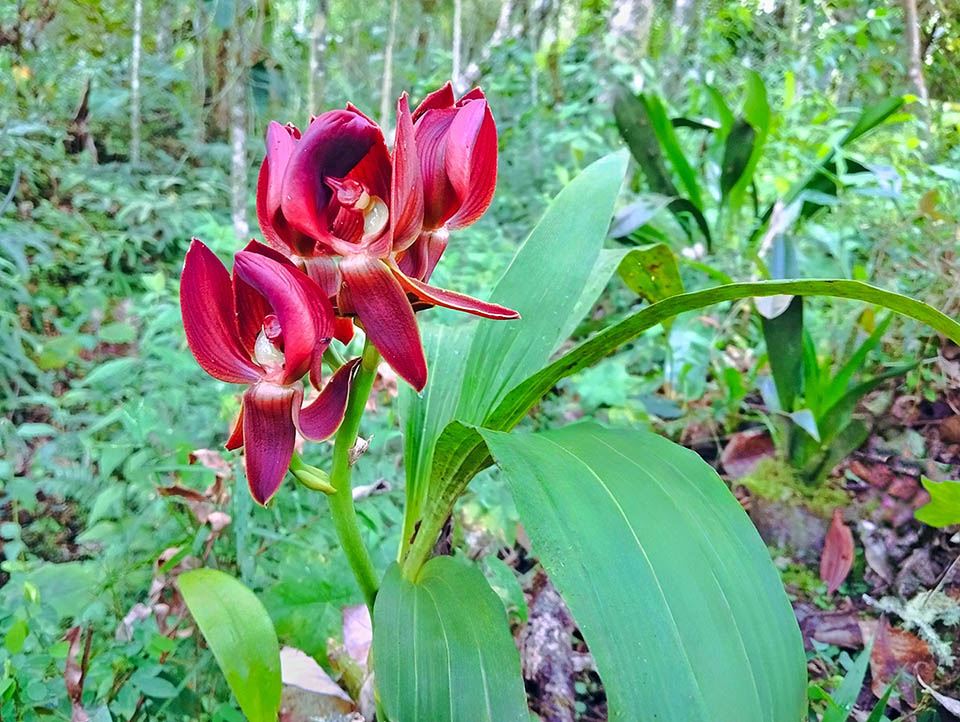
Mormodes rolfeana is a rare orchid present in the rainforests of Bolivia, Colombia, Ecuador and Peru at altitudes between 900 and 1900 m © Paola Ordóñez M.
The pollination is exclusively entrusted to the males of the bees of the tribe Euglossini called “bees of the orchids”. In fact, the males collect the volatile aromatic substances present in the flowers with their bristly structures present on the fore tarsi and immediately conveyed in spongy cavities, present in the rear legs. The odours collected can play a rôle of sexual attractiveness towards the females. When the bee lands on the labellum and touches the antenna of the column, the flower expels violently the pollinodium that adheres immediately to the back of the insect by means of the viscidium (or retinaculum).
Studies on some species of the genus Catasetum, of the same subtribe Catasetinae to which belongs the genus Mormodes, have estimated that the pollinodium is expelled at a speed of 2-3 metres per second and the time of reaction, from when the insect touches the antenna, is of about 10-15 milliseconds. The impact is strong and serves to allow the viscidium to merge instantly with the body of the bee. The bee, stunned, leaves the flower immediately and resumes its research on another flower ensuring the cross-pollination.
The flowering of Mormodes rolfeana begins in winter and continues until early spring.
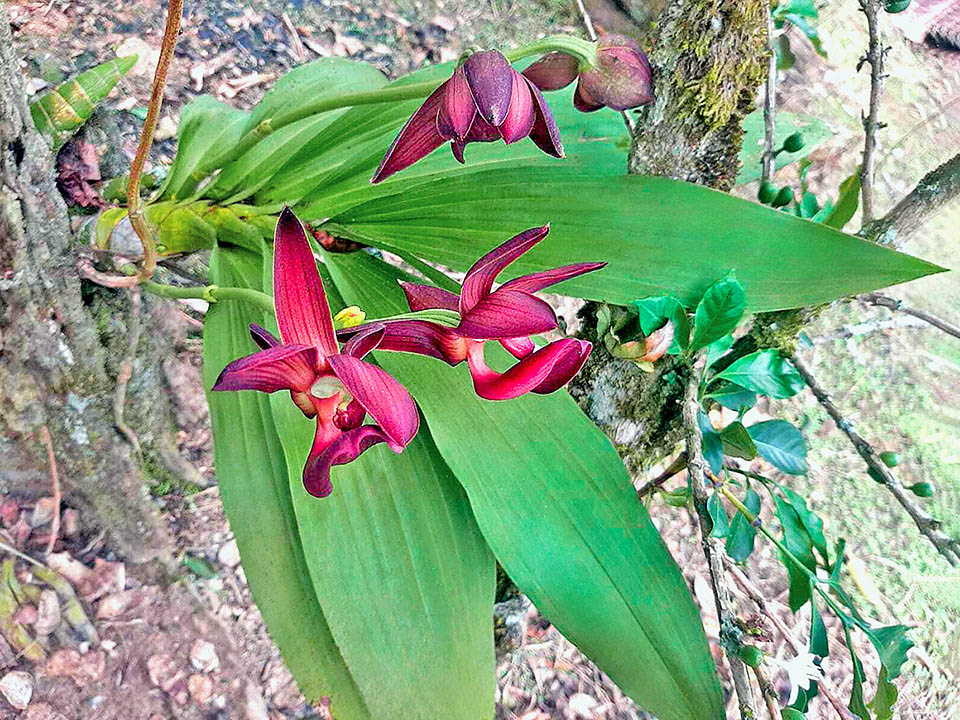
Epiphyte cespitose, can be 60-70 cm tall, with even 27 cm long pseudobulbs and almost 40 cm deciduous leaves © mariela_cordova
After fecundation from the ovary forms a dehiscent fruit (capsule) that frees very small seeds that will be dispersed by the wind. Germination requires symbiotic mycorrhizal fungi to provide essential nutrients, as the seeds have no endosperm and depend on fungi for the initial development. Mormodes rolfeana is threatened due to the loss of its habitat and the unlawful collection. It is protected by the Appendix II of CITES that rules the international trade for preventing its excessive exploitation. The climate change further endangers the populations for the changes in the seasonal precipitations as well as for the resulting fires that may interest vast areas of its habitat.
It is a very ornamental plant and for this reason is sought after by collectors. Its flowers are particularly appreciated not only for their particular shape, but also for their intense fragrance. For its cultivation may be utilized pots or baskets and a loose substratum like pine or fir bark that rapidly drains the excessive water. The possible addition of peat, sphagnum or perlite is useful for maintaining the substratum moderately humid. Charcoal can also be inserted to guarantee the permeability of the substratum to air and protect it from acidification. Mormodes rolfeana has moderate thermal needs.
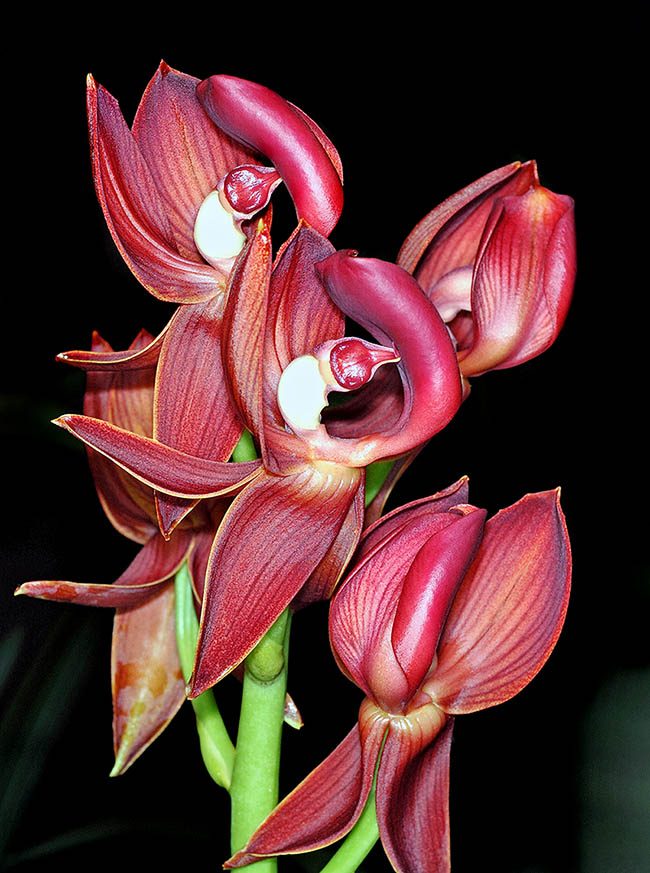
Mormodes rolfeana grows well in cultivation and has originated several prestigious hybrids © Eric Hunt
It grows well with an average day temperature of 23-28 °C, and slightly cooler by night, 18-24 °C. Throughout the year it requires 75-80% of humidity.The light must be intense and filtered but the direct sun must be avoided.
It mainly propagates vegetatively by the division of the rhizome, with 1 or 2 pseudobulbs and also by seeds, but in conditions controlled in vitro.
In cultivation the plant is to be often watered during the active growth, but it is good to control that in the roots no water stagnates. The buds are very sensitive to root, therefore attention is to be paid that the water does not settle on the rowing young buds.
During the growth it is better to fertilize weekly with 1/4-1/2 the dosage recommended of fertilizer for orchids. A fertilizer with a high content in nitrogen is useful from spring to mid-summer, whilst one richer in phosphorus is good in late summer and in autumn. When the leaves do fall, the plant enters rest and does not need water. Also the fertilization must be stopped until the appearance of new buds.
Waterings may be resumed in spring. Too much water in winter causes the plant to die by rotting. However, if the pseudobulbs wrinkle, it is necessary to water lightly, but with high humidity usually this problem does not arise. When only sphagnum is utilized as substratum, it is necessary to do one annual repotting, otherwise 2-3 years can be awaited. It is good to do the repotting when there are present more pseudobulbs in the same container. They may be separated leaving only one or two of them in the pot. The old dead roots should be eliminated. After repotting, watering must not be done until the new roots do not appear. After, during the new growth, it is possible to proceed with one normal watering.
Mormodes rolfeana has no varieties, even if in the world of collecting may be observed specimens presenting very marked streaks and others almost with solid colour, but they fall into the natural variability of the species and are not classified as botanical varieties.
Interesting is the primary hybrid Mormodes Wild Rainbow with its lively colours, from yellow to intense red, with streaks obtained by crossing Mormodes rolfeana and Mormodes andicola by William A. Baker, hybridizer active in many different genera and in particular in those of the subtribe Catasetinae. The hybrid was officially registered at the Royal Horticultural Society (RHS) on November 25, 2015. The hybrid Mormodes
Nitty-Gritty (Mormodes Exotic Treat and Mormodes rolfeana.) has flowers from dark orange to intense red, often with bordeaux or crimson spots. This hybrid has been created by Fred Clark, owner of the renowned nursery Sunset Valley Orchids, and officially registered at the Royal Horticultural Society (RHS) in 2012. It is a hybrid producing many flowers and is easy to grow.