
Family : Anatidae

Text © Dr. Gianfranco Colombo

English translation by Mario Beltramini
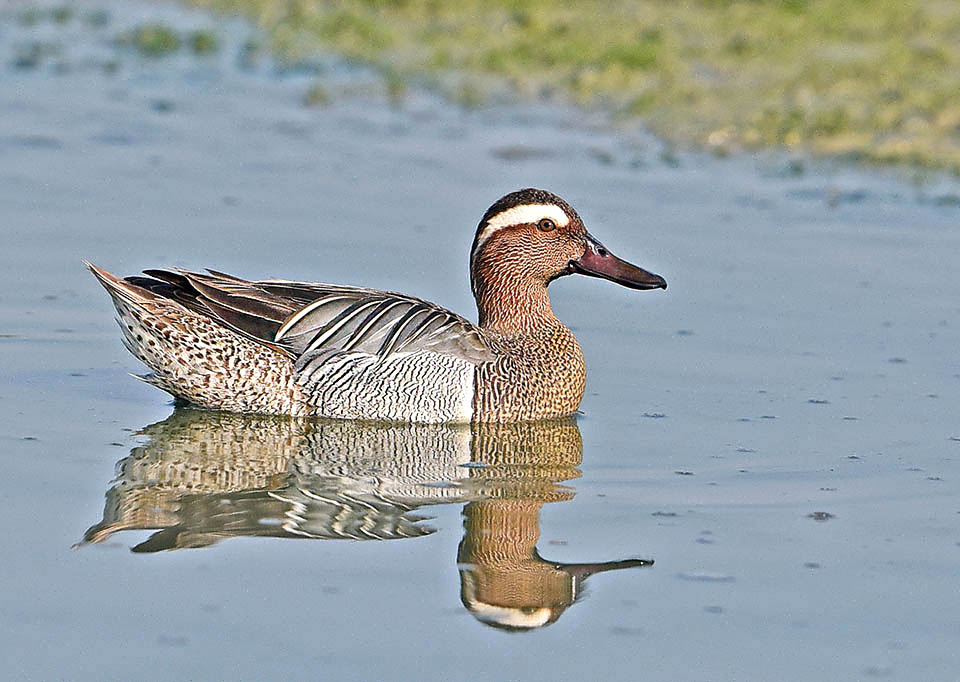
As the Italian vulgar name states, the Marzaiola (Spatula querquedula) migrates right in March in spring quarters to nest. Here male in nuptial livery © Gianfranco Colombo
Marzaiola (of March), a common name certainly spot-on this, given by the Italians to the Garganey, this small and lively duck!
Perhaps the only one that identifies a season, a specific period of the year instead the usual colours of the plumage or a morphological characteristic or even a behavioural trait. An ancient name, evocative, self-explanatory, that identifies the timing with absolute precision of the migration movements of a bird that crosses our skies twice a year with a constancy enduring from thousands of years.
The Garganey (Spatula querquedula Linnaeus, 1758) belongs to the order of the Anseriformes and to the family of the Anatidae and is together with the Eurasian teal (Anas crecca), one of the smallest Palearctic ducks.
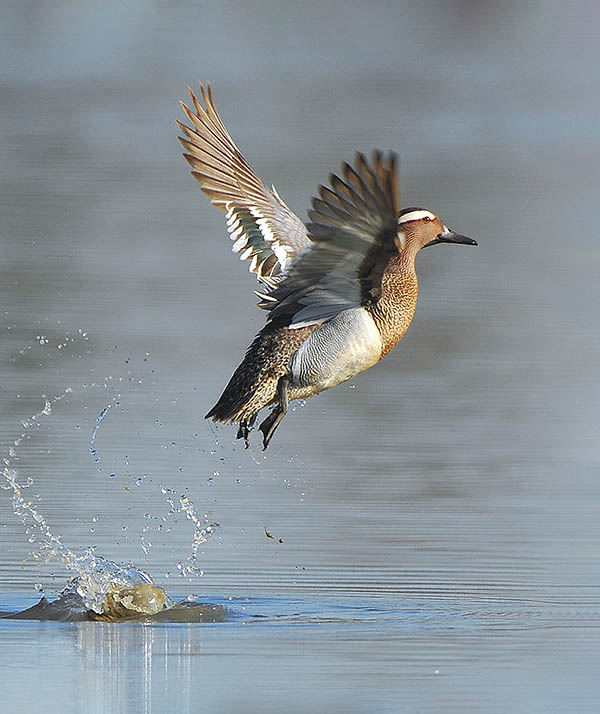
Like all anatids, it’s strictly linked to the freshwater humid environments © Gianfranco Colombo
The punctuality this bird demonstrates during the spring migration towards its nesting areas often has a majestic quality, veri similar to the big migrations the geese and the cranes perform when, very numerous flocks and concentrated in few days, flood the skies of the Palaearctic with their flights and even more with their sounds.
In mid-March, when those dark, rain-laden storm clouds cross the grey sky, pushed by an often strong wind but already warm for the season and that with scattered showers sudden and as fast as their speed, flood the underlying nature that is slowly waking up, here they begin to appear, unmissable, compact and darting flocks of these birds.
The flight of these small ducks is very fast and characterized by agitated and nervous movements, with the sudden spurts and abrupt movements typical of small wading birds but in the meantime with a compactness of the flock that displays a great capacity of aerial coordination.
On the other hand, these transfers being done on remarkable distances , their strength, although driven by the primal instinct to return to their native places, must be helped by a considerable flight capability.
As we have said for the Eurasian teal, the local names given to the Marzaiola in various parts of Europe and also the scientific binomen Linnaeus has given to this species, has probably had its origin from an overlapping between the species and often also by a confusion that still now occurs often among these birds.
Both the Latin term crecca and querquedula given to the two species, have an onomatopoeic origins as both are fairly talkative and noisy.
Crecca, given to the Garganey, should come from the Swedish “kricka” that perfectly imitates the sound “crekcrek” emitted by the Marzaiola and querquedula given to the Eurasian teal imitates the particular and low “quekcuekcuek”, typical to the Eurasian teal.
Equally significant but distinctive is the Lombard vulgar name given to the Marzaiola, “resghèt”, hacksaw, rightly for identifying the typical noise of the saw emitted continuously by this bird and and “garganel” to the to the Asian teal, name that, just to facilitate the confusion, the English, with “garganey”, give to the Marzaiola.
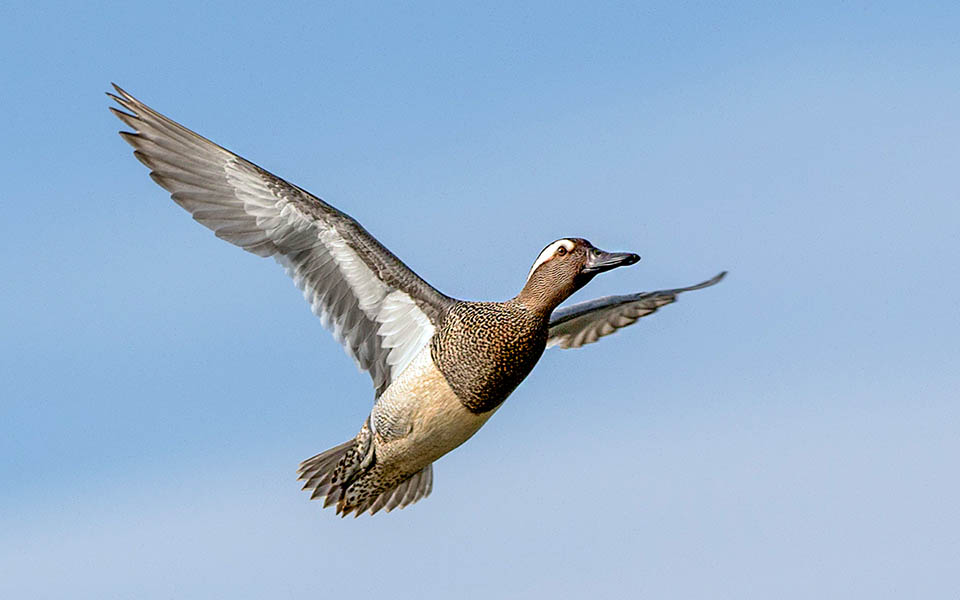
Measures about 40 cm with a 60 cm wingspan. The flight is very fast, characterized by restless, nervous movements © Gianfranco Colombo
In short, unifying the traditions and the vulgar names given to these birds by all peoples that are flown over by them, is quite difficult. In France the Marzaiola is called Sarcelle d’étè to identify it from the Sarcelle d’hiver, the Alzavola, in Germany Knäkente, in Spain Cerceta Carretona, in Portugal Marreco and in Great Britain, rightly, Garganey.
The etymology of the scientific binomen comes from the Latin ‘spatula”, spoon, of course referred to the typical beaked form of the ducks, even if this term should be more proper to the congener Northern Shoveler
Spatula clypeata, known also as Anas clypeata, and Spatula spp), ducks rightly characterized by shapeless neaks and querquedula by the sound “kwerk” or “kwak”, the particular muttering emitted by this duck, paired with Latin “querulus”, talkative.
Zoogeography
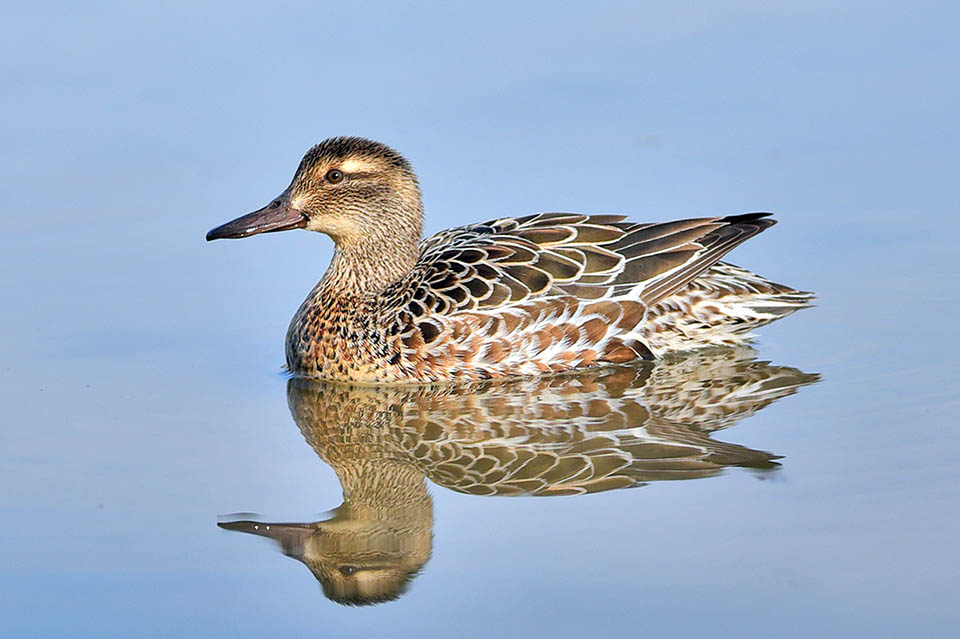
Female, practically same as that of the Alzavola (Anas crecca) has the body dotted of ocher brown, with the lower part cream © Gianfranco Colombo
The nesting territory of Spatula querquedula is fairly vast and covers a large part of the north continental part of Europe and of Asia, uninterruptedly from the Atlantic coasts up to the Pacific ones. The northern limit of the range does not usually exceed the Arctic Circle and in the southern part indicatively stops around the 49° parallel, avoiding, of course, the arid and mountain zones, sites not suitable for its style of life, strictly aquatic.
However, its presence on the territory is not regular and assiduous and often presents sparsely populated areas or even with showy blank spaces while presenting the ideal conditions for its presence. In Europe it lives in the southern part of the Scandinavian Peninsula and the territories that skirt the North Sea and the Baltic, in the central part with scattered but discontinuous colonies up to gradually being totally absent in the Mediterranean area.
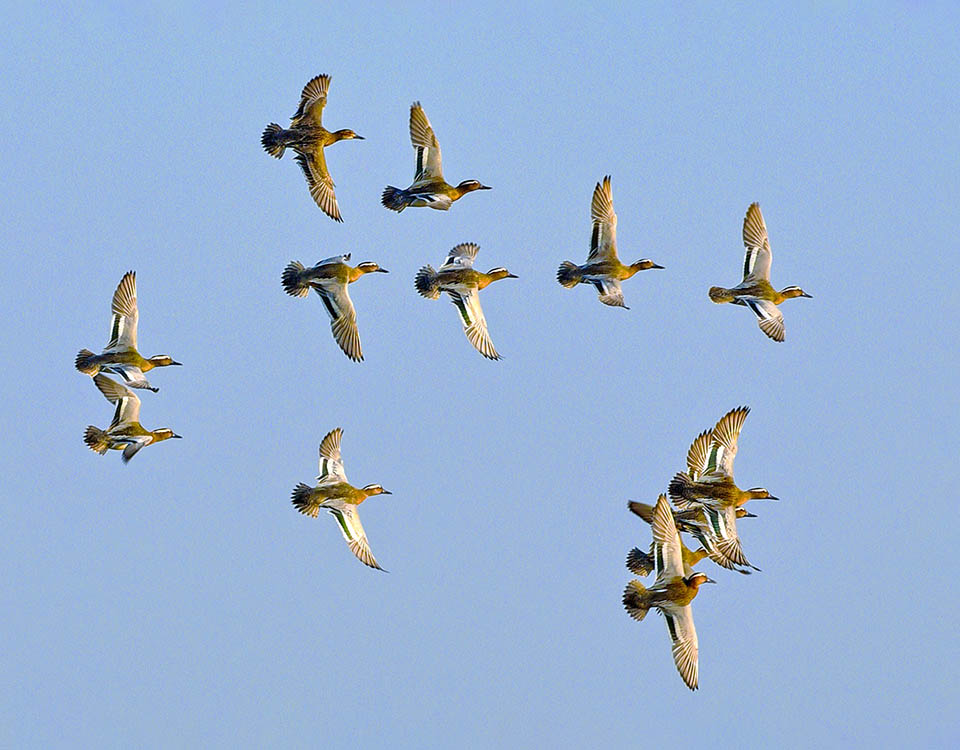
Marzaiola is a long range migrant, at transsaharien level for European and west Asian populations and towards India and south east Asia for the Siberian ones © Gianfranco Colombo
In Italy, the southern margin of the reproductive range and in particular in the Po Valley, it nidifies in a fragmentary way, in reduced numbers and never constant in the time.
In Russia and even further east, its present is instead more continuous and is found all over the belt occupied by the taiga and by the plains crossed by the big Siberian rivers and by the central lakes.
Spatula querquedula is a long-distance migrant, at a trans-Saharan level for the European western Asia populations and in the Indian subcontinent and south-east Asia for the Siberian populations.
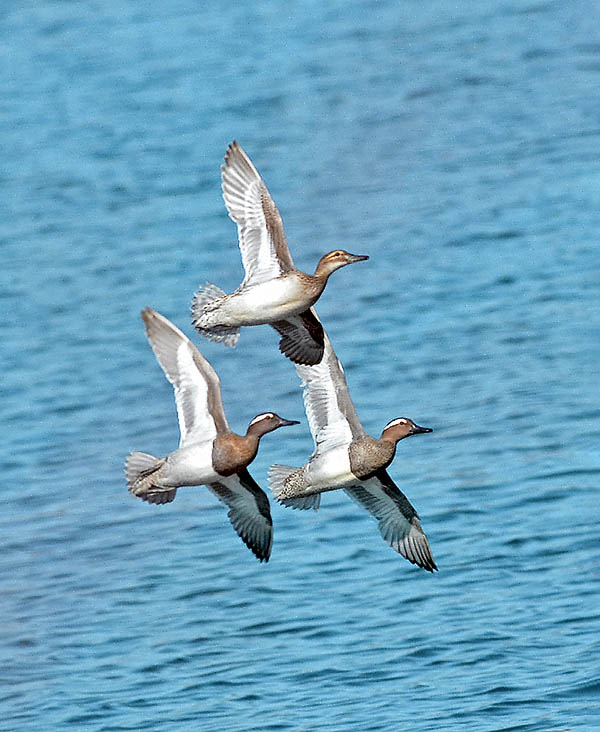
Two males and one female. Courtships begin in the winter quarters and consolidate while travelling © olegglushenkov
In Africa the largest concentration stands in the western part of the continent, from Senegal up to Lake Chad, though being present also in the eastern part reaching Sudan and the Horn of Africa.
In Italy and in the Mediterranean areas it is present only during the migrations and quite rarely appears in winter.
Ecology-Habitat
Like all ducks, also Spatula querquedula is strictly linked to the freshwater humid environments, for whatever genus and in any place they are sited.
It avoids the strictly marine environments even if at times it can rest on the sea during the migration but only temporarily to catch its own breath before undertaking again the voyage to the destinations. The marshes are surrounded by grassy meadows, with bodies of water, even if with limited open space, surrounded by marsh and riparian vegetation, also dense, ponds and flood plains.
It is not uncommon to observe, during the winter gatherings that take form regularly every year on some lakes and swamps of western Africa, flocks at times massive formed by tens of thousands of individuals.
Like the Asian teal, also the Garganey is a surface duck and gets its food plunging its head deep down and flailing its legs in the air in order to keep the precarious balance while rummaging through the bottom with its beak, emitting a noisy rumble caused by the emission of air bubbles.
Morphophysiology
The male of Spatula querquedula is unmistakable, especially during the reproductive time, when in the full majesty of its livery, displays colors and shadows of a particular beauty.
The head is blackish brown crossed by an ample white band that goes, starting from the front and following the brow line, ending at the nape of the neck.
The shoulders are covered by long white filiform feathers edged black that fall on the sides forming a fluttering shawl at the lightest breath of wind.
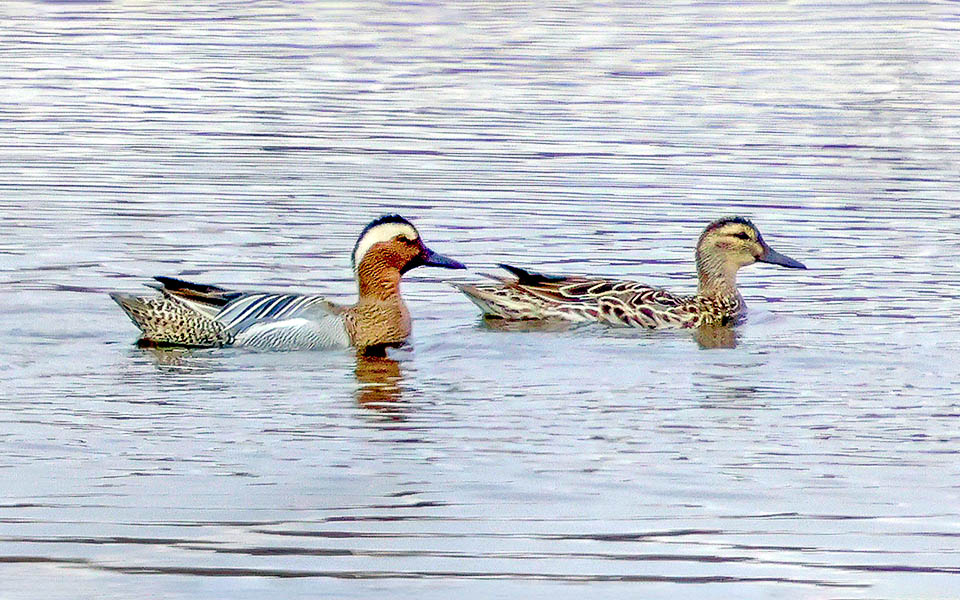
Here very close couple at destination. Marzaiola dedicates lot of its time in feeding during the night as well as during the day © Antti Henttonen
The chest has the same colour as the head but in detail it is formed by a dense and complex inlay of white and black feathers intersecting one another with the belly which, instead, is whitish even if, actually, it is the result of a very intricate and delicate embroidery formed by very thin lines of brownish colour on white background.
The terminal part of the body is densely spotted with hazel-coloured patches, colour typical of many ducks.
The legs are olive grey, the beak is pearl blackish and the eyes are intense dark brown.
During the eclipse season most of this vividness of colours goes losteven if the characters and the identifier drawings are maintained in a suffused way.
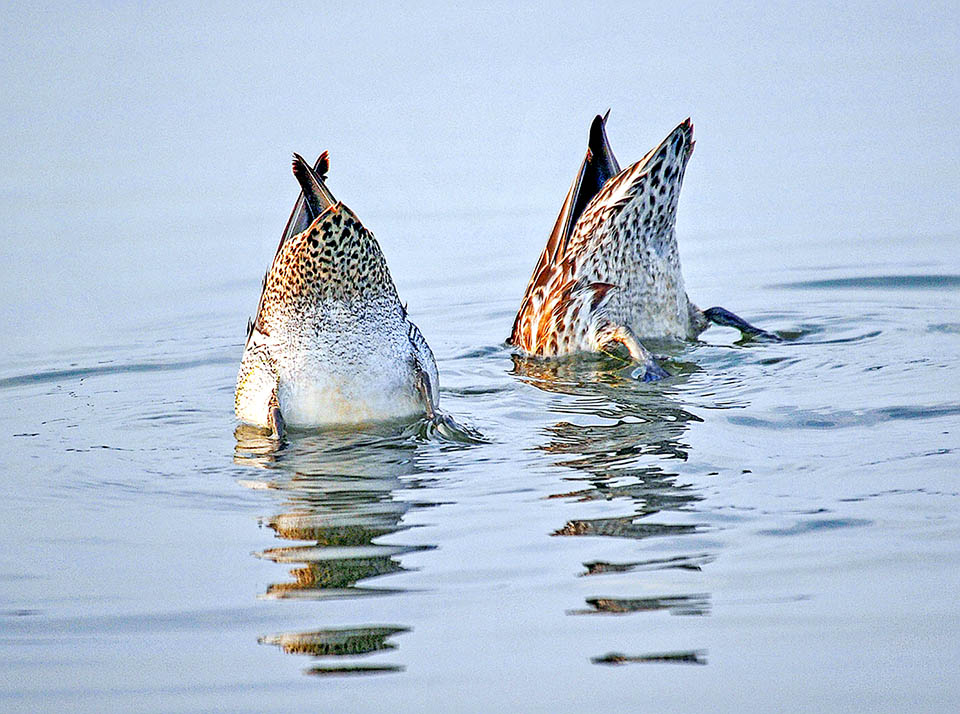
Feeds mainly on seeds and roots, weeds and tubers but does not disdain small aquatic invertebrates, crustaceans and mollusks, worms and larvae © Gianfranco Colombo
Conversely, the female does not display any colour or drawing that may attribute it to that of the partner, seeing that all the body is practically dotted ochre-brown with exclusion of the lower part that is homogeneously of cream colour.
This livery renders it practically the same as that of the female of the teal with which is often confused.
Only good connoisseurs of avifauna are able to identify at first glance between the two females belonging to this or that species, in particular when those small essential differences for determining cannot be observed due to the distance or the lack of light.
The female of Garganey has the beak slightly longer and darker, almost always blackish, unlike the Teal who has the lower jaw displaying a yellowish shade and presents also a whitish dot at the attachment of the beak.
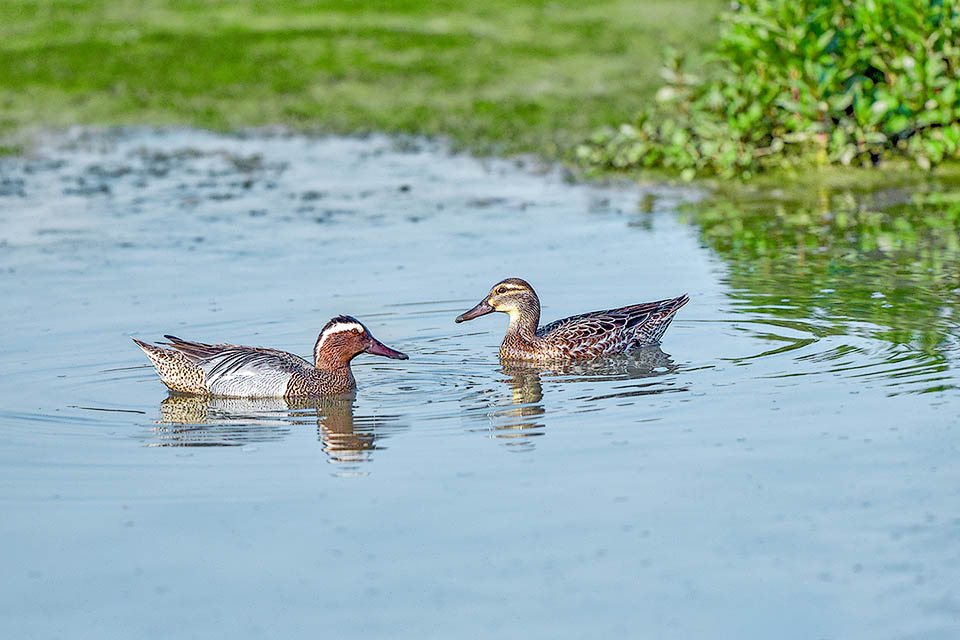
Best place for nesting. The female begins to build up the nest, hidden among high grass or well hidden under low bushes © Gianfranco Colombo
Is also present on the Garganey brow ridge a whitish line more or less defined but often well marked, characteristic not appearing on the Teale. Finally, small, particular but often decisive, is the green blue speculum not visible in the Garganey when staying on the ground, unlike the emerald green of the Teale who has it always very evident.
Additional variables might be added, also the different movements and the different posture when on the ground or in water.
The Garganey is much more lively than the Teale, with more jerky and agitated movements and its silhouette, often more elongated, makes her slimmer and thinner than the other, even if they are almost perfectly similar in their size.
The juveniles have the livery similar to the female and it is not easy to distinguish them from the adults as the growth period of the offspring coincides with that of the moulting of the parents thus creating even more confusion in the classification.
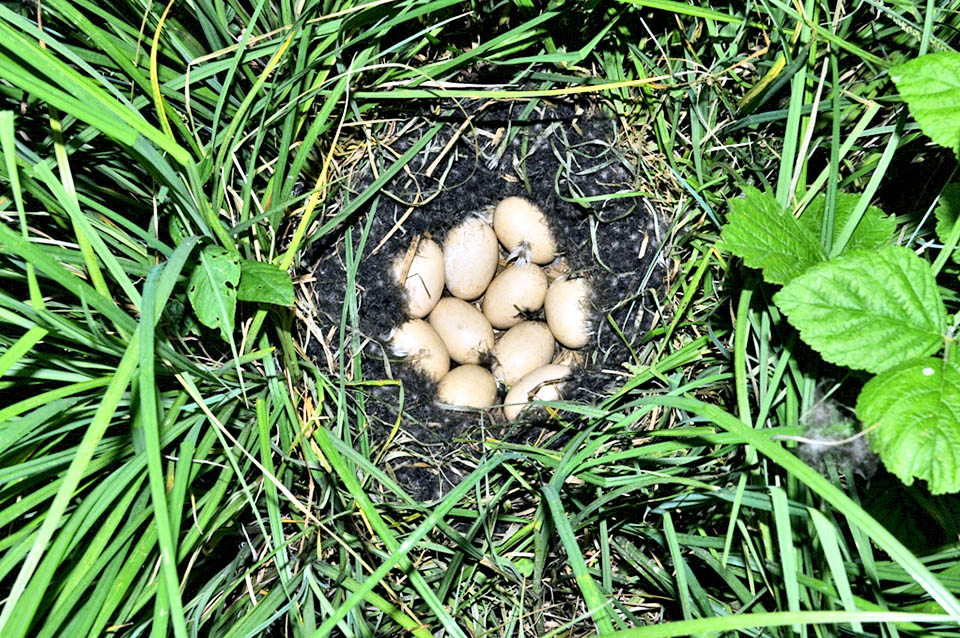
About a ten of eggs are laid, hatched by the female for three weeks © Gianfranco Colombo
However they have the chest much more speckled and the nuances all over the body are much more marked than the normal livery of the females.
Averagely, Spatula querquedula weighs 250 to 500 g depending on the season, a length of about 40 cm and a wingspan of 60 cm. A particularity typical to the membres of the order of the anseriformes is the composition of the tail.
Whilst in almost all other orders the number of the feathers forming the rectrices is of six couples, that is a total of twelve, in the ducks this is variable and goes from fourteen to eighteen. In the Garganey like in the congener Teal, the number of the rectrices usually stands in fourteen.
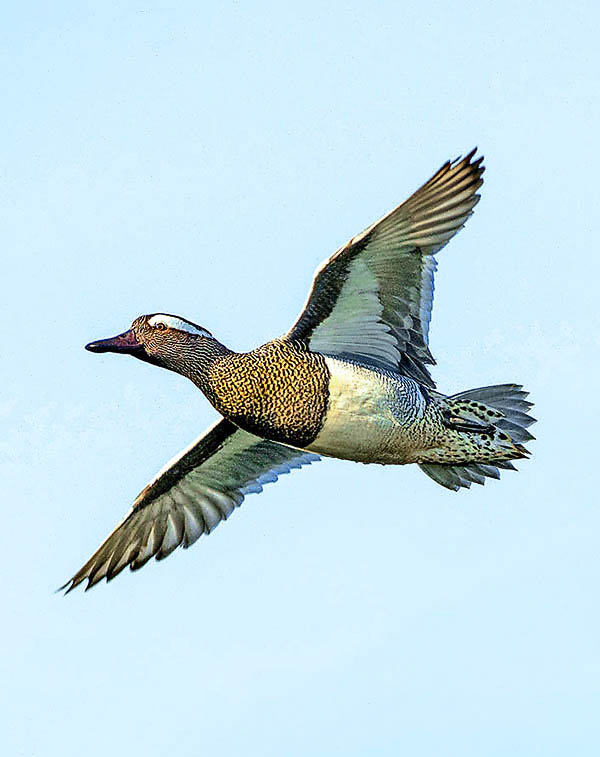
Male surveys from sky the territory defending it against intruders © Gianfranco Colombo
Reproductive Biology
As usual in the ducks, the formation of the couples occurs in the winter quarters and the return voyage to the nesting sites, sees consequently the formation of flocks composed by already formed couples and now well-coordinated.
Courting is continuous also during the migration and the autonomy of the couple is firmly established and defended by the strong promiscuity that arises during these extremely crowded transfers.
In the southern sectors of the range, nesting occurs in late spring but may also begin in full summer in the northernmost ones, seeing the different atmospheric conditions existing locally.
The subjects bound in these northernmost sites, often slow down their movement, lingering longer in the intermediate stages, as if they knew beforehand the climate conditions they will meet there upon arrival.
The relationship between the partners is so close that upon arrival on the place chosen for nesting there is no longer any reason for delaying the beginning of the reproduction.
The couple isolates themselves from the group and the female begins the building of a nest in a dry site, hidden among the tall grass or well hidden under low bushes at times many tens of meters far from the nearest stretch of water.
A base formed by aquatic grass, sedges and dried herbs decorated during the deposition and hatching, by a soft and light down released by the female itself.
The male will have no choice than to defend the territory against possible enemies and intruders keeping a continuous lookout, in a strategic location, during the the three weeks required by the hatching of the ten eggs laid by its partner.
The hatching is simultaneous and in a few hours all the whole brood, escorted by both parents, will immediately reach the nearest stretch of water keeping hidden among the grass on the banks and starting their aquatic life of which the ducks are true masters.
In a few months they will attain the size of their parents and by the time of the late summer/autumn migration, they will be fully ready for undertaking the long journey towards more pleasant climates. The juveniles will reach maturity by the first year of life.
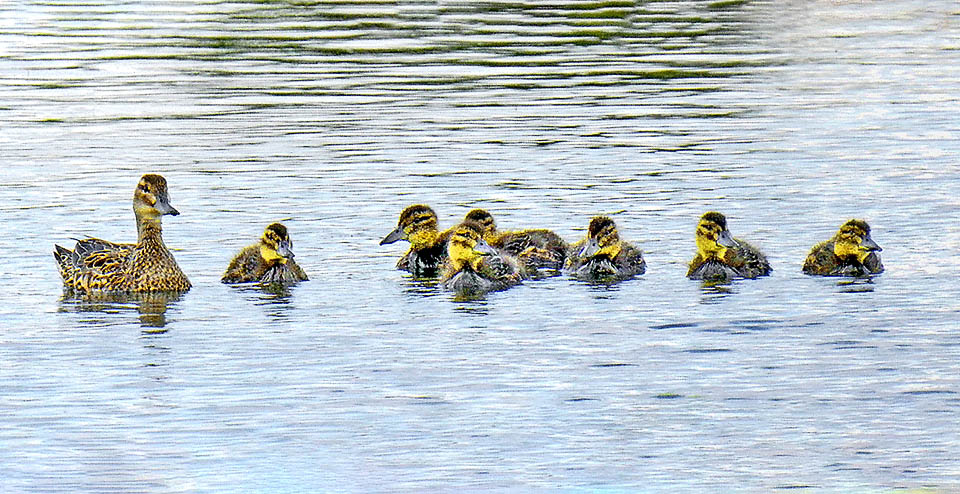
All went well. Here an alert female among her chicks © Thorsten Stegmann
Spatula querquedula is a very talkative bird in any moment of its life, particularly the male who emits continuously the famous “crekcrek” from which comes its scientific name and that has value of contact when in group as well as support to the partner while nesting. Conversely, the female emits a simple and low “quak” as if to answer to its call.
Spatula querquedula feeds mainly on plant material, seeds and roots, weeds and tubers but, if the occasion arises, does not disain small aquatic invertebrates, crustaceans and mollusks, worms and larvae.
It dedicates most of its time to feeding during the night as well as during the day, spacing these periods with the cleaning of its plumage and short naps in a state of alertness without losing the slightest bit of attention to everything happening around.
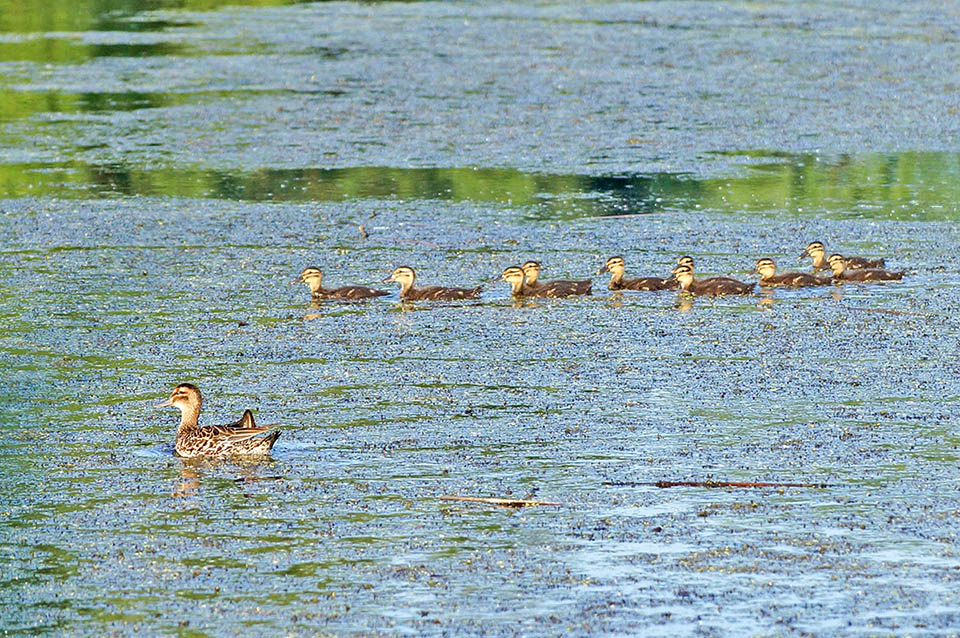
They grow up visibly reaching in few months the size of the parents ready for the late summer/autumn migration © Marina Privalova
Together with the Teal, this bird is one of the most hunted anatids in all the Palearctic and often is pointed out as an emblem for the struggle against the hunting activity and the request for a limitation of the same.
Nevertheless, albeit subject to heavy withdrawals, this duck does not show evident signs of reduction, on the contrary, it has been noted an expansion of its range with partial conquest of new territories in the southern part of its habitat. Consequently, from 2025 Spatula querquedula appears as “LC, Least Concern” in the IUCN Red List of the endangered species.
Synonyms
Anas querquedula Linnaeus, 1758
→ For general information about the Charadriiformes please click here.
→ To appreciate the biodiversity within the CHARADRIIFORMES please click here.