
Family : Bythitidae

Text © Dr. Giuseppe Mazza

English translation by Mario Beltramini
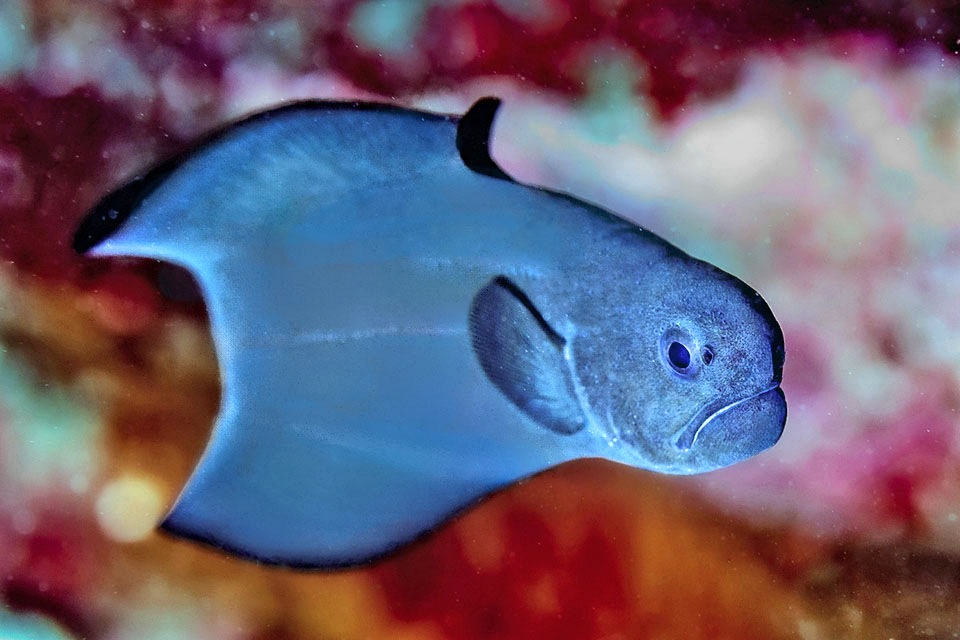
About 8 cm long, Stygnobrotula latebricola is present in the Caribbean basin and along the west coasts of tropical Atlantic, from south Florida up to Brazil © www.carlosestape.photoshelter
Within the Ophidiiformes, the family Bythitidae includes predominantly benthic fishes, closely associated to the seabed and to the numerous shelters offered by the substratum, where many species spend most of their existence. Unlike the Ophidiidae, the Bythitidae are ovoviviparous, characteristic representing one of the most peculiar biological traits of the family.
One of its most enigmatic members is Stygnobrotula latebricola Böhlks, 1957, described by James E. Böhlke on the basis of specimens collected in the Caribbean. The genus Stygnobrotula is monotypic and includes only this species, remaining known for many years almost exclusively through the original description and few subsequent reports, a circumstance that has made it one of the least documented Bythitidae.
The etymology exactly reflects the appearance and the habits of the animal. The generic term comes from the Greek “στυγνός” (stygnós), dark, gloomy or sullen, associated to brotula, the typical genus of the family, whilst the specific epithet latebricola originates from the union of the Latin terms “latebra”, hiding place, and “-cola”, denizen.
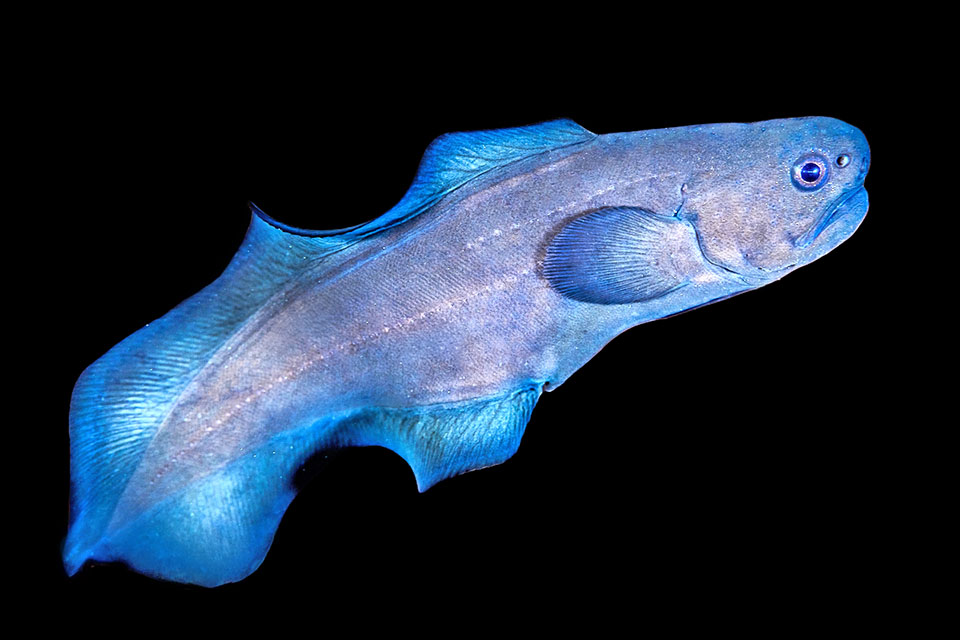
To note the continuity of odd fins and the characteristic double lateral line, partly overlapping, to detect even in dark the movements in the environment it lives © www.carlosestape.photoshelter
In its whole therefore the name may be then interpreted as “dark brotula living in the hideouts”, a surprisingly adhering definition to the behaviour of the species.
From its description, Stygnobrotula latebricola has remained one of the least observed Caribbean coral reefs fishes. Not so much because it is actually rare, but because it spends most of its life inside the cavities of the reef, leaving only occasionally its own shelter. For this reason underwater photography nowadays represents a valuable tool for integrating the limited information available about its natural history, documenting. its appearance, the behaviour and its relationship with the microhabitats.
Zoogeography
Species typical to the tropical western Atlantic, Stygnobrotula latebricola is widespread in the Caribbean basin and along the western coasts of tropical Atlantic, from southern Florida up to Brazil.
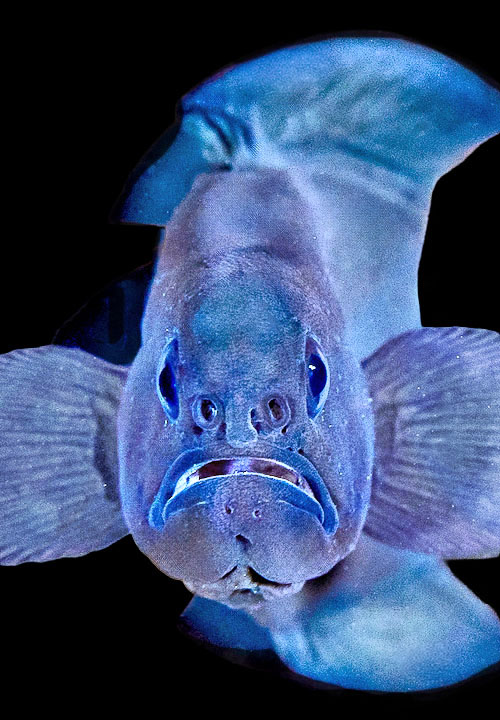
The mouth is wide and also the head has several sensory organs to locate the prey © www.carlosestape.photoshelter
The relatively few reports available probably reflect its extremely cryptic habits more than a real rarity. Living almost exclusively hidden in the ravines of the reef, the species easily escapes the observation and its range could be wider than what is presently documented.
Ecology-Habitat
Stygnobrotula latebricola is a species closely linked to the environments rich in hideouts. It lives in narrow cavities, cracks and small crevices of the coral and rock formations, where it gets protection from the predators and, probably, even the ideal conditions for the reproduction. More than a reef dweller, it could be considered as a dweller of its cavities.
The observations done in the natural environment display an extremely shy animal who rarely moves far from its osn shelter. In most cases only the fore part of the body is allowed to surface, staying ready to return the cavity upon the least sign of disturbance. This behaviour, combined with its small size and the inconspicuous livery explains why this species is observed so rarely also in areas where it might be relatively common.
The reports come from coral and rocky seabeds ranging from a few metres to over one hundred metres deep, as evidence of a remarkable ecological plasticity. However, in all cases, the presence of cavities and shelters appears to represent an essential requirement for the species.
Morphophysiology
The long and slightly laterally compressed body attai,s a maximum length of about 8 cm.
As in the other Bythitidae, the dorsal, caudal and anal fins join together to form only one continuous fin, solution favouring slow and precise movements inside the narrow ravines where the species does live.
The small cycloid scales are deeply embedded in the skin, giving the body a smooth appearance. The eyes, small and not very prominent, reflect a limited importance of the eyesight compared to the other sense organs. The mouth is wide and armed with small conical teeth: around the nostrils and the cephalic region we observe several sensory pores that, alongwith the lateral line, form an effective system to perceive the slightest water vibrations and locate the prey even in poorly lit environments. These structures are particularly evident in the frontal vision of the animal.
The presence of two lateral lines stands out among the most peculiar characteristics of the species. The upper originates behind the operculum and ends at about half body; the second originates under the pectoral fin and reaches the base of the caudal fin. This unusual arrangement, already evidenced by Bôhlke in its original description, constitutes one of the most evident diagnostic characters of the species.
Ethology-Reproductive Biology
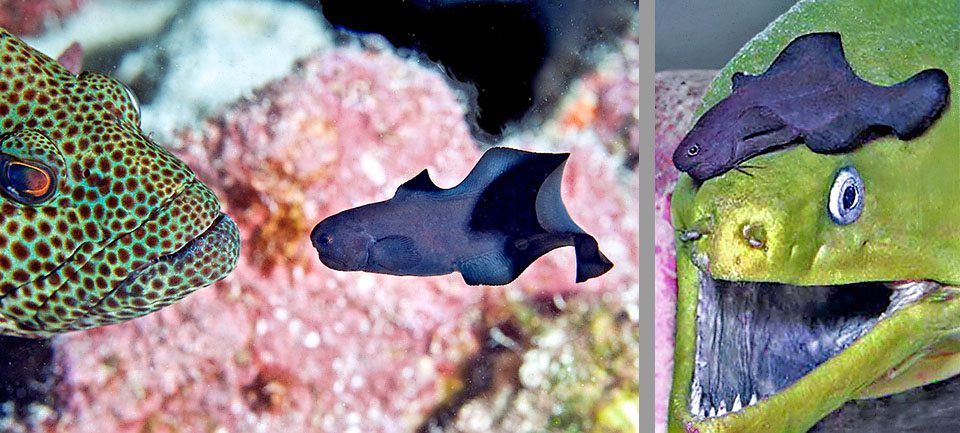
Unusual close encounters with two marauders: a grouper and a moray eel. A cohabitation with still unknown meaning © www.carlosestape.photoshelter.com (left) © Ellen Muller (right)
The knowledge about the behaviour of Stygnobrotula latebricola are still extremely limited, being a direct consequence of its cryptic habits. Taking refuge almost constantly in the cavities of the reef, the species is only occasionally observed and most of the available information concerns its morphology rather than its natural history.
Like all Bythitidae, Stygnobrotula latebricola is an ovoviviparous species: the fecundation is internal and the embryos complete their development inside the female, that deliver already completely formed newborns. However, remain almost unknown the reproductive behaviour, the modalities of the courtship and the relations between the two sexes. The images here document a prolonged interaction between two individuals. For a few minutes the fishes repeatedly approach, keeping a close contact, swim side by side and appear to always follow mutually coordinated movements. Although not allowing to attribute with certainty an ethological meaning to this sequence, the whole of the observations appears compatible with a recognition phase between conspecifics or with a possible courting behaviour. In the absence of further observations, such interpretation must however be considered as purely hypothetical.
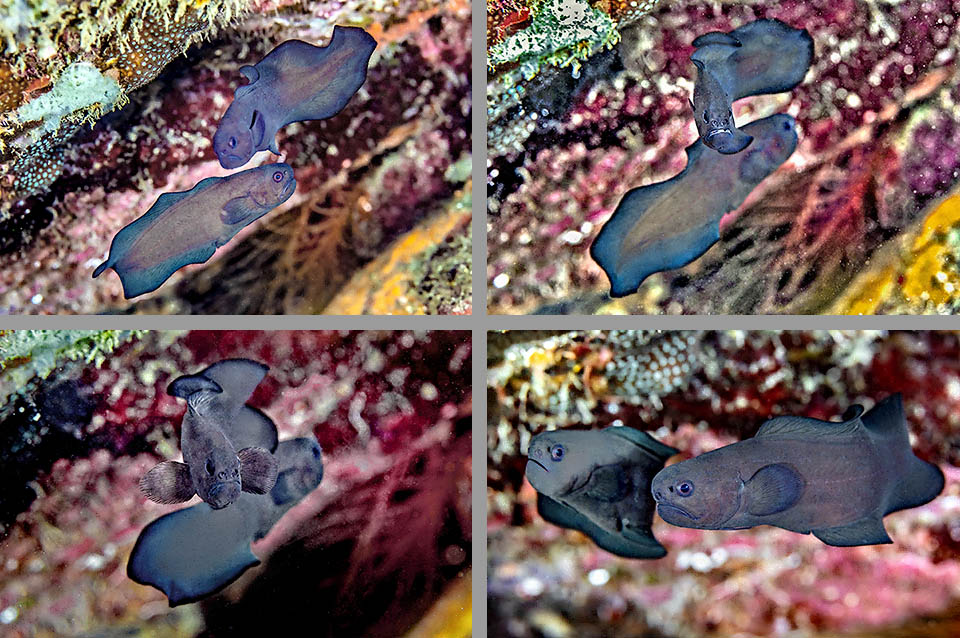
Stygnobrotula latebricola reproduction is little known. We know that it’s an ovoviviparous species and these images might suggest maybe a courting © www.carlosestape.photoshelter.com
Further observations document Stygnobrotula latebricola in close proximity to a moray eel and, on another occasion, to a grouper. Both meetings have occurred in correspondence of ravines of the reefs utilized as shelter. It is not possible to establish if it’s a matter of a simple sharing of the microhabitat or of a behavioural association; the photographic documentation is in any case a rare testimony of the natural history of the species.
The resilience of the species is considered as low, with an estimated minimum time for the doubling of the population within 4,5 and 14 years. However the fishing vulnerability is very reduced (10 on a scale of 100) and, considering the ample geographic distribution and the absence of specific threats, excluding the progressive degradation of the coral environments, from 2019 Stygnobrotula latebricola is classified by the IUCN Red List as “LC, Least Concern”.
Synonyms
Eutyx tumidirostris Boeseman, 1960.
→ For general information about FISH please click here.
→ For general information about BONY FISH please click here
→ For general information about CARTILAGINOUS FISH please click here.
→ To appreciate the BIODIVERSITY of BONY FISH please click here.
→ To appreciate the BIODIVERSITY of CARTILAGINOUS FISH please click here.