
Family : Campanulaceae

Text © Prof.sa Franca Bessi

English translation by Mario Beltramini
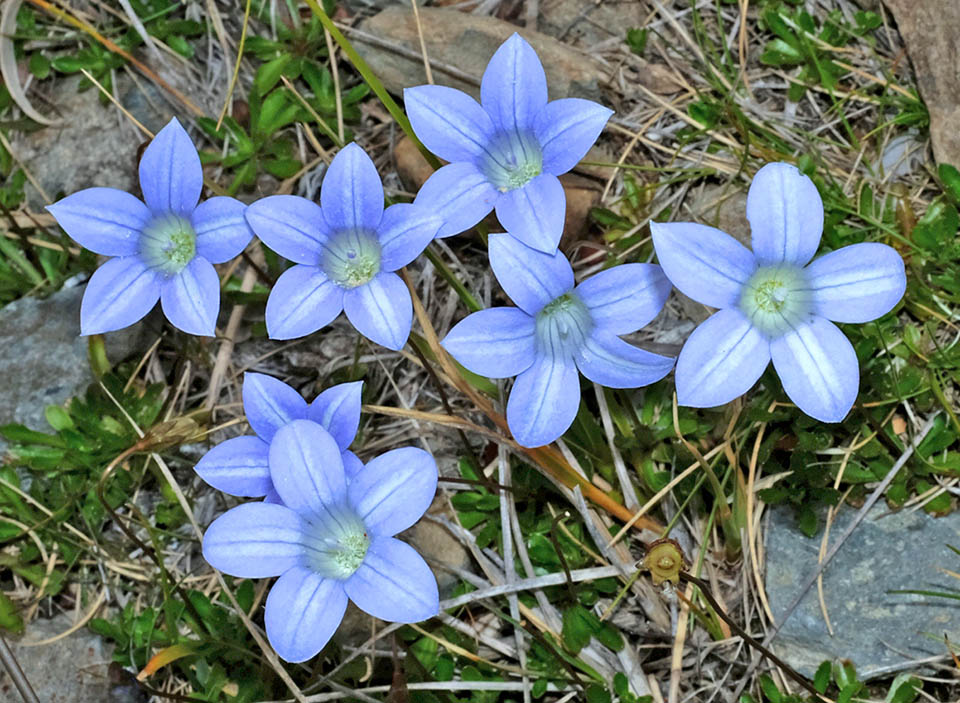
Wahlenbergia albomarginata is a perennial herbaceous plant endemic to New Zealand where grows at 700 to 1700 m of altitude © snowslave
Wahlenbergia albomarginata Hook. (Icon. Pl. 9:t, 818,1851) has been validly described by William Jackson Hooker (1785-1865), professor of botany of Glasgow University, scholar and prolific scientific writer, as well as director of the Royal Botanic Gardens of Kew of which he expanded the surface of the gardens and of the Arboretum.
Wahlenbergia albomarginata is a species endemic to New Zealand. The generic epithet is honoured to the Swedish Georg Göran Wahlenberg (1780-1851), physician and professor of botany at the Uppsala University. The name of the specific epithet comes from the union of the Latin terms “albus” (adjective) and “marginatus” (past participle of “to margin”, that in turn comes from “margo-ginis”, margin) and means “having a white/whitish margin” that in this case is referred to the leaves.
The English common name is “New Zealand harebell”.
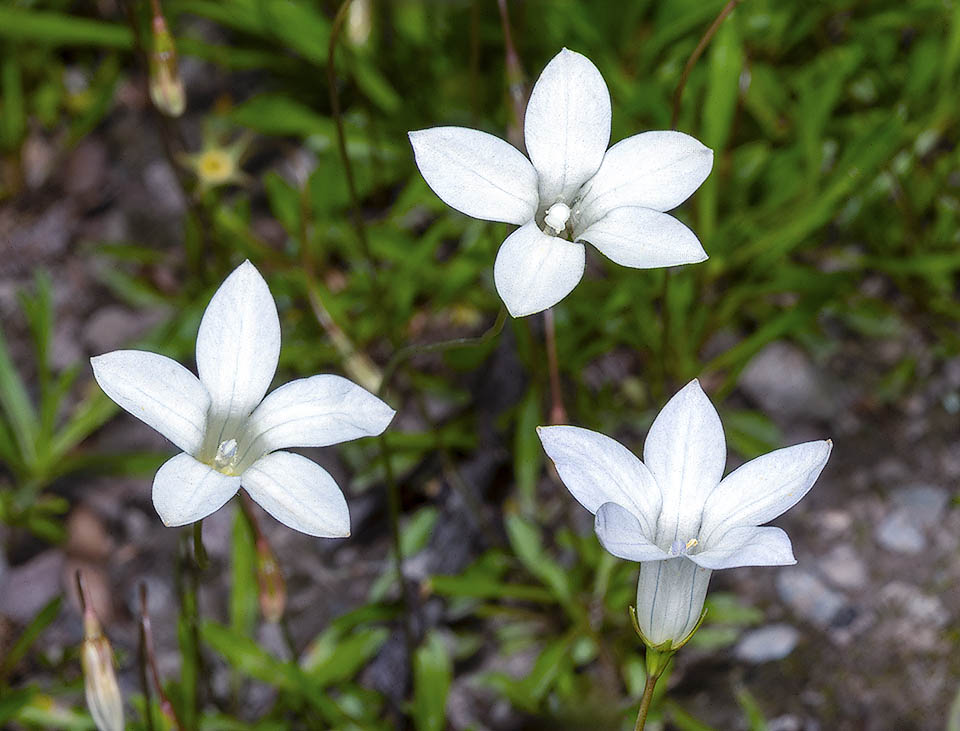
The flowers, blue or white with streaks, are long-pedunculated and the corolla, bell-shaped and rotated, has an elongated basal tube © Giuseppe Mazza
The translations of this name in other languages are not significant or are ineffective indicating specifically the
Wahlenbergia albomarginata, to the point of being misleading: in fact, with “Campanilla de Nueva Zelanda” refers to a small passerine bird (Anthornis melanura Sparrman).
Wahlenbergia albomarginata belongs to the genus Wahlenbergia Schrad. ex Roth. (Nov. Pl. Sp.: 399, 1821) that after the system APG IV (Angiosperm Phylogeny Group. 2016), that is, the international reference for the classification of the angiosperms (plants with flowers), belongs to the subfamily Campanuloideae, of the family Campanulaceae and of the order Asterales. Only most species of the genus are ascribed to the clade Campanulidi, as Wahlenbergia is considered a polyphyletic genus. The denomination Wahlenbergia Schrad. ex Roth is a “nomen conservandum” (nom. cons.) seen the common use , amply utilized and recognized made of it.
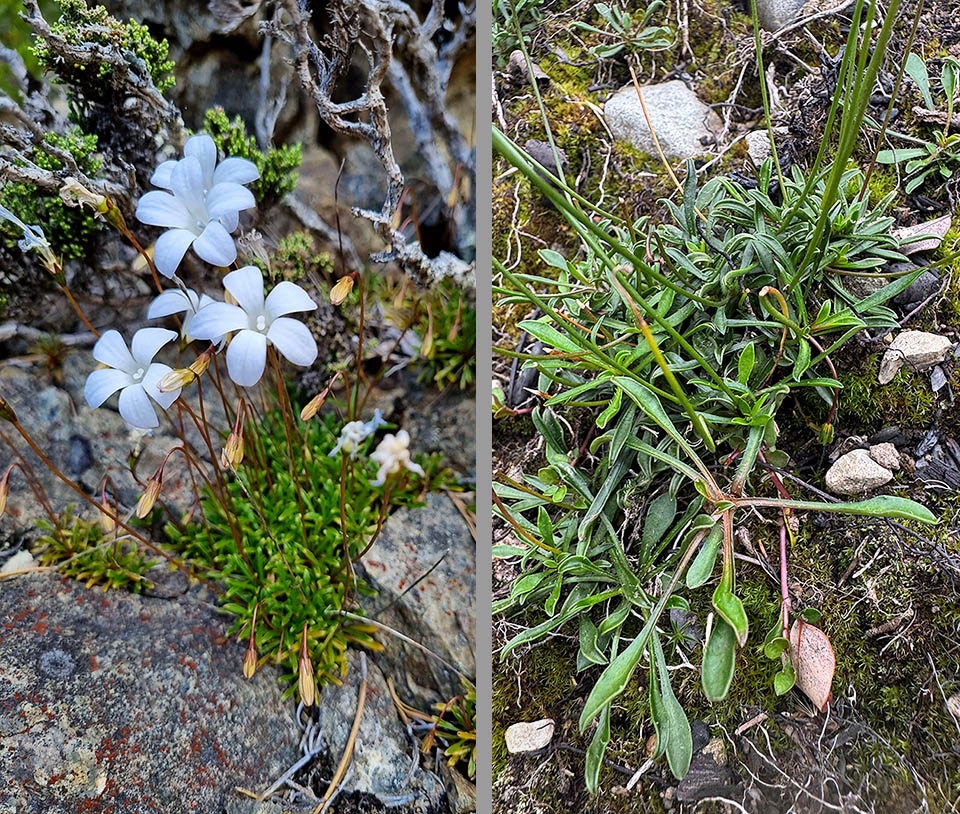
Flowering plant with a basal rosette of entire, elongated leaves with thickened margins. Several spoon-shaped leaves © beckykerr (left) © Ian Dickie (right)
The genus has been validly described in Novae plantarum species praesertim Indiae orientalis (Nov. Pl. Sp.: 300, 1821) by Albrecht Wilhelm Roth (1757-1834) physician and botanist who endowed Vegesack (Bremen) of a public garden.
The genus Wahlenbergia includes 260 cosmopolitan species (or more, depending on the sources), with a vast range: Old World (with a high concentration in South Africa and with two species in China), part of South America, Australia and New Zealand. For some authors, Wahlenbergia has differentiated in South Africa about 29,6 million years ago; in New Zealand have differentiated herbaceous species with rhizomatous shape and others with rooted form. The species with roots emphasize in the stems and in the leaves a marked variability; therefore, their specific distinctive characters are to be found in the flowers and relevant reproductive organs. The species ascribed to the genus Wahlenbergia are annual or perennial herbs, rarely small shrubs, have alternate leaves, occasionally opposite and actinomorphic (radially symmetric), lobate. When ripe they produce loculicidal capsules (dried fruits that open spontaneously along predefined lines) in number equal to the loculi of the ovary and these then release numerous seeds.
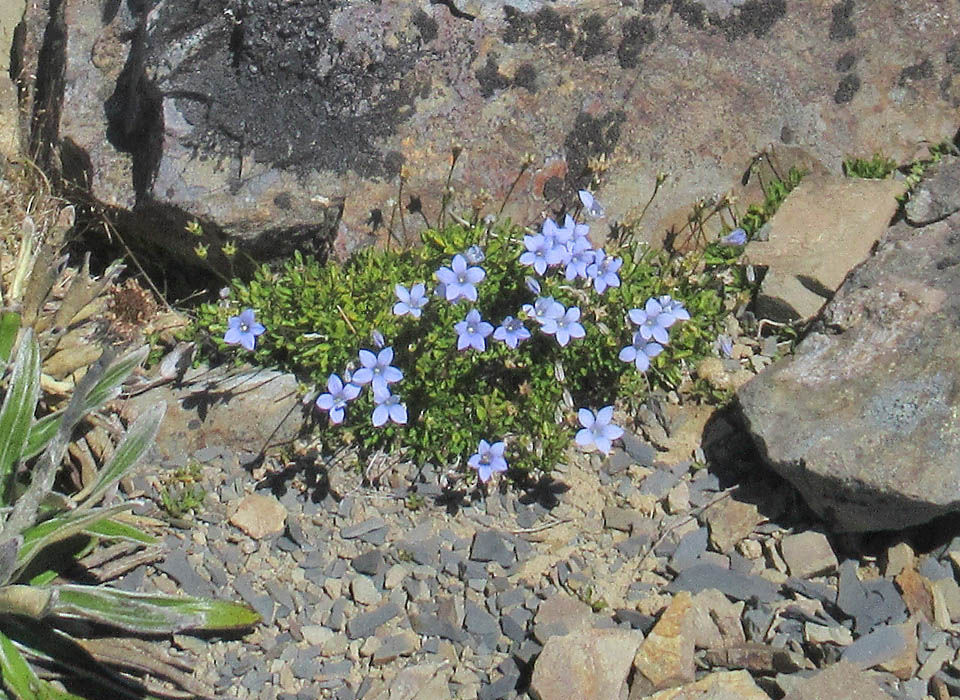
Wahlenbergia albomarginata mainly grows where annual rainfalls are poor or on well drained soils such as the rocky habitats © Roger Frost
Wahlenbergia albomarginata is a mountain plant: it grows from 700 to 1700 m of altitude, mainly where the annual rainfall is low, in the dry meadows, in the rocky and subalpine habitats and also along the waterways provided the soil is well drained, sandy or stony. It is a small perennial herbaceous plant, very rustic, that may survive the adversities thanks to its underground portion. Its taproot, after the first year, develops thin and intertwined rhizomes that favour its diffusion with the formation of colonies and contribute to the consolidation of the loose soils. In the pastures it is sought after by sheep and goats and everywhere it is preyed upon by snails and grasshoppers.
Wahlenbergia albomarginata stands out within its genus for having the tube of the bell-shaped corolla, usually longer than wide, the radical leaves arranged in a rosette and the flowers, bell-shaped, solitary on long, smooth and erect, stems. Wahlenbergia albomarginata has whole leaves of form from linear or elliptic to ovate or obovate (from 10 x 2 to 40 x 10 mm), attenuated and gradually narrowed towards the petiole, as long as the lamina; overall similar in appearance to a spoon.
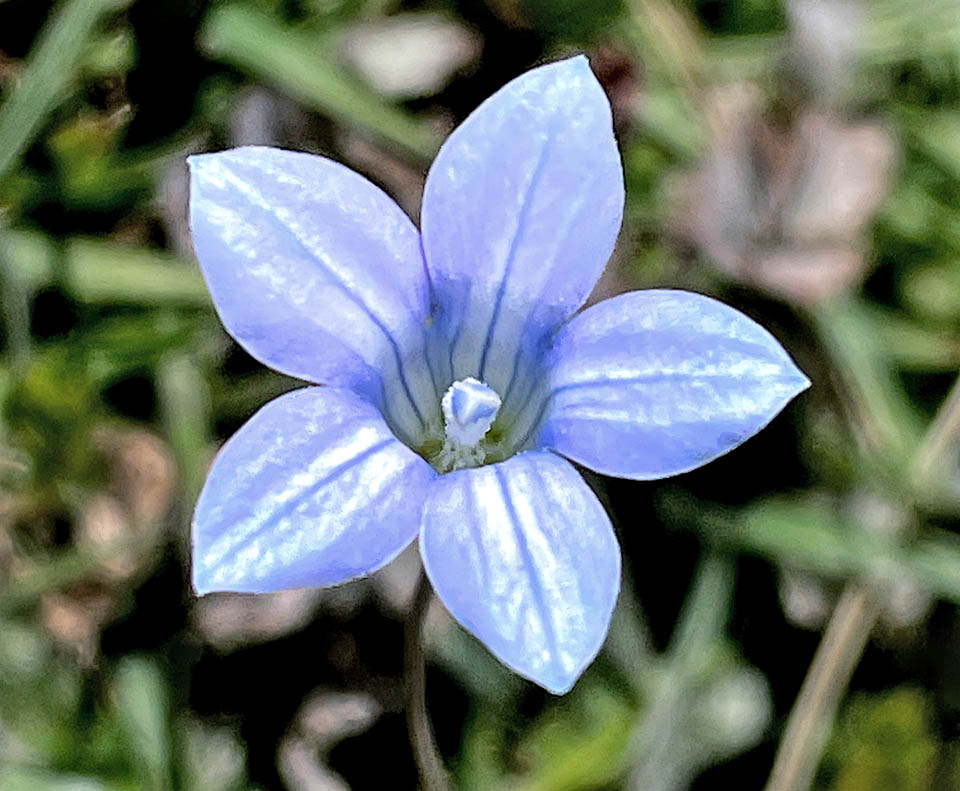
The corolla is made up of five petals with a pointed tip. The style, as long as the corolla tube, bears a trilobed stigma © snowslave
Usually the leaves are arranged in a rosette over a very short stem; the radical ones are spatulate, often shaggy, crenate-serrate with white thickened margin and flat and ciliate. The colour of the leaves is variable and at times has red shades.
Every flower strictly bell-shaped-round, with 5 equilong and arranged in a “starry” shape, lobes, is carried by one solitary, cylindrical, single scape. In Hooker’s description the scape is defined as spithameus, that is not exceeding the length of a span. The calyx is much shorter than the tube of the campanulate corolla, three times longer; conversely, the style is as longer as the corolline tube. The colour of the flowers is clear (with veins) and in the different populations varies from very pale blue (at times tending to light violet), up to white.
The dried fruit is a capsule, cylindrical cupola-like and loculicidal (dehiscent in the middle of the median line of every carpel), with three minute apical valves.
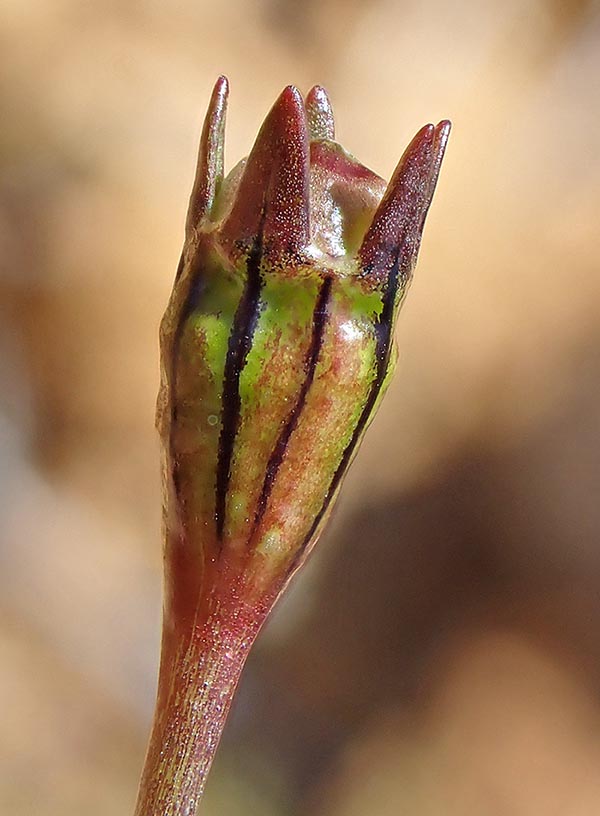
Ripening capsule. The numerous seeds, brown when ripe, are ellipsoid smooth and glossy, 0,5 mm long © Duncan Cunningham
The seeds, numerous, are 0,5 mm long, ellipsoid smooth and glossy, of brown colour when ripe. It blooms at the end of spring-early summer, with a long blooming period. Chromosomal complement: 2n=36.
Wahlenbergia albomarginata responds to specific environmental conditions with some morphological variation: is it grows in windy environments it has stiffer and more or less sessile leaves in compact tufts; if it grows in the shade it presents the leaves, at times alternate, on elongated stems: in drought conditions the margins of the leaves get thicker.
According to Plants of the World Online, Wahlenbergia albomarginata counts five subspecies:
– Wahlenbergia albomarginata Hook. subsp. albomarginata, that is the subspecies nominal or monotypic, that is the first population described formally and scientifically.
– Wahlenbergia albomarginata subsp. decora J.A.Petterson,Wahlenbergia albomarginata subsp. flexilis (Petrie) J.A.Petterson;
– Wahlenbergia albomarginata subsp. decora J.A.Petterson, Wahlenbergia albomarginata subsp. flexilis (Petrie) J.A.Petterson;Wahlenbergia albomarginata subsp. laxa (G.Simpson) J.A.Petterson;
– Wahlenbergia albomarginata subsp. olivina J.A.Petterson.
Judith Ann Petterson (1928-2007), formed at the Victoria University of Wellington, has been the author of the important Revision of the genus Wahlenbergia (Campanulaceae) in New Zealand, published in the New Zealand Journal of Botany 35(1): 9-54, 1997. In this opus are made explicit the distinctive characters of the five subspecies of Wahlenbergia and the respective native areas summarized as follows: Wahlenbergia albomarginata subsp. albomarginata lives in areas with scarce rainfall and is distinguished for having whole leaves, linear to elliptical, often with leaves of white margins; Wahlenbergia albomarginata subsp. decora grows on screes and has toothed leaves, wavy and scented flowers; Wahlenbergia albomarginata subsp. flexilis develops on calcareous substrate and displays whole and ovate leaves; Wahlenbergia albomarginata subsp. laxa lives in high rainfall regions and shows oblanceolate leaves, toothed, wavy and not having white margins, with flowers relatively bigger than the other subspecies;Wahlenbergia albomarginata subsp. olivina is a serpentinophyte (species adapted to serpentine substrata) with whole leaves of dark olive green colour and with white margins.
Wahlenbergia albomarginata is utilized as an ornamental plant for flower pots and rock gardens. With the flowers it reaches the height of 10 cm and is considered as a plant requiring relatively low maintenance. It needs a well drained soil and direct exposure to the sun. It benefits from mulching and propagates asexually. For this plant, the indicated hardiness zones are Z5–Z9 (approximately −29 °C to −1 °C).