
Family : Petrosiidae

Text © Dr. Giuseppe Mazza

English translation by Mario Beltramini
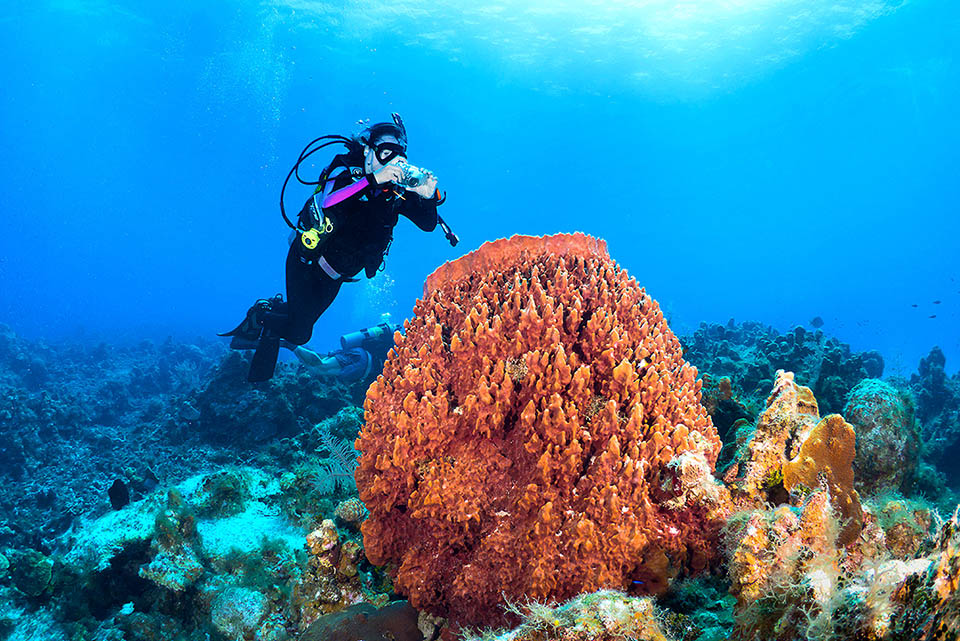
With a height that may reach 2 m, Xestospongia muta is a sponge frequent in the Caribbean © Brian Cole
The unusual barrel sponges, Xestospongia muta (Schmidt, 1870), similar to large containers with a wide top opening, have earned the title of “sequoias of the Caribbean”, thanks to their remarkable size and their exceptional longevity.
According to estimates based on growth models, the longest-lived specimens could in fact attain the age of around two thousand years: the giants that now we admire in the coral reefs might therefore have originated well before the arrival of Christopher Columbus in the Americas.
Xestospongia comes from Greek terms referring to what is smoothed or polished and sponge; whilst the specific epithet muta, in latin mute or silent, almost seems to tell us with a touch of discretion that this organism, with its monumental dimensions, surely does not need to shout to get noticed.
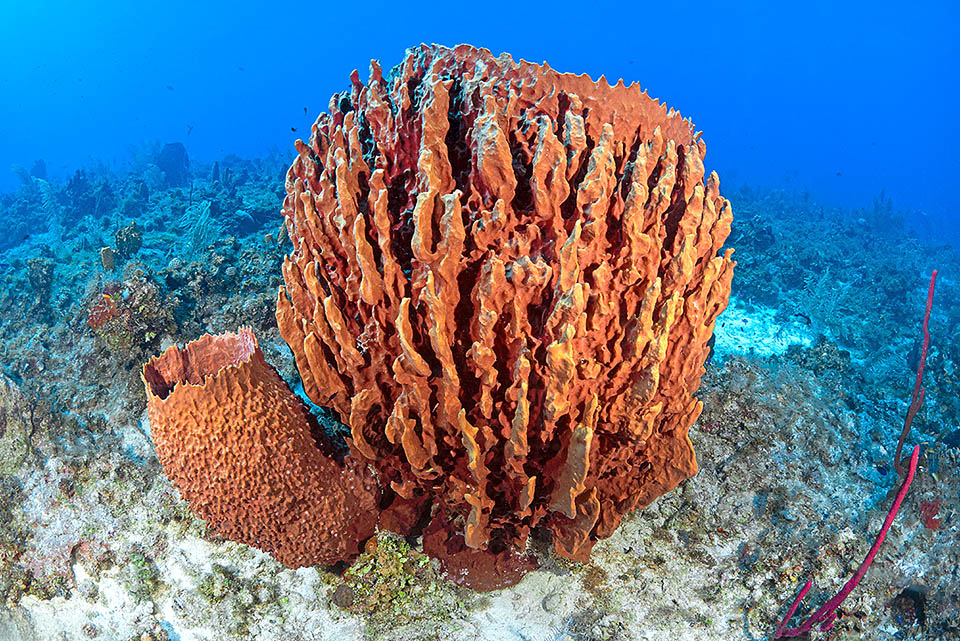
Its range, vast but in pieces, reaches the northern coasts of South America and is found also in Brazil © Brian Cole
Like all sponges, it belongs to the phylum Porifera, that means “pore carriers” and reminds a fundamental characteristic of these animals: the body traversed by a complex system of channels where the water continuously circulates conveying food particles and microorganisms.
The species belongs to the class Demospongiae, which includes the great majority of the known sponges. In this group the skeleton may be formed by siliceous spicules, by fibres of spongin or by a combination of the two and in
Xestospongia muta the skeletal structure is supported by siliceous spicules organized in a tridimensional net. Moving down the classification we meet the order Haplosclerida, characterized by a reticular organization of the skeleton, and the family Petrosiidae, which includes several genera of sponges, within which Xestospongia.
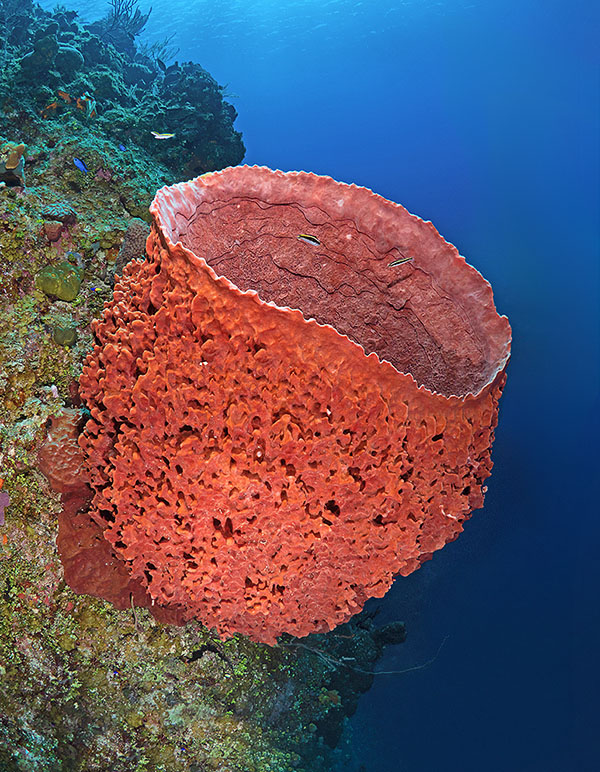
Typically barrel-shaped, this specimen may already have been there when Columbus reached America © Brian Cole
Zoogeography
Xestospongia muta is widespread in western tropical Atlantic, with a particularly significant presence in the Caribbean Sea, where it represents one of the most characteristic elements of the benthic communities of the coral reefs. Its range includes the Florida Keys, the Bahamas, the Gulf of Mexico, the Greater and Lesser Antilles and several sites along the central American coasts, extending toward the northern regions of South America. The species is reported also along the Brazilian coasts.
The distribution is not uniform: some areas host particularly abundant populations, whilst in others the species is less common. Genetic studies made in Florida and in the Caribbean have evidenced differences between geographically far populations suggesting that the dispersion and the exchange of individuals between several locations may be limited. The ocean currents favour the transport of the larvae, but do not necessarily guarantee an effective connection among all populations.
The nickname of “sequoia of the Caribbean”, corresponding to the English “redwood of the reef”, renders well the importance of the species in the coral ecosystems of the region. Its presence, however, is not limited to the coral barriers alone in sensu stricto, as the range covers several submerged environments of the western tropical Atlantic.
Ecologia-Habitat
Xestospongia muta lives anchored at the substratum in the tropical seas of western Atlantic, especially on the Caribbean coral reefs. It loves hard surfaces, cliffs and rocky walls, but may even settle also on other suitable substrata. It is met at variable depths, from the relatively shallow zones up to mesophotic environments, where the light is remarkably reduced. As a filter feeder, it contributes to the transfer and the material recycling in the ecosystem. The water that flows through its body carries organic particles and microorganisms that may be held and utilized as food resources. Moreover, the tissues host communities of symbiotic microorganisms, involved in various metabolic processes and in the biologic balance of the sponge.
The bigger specimens contribute to the structural complexity of the reef, offering surfaces and microenvironments that may be used by other organisms such as fish, crustaceans, brittlestars and crinoids. However, the slow growth renders these giants vulnerable to the physical harms and the alterations of the marine environment: a structure built during many years can be compromised in relatively short times.
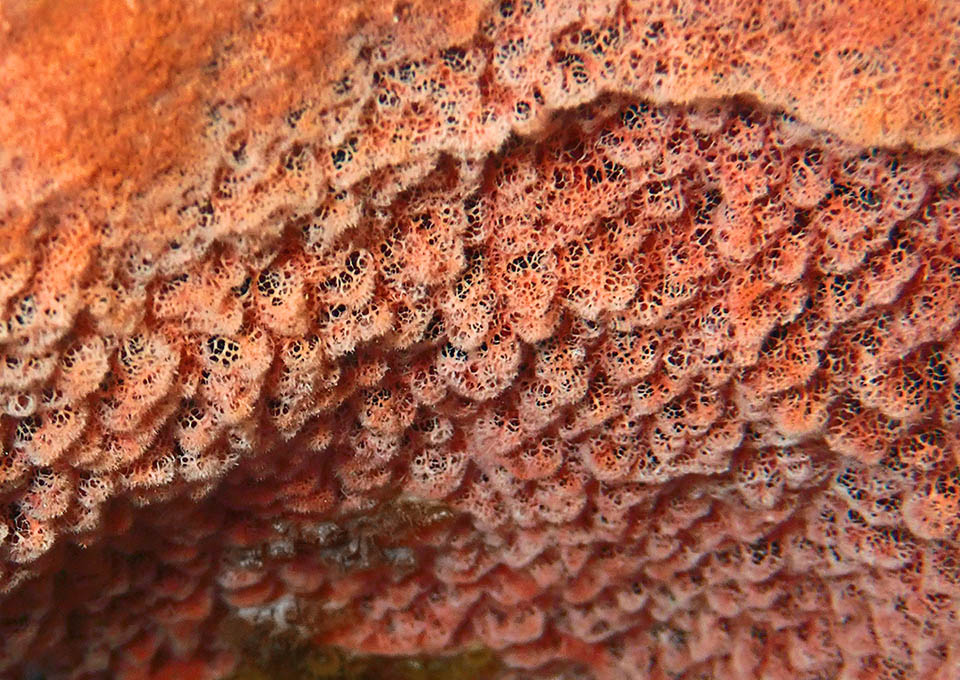
Inside we note a carpet of filtering chambers. Cells with flagella circulate the water and the sponge lives of food particles and microorganisms © Matteo Bellucci
Morphophysiology
Xestospongia muta usually displays a great barrel or a great bowl shape, with an ample central cavity opening upwards.
This is one of the most impressive sponges. Exceptional specimens may exceed two meters in height and attain diameters of more than three metres.
The outer surface is often rough, with crests, protuberances and irregular reliefs, whilst the inner wall of the cavity displays a characteristic texture. The youngest specimens or of reduced size may take on more conical and slender forms.
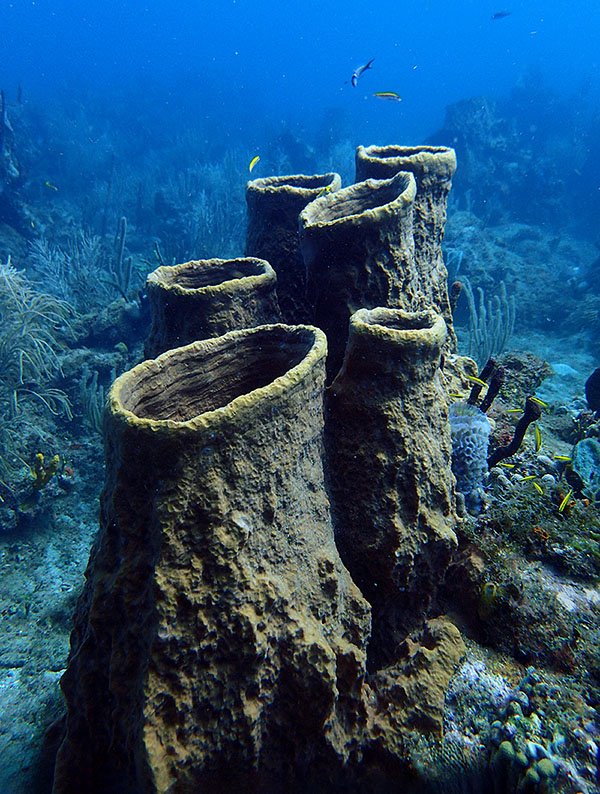
Colour partly depends on symbiotic microorganisms, like cyanobacteria of the group Synechococcus © Laurent Fey
Also the colouration is variable: we meet brown-reddish specimens, or of rust, greyish, pinkish and purplish colours.
The shades depend in part on the symbiotic microorganisms present in the superficial tissues, among which cyanobacteria of the group Synechococcus, able in contributing to the characteristic pigmentation of the sponge.
The availability of might can influence the abundance and the composition of these symbionts: in some deep environments we can observe paler individuals.
In any case, the differences in shape cannot be all explained through the depth or the age. Also the local conditions and the individual variability may contribute, and has not been proved a relationship simple and universal between morphology and environment.
Similarly, an unusually clear sponge does not necessarily indicate a pathologic condition, but a marked loss of colour can be associated with stress or disease.
The body is supported by a skeleton of siliceous spicules organized in a tridimensional net. The water gets in through tiny pores, passes through the internal system of filter chambers and is expelled from the central cavity through the upper opening, the osculum.
The movement of the water is produced by the choanocytes, cells equipped with flagella that create currents and hold food particles and microorganisms.
This organization allows the sponge to continuously filter big volumes of water, even without processing organs and systems comparable to those of more complex animals.
Ethology-Reproductive Biology
At first glance, Xestospongia muta may seem an immobile and passive organism, but its apparent calm hides a continuous activity: the water ceaselessly traverses the body, carrying oxygen, food particles and microorganisms.
The sponge doesn’t move looking for food; its strategy consists in filtering the surrounding water and exploiting the resources it carries.
The reproduction occurs sexually. The individuals are generally considered with separate sexes and release in the water male and female gametes.
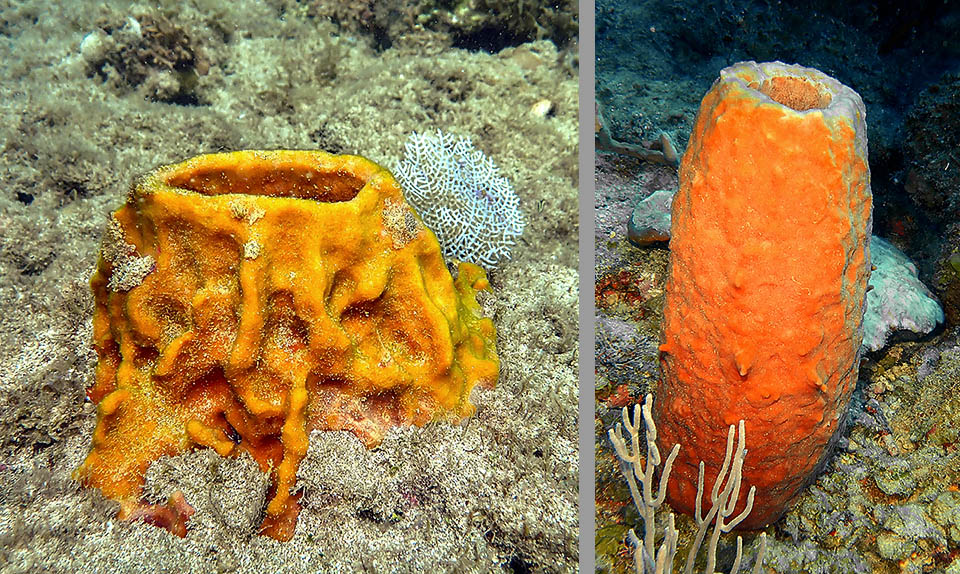
Reproduction occurs with clouds of gametes given to the currents. Left, a young specimen and right its possible behaviour hundred years afterwards © Alex Doyle (left) and © Robin White (right)
A particularly interesting aspect is the synchronized liberation of the gametes: various individuals of the same area can release sperm and eggs in a relatively short time interval, increasing the probabilities that the external fecundation takes place. In some cases, the releasing of the sperms is visible underwater like a whitish cloud, almost a puff of smoke getting out from the sponge.
The reproduction has been observed in various periods of the year, with reports in spring and between late summer and autumn, but the seasonality may vary depending on the location and the environmental conditions.
After the fecundation, the larvae develop and are dispersed by the currents before they settle on a suitable substratum. This phase is essential for the colonization of new sites and for the connection between populations, even if the actual dispersion depends on the duration of the larval phase and on the local conditions.
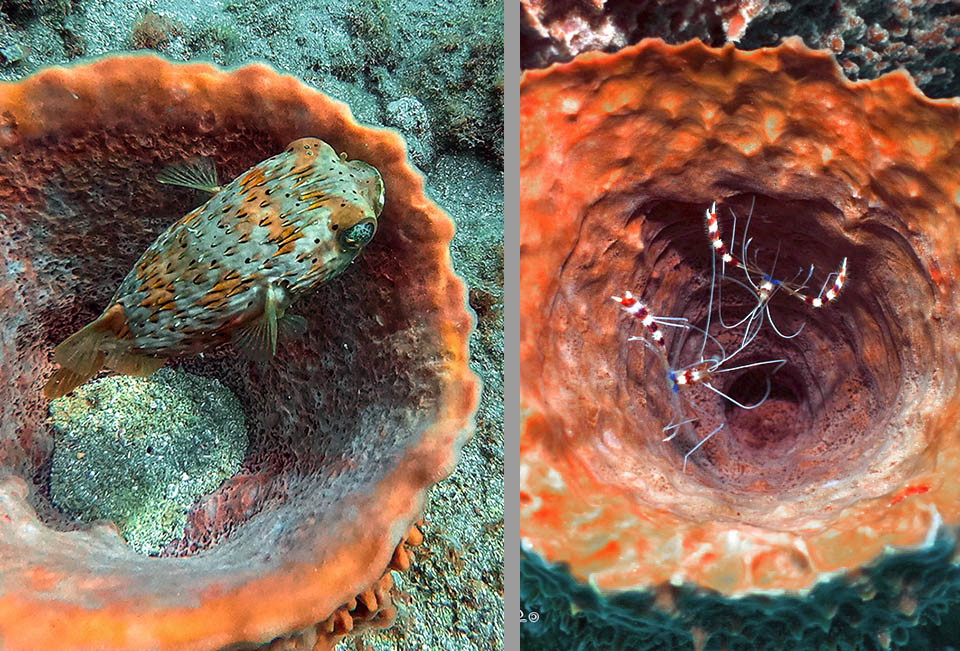
The biggest specimens contribute to the survival of several marine organisms, such as fish, crustaceans, brittlestars and crinoids. Here, left, they offer shelter to Diodon holocanthus (© David Torres) and, right, a group of Stenopus hispidus may be planning a cleaning station, using the red sponge as a signboard (© Pauline Walsh Jacobson).
Once fixed to the substratum the young sponge grows slowly and may reach, over the course of many decades or centuries, the imposing dimensions of teh adult specimens.
The growth, however, is not necessarily constant: availability of food, environmental conditions, competition, extreme weather events and diseases may influence the development and the survival. It is rightly this combination of prolonged growth and remarkable longevity to render Xestospongia muta an organism particularly interesting for the study of the coral reefs dynamics.
Synonyms
Schmidtia muta Schmidt, 1870; Petrosia muta (Schmidt, 1870); Prianos grayi Hechtel, 1983; Xestospongia grayi (Hechtel, 1983).