
Family : Orchidaceae

Text © Prof. Pietro Pavone

English translation by Mario Beltramini
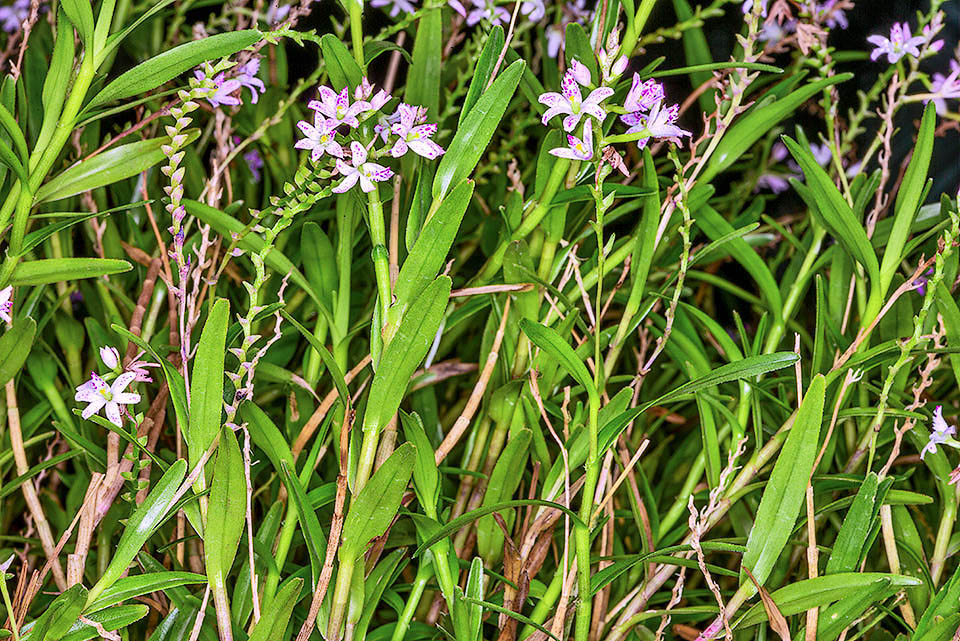
Epidendrum fimbriatum grows in South American rainforests from 1100 to 3700 m of altitude. The cane-shaped stems have long and narrow leaves widened in the centre © Dr. Giuseppe Mazza
Epidendrum fimbriatum Kunth is a species of the family Orchidaceae, subfamily Epidendroideae, tribe Epidendreae, subtribe Laeliinae.
It is present in Colombia, Ecuador, Peru, Bolivia and Venezuela in the humid mountain rainforests at altitudes between 1100 and 1700 metres where it grows along the banks of the waterways, but may be found also along the edges of mountain roads.
The species was described in 1816 by Carl Sigismund Kunth (1788-1850) in Nova Genera et Species Plantarum (Nov. Gen. Sp. [H.B.K.] 1: 31, volume documenting and describing the species collected by Alexander von Humboldt (1769-1859) and Aimé Jacques Alexandre Bonpland (1773-1858) during their scientific expedition in South America.
The genus Epidendrum counts more than 1.880 species and is one of the largest and richest genera of the family Orchidaceae. The name of the genus comes from the Greek επί, epi (above) and δένδρον, dendron (tree) “on the trees” with reference to the epiphytic posture, whilst the specific epithet comes from the Latin “fimbriatum” that means fringed, decorated with fringes because the petals and the labellum have fringed edges.
The common name is Fimbriated epidendrum.
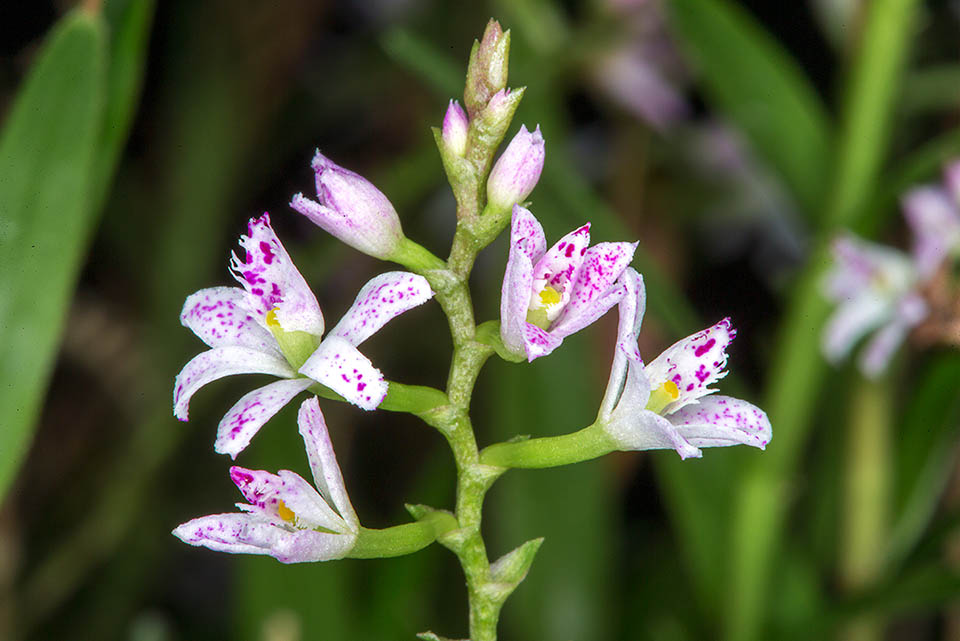
Epiphytic orchid, terrestrial or lithophytic with drooping posture, can reach, with its rich terminal inflorescence, 35 cm of height © Dr. Giuseppe Mazza
Epidendrum fimbriatum is an epiphyte herbaceous plant, terrestrial or lithophytic, with drooping posture, about 35 cm tall including the inflorescence. The roots are smooth, thick and whitish, 8-10 cm long. The cane-shaped stems are thin, erect, ramified and bear up to 10 leaves, 4-6 cm long, coriaceous, simple, alternate, linear-lanceolate, with obtuse base and crenulated margin.
The inflorescence is terminal, racemose, with many flowers, up to 10-12 cm long, with flexible and glabrous rachis. The flowers, not resupinate, are numerous, pedicellate, of white to pale pink colour with violet dots, odourless. The about 5 mm floral bracts are glabrous, erect, ovate to oblong-lanceolate.
The ovary is glabrous, striated, 1,5 cm long. The 4,5 x 2,3-2,5 mm sepals are strictly ovate-oblong, with rather irregular margins at the apex. The 4,5 x 1,5-1,7 mm petals are strictly elliptic-oblanceolate and with slightly irregular apical margins. The labellum, adnate to the column, is ovate and is superficially trilobed, irregularly divided in many thin lacinia (fimbriate), 4,3-4,5 x 4-4,3 mm, purple stained. The column (gymnostemium), 3 mm long, is robust and calavte. The apical is apical and fissured. The pollinarium is formed by 4 pollinia.
The blooming takes place during the month of October, even if it may occur, especially in cultivation, in many other months of the year. The structure of the flower with the column fused to the labellum to form a narrow tube, is typically suitable for the haustellum (proboscis) of the Lepidoptera.
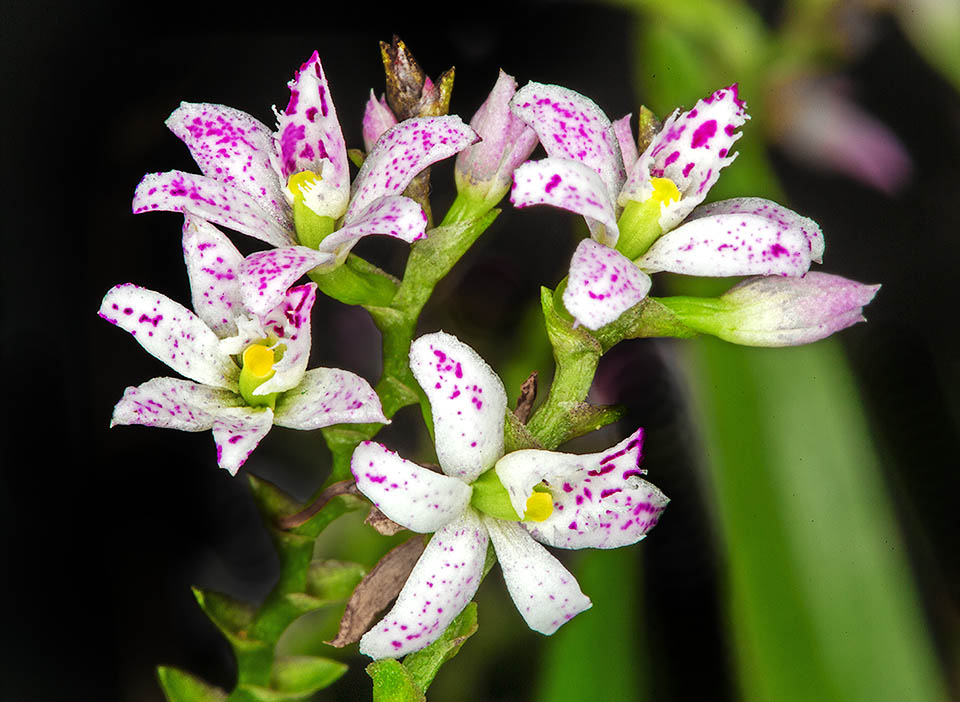
The odourless numerous flowers, pedicellate, have purplish spots on white pinkish background © Dr. Giuseppe Mazza
The fruit is an ovate, glabrous capsule, the size of a fruit of a prickly blackthorn (about 1,2 cm). The seeds are very small, powdery, and germinate in nature insymbiosis with some species of mushrooms (mycorrhizae) that provide nutrients to the embryo that has no endosperm. In nature these plants reproduce by seeds or by means of the vegetative reproduction, but this is a very slow process.
Due to the reduction of the plants in their places of origin, trade restrictions have been adopted (II CITES 2018).
The indigenous of Ecuador (Saraguro) treat infections, inflammation and feverish states with wild and cultivated plants. In fact, the plants as therapeutic agents are widely used in their traditional medicine. Their healing properties have been passed down orally for centuries and now these knowledge are prerogative of the community known as “Hampiyachakkuna” that, unlike spiritual healers, utilizes this orchid to treat tumors.
Epidendrum fimbriatum is also an ornamental plant appreciated for its prolonged flowering that may beautify verandahs and gardens. In the cooler climates it may be grown indoors with bright or indirect light. The direct sun is only in the morning and the afternoon. In the warm climates it requires shadow.
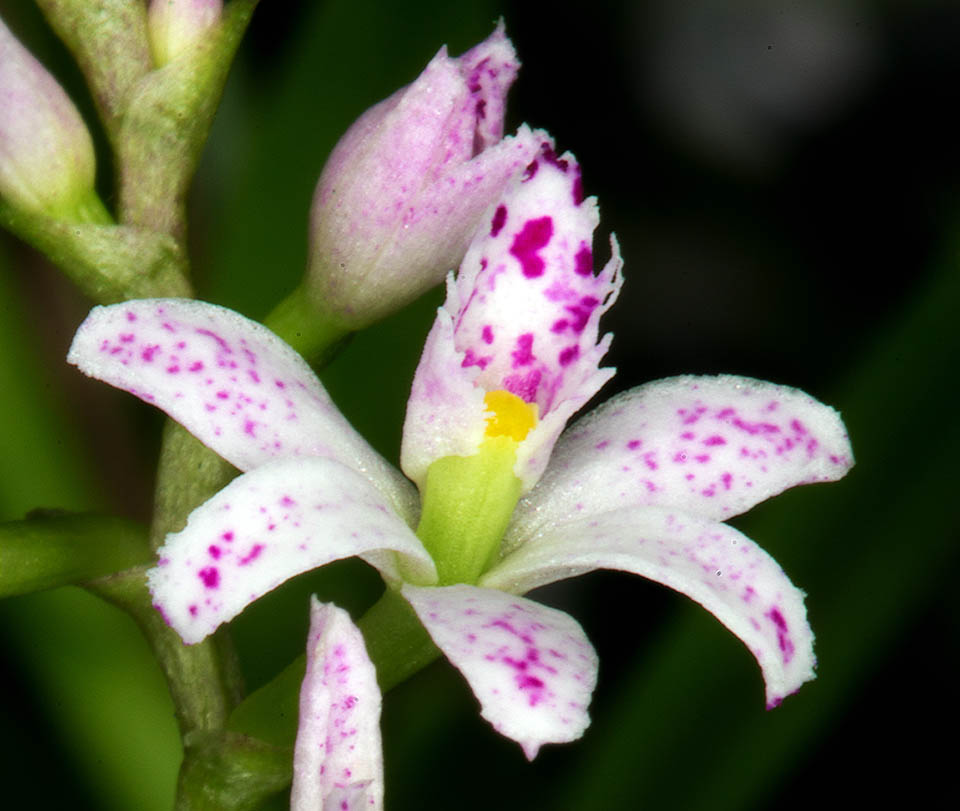
They have lost resupination secondarily and the labellum is merged to the column to form a tube well adapting to the proboscis of the Lepidoptera © Dr. Giuseppe Mazza
For growing is to be utilized a well draining loam with specific bark for orchids in order to prevent the root rot. To water regularly but let dry between waterings.
The growth temperature must fluctuate between 12,5-33 °C. The optimal humidity levels stand between 50-70%, even if the plant, with good air movement, may grow in conditions of higher humidity (65-85%). If the air is dry to utilize humidifiers or to spray the plant directly.
To promote the development a balanced orchid fertilizer must be used, like the 20-20-20 and when the plant overflows from its container, to repot, this operation should be done in spring. The propagation may be done by division of the tuft, however, being sure that each section has healthy roots and buds.
No pruning is necessary, at most remove dried or yellowed leaves from the stems in order to maintain the appearance and the health of the plant. If parasites, like aphids and mites are present, it’s good practice to eliminate them without wasting time.
Synonyms: Epidendrum alternans Lindl. ; Epidendrum fimbriatum var. rhomboglossum (Kraenzl.) C.Schweinf.; Epidendrum integrilabium Ames & C.Schweinf.; Epidendrum rhomboglossum Kraenzl.