
Family : Apogonidae

Text © Dr. Giuseppe Mazza

English translation by Mario Beltramini
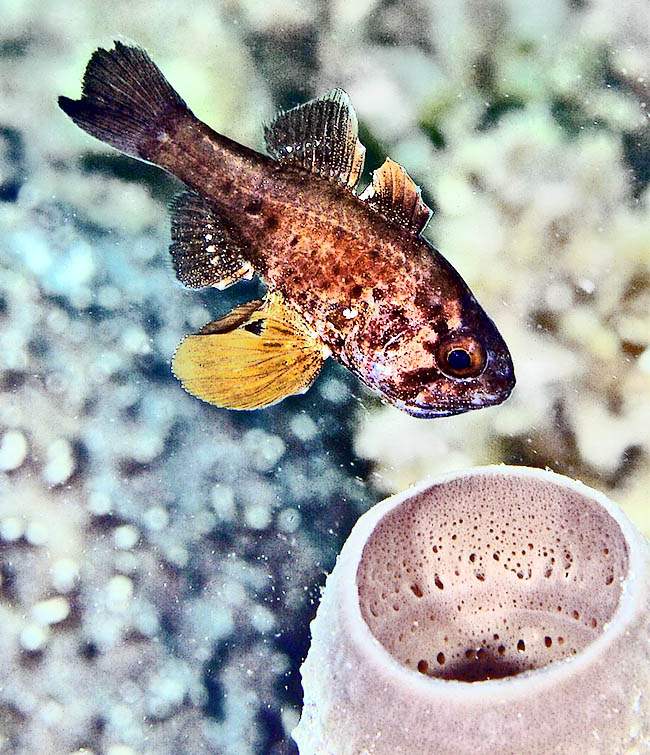
As the big eyes suggest, the Caribbean Astropogon puncticulatus is a fish active the night. It spends the day hours hidden in small cavities, included the narrow openings of the sponges © www.carlosestape.photoshelter.com
Commonly known as Punctate cardinalfish or Blackfin cardinalfish, Astrapogon puncticulatus (Poey, 1867) is a species belonging to the class of the Actinopterygii, the ray-finned fishes, to the order of the Perciformes and to
the family of the Apogonidae, that counts more than 200 species present in the tropical seas, with some exceptions like the Mediterranean Apogon imberbis and some freshwater fishes belonging to the genus Glossamia.
The genus Astrapogon, created by Fowler in 1907 observing the starred livery of Astrapogon stellatus, comes from the union of ‘aster’ (ἀστήρ), celestial body, star, and Apogon; whilst the specific term puncticulatus, dotted in Latin, is a reference to the numerous small black dots of the species.
Zoogeography
Astrapogon puncticulatus is present, with a distribution centred on the Caribbean, from the Bahamas and the Gulf of Mexico up to Brazil.
Ecology-Habitat
It lives in shallow waters having temperatures from 26,3 to 28,2 °C, without going deeper than 8 metres.
It is often found in the tide pools and in the submerged prairies of marine phanerogams like Thalassia testudinum where, during the day, it often hides into the empty shells of Strombus raninus.
In fact, it is a nocturnal fish that, despite the camouflage livery, it cannot help to hide when there’s light, in small cavities, sponges openings included.
Morphophysiology
Astrapogon puncticulatus reaches 10 cm in length at most.
The body is compressed on the sides with ctenoid scales and the head, partially scaleless, has a short snout with big eyes for perfect vision in poor visibility conditions.
-
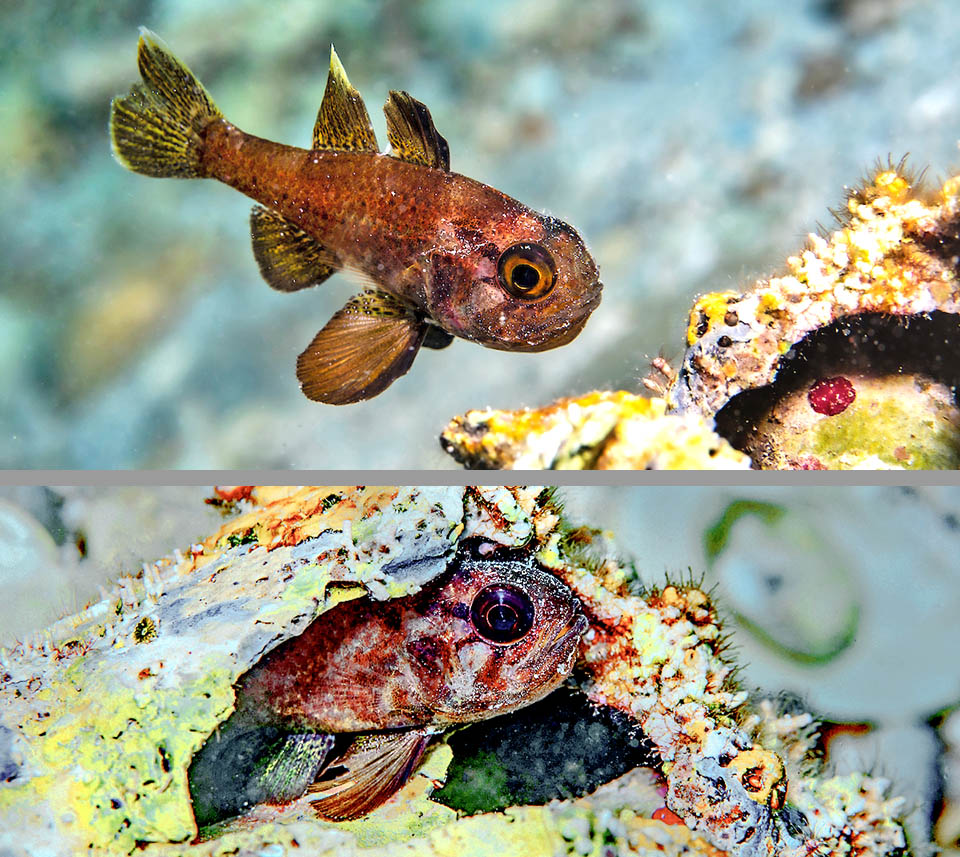
Here has chosen the empty shell of a Strombus raninus, common in the submerged prairies of Thalassia testudinum where it feeds on plankton and small benthic animals © www.carlosestape.photoshelter.com
The mouth, wide and oblique, is that of an opportunistic predator feeding, in addition to plankton, on small benthic crustaceans, small fishes and other small sized invertebrates. The teeth, tiny, are present in the centre and on the sides of the palate. The lateral line is complete and the edge of the preoperculum is smooth.
There are two dorsal fins: the first usually has 6-7 spines and the second 1 spiny ray and 8-9 soft rays.
Then anal has 2 spiny rays and 8 soft; the showy pelvic fins 1 spiny ray and 5 soft; the pectoral ones 13-16 sofy and the caudal 15-16 ramified rays.
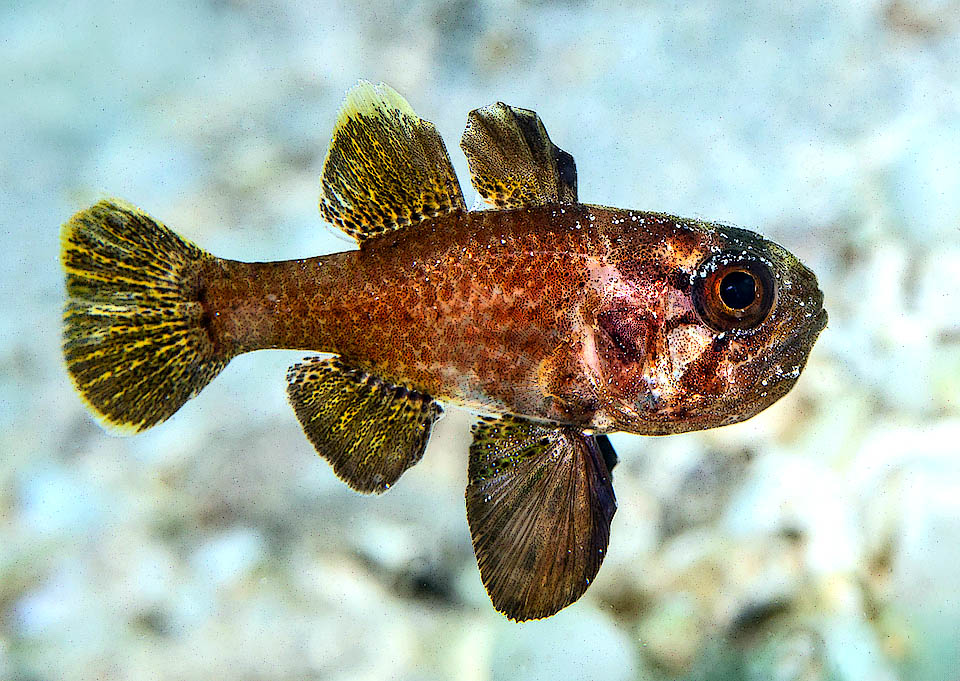
Is 8-10 cm long. Mimetic livery is bronze, dotted with black dots and traits. Males pick up the eggs fecundated on the seabeds and keep them in the mouth until they hatch © www.carlosestape.photoshelter.com
The livery is bronze and, in addition to the mentioned black spots, we note some dark lines starting from the back of the eye. The transparent pectoral fins are poorly visible and the others are darker towards the extremity.
The juveniles, especially during the first phase, display iridescent reflections with the dorsal, anal and caudal fins almost transparent.
Ethology-Reproductive Biology
It is a very shy species, only goes hunting in the evening.
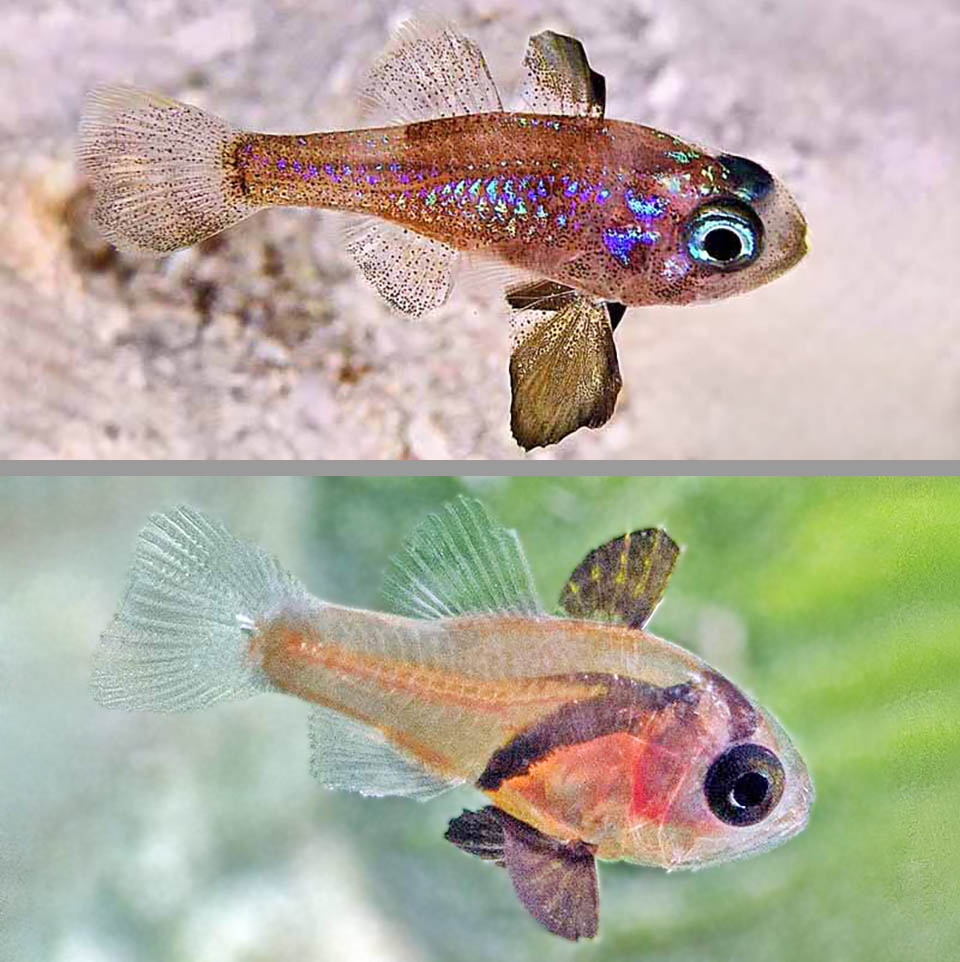
Jouveniles livery two phases with iridescent glares at first and fins partially transparent. Preyed by Pterois volitans, Astrapogon puncticulatus is not however endangered © www.carlosestape.photoshelter.com (above) and © Mickey Charteris (below)
The eggs are spawned and fecundated on the seabeds but then are collected by the male who, like all Apogonidae and the small Opistognathus aurifrons, protects them inside its mouth until they hatch.
The resilience is high with a minimum time for doubling of less than 15 months and the fishing vulnerability very low, marking only 10 on. scale of 100. Even if probably preyed upon by the Red lionfish (Pterois volitans) carelessly introduced in the Caribbean, Astrapogon puncticulatus is anyway classified “LC, Least Concern” in the IUCN Red List of the endangered species.
Synonyms
Apogonichthys puncticulatus Poey, 1867.
→ For general information about FISH please click here.
→ For general information about BONY FISH please click here
→ For general information about CARTILAGINOUS FISH please click here.
→ To appreciate the BIODIVERSITY of BONY FISH please click here.
→ To appreciate the BIODIVERSITY of CARTILAGINOUS FISH please click here.