
Family : Orchidaceae

Text © Prof. Pietro Pavone

English translation by Mario Beltramini
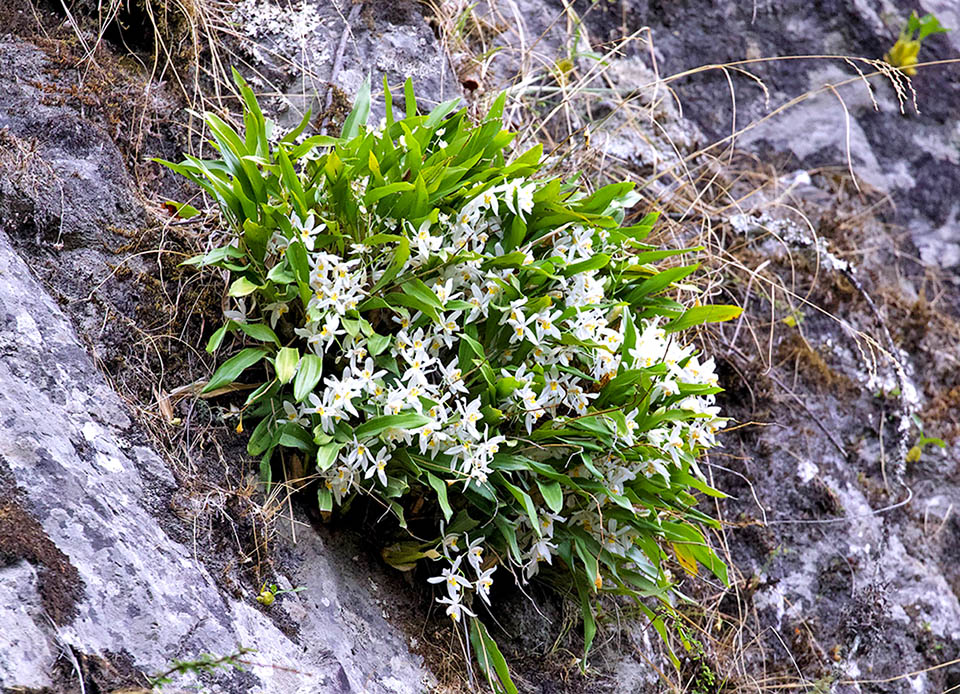
Coelogyne nitida covers a vast range from Nepal to China and Indochina. Can live also on rocks covered by moss, mainly in the high altitude mountain forests © connk
Coelogyne nitida (Wall. ex D. DON) Lindl. is a species of the section Ocellatae, subtribe Coelogyninae, tribe Arethuseae, subfamily Epidendroideae, family Orchidaceae.
Molecular studies on the subtribe Coelogyninae have highlighted that in the same had been included genera and species with different DNA; this made the subtribe polyphyletic. Recent studies (Chase et al. Phytotaxa, Vol. 510, No. 2, 2021) have proposed a new classification of the subtribe transferring as many as 14 genera under the name
Coelogyne to render it monophyletic, thus eliminating classifications based on unstable characters like the number of leaves or the shape of the pseudobulb, that have turned out to be unreliable on the taxonomic point of view.
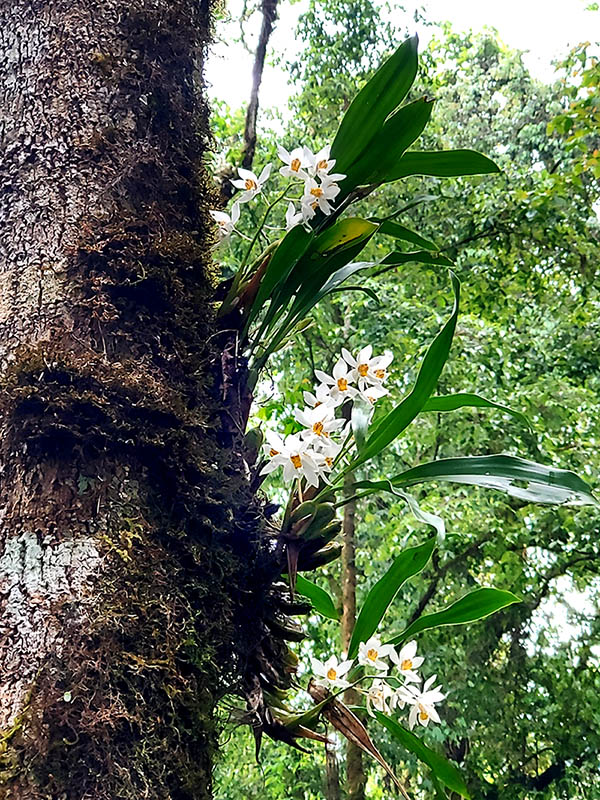
However, it is more easily found as an epiphyte attached to the bark of large trees covered with moss in areas characterized by persistent thick fogs and frequent drizzles throughout the year © Shilpa Avate
The new classification has involved the change of previous names and of the endings, new combinations and the resolution of the conflicts due to the homonyms that have arisen in some cases.
In accordance with this new classification, the subtribe Coelogyninae presently includes the genera Aglossorrhyncha (13), Bletilla (5), Coelogyne (600), Dilochia (10), Glomera (155), Pleione (26), Thunia (4).
The genus Coelogyne has been described by John Lindley (1799-1865) based on a plant coming from Nepal that he did call Coelogyne punctulata Lindl. described in Coll. Bot.: t. 33 (1824).
The main morphological characteristics defining the present perimetre of the genus include the presence of variously shaped pseudobulbs (ovoid to cylindrical, at times flattened), with one or two leaves at the apex. The petals are often linear or lanceolate, at times very reduced compared to the sepals and the generally trilobate labellum, with the base (hypochilus) that may be concave or sac-shaped, and equipped with a series of slats or crests (calli) longitudinal on the surface. The column is normally long, with the apical or lateral wings surrounding the anther.
Coelogyne nitida has been discovered by Nathaniel Wallich, (1786-1854), Danish physician and botanist, superintendent of the Calcutta Botanical Garden. He had collected many plants in India and in Nepal to introduce them in the Garden, assigning them a catalog name without however publishing officially their name. It was instead David Don (1799-1841), Scottish botanist, to scientifically validate the name of the plant together with its description on the volume “Prodromus Florae Nepalensis” (Prodr. Fl. Nepal.: 35, 1825) and called it Cymbidium nitidum. However, John Lindley (1799-1865), considered the father of modern orchidology, thought it was correct to place it within the genus Coelogyne in The Genera and the Species of Orchidaceous Plants, London (Gen. Sp. Orchid. Pl. 40, 1830).
The name of the genus Coelogyne comes from the Greek words “κοίλος” (koílos), empty, hollow, and “γῠν”, (gyné), woman, with the meaning of female due to the hollow shape of the upper part of the pistil (stigma). The specific epithet refers to the look of the pseudobulbs having a shiny surface.
Its common name is The Shining Coelogyne.
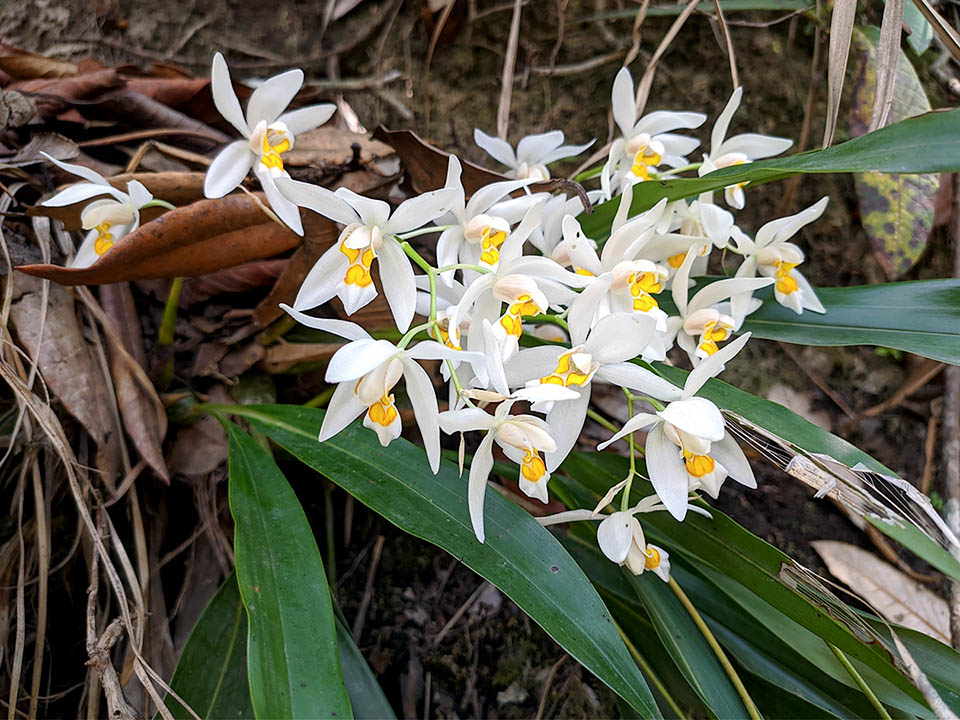
The leaves are coriaceous and plicate, elliptic-lanceolate. In spring get form inflorescences with 3-8 bright white flowers emitting a sweet mossy scent © Basu Dev Neupane
Coelogyne nitida has an area of origin extending from Nepal to China (Yunnan) and Indochina. In particular, it has been found in Assam (India), Bangladesh, central-southern China (Yunnan) eastern Himalaya (Bhutan), Laos, Myanmar (Burma), Nepal, Thailand, Vietnam. It is mainly found in the high altitude mountain forests, at altitudes between 1.300 and 2.600 metres, where the climate is cooler and humid. It lives on moss-covered trees but can also live on moss-covered rocks, in areas characterized by fog and drizzles frequent almost all year round. The diploid chromosome number is 2n = 40.
The rhizome is robust, rigid, with scaly sheaths. The pseudobulbs are spaced along the rhizoma of about 1,5-4 cm each other. They are oblong-ellipsoidal, glossy, with aging they tend to get slightly grooved and wrinkly, with 2 leaves on the apex.
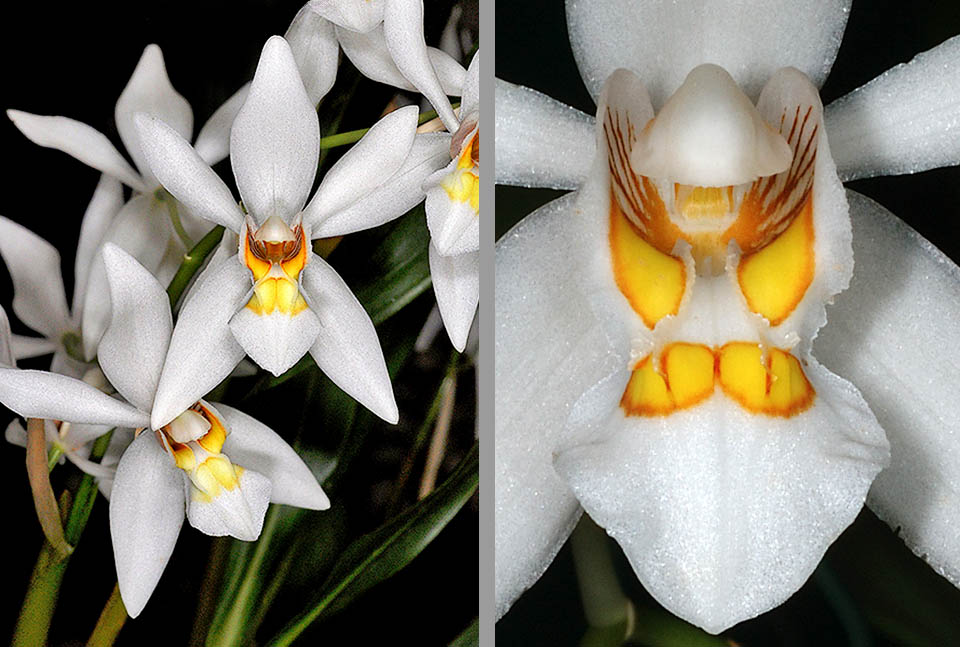
The 40-50 mm broad flowers are star-shaped, with ovate-lanceolate sepals and linear-lanceolate petals. The labellum is trilobate, ovate, bright white with yellow-orange veins and two intense yellow oculiform spots simulating abundant pollen for pollinators. A refined visual and olfactory deception © Ron Parsons (left) © Eric Hunt (right)
The leaves have lamina of about 7 x 1,5 cm, coriaceous, elliptic-lanceolate, sharp, plicate, with 8 veins, gradually narrowing towards the bottom in an elongated base, grooved, with the base getting thinned in a 2 cm petiole.
The inflorescence forms in spring and emerges from the base of the pseudobulb. It is 6 to 20 centimetres long, with the lower part wrapped by coriaceous sheaths and with the rachis that may be erect or somewhat drooping usually bearing 3 to 8 flowers that open at the same time. The flowers are white, bright and emit an intense scent., sweet and musky. The sepals are ovate-lanceolate. The dorsal is erect or slightly curved over the column, whilst the lateral two are extended. The petals are slightly narrower than the sepals and have a linear-lanceolate shape.
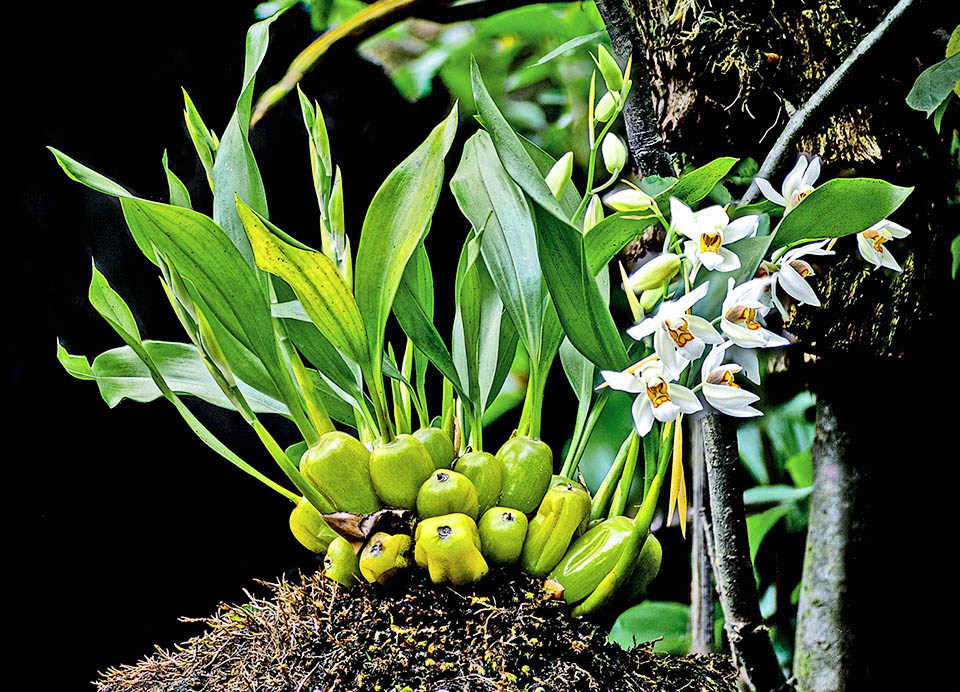
The numerous oblong-ellipsoidal pseudobulbs have two leaves at the apex. The inflorescence develops from the base, characterized by erect or slightly drooping rachis © Bon Pradhan
They are arranged laterally, giving the flower a star shape. The sepals are oblong, 17-19 x 4,5 ll, with sharp apex and the petals are almost linear or strictly oblong, about 15 x 2-3 mm. The opening of the flower is about 40-50 mm.
The labellum is ovate, about 15 x 10 mm, trilobate; lateral lobes erect and median almost elliptic, about 5 x 4 mm, with 3 longitudinal lamellae. The lateral lamellae are massive and the median is hardly visible. It has a bright white colour with oblog spots and yellow-orange veins, at its base are present two deep yellow coloured oculiform spots. The column is slightly curved, about 12 mm, with wings on both sides widening from the base to the apex. The contrast between the pure white of the perianth and the yellow-orange spots of the labellum is a precise evolutionary strategy aimed at reproduction.
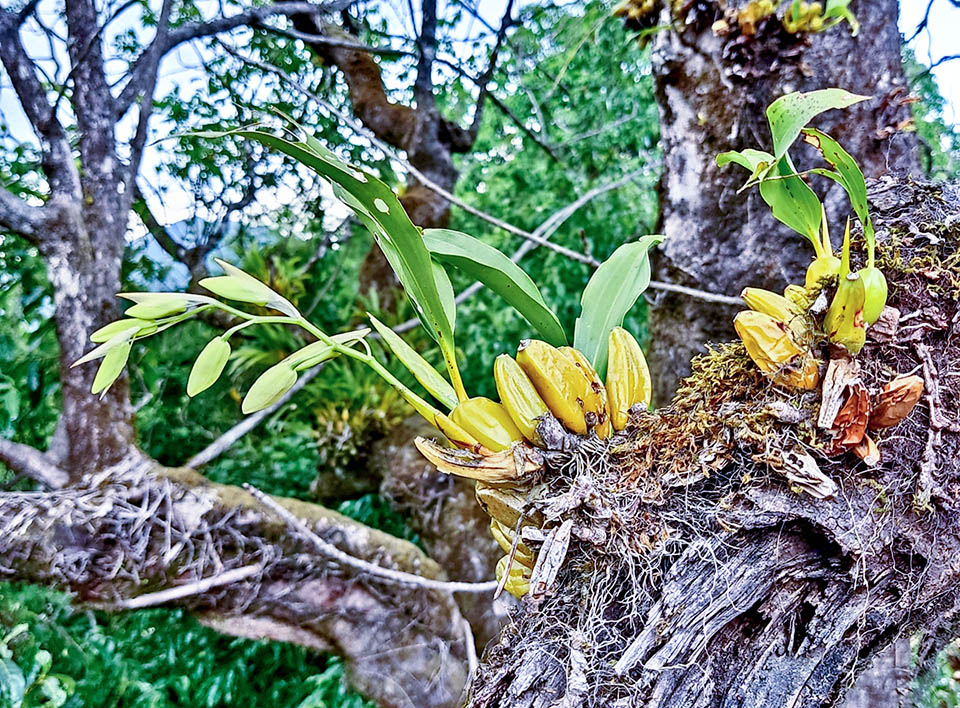
Here, on the left, an inflorescence with still budding flowers. As years go by, the pseudobulbs lose their leaves, become wrinkly and finally they completely dry up © Александр Кулагин
As a matter of fact, the white colour makes the flower very visible compared to the green or the brown of the surrounding environment and the intense yellow of the labellum simulates the presence of abundant pollen that the pollinators associate to a source of energy food. This is a visual and olfactory deception. The main visitors of Coelogyne nitida belong to the order of the Hymenoptera like the Wild bees, the Bumblebees and the Wasps and to the order of the Diptera such as the Hoverflies (Syrphids). All these insects have a masticatory-licking or sucking buccal mouthparts, perfect for exploring the base of the labellum. When an insect lands on a labellum, because attracted by the yellow spots, moves inwards the flower through the narrow passage formed by the labellum and the column, by doing so rubs the rostellum that adheres to it sticking the pollinia rich in pollen on its back. When the insect enters another flower, the pollinia bump the stigma carrying out the pollination.
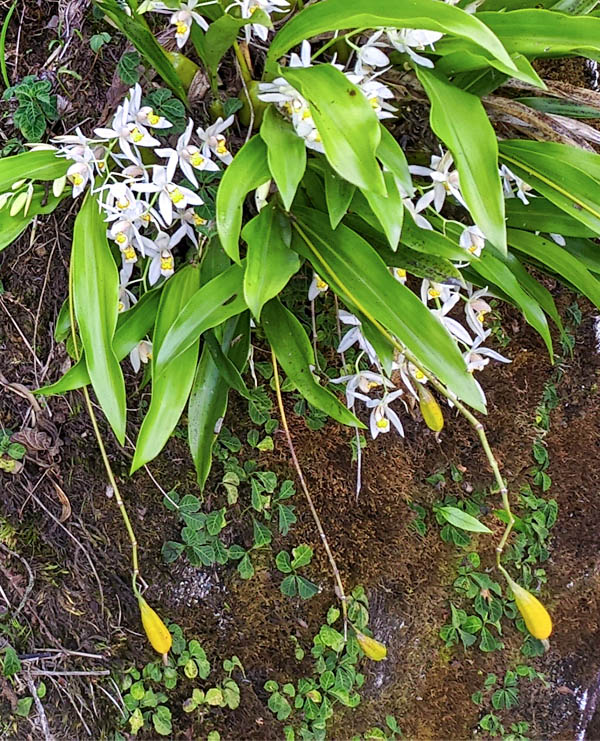
After fecundation, the ovary increases in diameter and transforms in a capsule-shaped fruit initially green, then yellow and finally brown when ripe when it cracks to free to the wind tiny seeds similar to powder © Basu Dev Neupane
After the fecundation, the ovary increases in diameter until it transforms into a capsule, initially green and then brown and fissured, with thousands of tiny seeds, similar to powder, suitable for being dispersed by the wind.
Coelogyne nitida is included in the CITES Appendix II that regulates international trade in order to guarantee its survival in nature. The specimens, if collected in nature, require the appropriate documentation for the export and import. The plants reproduced artificially can be marketed more easily, but must however respect the CITES rules if not clearly declared exempt.
There are hybrids obtained by cross between this species with others of the same genus.
Coelogyne Fredensberg is the outcome of the cross between Coelogyne nitida and Coelogyne lawrenceana, registered at the Royal Horticultural Society (RHS) on Oct. çth, 2019 by Olas Rainer Gruss (1948 -), well known German expert and hybridizer. It has the generous dimensions of Coelogyne lawrenceana together with the typical colouration of Coelogyne nitida.
Coelogyne Himmelskönigin is a hybrid obtained by cross between Coelogyne mooreana x Coelogyne nitida, registered at the Royal Horticultural Society (RHS) on Jan. 29, 2025 by Tim Grudda, owner of the nursery Thüringer Orchideenträume. This hybrid combines the elegance and the pure white of Coelogyne mooreana with the intense scent of Coelogyne nitida. In fact, the name “Himmelskönigin” means “Queen of Heaven” due to the beauty of its flowers.
Other marketed hybrids do exist, but not officially registered, and also several varieties, cultivars, vlones and forms.
A form quite rare but appreciated by the collectors is Coelogyne nitida f. alba. It has very fragrant white flowers without the typical orange or yellow spots on the labellum.
Coelogyne nitida can be cultivated in a pot or in a basket with a substratum of fine bark mixed with moss. Can also be cultivated in a raft (cork or wood) on a layer of sphagnum but requires much more care because the roots can dry up and therefore might need to be watered or nebulized several times during the day.
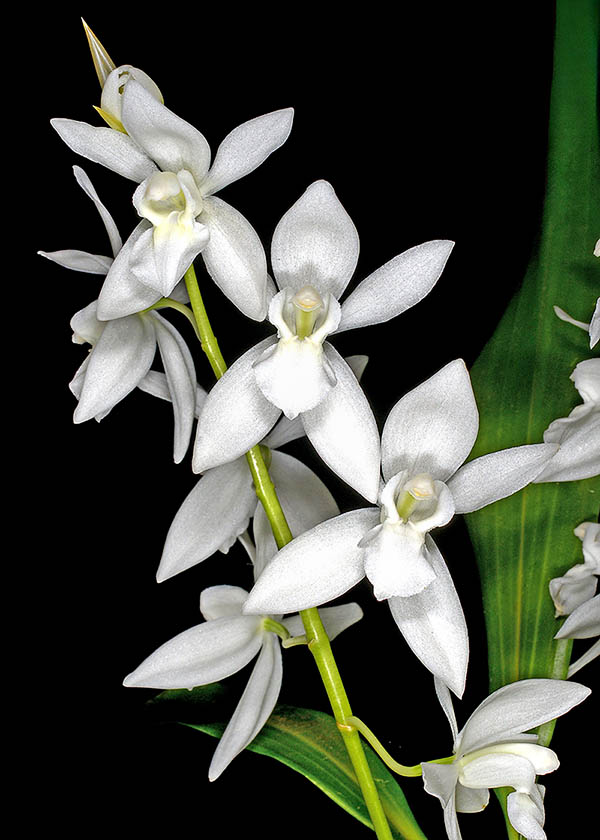
There do exist hybrids obtained by cross between this species and others of the same genus, but a form quite rare exists, Coelogyne nitida f. alba, highly desirable by the lovers and collectors © Ron Parsons
It loves a filtered brightness and never a direct sunlight in order not to burn the leaves. It does not tolerate the complete drought and consequently requires rainwater, distilled or by reverse osmosis to maintain the substratum constantly humid, avoiding in any case water stagnations that could rot the roots.
The environmental humidity should stand between 50% and 80%.
During the winter rest phase the waterings can be reduced but we have to limit to occasional sprayings to avoid the pseudobulbs from wrinkling.
It grows well in a cool greenhouse or in a terrarium with summer temperatures of 18-24 °C and winter ones of 10-12 °C. The thermal shock and the drop in temperatures are indispensable for stimulating the spring flowering.
During the phase of active growth when the new leaves or the roots form, it is good, every two or three waterings, to fertilize with a ternary fertilizer, as NPK 20-20-20, mixed to irrigation water, but in half the dose indicated on the package. In winter the fertilizations are to be suspended.
Periodically, it is good to rinse teh substratum with pure water to prevent mineral salts accumulation, that would male the roots dark and soft.
If the plant grows out of the basket, the repotting can be done but we must not damage the roots. This attention is useful because the repotting is badly tolerated by all species of Coelogyne.
Synonyms: Coelogyne conferta T.Moore & Mast. (1875); Coelogyne nitida f. candida Roeth (2002); Coelogyne ochracea Lindl. (1846); Cymbidium nitidum Wall. ex D.Don (1825); Pleione nitida (Wall. ex D.Don) Kuntze (1891); Pleione ochracea (Lindl.) Kuntze (1891).