
Family : Pempheridae

Text © Dr. Giuseppe Mazza

English translation by Mario Beltramini
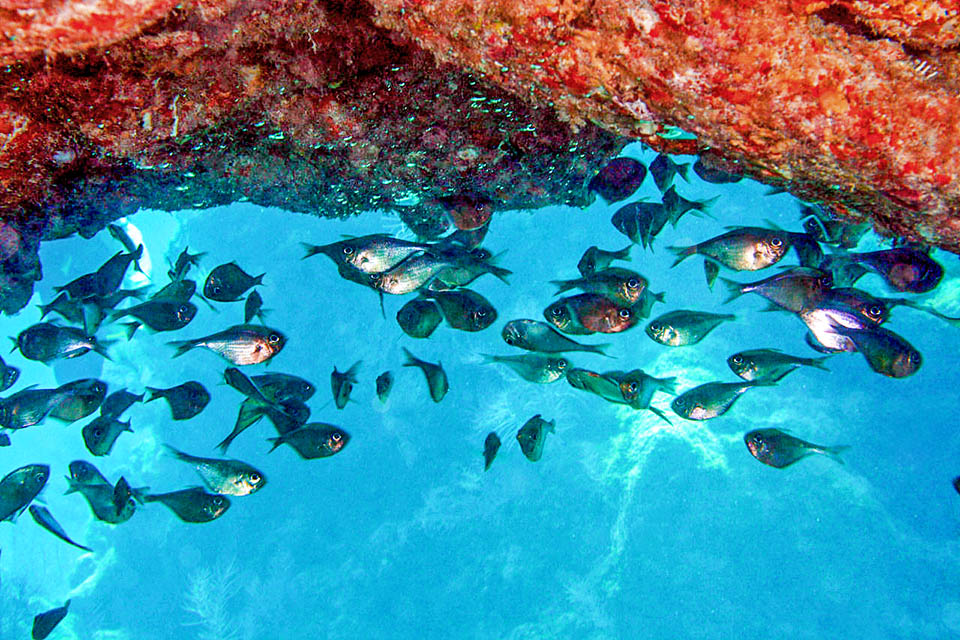
Pempheris schomburgkii is a small Caribbean fish with nocturnal habits. During the day it remains hidden in dense schools inside rocky ravines and madreporic shelters © Kevin Bryant
He who dives in the Caribbean often notes an odd silver shadow moving in the cavities of the reef. But it is only necessary to wait for the sunset to see them getting out in groups from their shelters, transforming from discreet inhabitants of the grottoes to tireless hunters of plankton.
In fact, life in a group represents one of the most effective survival strategies in the aquatic world.
Moving in compact schools, the individuals reduce the risk of being seized by the predators thanks to the effect of dilution and to the visual confusion the school causes. Moreover, the presence of many eyes increases the probability of early detection of a danger and allows the fishes to coordinate their movements quickly.
These little fishes, known as Pempheris schomburgkii”Glassy sweepers”, that is Müller & Troschel, 1848, and commonly known in English as “Glassy sweepers”, referring to the silver and semi-transparent appearance of their body, particularly evident in the juveniles, belong to the order of the Acropomatiformes and to the family of the Pempheridae known also as that of the sweepers.
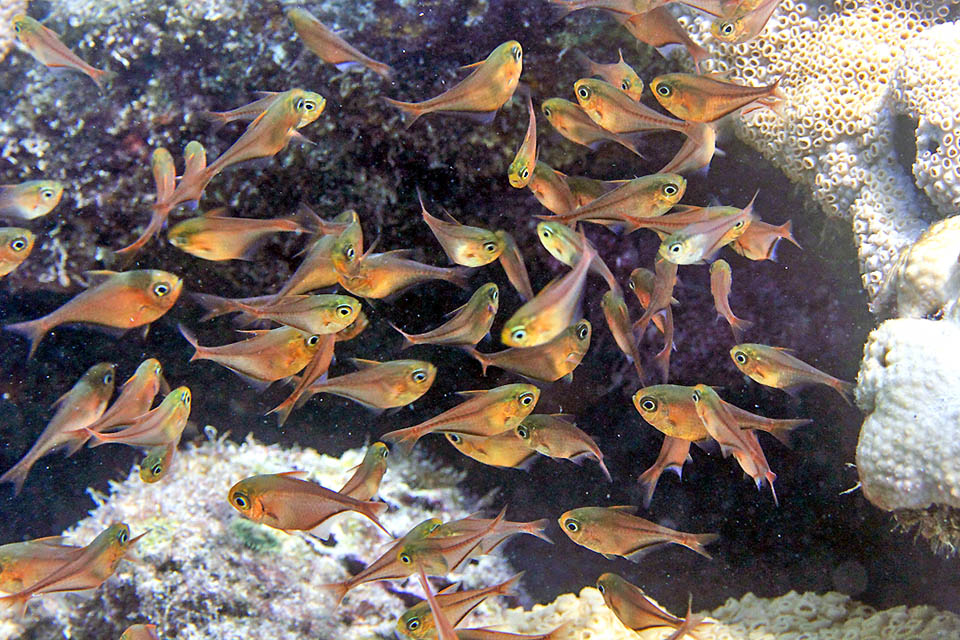
At dusk the school comes alive: the fishes reach the open sea for feeding on zooplankton, seizing mainly the larval stages of many invertebrates © Kevin Bryant
Cuvier formed in 1829 the genus Pempheris, taking up the name with which the Greek philosopher Numenius of Apamea (second century AD) indicated a small fish unidentifiable in our times. Conversely, the specific term
schomburgkii pays homage to the memory of the German explorer Robert Hermann Schomburgk (1804-1865) who treats this unusual fish in his “The history of Barbados”.
About the genus Pempheris, by far the richest of the Pempheridae, they talk nowadays about more than 70 valid species between the Indo-Pacific and the Atlantic, but some are synonyms and the taxonomists climb on the mirrors counting the number of rays on the fins, the scales of the lateral line, the shades of colour and the head-eye ratio, not to mention the molecular biology.
Zoogeography
Pempheris schomburgkii substantially is a Caribbean fish, present from Florida to the Central American coasts, in the Antilles and in Venezuela.
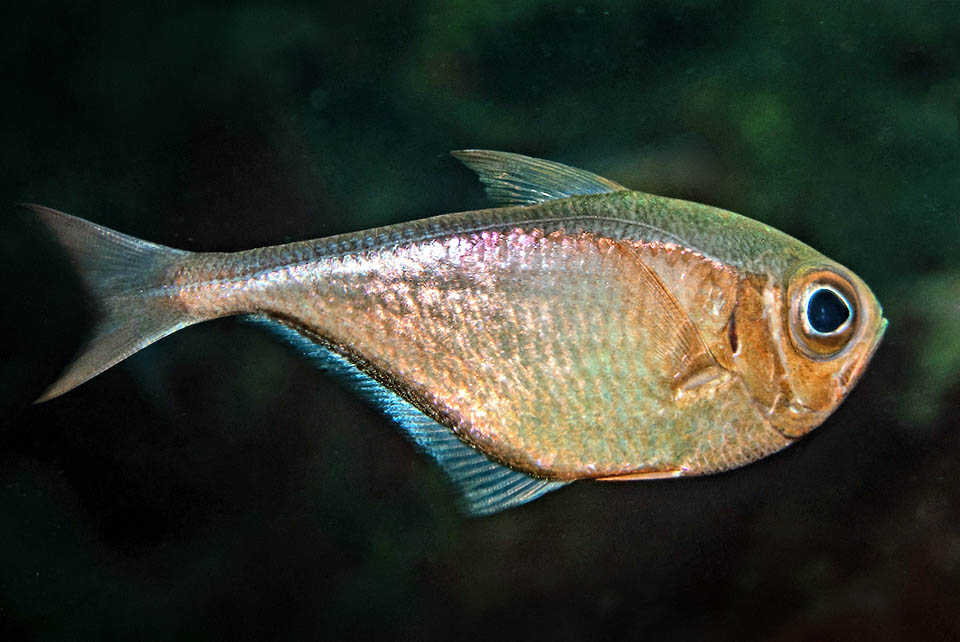
Adults attain 15 cm. The compressed body, the branched livery and the big eyes favour the night life © www.carlosestape.photoshelter
Ecology-Habitat
It frequents the coastal waters in 3 to 30 m of depth with temperatures included between 25 and 28,1 °C, taking shelter during the day in small rock or madreporic caves.
Morphophysiology
Pempheris schomburgkii attains the length of 15 cm with an oblong body, very deep and strongly compressed. The upper profile of the head is moderately oblique and the back then proceeds horizontal. The chest is keeled just before the pelvic fins.
Living in the darkness, the eye is big, about one third of the body. The snout is very short. The mount, oblique with small teeth, opens upwards.
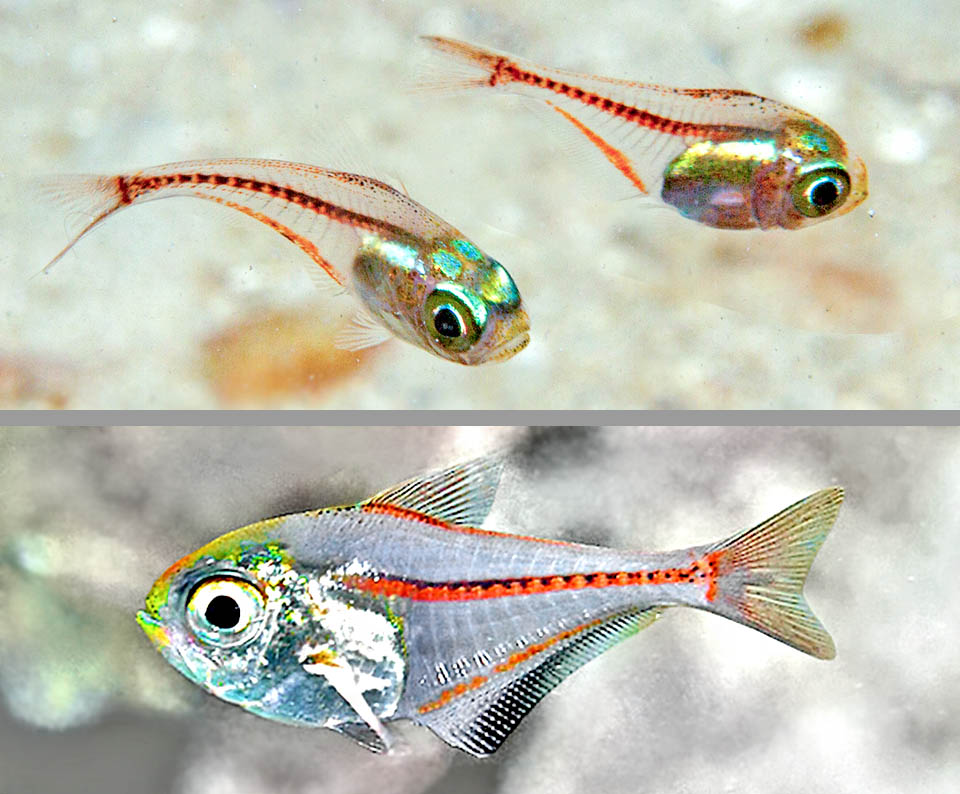
Two juvenile stages after metamorphosis. Transparency renders inner organs visible; with growth appears the final livery and juveniles aggregate to the school © www.carlosestape.photoshelter
The dorsal fin, with a short base, starts before the anal with 4-6 spiny rays and 8-10 unarmed. The anal, much longer, has instead 3 hard rays and 29-36 unarmed. The pectoral ones, long and sharp, have 15-18 rays and the caudal is forked.
The lateral line, high, markedly arcuate and complete, extends almost to the tip of the central rays of the tail.
The scales are ctenoid along the back, posterior to the dorsal fin, and on the ventral part of the head and of the body; conversely in the other regions they are cycloid and branched. Finally, we note a dark band at the base of the anal fin.
Ethology-Reproductive Biology
Pempheris schomburgkii feeds during the night on zooplankton, especially larval stages of many invertebrates. Then, wth the first light of dawn the journey ends and the fishes get back to their coral shelters, recomposing the school up to the following evening’s fall.
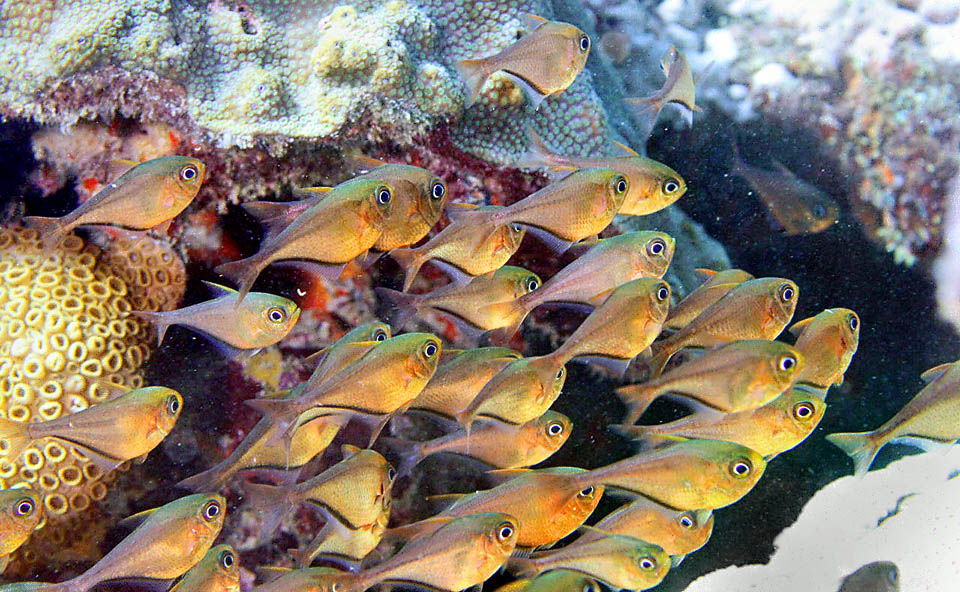
At dawn first light the journey is over: the fishes get back to their coral shelters, where they recompose the school and keep hidden up to following evening © www.carlosestape.photoshelter
Reproduction is little known but is certainly oviparous with external fertilization and pelagic eggs entrusted to the currents.
Also the larvae are planktonic but after the metamorphosis the juveniles settle down in the same shelters as the adults assuming the gregarious behaviour typical of the species.
Resilience is high, with a minimum time for the doubling of the populations of less than 15 months, and the fishing vulnerability, very low, marks only 10 on a scale of 100. Since 2013 Pempheris schomburgkii has been classified as “LC, Least Concern”, in the IUCN Red List of the endangered species.
Synonyms
Pempheris mexicana Cuvier, 1831; Pempheris muelleri Poey, 1860.
→ For general information about FISH please click here.
→ For general information about BONY FISH please click here
→ For general information about CARTILAGINOUS FISH please click here.
→ To appreciate the BIODIVERSITY of BONY FISH please click here.
→ To appreciate the BIODIVERSITY of CARTILAGINOUS FISH please click here.