
Family : Meandrinidae

Text © Dr. Giuseppe Mazza

English translation by Mario Beltramini
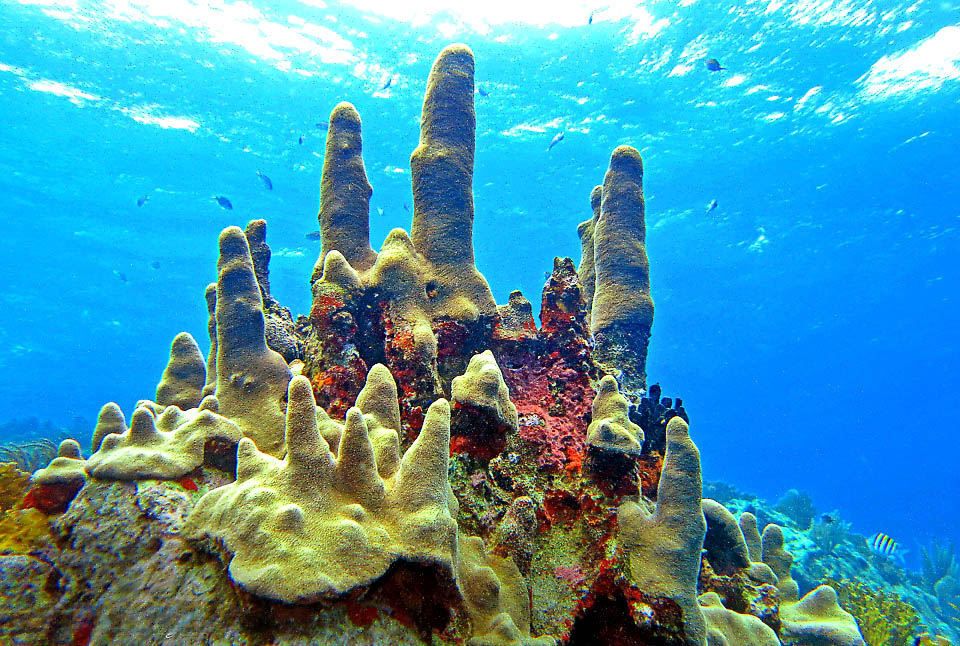
Seems a submerged castle, but is the cylindrical architecture of a Caribbean madrepore © Pauline Walsh Jacobson
Within the Caribbean madrepores, few have such an unusual architecture like Dendrogyra cylindrus (Ehrenberg, 1834). Its vertical columns recall a series of small pillars emerging from the coral reef; however, observing closely the surface, we discover an infinite number of tiny polyps that, with their tentacles stretched out, transform the calcareous skeleton into a living covering.
It belongs to the phylum Cnidaria, to the class Anthozoa and to the order Scleractinia, that includes the hard corals builders of calcareous skeletons. It is classified within the family Meandrinidae and is the only extant species presently recognized of the genus Dendrogyra.
The name of the genus comes from the Greek “déndron”, tree, and “gŷros”, circle or curvature, with reference to the structure of the column and to the sinuous trend of the skeletal formations. The specific epithet cylindrus means in Latin cylindrical and describes the characteristic shape of the columns.
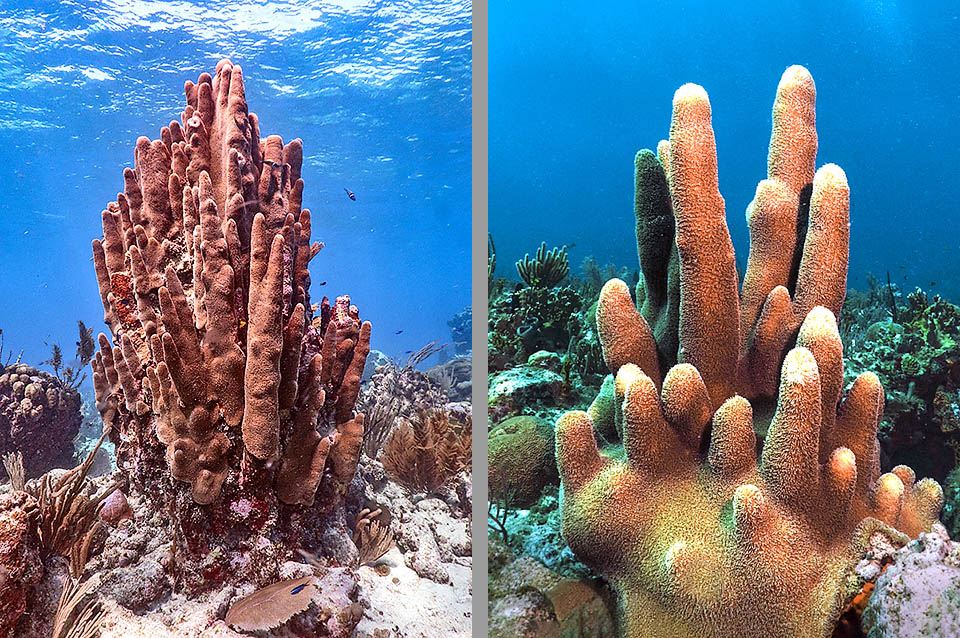
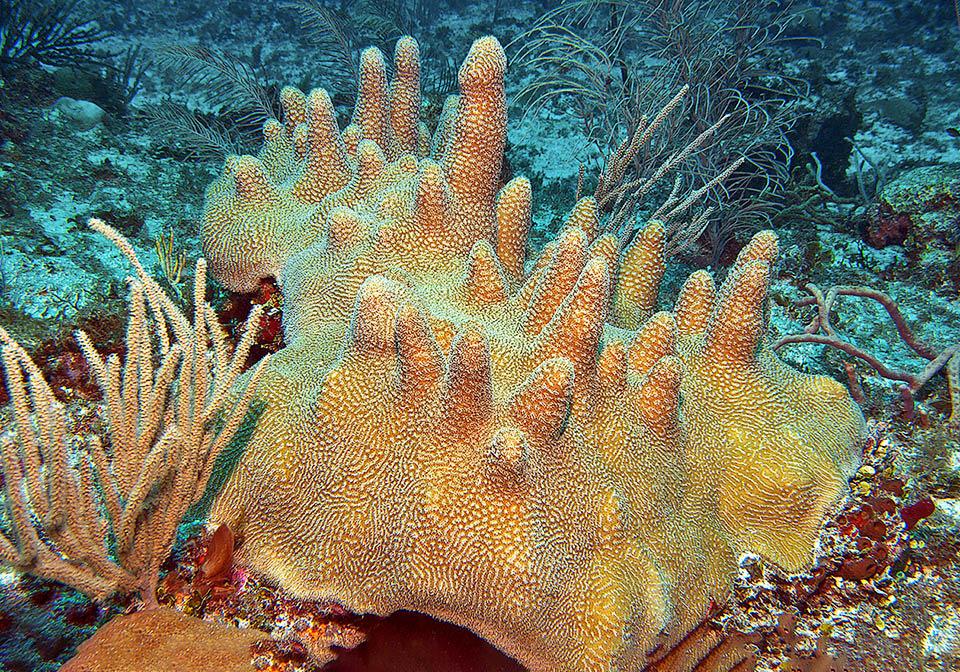
It is a Dendrogyra cylindrus, an unmistakable madrepore, unluckily classified Critically Endangered in the IUCN Red List © Lorenzo Alvarez-Filipv (left) and © Pauline Walsh Jacobson (right)
Zoogeography
This species is native to the tropical western Atlantic, with a distribution including the Caribbean Sea, the Gulf of Mexico, Florida, the Bahamas and the other insular areas of the region. However, its presence is not uniform: the columns may be locally rare and spaced, even if in apparently favourable coral environments.
Despite the vast geographic distribution, the species has sparse populations in numerous locations. The decline observed in various Caribbean aeras has rendered this madrepore an important object of attention for the conservation and monitoring programs of the coral reefs. Its rarity and the recruitment difficulties of the young individuals increase the vulnerability of the residual populations.
Ecologia-Habitat
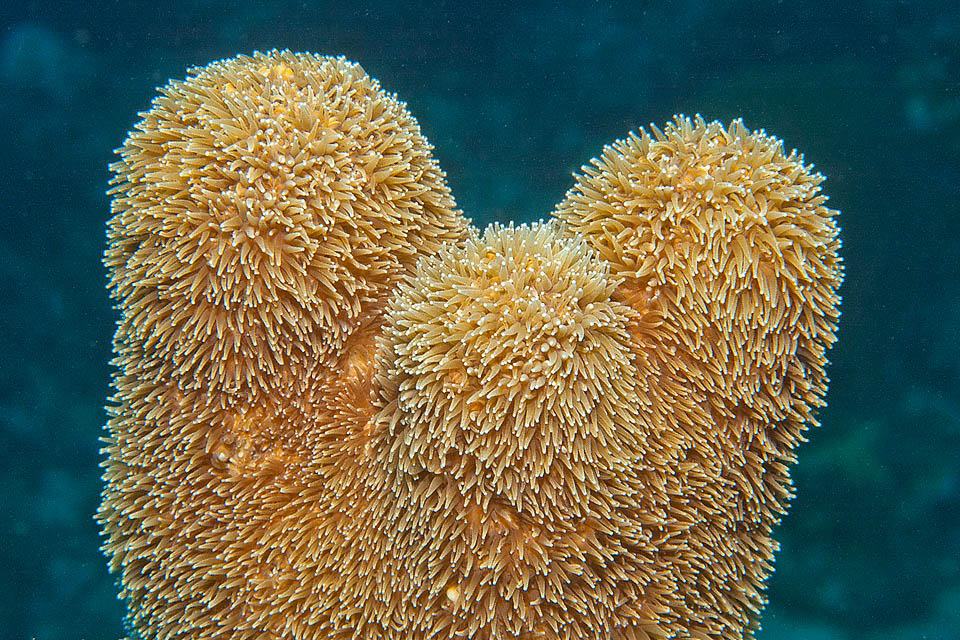
Lives in shallow waters where the light allows symbiont green algae photosynthesis that complete a diet mainly based on the plankton seized with the tentacles © taxonomy
Dendrogyra cylindrus colonizes hard substrata of the coral reefs, in environments enlightened and characterized by a circulation of water sufficient for favouring the gas exchanges and the intake of food particles. The species lives mainly in relatively shallow waters, but may settle also in bigger depths, depending on the local characteristics of the reef.
It is reported especially between 5 and 15 m of depth, but may be found also at about 1 m and up to 25 m. The availability of light is important for the survival of the symbiotic algae housed within the tissues, whilst the movement of the water contributes to the transport of oxygen and of food particles.
Like other building corals, it guests symbiotic photosynthetic algae of the family Symbiodiniaceae. Through photosynthesis, these provide to the coral a significant portion of the organic compounds necessary for the metabolism and contribute to the energy balance of colony.
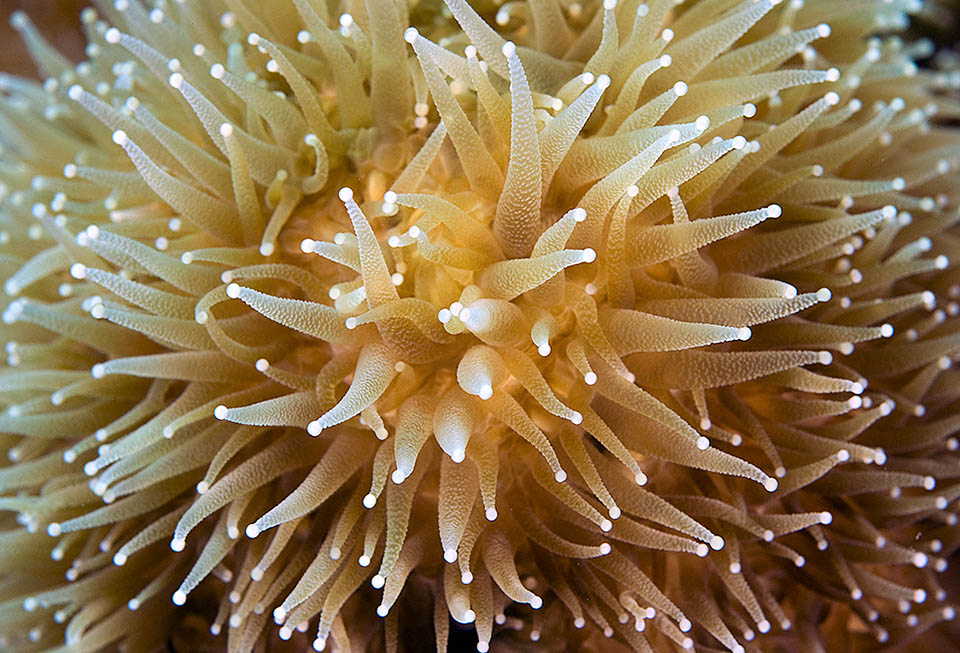
Here enlarged: like marine anemones and in corals, they are those of an anthozoan, having stinging cells © Terence Zahner
In any case, the coral does not depend only on photosynthesis: the polyps integrate this contribution by seizing zooplankton and other food particles suspended in water.
The main threats include marine warming and the whitening, the coral diseases, the habitat degradation and the ocean acidification. The hitening occurs when the coral loses the symbiont algae or the pigments produced by them, with the consequent reduction of the energy input. The slow growth and the poor recruitment observed in various locations render difficult the recovery of the damaged populations.
Morphophysiology
The colony develops starting from a crust-forming base, from which robust cylindrical columns rise, at times slightly curved or irregular, that may attain considerable dimensions.
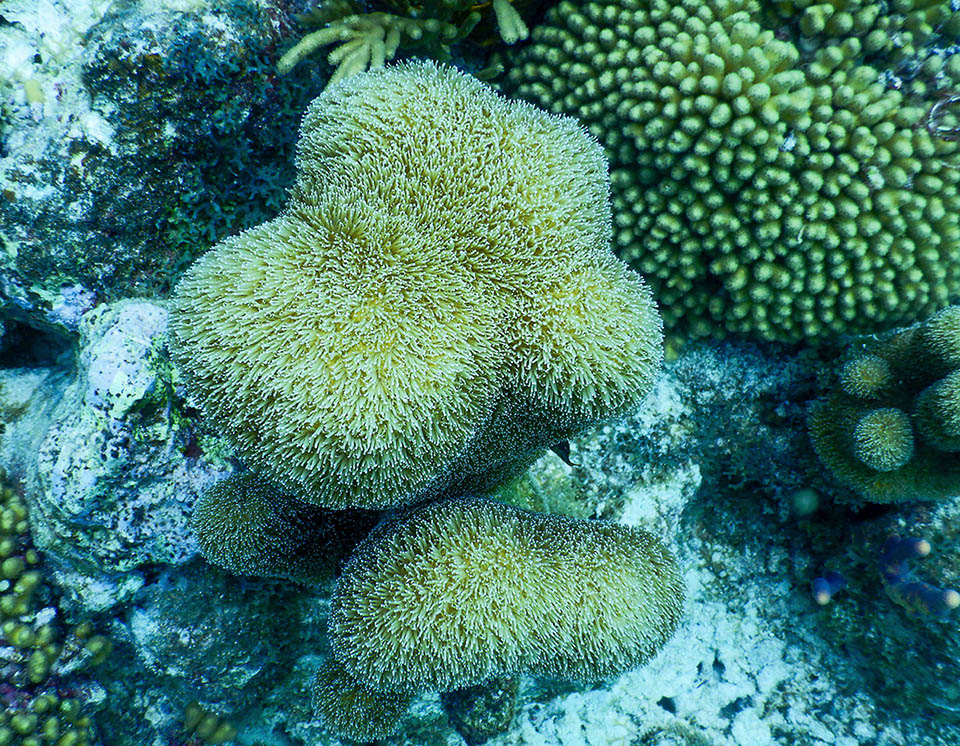
Often tawny, they may be also green, like in this colony © Patrick Palines
Under favourable conditions, the columns can reach about two metres in height. Unlike the ramified madrepores, teh growth is mainly vertical and confers the column and easily recognizable profile.
The calcareous skeleton presents elongated and sinuous valleys, with septal reliefs and structures following a meandering course. The valleys develop along the surface of the columns and guest the polyps, forming an irregular pattern of grooves and ridges. The arrangement of these structures, together with the columnar growth, forms one of the distinctive characteristics of the species.
The colouring of the tissues varies from brown and grey brown to beige and cream, with possible warmer or greenish tones.
The chromatic aspect may depend on the pigmentation of the tissues, of the symbiotic algae, of the environmental conditions and on the enlightening at the moment of the observation. The differences in colours do not necessarily indicate the presence of distinct taxonomic varieties.
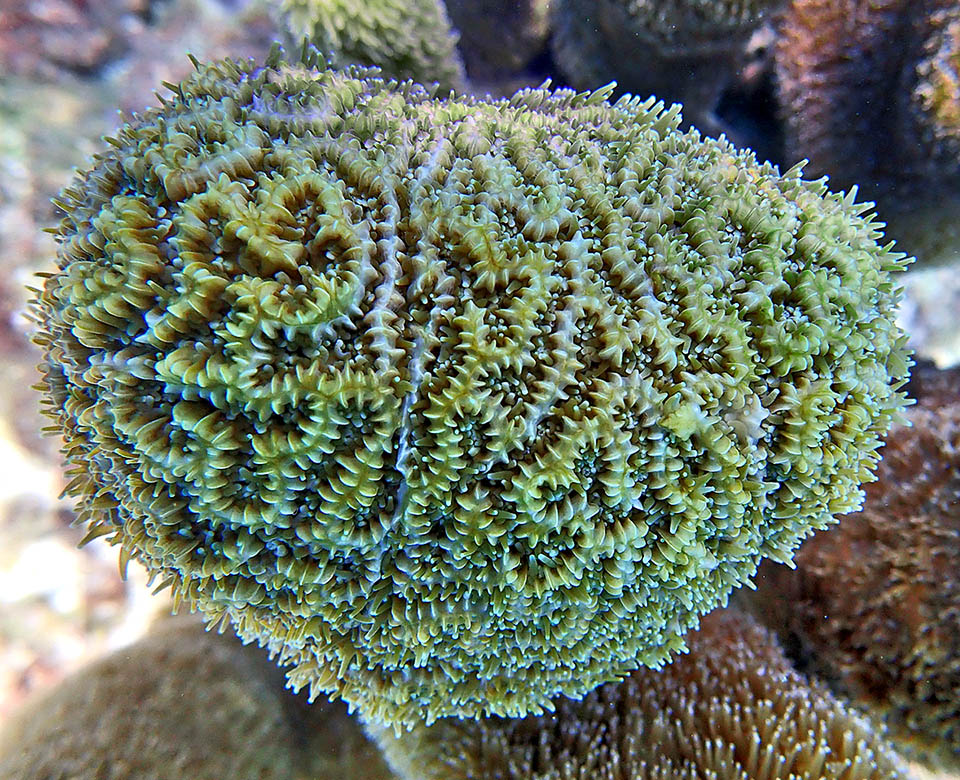
The skeletal labyrinth calcareous structures allow the polyps to move back to protect from predators and contribute to the colony’s nutrition © Pim Bongaerts
The polyps are equipped with thin tentacles and may remain extended even the whole day. When this happens, the covering of the column gets a delicately hairy look, particularly evident in the close-up photos. The tentacles participate in the capture of the food particles and in the interaction with the surrounding environment.
The combination of cylindrical columns, sinuous valleys and polyps frequently extended renders Dendrogyra cylindrus one of the Caribbean madrepores more easily recognizable. The differences in height, in the disposition and in the density of the columns confer moreover a variable appearance to the columns.
Ethology-Reproductive Biology
The polyps seize food particles carried by the currents, while the symbiotic algae contribute to the energy balance of the colony by means of photosynthesis.
The sexed reproduction entrusts to currents thousands of planula larvae that if reach a good substratum can settle there and originate a new colony © emmaalves
The extension of the tentacles allows them to interact with the surrounding water and to intercept the available food material.
The sexed reproduction involves the production and the release of gametes in the water. After the fecundation, planula larvae develop that can disperse before settling on a suitable substratum and originate new colonies. The success of this process depends on several environmental factors, on the availability of surfaces suitable for the settlement and on the survival of the larvae and of the young polyps.
The sexed reproduction allows the dispersion of the species and favours the genetic variability of the populations. The reproduction and the initial development are however particularly vulnerable phases: the larvae must find favourable conditions for settling, whilst the young colonies must overcome the difficulties linked to the competition, the predation and the environmental variations.
The species may also benefit from asexual propagation when fragments of the colony survive and settle again on the seabed. This process may contribute to the maintenance of the local populations but does not replace the necessity of an effective sex-based recruitment.
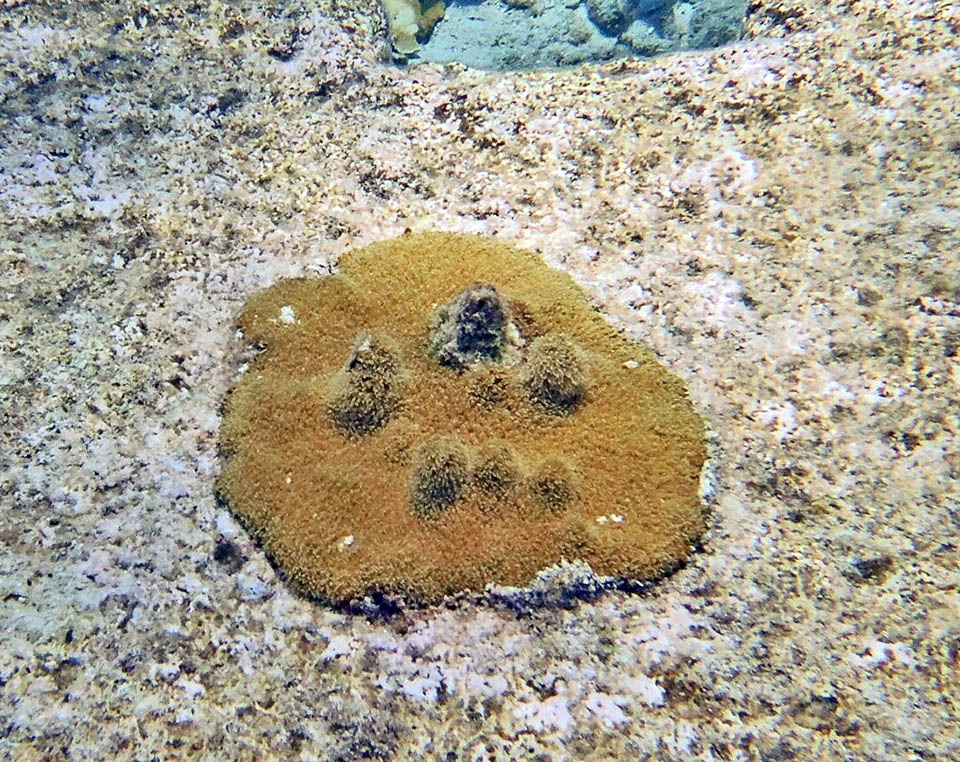
Here after several years, a growing colony with its first cylindrical structures. It can’t move: its future is linked to the environment conditions © taxono-my
The scarcity of young colonies in various studied areas represents a serious obstacle to the recovery of the populations. For this reason the conservation of the adult individuals and of the habitats in which they live is quite important.
After the Red List of the International Union for the Conservation of Nature (IUCN), Dendrogyra cylindrus is classified as “CR, Critically Endangered”, in a critical danger. The evaluation published in 2022 shows a marked decline of the population, associated especially with the coral diseases, the whitening and the deterioration of the habitats. The rarity of the species and the limited recruitment of the young individuals hinder the recovery of the populations and render quite important the protection of the remaining colonies.
Synonyms
Dendrogyra caudex (Ehrenberg, 1834); Dendrogyra spatiosa (Ehrenberg, 1834); Dendrogyra sanctihilarii Duchassaing & Michelotti, 1864; Maeandra caudex Ehrenberg, 1834; Maeandra spatiosa Ehrenberg, 1834; Meandrina caudex (Ehrenberg, 1834); Meandrina spatiosa Ehrenberg, 1834.
→ To appreciate the biodiversity of the CNIDARIANS please click here.