
Family : Orchidaceae

Text © Prof. Pietro Pavone

English translation by Mario Beltramini
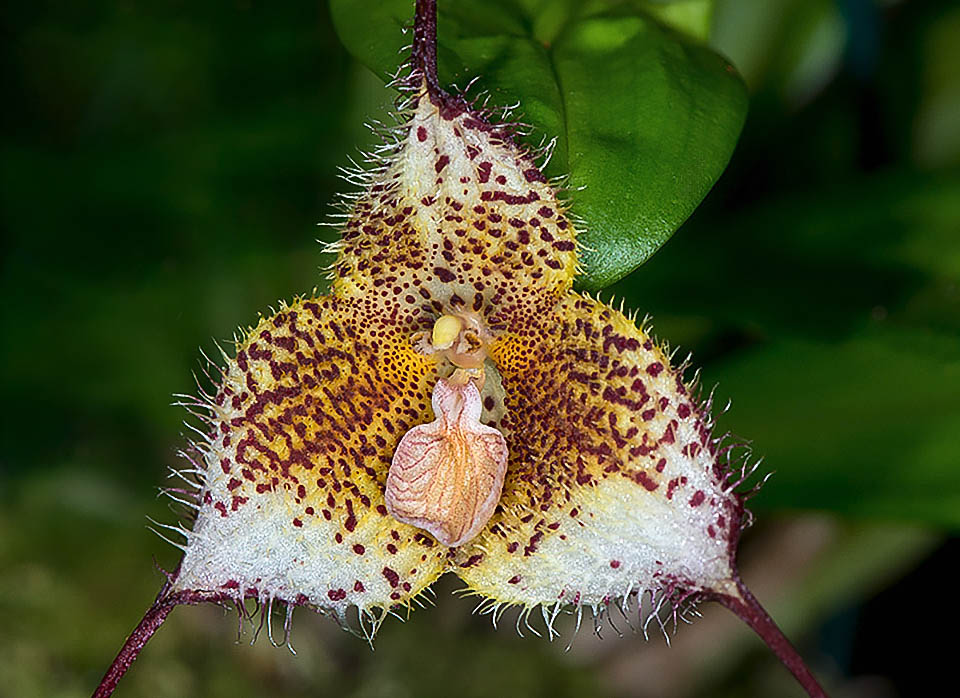
Dracula diana is a rare endemism of Colombia rainforests, present between 1200 and 1600 m on the Valle del Cauca Department, on the Western Cordillera © Eerika Schulz
Dracula diana Luer & R.Escobar is a species of the subtribe Pleurothallidinae, tribe Epidendreae, subfamily Epidendroideae, family Orchidaceae.
The genus Dracula, created in 1978 by Carlyle August Luer (1922-2019), is found in America, in the Central and Western Andes Cordillera. Presently it counts about 146 species.
Initially species of this genus were discovered starting from 1870 and included in the genus Masdevallia, created in 1794 by the two Spanish botanists, Hipólito Ruiz López (1754 – 1816) and José Antonio Pavon (1754-1840). Carlyle A Luer noticed that the Masdevallia species included presented characters substantially different from the others included of the genus so he separated them creating a new genus he called Dracula. As a matter of fact, the species of the genus Dracula differ for the shape of the flowers, that reminds the muzzle of a monkey or the head of a dragon, and of the leaves that are leathery, dorsally keeled and gradually narrowed at the base.
The name of the genus means “small dragon” due to the resemblance with a dragon, the sepals long pointed present in almost all species of this genus. The specific epithet refers to the Roman goddess Diana, goddess of woods, of hunting, wild animals, and of the moon.

The odd flower resembles a monkey’s muzzle. The leaves, leathery, are dorsally keeled and narrowed at the base © Dr. Giuseppe Mazza
All species of this genus do live in the humid tropical rainforests, where there is always present a suffused fog due to the low-altitude clouds.
Dracula diana has been described recently by Carlyle A. Luer and by Rodrigo Escobar (1935-2009) in the magazine Orquideologia 15(1): 15(1981).
It is a rare orchid of Colombia, which is found in the Valle del Cauca Department, on the Western Cordillera, in the humid tropical biome, caused by the hazy forests, at altitudes between 1200 and 1600 m.
Dracula diana is a small epiphyte, cool-growing, with roots covered by velamen that allows the plant to absorb the moisture and the nutrients from the surrounding environment. The stems, called ramicauls, are erect, 3-4 cm long, wrapped up low by 2 to 3 loose and tubular sheaths, each with one single apical leaf, erect, thinly leathery, keeled, a little bent, dorsally strictly obovate, 10-22 cm long, that gradually narrows at the bottom towards the petiole. There are no pseudobulbs. The inflorescence, thin and horizontal, is a raceme formed by few small flowers (5 x 10 cm) carried by an 8-10 cm long peduncle that originates from the ramicauls.
The flowers have an unusual appearance, due to the long extensions (tails). The floral bract is 1 cm long, The peduncle bearing it 1,3-1,5 cm. The perianth is formed by white-yellowish sepals in the upper part of the flower, yellow in the lower one with light and dark brown spots that merge in stripes and briefly pubescent. The dorsal sepal is ovate, 12 mm long and broad, connate to the lateral sepals by 5 mm, with the rounded apex contracted in a thuin tail, pale brown, about 4 (7) cm long.
The lateral sepals, ovate they too, are 20 mm long and 14 mm broad, they also have a long tail. In the outer whorl are present ivory-coloured petals, spotted with brown, 3 mm long and 1,5 mm broad.
The labellum is white, dotted with pink, spatulate, 10,5 mm long and 6 mm broad. It is divided into two portions. In the basal (hypochilo) it appears elliptical (oblong), 3,5 mm long and 3 mm tall, with erect and obtuse marginal angles, having a concave base hinged to the foot of the column. In the apical portion (epichilus) it is ovate with rounded apex, 7 mm long and 6 mm broad, little deep, concave, with gently sloping edges, having numerous ramified veins.
The gymnostemium (or column) is yellowish-white, 4 mm long, with an equally long foot. The pollen is organized in two compact masses (pollinii) that come off easily and by means of a sticky adhesive (viscidium) stick to the pollinators. This mechanism is essential for transporting the pollen from one flower to another. The ovary is brown and is 5 mm long.
Flowering occurs in autumn and in spring.
A study on 22 species of the genus Dracula has highlighted that the pollinators are drosophila flies thriving among wild mushrooms found in the areas where these orchids do grow. It was seen, in fact, that the key element of camouflaging is the labellum having the look and the smell typical to the mushrooms.
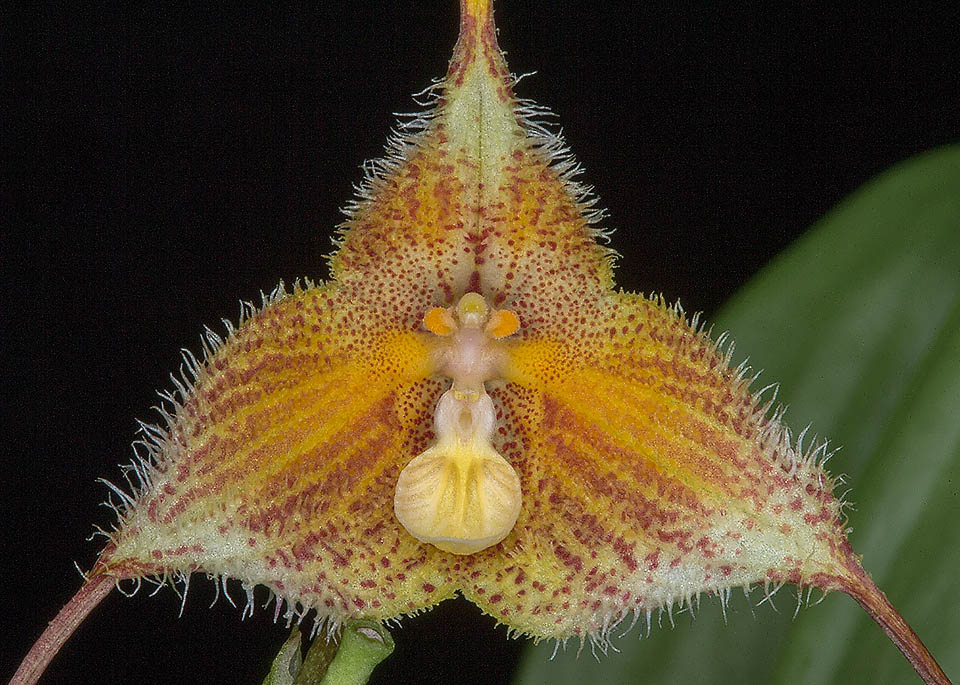
Dracula diana var. xanthina differs for the yellow shades of the flower instead of the typical red-brown colour of the species © Dr. Giuseppe Mazza
Only two intergeneric hybrids exist obtained with Dracula diana and with two species of the genus Masdevallia. This low number is probably due to the infertility between the two genera.
Dracuvallia ‘Rio Tomebamba’ is a hybrid of the genus Dracuvallia, registered at the Royal Horticultural Society by Ecuagenera in 2010. The registered parents are Dracula diana × Masdevallia uniflora. Both species have contributed 50%.
Dracuvallia ‘Mrs. Hein’ is a hybrid of the genus Dracuvallia, registered at the Royal Horticultural Society by E.S.Eyre in 2010. The registered parents are Masdevallia welischii × Dracula diana. Also in this hybrid each parental species has contributed 50%.
The variety Dracula diana var. xanthina is known, so called, particularly in the horticultural trade, due to the colour of the flower that is yellow instead of the typical red-brown colour of the species.
Dracula diana, like many other species of orchids, stands at extinction risk because many hectares of tropical rainforest in South America are lost every year due to deforestation, especially caused by the crop establishment, the breeding, the wood removal, the mining and the oil extraction.

Labellum is clear with ramified veins in the ovate apical part. Smells mushroom and the plant sticks for the transport the pollen sacs to the drosophilae, very attracted by this smell as they thrive among the undergrowth mushrooms © Dr. Giuseppe Mazza
In Colombia this has caused the loss of habitat and the possible extinction of many species of orchids. In fact have been registered 206 species of orchids in the Red Book of Colombian Plants and in the Administrative Decision of the Ministry of the Environment and of the Sustainable Development (2017).
In order to guarantee their survival they have been protected by the Convention on International Trade in Endangered Species of Wild Fauna and Flora (CITES).
In 2015, The Ministry of the environment and of the Sustainable Development and the National University of Colombia have defined a Plan for the Study and the Conservation of the Orchids present in Colombia and in Ecuador, nations with the highest concentration of orchids in the world, having about 9.000 species, that represent 30% of all known orchids. In 2022, Dracula diana has been inserted in the IUCN Red List in the category “EN, Endangered” being deemed at high risk of extinction in the wild.
It is not easy to grow Dracula diana, particularly in our temperate zones, because it needs cool, humid and shaded environments that can be obtained in the temperate-cold greenhouses.
The plant may reproduce by division of the tufts that can be settled in terraria.
As the plant loves a light breeze, it is good that in the environment there is sufficient ventilation and suffused luminosity (1.000-1.500 lux), especially during the summer months, as the sun may cause burns to the leaves.
The growth ground can be formed by sphagnum peat, plant fibres and shredded bark. It is better to utilize holed baskets, preferably hanging, to allow the flowers to develop downwards so as to always have blooming as the blooms can last all year round. The night temperatures must not fall below 12-15 °C and the day ones must not exceed 25 °C. If the temperature exceeds 28 °C, frequent vaporizations must be done to lower it and in the meantime to increase the environment humidity. Stagnations in the ground are to be avoided as this factor damages the health of these plants as root rot may develop.
Fertilizers should not be overdone, especially if done in absence of humidity, because the plant is sensitive to leaf blade run. Fertilizers should be always dissolved in the irrigation water and administered with the substratum always humid. A higher content of nitrogen (N) is preferable to the phosphorus (P) and to potassium (K). Do not fertilize in winter (from November to February) even if the plant has a continuous growth during the whole year.
Possible parasites are the cochineals and the aphids that, in the home cultivation, may be eliminated with a cotton ball soaked in alcohol to be passed over the leaves.