
Family : Muraenidae

Text © Dr. Giuseppe Mazza

English translation by Mario Beltramini
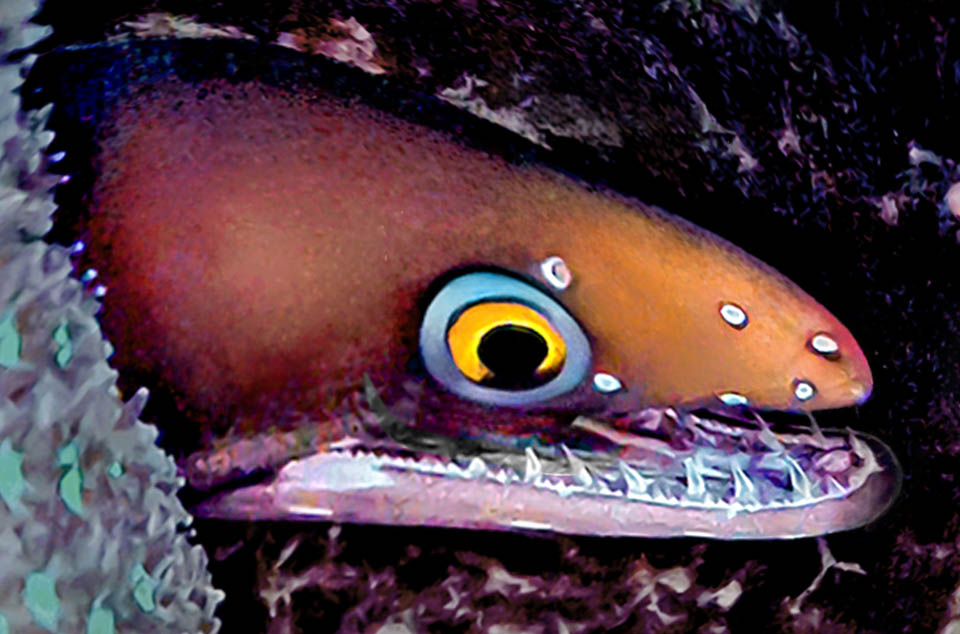
The Chestnut moray (Enchelycore carychroa) is a viper moray present from Bermuda, south Florida, Bahamas and Gulf of Mexico up to the Brazilian coasts © www.carlosestape.photoshelter.com
Chelycore carychroa Böhlke & Böhlke, 1976, belongs to the class of the Actinopterygii, the ray-finned fish, to the order Anguilliformes, to the family Muraenidae and to the so-called viper morays characterized by slender body, narrow head and teeth curved inward, group for which Kaup established in 1856 the genus Enchelycore.
The etymology, not explained, should be, after some, connected to Greek “ἔγχελυς” (énchelys), eel, and “κόρη” (kórē),” the “pupil of the eye” relatively conspicuous at the centre of the snout, whilst for others could also mean “little girl” referring to the modest size of this moray.
Conversely, the species carychroa should come from the Greek “κάρυον” (káryon), nut, and ”χροιά” (chroiá), colour of the skin, with reference to its chestnut livery, as suggests also the English name of Chestnut Moray.
Zoogeography
Enchelycore carychroa is a species located in the Caribbean, present in the western tropical Atlantic from Bermuda, southern Florida, Bahamas and west Gulf of Mexico up to the Brazilian coasts. Then there is one single and not confirmed record on the other side of the Atlantic in Equatorial Guinea. Theoretically the planktonic larvae might get there, as for other species carried by the currents, but the absence of new findings render this report unconvincing.
Ecology-Habitat
Enchelycore carychroa usually lives in waters having temperatures between 25 and 28,1 °C, between 1 and 20 m of depth, but after some observations it might get down to 50-65 m.
It frequents rocky and madreporic seabeds full of cavities and cracks to spend, undisturbed, the hours of light. Though its visual acuity is relatively modest, it actually goes hunting in the dark being guided by a very fine sense of smell.
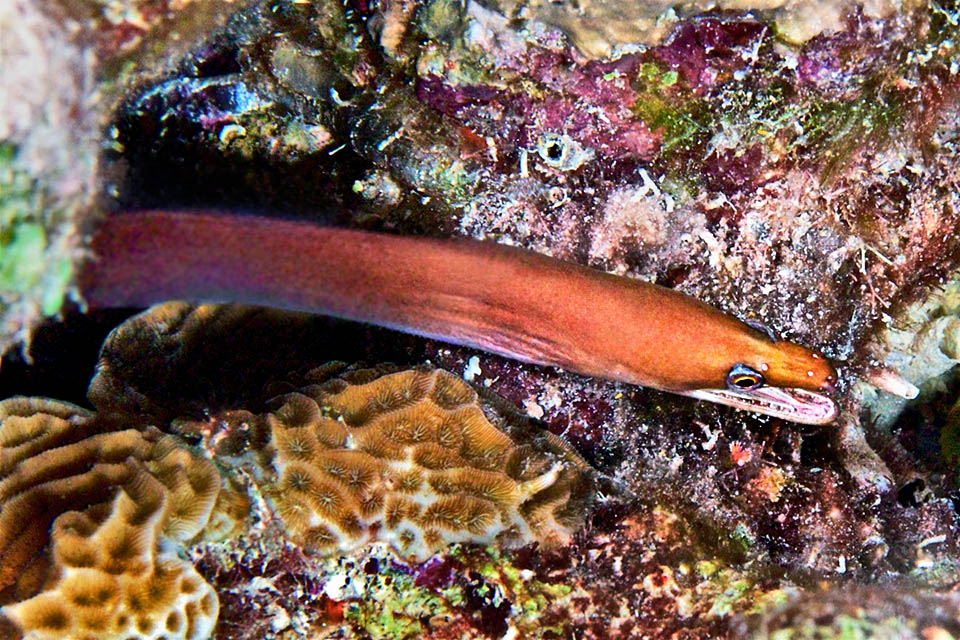
To utmost attains 34 cm in length and is one of the smallest moray eels of the genus Enchelycore © www.carlosestape.photoshelter.com
Morphophysiology
Enchelycore carychroa attains to the utmost the length of 33,5-34 cm and it is one of the smallest in the genus Enchelycore.
Like all morays the body has no scales, as they are replaced by a mucus protecting them from the parasites and allowing them to slip into the holes without scratches.
There are no pectoral and pelvic fins. The dorsal, the caudal and the anal are merged in only one long ridge used for an undulatory swimming.
The strongly arched jaws touch only at the ends; even with mouth closed they are consequently visible the conical and sharp teeth used for grabbing their prey, then held by a second line of pharyngeal mobile teeth that, advancing into the mouth, drag them towards the oesophagus.
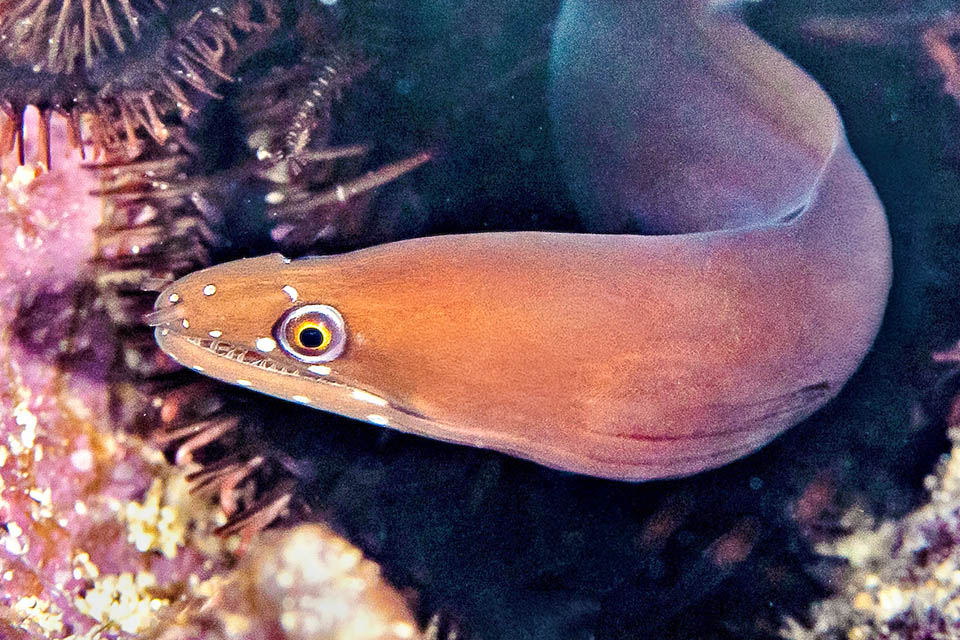
Spends all light hours in a den and hunts the night guided by sense of smell looking for tiny fish, shrimps, crabs and modestly-sized cephalopods © www.carlosestape.photoshelter.com
The jawbone is slightly longer; the anterior nostrils appear like protruding tubes, while the large posterior ones running under skin do open over the anterior edge of the eye.
The moray eels do not have opercula, but gill orifices: two simple holes placed at the end of the head on the extension of the jaw from where flows out the water that has oxygenated the gills, pushed by the rhythmic movement of the mouth. In this case the two sensitive openings are masked by dark horizontal lines whilst a series of small white dots camouflage the nostrils.
Ethology-Reproductive Biology
Enchelycore carychroa goes out at night guided by its sense of smell. It preys usually on small fish but also on shrimps, crabs and small-sized cephalopods. Unlike what is observed in some species of moray eels, there are not known instances of cooperative hunting with groupers of other fishes.
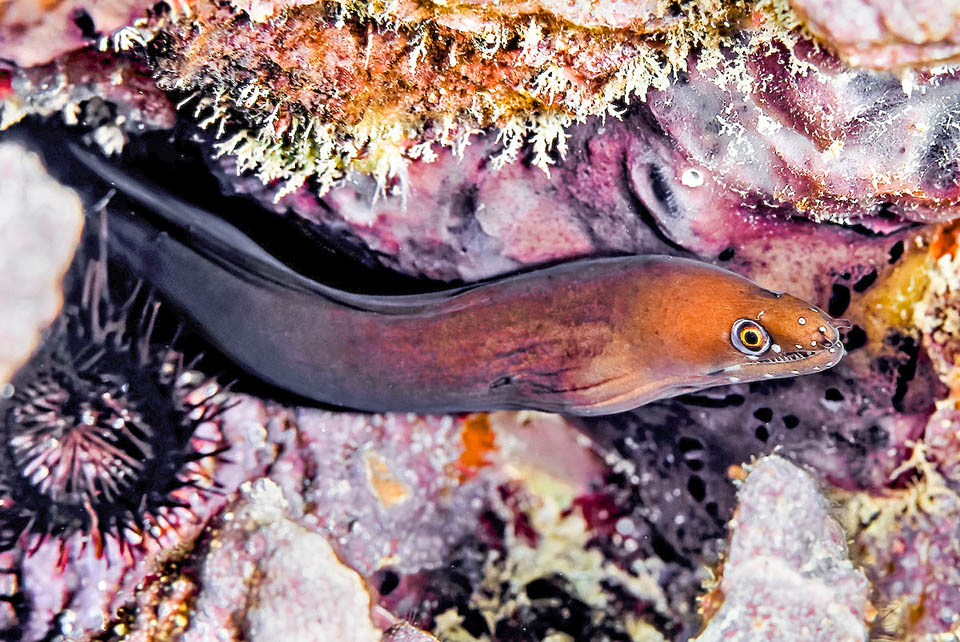
Enchelycore carychroa reproduction is poorly known, but like for other morays eggs and larvae are planktonic © www.carlosestape.photoshelter.com
Its reproduction is little known, but, like other moray eels, egg and larvae are planktonic.
At a certain point these take on a characteristic shape, called leptocephalus, similar to a transparent leaf of willow as having no red blood cells, with small head and protruding needle-shaped teeth.
The leptocephali do not live on zooplankton, like the normal fish larvae, but seize tiny food particles carried by the currents. They can swim backwards with rapid undulatory movements and wrap themselves up, like a ring, tking on the appearance of a small wandering cylinder resembling a jellyfish and therefore unappetizing.
The resilience of the species is average with a minimum time for doubling the populations of 1,4-4,4 years, and the fishing vulnerability, low, marks 24 on a scale of 100. Considering also its vast diffusion, Enchelycore carychroa appears therefore from 2015 “Least Concern”, in the IUCN Red List of Threatened Species.
→ For general information about FISH please click here.
→ For general information about BONY FISH please click here
→ For general information about CARTILAGINOUS FISH please click here.
→ To appreciate the BIODIVERSITY of BONY FISH please click here.
→ To appreciate the BIODIVERSITY of CARTILAGINOUS FISH please click here.