
Family : Orchidaceae

Text © Prof. Pietro Pavone

English translation by Mario Beltramini
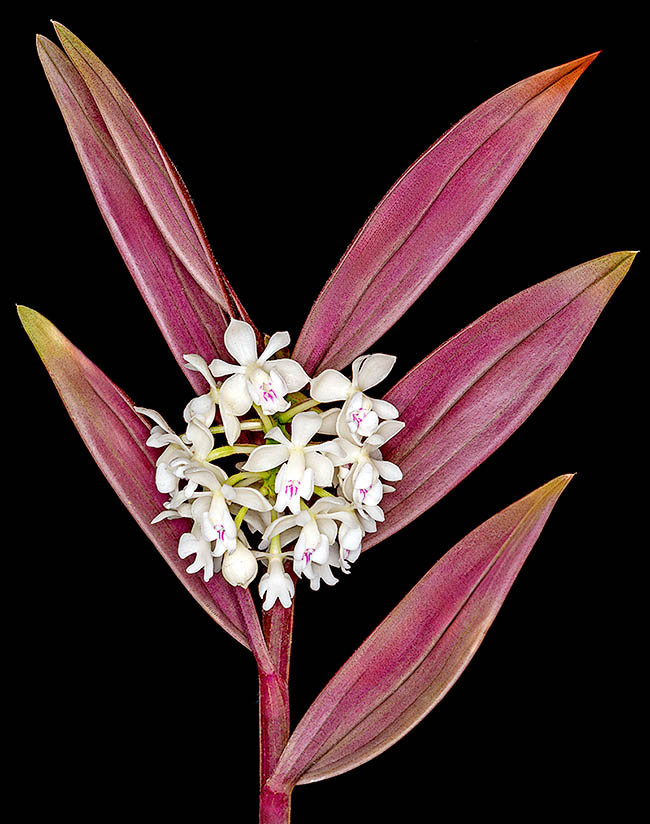
Epidendrum hugomedinae is an epiphyte recently discovered in south-east Ecuador at about 1600 m of altitude © Dr. Giuseppe Mazza
Epidendrum hugomedinaeHágsater & Dodson 2004, is a species of the family Orchidaceae, belonging to the subfamily Epidendroideae, to the tribe of the Epidendreae, subtribe Laeliinae.
This species has been recently described in the magazine Icon. Orchid. t. 745 (2004) by the Mexican botanist
Eric Hágsater, (1945- ) and by the Californian Homer Dodson (1928-2020), great orchid expert, Executive Director
of the Marie Selby Botanical Gardens of Sarasota, Florida.
It was discovered in 2003 by the orchidologist Hugo Medina Troyani in the province of Morona Santiago, south-eastern Ecuador, at about 1600 metres of altitude.
Epidendrum hugomedinae is included in the group Bicirrhatum, a small group of species recently discovered and characterized by the cespitose posture, simple stems, leafy and short, compact and pendulous inflorescence.
The name of the genus comes from the Greek επί, epi (over) and δένδρον, dendron tree) “on the trees” referring to its epiphytic posture.
The specific epithet gets its name from its discoverer, Hugo Medina, well-known orchid collector and expert at Ecuagenera, one of the most important companies in the world of conservation and cultivation of Ecuadorian exotic plants. The common name is Hugo Medina Epidendrum.
Epidendrum hugomedinae is a herbaceous plant growing on the trees (epiphytic), bushy, about 20 cm tall with flesh roots. The stems (20 x 0,2 cm) tall, are simple, similar to canes, slightly compressed laterally, a little sinuous at the apex. The leaves, up to 7 along the stem, are alternate, fleshy, with tubular sheath finely striated and oblong-elliptic lamina, acuminate, smooth, (2,5-7,0 x 0,6-1,4 cm) and entire margin, intense green at times with violet shades.
The inflorescence is pluri-racemose as the main axis bears other raceme inflorescences. It is an inflorescence of indefinite multiflora type, apical, arcuate, dense. The main axis flowering again for several years. The floral bracts are lanceolate triangular. The flowers are small (about 1 cm) and up to 28 in the inflorescence. They open simultaneously and are resupinate, of snow white colour with the labellum keels shaded in purple. The sepals are expanded, free, fleshy, glabrous, with rounded apex, concave, 8-ribbed and entire edge. The dorsal sepal is elliptic, 8,2 x 4 mm. The lateral ones are obovate, 8,4 x 4,8 mm.
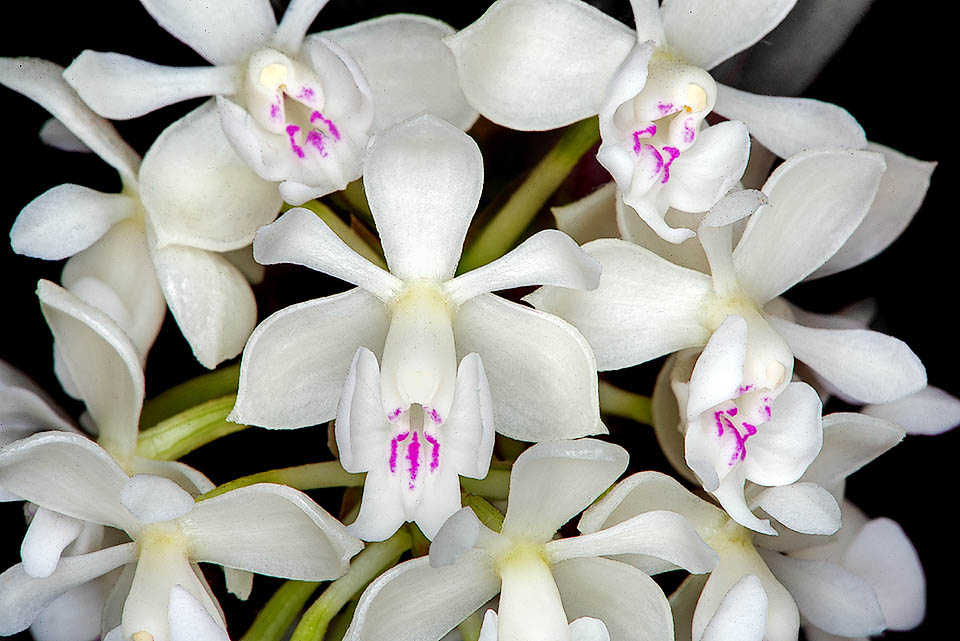
The inflorescence has up to 28 1 cm flowers opening at the same time. It’s pluri-racemose with main axis re-flowering for several years © Dr. Giuseppe Mazza
The 6 x 3 mm petals are partially spread apart, free, spatulate with 3 veins and the entire margin. The labellum is adherent to the column (gynostemium), trilobed, with deeply carded base, entire margin, 9,5 x 10,6 mm with two thin fleshy protuberances and, in the central portion, disk with 3 parallel keels. The lateral lobes are rounded, 4 x 6 mm. The median is bilobed, with slightly spread lobes, 4 x 4,8 mm. The 5 mm long column is thin, obconic at the apex. The rostellum is apical and fissured. The ovary is cylindrical, not swollen, 7-14 mm long. The anther is obovoid, 4-locular. The pollinia are 4, strictly ovate, not shaped like a bird’s wing, elongated, strongly compressed laterally, unequal, the inner ones are smaller. The nectary is smooth.
Blooming occurs in autumn (March-May) and the flowers emit, especially during the central hours of the day, a sweetish scent similar to that of some species of Pittosporum.
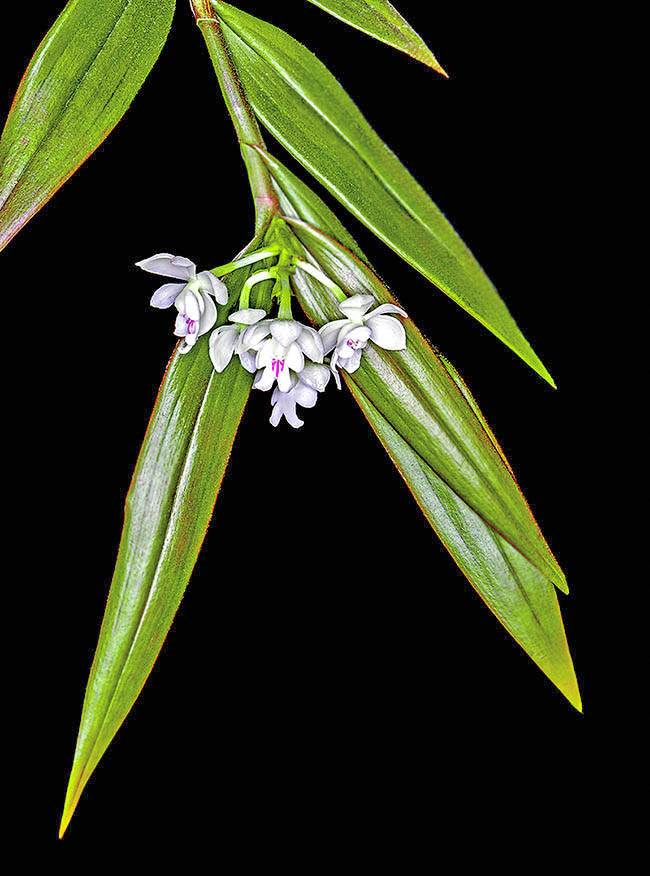
Fairly rustic, it’s an orchid of easy growth even at home with spectacular blooms repeated often during the year © Dr. Giuseppe Mazza
Epidendrum hugomedinae is a fairly rustic orchid and easy to cultivate.
In the cooler climates it may be cultivated indoors with bright or indirect light.
In summer also in the garden but in slightly shaded positions. Indoors, 18-25 °C the day, 15 °C by night.
For the growth is to be utilized draining loam like cork bark or bark specific for orchids in order to prevent root rot.
Watering must be done every 15 days in spring and in summer, reduced in winter.
During the phase of growth it is good to fertilize with a liquid fertilizer for orchids to be diluted in the irrigation water.
The propagation may be done by division of the tuft, but we have to make sure that each section has healthy roots and shoots.
Pruning is not necessary, at most remove from the stems the dead or yellowed leaves to maintain the look and the health of the plant.
If parasites, like aphids and mites, are present, it’s good practice to eliminate them promptly.
There are various hybrids of Epidendrum hugomedinae that are preferred for their beauty, ease of cultivation and frequent bloomings, easily available at the specialized nurseries.
The cross Epidendrum capricornu × Epidendrum hugomedinae has produced the hybrid Epidendrum ‘Anika Hassinger’ with abundant blooms and deep pink scented flowers.
This hybrid has been produced by the German company Hassinger Orchideen and registered on 12/08/2021 at the International Orchid Register della Royal Horticultural Society (RHS), world reference authority for the classification and the registration of orchids.
It is a medium-sized plant, easy to cultivate also in pots, in conditions from warm to cool with a spectacular flowering that may repeat more times during the year. It requires intense and indirect light, in summer, indoors, 18-25 °C during the day, 15 °C at night. In winter, about 12-15 °C continuously. Watering must be regular during the growth in order to maintain the loam slightly humid without stagnation, and must be reduced during the winter rest without letting them wither. In spring and in summer it is good to fertilize, every two weeks, with liquid fertilizer for orchids. The fertilizations during the winter time are to be suspended.